Thursday, 30 April 2015

Not A Matter Of Life Or Death

The late Bill Shankly famously said that football wasn't a matter of life or death, but that it was more important than that: it isn't. At this time of year in particular, as the football season reaches its climax, it stirs the emotions in a way in which probably no other sport does and for supporters of clubs in danger of relegation, the thought of dropping a division, or even out of the Football League like Tranmere Rovers and Cheltenham Town, must feel like a tragedy. But tragedy is an overused word in a football context. Back in 1985 I thought it would be tragedy if the club I supported at the time, Leyton Orient, dropped out of the old Third Division and into Division Four. On the final day of the season, 11th May, O's entertained Bournemouth and nothing less than three points against mid-table Bournemouth would be enough to keep them up. The game ended 0-0, O's were relegated and as we drowned our sorrows in the supporters club bar after the match we became aware of events that had unfolded at Valley Parade, Bradford.


Bradford City had won the Third Division and their last home game against Lincoln City should have been an afternoon of celebration; it turned into a disaster, a tragedy of unimaginable proportions that ended with 56 dead and over 250 injured as the main stand, which was due for demolition, caught fire. As we watched the TV news of the blaze the previous 90 minutes of football we had seen, the whole season in fact, became meaningless. Relegation became irrelevant because come the next August we would be back to watch our team. Over fifty people who had set out to support their club that afternoon never went home, many of those who did make it out of Valley Parade that day probably never had the stomach to return; that was tragedy, relegation wasn't.

Photo: The Guardian

Despite my best efforts to keep matters in perspective however, I am just one of countless thousands, millions even, whose mood is affected by the performances and results of the team I support. It used to be said, in the days when the UK was a manufacturing powerhouse, that Saturday's football results had a direct effect on productivity and absenteeism. If the local team won the workers were happy, and happy workers were productive workers. If the local team lost them absenteeism was higher and productivity lower. In my case the fortunes of my team, Romford FC have distinctly affected my mood this last season.[1]

The season began on a high, with a 4-0 win over Burnham Ramblers last August, but this was followed by an not unexpected defeat at the eventual runners up, Harlow Town. The next two away games were galling however as Boro contrived to lose at Waltham Abbey and Maldon & Tiptree despite leading both games as they entered the final five minutes. Dropping points from winning positions was a feature of the season. Boro led 2-0 against Tilbury, but drew 2-2, lost twice to Soham Town Rangers despite leading in one game and drawing until the final minute in the other, and dropped points at Aveley in a thrilling 4-4 draw having been 1-0 and 4-3 ahead. Heavy defeats were another unfortunate feature of the season; 8-0 at Wroxham, 6-2 at Needham Market, 5-0 at home to Brentwood Town and 6-2 at Thurrock. It was difficult to remain positive as relegation became a very really possibility, however three wins from the last three league games garnered sufficient points to avoid the drop into the Essex Senior League, but it was nail biting stuff.

Two goals by Nick Reynolds in a 3-1 win over Ware secured 20th place in Ryman League Division One North.


The narrow defeats are somehow harder to bear than the heavy ones. When you are 5-0 down at the home of the eventual champions (Needham Market), getting two quick goals back is some consolation, even if the hosts get a sixth, but leading with little more than stoppage time to play and still losing makes for a dispiriting weekend. 

Romford's visit to Needham Market, home of possibly the biggest hedge in football.

In fact, weekends between August and November were generally a bit depressing as we saw only one league win, although there were a few unforgettable cup ties. Having beaten St Margaretsbury (one league below Romford) in the FA Cup Preliminary Round, Boro were rewarded with a home tie against Bury Town from the division above, and on a memorable Sunday afternoon, Romford won by the game's only goal to set up a tie with Kingstonian, also from the division above.


Boro on the attack at St Margaretsbury.


The first game ended goal-less, but the replay at Kingstonian was a match that will live long in the memories of all who saw it. Romford led twice in the first 90 minutes and after K's had twice equalised, Boro nearly won it with the last kick of the match. In extra-time Romford again took the lead only for the home side to run out eventual 5-3 winners. Almost equally remarkable was the 4-4 draw at Aveley where Romford were 1-0 up, 3-1 down and 4-3 ahead before having to settle for a share of eight goals and the points.


It's games like those at Kingstonian and Aveley, even when you don't win, that make memories and then there were the final three wins, after a run of just three in the previous sixteen, that kept Boro up and meant that despite finishing 20th out of 24, the season finished on something of a high. For those of us who don't support Chelsea or Manchester City, or in the lower reaches of the game, clubs like Needham Market or Maidstone United, league titles are a dream rather than a real possibility so you take pleasure in other ways. In Romford's league there are teams with playing budgets that run into the thousands of pounds per week, and then there are Boro and a handful of others who pay little or, as in our case, nothing at all. Just competing with the teams who can afford to recruit ex-Football League or noted non-League players is success to a degree. In a similar way supporters of the majority of clubs in most divisions know that their chances of winning something each season are slim; you take your glory when it comes in individual games and hope you don't end up at the bottom of the pile.

The players of Dereham Town and Romford mark the Football Remembers event commemorating the outbreak of The Great War.

Leyton Orient still have a place in my heart and after reaching the League One Play-Off Final last season now find themselves on the brink of relegation to the Football League's lowest division next season, just as they did thirty years ago. That day when they were relegated it wasn't a tragedy, the fire at Bradford was; this time round if O's get relegated it won't be a tragedy either, but Bradford still will be.


[1] In case you are wondering how I went from supporting Orient to following Romford, see Romford 1 Manchester United 0

Thursday, 23 April 2015

If Voting Changed Anything...

The organisation I used to work for gave everyone an annual appraisal, at which every employee would be awarded a rating from one to five. A rating of one or two meant that you were a high performer; a four rating meant that you required improvement and a five signified that you were probably beyond redemption and should consider an alternative line of work. The majority of people were rated three. Management frequently denied the existence of a bell curve but generally ratings were allocated such that 20% of people were ones or twos, 10% were fours or fives leaving 70% in the middle, rated three. And that is how the population of Britain are generally affected by the result of a general election, and especially in the event of a change of government, which likely means that 20% of the population are better off, 10% are worse off but for 70% of us there really is little difference except the colour of the Prime Minister's tie.


The latest polls suggest that it is pretty much even stevens between the Conservatives and Labour but with UKIP outperforming the Liberal Democrats and the Greens it isn't beyond the realms of possibility that UKIP could hold the balance of power in another hung parliament. Except that a couple of by-election victories (notorious for protest votes and being overturned in a general election) and a good showing in the polls count for nothing in the real thing. But, UKIP undoubtedly have the main three parties worried, or if not worried then certainly mindful of the potential they have to exploit the great swathes of the electorate disenchanted with the red and blue hues of UK politics.  Perhaps more worryingly for the Tories, and it has to be said, for Labour, is the possibility of the Scottish Nationalists winning enough seats to hold the balance of power, a more credible possibility than UKIP doing so.  

Except that the SNP won six seats last time out (six more than UKIP, mind you!) so are they really a threat to the cosy two and a half party system we currently have? Anyone's guess really, after all at the last election the "other" parties mustered just 36 seats between them, twenty less than the Lib-Dems and for all the sabre rattling that the wee Jimmy Krankie lookalike has been doing it is possible that the SNP will have as much influence in Westminster next month as Sinn Fein or the independents. We have seen it before in the run up to elections, usually it is the Lib-Dems, talking up their chances but aside from a few mild shocks in unseating a more favoured candidate, ultimately failing to deliver. There are 59 seats in Scotland; Labour hold 41 and the Lib-Dems 11 and yes, the SNP will likely win a chunk of those but it remains to be seen if it will be enough to make a difference.

Wee Jimmy Krankie

"The most dangerous woman in the world" according to Piers Morgan in the Daily Mail


While David Cameron and the Tories have been bigging up the threat that the SNP pose, wheeling out former PM John Major this week, it is perhaps Labour that have more to fear from the nationalists, although contrarily the Tories would probably welcome Labour holding them off north of the border. If nothing else, it makes this campaign more interesting than the norm to see the major parties worried about more than each other, but it remains a somewhat tedious aspect of British politics (and likely, politics the world over) that party leaders and party spokesmen spend more time and effort bad mouthing their opponents than propounding their own policies.

The Tories wheeled out John Major to talk about the threat posed by the SNP

In the interest of balance, here is a picture of a former Labour Prime Minister.

The SNP may be limited to fielding candidates in Scotland but chances are they will return more MPs than UKIP, because despite UKIP's by-election successes at Clacton and in Rochester & Strood, it is really doubtful that they will translate that into more seats on 7th May. By-elections are notorious for producing unusual, protest driven results and I would be surprised if the confidence the party exudes is translated into bums on seats at Westminster. UKIP have such a propensity to shoot themselves in the foot anyway that it is difficult to take them seriously. They remind me of the man who sits next to you on the bus, engages you in polite, sane conversation for five minutes before declaring that he is actually King of The Lizard People and that his tribe will be arriving from Venus imminently. Otherwise apparently sane people are giving the party some credence by supporting them publicly; I think it will all end in tears. For a party so obsessed about geography (in the sense that they want us out of Europe and migrant Europeans out of the UK), it is ironic that they have such a frail grasp of local geography as they have been thrusting leaflets through my door asking me to vote for their candidate in the neighbouring constituency. Mind you, Labour are no better as they have done the same. I actually had the (correct) UKIP candidate at my front door a week or so ago; he seemed to be a perfectly normal, sane human being, but I suppose appearances can be deceptive, he might have told me that he was the Lizard King if I'd let him talk long enough.

While this election has some features that make it slightly different, slightly edgier, even slightly more interesting than some past polls, one element that remains the same is the manifesto. If a politician's broken promises could be cashed we'd all be rich and the cheque they are written on is the manifesto. Clearly no politician ever believed that they would be called to account for their manifesto, actually ever made to fulfil their empty promises considering the drivel they put out. Mind you, did any uncommitted voter ever read a manifesto and say, "You know what, I like the cut of their jib and I really think they will make good on their promises"? Apart from the King of The Lizard People that is. Perhaps manifestos should be made legally binding and subject to performance related pay. Win the election and fail to met your targets and have your pay slashed or get booted out. Perhaps disgruntled voters could take out class action lawsuits against governments that renege on their promises, now that might focus a few minds!

Mark Twain. No, you can't vote for him.


It was Mark Twain who said, "If voting made any difference they wouldn't let us do it," and plenty other people have paraphrased him over the years; Emma Goldman and Ken Livingstone to name but two. For about 70% of us, it is probably true that voting makes no difference but come 7th May it is imperative that we all go out and vote, vote for whoever, be it Conservative, Labour or Monster Raving Loony Party. Because it's like the lottery; if you don't buy a lottery ticket you can't win a prize. If you don't vote you can't really complain about what you get, but if you do...

Thursday, 16 April 2015

New Fangled or Old Fashioned?

We came across some old and no longer wanted DVDs and video tapes the other day. The DVDs we can probably sell (stores like CeX will buy them) but the videos will either be dumped or go to a charity shop, who will almost certainly have them on their shelves for some time. After all, who buys video tapes these days? And if you do buy a video tape, what will you play it on? Unless you have a vintage video cassette player you won't find one in the shops. Dixons (part of the Currys-PC World group) stopped selling them in 2004 after just 26 years on sale. The video cassette player is one of those bits of technology that has been and gone in a single lifetime. I accept that they aren't technically defunct, but they might as well be, they  are as relevant today as a mangle is.


Back in the 1980's when video took off a new machine might cost £500; the first machine I bought cost about £300 in 1989. By the time I bought my last machine the price had dropped to around fifty quid. It is true of a lot of consumer electronics that prices have fallen in actual and real terms over the years. Look around your own home and price up your TV, fridge, computer and hi-fi. Chances are that they were a cheaper than the models they replaced, and even if they weren't the spec will be a lot better. When I bought my first PC they weren't even that commonplace in many offices; at about that time I think we shared one PC and two dumb terminals between thirteen people at work. Now your average home has a better network, better hardware and better operating systems than we used at work less than twenty years ago.


An indispensable piece of office machinery circa 1995 was the fax machine. I recall that ten years earlier, when I was working at Midland Bank in Barking a customer of ours was dumbfounded that we did not have a fax machine in the branch. Fax machine? We barely had a photocopier! We had a Scotch copier, to use which one had to copy the original document to a piece of pink, shiny paper and then use that to transfer the image to a piece of normal paper. A single copy took a good couple of minutes. Think about the printer that probably sits next to your PC, a printer that also scans and photocopies and probably cost you a whole lot less than that Scotch copier that retailed for around £80 in the 1980's. Fax machines then did not use standard paper either, they used special rolls of paper and woe betide the person who put the paper in the wrong way round, resulting in a whole sheaf of blank faxes being printed. I know someone who did that (it wasn't me), and the fall out was a number of frantic calls to customers who may potentially have sent us the blank faxes we were receiving.


When the fax machine finally slips into oblivion the chances are the word will go with it but that is not the case with other things that have disappeared. The previously mentioned video recorder lives on in common parlance since we still say we "tape" TV programmes (well, we do in our house) even though what we are actually doing is saving them on a hard disk drive. That expression, together with the video tapes themselves that we have lying about, made me think about other words and phrases that we commonly use that now have little relevance but those of us of a certain generation in particular, are unlikely to ever give up.
Of all the areas of technology that have shown the greatest advances in recent years, the mobile phone is the one with which we are all probably the most familiar. Mobile phones have always had keypads and landline phones have had them for many years, even though phones with dials co-existed with them for a long time. Now I am certain that there are still plenty of phones with dials still in use, but even those of us who no longer have one still say dial, as in "What number did you dial?" when we get a wrong number. The younger generation, who have possibly never seen a rotary dial phone, will be used to their parents saying dial and chances are that the expression will live on way past the demise of the rotary dial phones themselves.


When Britain switched to decimal currency in 1971 there was inevitably a long period of time in which everyone was converting pounds and pence back to pounds, shillings and pennies but despite the passing of the best part of half a century (now that is a frightening thought to someone who was a teenager when we changed the currency), I find that I still sometimes do it. Take newspapers or chocolate bars. Despite the amount of time that has passed I still get the occasional shock when I realise that I have just spent eighteen shillings on a newspaper, or twelve shillings on a Mars bar. The price of a Mars bar is actually used as an index by some economists to illustrate increases in prices. Speaking as someone who can remember vividly when a Mars Bar cost just 2p (it was 1971) and a newspaper cost 3p at the same time, it makes me wonder if, just as my children look at me askance when I say "five bob" or "half a crown" whether their children will similarly look doubtfully at them when they mention pennies in years to come as the value of our bronze coinage diminishes all the time and will inevitably be phased out eventually.


Having said that video tapes and the machines to play them on are as outmoded as the mangle, I now find however that there are some people who believe that they are poised for a comeback, swept in on a wave of nostalgia. They have been compared with the vinyl record, which still has its adherents, except there is a world of difference between the two. Firstly the record deck never went away. It is much easier to go out and buy a good record deck than a video recorder. Secondly there is the aesthetic property to playing a record, the ritual of sliding it from its sleeve, cleaning it, placing it almost reverentially on the turntable and placing the stylus on the platter. Sliding a video tape into the slot in a grey box doesn't compare. And then there is the quality. Vinyl aficionados will argue that the sound quality of a record is superior to CD or MP3 or any other format for that matter, and their arguments have merit. It is difficult to make the same case for the video tape. Subsequent digital formats have knocked the picture quality that tapes were able to deliver into a tin hat. Can you seriously imagine watching a video tape version of one of the current blockbuster, special effect laden movies on a fifty inch television?


 Nostalgia is all very well, but some things are best left where they belong, in the past.

Thursday, 9 April 2015

Four Men In Another Boat

Buoyed up by the success of our trip on The Broads the year before (see Four Men In A Boat), we (that is to say, Gerry Baker, Paul Calvert, Keith Markham and I) booked a holiday in 1986 on a narrowboat on The Staffordshire & Worcestershire Canal. After the previous year when we had taken too much food, we decided not to bother this time round and rely on eating out; this proved a bit hit and miss.


We set off for Stourport in Worcestershire where we would pick up our narrowboat and stopped en route at The Badgers Sett in Hagley where I had what was possibly the hottest chilli I have ever eaten. Half way through I had to get liquid reinforcements to put out the fire in my mouth! At Stourport we picked up our narrowboat. Compared with the previous year's cruiser on The Broads this vessel was shall we say, basic and had obviously seen better days. Under one of the bunks we found a piece of ominous graffiti, which unfortunately proved rather prophetic.

Stourport Basin

A number of things were different about this holiday compared with The Broads. Firstly the weather. It rained; it rained a lot. In fact it rained most days. Then there were the locks. The Broads has no locks, the Staffs and Worcester Canal has somewhere in the region of thirty, including The Bratch, a three lock staircase. 

The Bratch. Photo: BBC

Remarkably we managed to negotiate these, and other locks quite successfully, although this was the first time any of us had steered something with a tiller, which as anyone knows is weirdly counter-intuitive at first. No one fell in, no one dropped a lock key into the canal and we singularly failed to flood our boat; we ran aground on a sandbank once but that's one of the reasons you have boathooks! The approach to the lock at Kinver was, however the scene of a near disaster. We were chugging along quite happily at the speed of an arthritic sloth one grey summer's morning and as was our custom, I was at the bow with a lock key, ready to jump off and prepare the lock. Paul was driving. As we approached the lock I turned and shouted, "Slow down!" as we appeared to be nearing a vulnerable looking cabin cruiser at a speed that, although relatively slow, could have caused significant damage in the event of a collision. "I can't," yelled back a rather stricken looking Mr Calvert. There was a collision with the canal towpath and we struck the cabin cruiser a glancing, but fortunately damage free, blow and came to a somewhat ungainly halt. As you probably know, the only way to stop a boat (apart from hitting something) is to throw it into reverse. It transpired that the gearbox had packed up, hence no reverse gear, hence no orthodox method of stopping. We were stuck at Kinver for some days while an engineer was despatched from the boatyard to effect repairs. It could have been worse, at least there were pubs and shops, there are some locks in the middle of nowhere it would have been awful to have been stranded at.

The lock at Kinver. Photo: Roger Kidd


Another difference about the canal was the lack of bollards to moor our boat. Instead we had to rely on mooring stakes, which are usually fairly effective, but what with the amount of rain we had had making the ground soggy and soft together with our inexperience in mooring a narrowboat, it's fair to say that we had some "issues." One afternoon, having returned from a pub lunch, we all had a bit of a snooze. Sometime later I woke up and looked out of the window. That's odd, I thought, I don't remember those bushes being that close when we moored. I'm sure you are way ahead of me, because sure enough when I emerged on deck I found that one rope had come away and we were now at right angles to the towpath! It was not the only time it happened. On another occasion we were actually having lunch when someone came into the pub and enquired if anyone had a barge matching a certain description because it was adrift. We laughed, "That happened to us the other day," confident it was not us as the colours did not match our boat. A vague nagging doubt had us leave the pub early and sure enough it was our boat. The man who had described it was presumably colour blind.

Food was, as I said earlier, a bit hit or miss. The Broads were well stocked with pubs, many of which did a nice variety of food, sufficient to satisfy even the most discerning eater. On the canal the pubs were fewer and further between and almost universally believed that chips were the only way to serve a potato. After a few days I was heartily sick of chips. We went into a pub for lunch and the first question I asked was, "Do you do potatoes any way other than chips?" They did roast potatoes, a chip's cousin perhaps, but sufficiently different; I was most grateful. Paul Calvert's thousand yard stare was turned on us to full effect on the Sunday lunchtime when we discovered that our chosen hostelry did not serve food on the Sabbath. With grumbling tummies and limited options we eked out a meal from a tin of ham and some odds and ends we had on board; a gourmet feast it was not.

Somewhere near Dudley we moored up and took a taxi into town to The Black Country Museum, which was well worth a visit, and Dudley Zoo which wasn't, and where we saw the world's most depressed looking polar bear. At one point we went through Wolverhampton; shortly afterwards we turned back and headed for Stourport, but not without stopping in Kidderminster, which we did not see at its best. By design rather than accident we had arrived in Kiddie on the day that Kidderminster Harriers played Walsall in a pre-season friendly, so there was no doubting that Keith and I would spend the evening at Aggborough, which we did. Walsall won 1-0 if memory serves me correctly (which increasingly these days it does not).

You will have noticed a shortage of photos from our canal trip. Someone did take a camera because there are a few pictures, but as Gerry remarked recently, " it was long before the days of smartphones of course (not even the days of smart people from what I can remember...and I include us in that!)"

Keith, in a rare photo from our trip. Obviously it didn't rain all the time!

I'll leave the last words to Paul, who recalls the conversation with the yard owner when we returned the boat to the yard in Stourport a fortnight after we had left, a lot damper, a fair bit heavier (thanks to the consumption of much beer and many chips) and a lot lighter of wallet.
 "I'll never forget the shock on the boat owners face when we took it back and only had to pay for one gallon of diesel", remembers Paul.
"Did you top it up before bringing back?"he asked.
"No" we replied.
"But you had it for two weeks lads" he said, "where did you get to then?"
We told him a place.
"But that's only ten miles away and you had the boat for two weeks!" he exclaimed in shock at how little we had covered.
"True, but there's an awful lot of pubs on the way there and back" was our response."


Despite the weather, the breakdowns, the fairly basic accommodation (did I mention that water came in when it rained?) and the unremitting diet of chips, it was still a fun holiday. The next year, though we decided to forsake England and boats and the variable weather and booked a holiday to Majorca, but that is another story!

Thursday, 2 April 2015

Four Men In A Boat

In 1985, Bob Geldof was busy arranging Live Aid to raise funds for relief of the ongoing Ethiopian famine. Meanwhile at Midland Bank in Barking, Gerry Baker, Paul Calvert, Keith Markham and I were arranging a slightly less significant, but to us, important event, a boating holiday on the Norfolk Broads. Having successfully negotiated the same two weeks holiday for us all (a task not to be underestimated, as anyone who has wrestled with a holiday rota will appreciate), we booked our boat, and on 6th July 1985, loaded our luggage and provisions  into Gerry's car and set off for Beccles.


Left to right: Keith, Me, Gerry and Paul
Remarkably since they were putting a fairly expensive piece of boating equipment into the hands of complete novices, the boatyard seemed comfortable with allowing us to steer their shiny cabin cruiser away from its moorings with minimal training beyond where the controls were and what they did. They did warn about the limited headroom, but a practical reminder is always better than a theoretical one and I soon learned to duck when going into the cabin by walloping my head on the door frame before we had travelled more than a few hundred yards.

The Norfolk Broads, or more correctly, The Broads, since they include parts of Suffolk, cover 117 square miles and have more than 120 miles of navigable waterway. I've no idea how many miles we covered in our fortnight there, but I do know how many pubs we visited because for some reason I decided to keep a record of them and somewhat geekily, I still have that list, which is reproduced below. Given the fact that the top speed of hire craft on The Broads is limited to a pace equivalent to no more than a brisk walk, we managed to travel a remarkable distance in the first couple of days alone, reaching Wroxham by Monday, about 26 miles from our starting point in Beccles. Mind you we might not have travelled so far had the pubs been open all day; in those days the licensing laws meant that pubs closed in the middle of the afternoon, typically at half past two or three o'clock, reopening at about six, except on Sundays when the closed for even longer.


On the Sunday we stopped at The Stracey Arms, a cavernous pub of little character that was extremely popular; compared with many of the more traditional, rustic pubs we visited it had little to commend it. Apparently it is now permanently closed and I doubt it is much missed. It seems that Gunga Din's Old Colonial Inn is no more either, although with such a non-PC name that is scarcely surprising! Other notable pubs included The Lord Mancroft, notable for a reason which Paul will recall but which I am not prepared to go into here on the grounds of delicacy, and The Bell Hotel in Norwich. The Bell served up one of the best pub lunches I have had, consisting of a vast steak and kidney pie and help yourself to potatoes and vegetables, which I took full advantage of to the point where I was unable to eat or drink anything else until much later that evening!


Food and drink played significant roles in our holiday. It was perhaps unnecessary for us to cart quite so much food with us (we stocked up at a supermarket the night before leaving) as we cooked little on board apart from breakfast, although I do recall concocting something with eggs and tinned potatoes (ugh) and Paul kindly offered to make beans on toast on one occasion, although he rather put the rest of us off by enquiring if we actually wanted our beans cooked and our bread toasted. Paul's appetite (and all who know him will know that it is wide ranging and sometimes prodigious) had to be addressed regularly and we always knew when he wanted to eat because he would be overcome with a sort of thousand yard stare.

The middle weekend of our trip found us in Thorpe St Andrew near Norwich, a charming little place that I would happily go back to (in fact Keith and I did, a few years later) on Live Aid weekend; the weather was glorious. While the others took themselves off for a curry, I stayed on the boat as I was not then a fan of Indian food, ate cheese and biscuits and watched Bob Geldof implore the nation not to go to the pub but to send him their (expletive deleted) money instead. I went to the pub.[1]

The Buck at Thorpe St Andrew
Earlier in the week we had reached Potter Heigham, renowned for the low bridge which it is only possible to pass under with the aid of a pilot. A few years later I went on a long weekend on The Broads with my wife and brothers-in-law; it was October, there were high winds and when we attempted to turn round at Potter Heigham we were at one point wedged sideways across the River Thurne. Judicious use of boathooks was needed to get us pointing down river again.  Most of The Broads is easy to negotiate, even for novices like us, especially for me as the only one of our number not to have a driving licence, but Gerry in particular proved adept at manoeuvring our boat into awkward moorings. It was the lack of speed rather than anything else that proved a problem when we came to crossing Breydon Water, a stretch of water about  three miles long and almost a mile wide that we navigated to enter Yarmouth and the northern Broads. At the limited speed we were capable of and against the wind, the crossing seemed interminable and at Yarmouth we encountered some pretty big vessels before gratefully reaching the River Bure.

By the middle of the second week we seemed to have covered a large proportion of The Broads and having reached Oulton Broad on the Wednesday, stayed there until Friday when we moored up in Beccles to return the boat the following day. Here we had a last meal in a restaurant (the name of which I have not recorded) and Keith and I ordered cauliflower cheese, which proved to be a whole cauliflower covered in cheese sauce rather than the more usual florets!


We returned our boat (intact, believe it or not), returned home and decided that this boating lark was actually rather good fun. So much so that we decided to do it again the following year, but this time not on The Broads. It proved to be a much different experience!
To be continued...


[1] At some point I gave Bob some money too.

Thursday, 26 March 2015

A Guilty Pleasure

I was changing the CDs in the car the other day, they were the usual mixed bag. A 1970's various artists compilation, Robert Plant's latest offering, Emerson Lake and Palmer, Big Big Train, Pet Shop Boys and...Thompson Twins. The Thompson Twins are pretty much my guilty pleasure, I saw them three times in the 1980's, under varying circumstances. The first time was by accident. I had a ticket to see Peter Gabriel at Crystal Palace football ground and he was being supported by an African group whose name eludes me (if indeed I ever knew it), The Undertones and Thompson Twins. I knew a little of The Undertones but nothing of the Twins, so I bought Quick Step and Side Kick and enjoyed it more than I expected. When Into The Gap was released I bought the album and saw them at the Hammersmith Odeon. To show how eclectic my tastes were (and still are), the next week I was back at Hammersmith to see Marillion.


It's funny how music, like smells, is so evocative. Listen to a song that you haven't heard for a while and you get transported back to the time you most associate with it. Thompson Twins songs like Hold Me Now and Doctor! Doctor! take me back to Friday evenings in the summer when I worked in Barking, going to The Victoria for a beer or several. The whole Close To The Edge album by Yes transports me back to Sixth Form, Hey Jude by The Beatles always evokes memories of Romford FC's old ground at Brooklands and the Housemartins song, Happy Hour reminds me of a pub in Kidderminster on a very rainy canal boat holiday in 1986.

Thompson Twins supported Peter Gabriel at Crystal Palace and at Hammersmith were supported by a band I am convinced were Primal Scream, but who probably weren't, but I have no recollection of who supported them on the third occasion I saw them, at Wembley Arena in 1983. That's the thing about support acts, they are either instantly forgettable or sometimes they linger long in the memory because they are either completely hopeless or totally brilliant. The best support acts I have seen, and here I am talking about bands that were previously unknown to me, were Fischer Z and Londonbeat.

Photo: Chewtonia.com


I saw Fischer Z support Dire Straits at the Rainbow, Finsbury Park. Vocalist John Watts bounced on stage and yelled, "I want to be a lemming in London tonight!" at which point  my spirits sank. What lunacy was this? I wondered. Then the band fired up, launched into their opening song, Lemmings, and I was hooked. As soon as was humanly possible I went out and bought their album, Word Salad and totally splendid it was too; I play it regularly to this day. For those of you unfamiliar with the band, and in a vain attempt to pigeon hole them, I would say that they are a blend of idiosyncratic pop, reggae and punk.


More straightforward to categorise are Londonbeat, a bit poppy, a bit of reggae and a bit of soul, probably best known for their song I've Been Thinking About You which was a Number 1 in the US and reached Number 2 in the UK. I saw them support Brian Ferry at Wembley and frankly they knocked the Roxy Music front man out of the park. Even my then wife June, who dragged me to the gig, admitted that Ferry, who short changed the audience with a short, lack lustre set, had been blown away by them. Again, on the strength of the band's performance I bought their album, In The Blood, at the earliest opportunity and it still gets a regular airing some 25 years later.


At the other extreme are the support acts that I would pay good money to guarantee never having to see again. Supporting the excellent Ian Dury & The Blockheads at the Hammersmith Odeon many years ago were poet Linton Kwesi Johnson, highly respected and critically acclaimed, but frankly not my cup of tea and Root Boy Slim and The Sex Change Band who were, and there is no other word for it, diabolical.[1]

Somewhere, a lifetime ago, I read that music critics are the very definition of pointlessness and there is a school of thought that a critic is "someone who has no discernible talent so tries to make someone else feel as useless as he/she is."[2] It's a point of view I'd be happy to go along with because in my experience most music critics have views on what is good and what is not that are diametrically opposed to my own. The New Musical Express (NME) called Thompson Twins "1984's most instantly kitsch mass program of monosodium glutamation of the brain". Aside from the fact that that sentence is actually just a random selection of words, one of which, glutamation, appears to have been the figment of the writer's imagination, the very fact that NME were criticising the band meant to me that they must be OK; doubtless the NME approved wholeheartedly of Root Boy Slim and his chums.

And that's because music is about opinion and taste. Yes, one can say that Egbert Plonk is a better guitarist than Sebastian de Villeneuve and you can probably quantify that can on the basis of ability and talent, but you cannot say that one band are better than another simply because you prefer them. On the basis that Steven Wilson has more musical talent in his little finger than all of One Direction put together, you could argue that Wilson is "better." Unless you are a teenage girl of course, for whom One Direction will undoubtedly trump Porcupine Tree or Wilson's solo output every day of the week, and why is that opinion any less valid just because I don't share it? It isn't.

There's a lot of po-faced tosh written about music masquerading as serious criticism and I make a point of taking the majority of it with a large pinch of salt. I have bought albums on the basis of great reviews and regretted it immediately the disc has started spinning, but equally I've bought albums that have been pilloried as a waste of vinyl or polycarbonate and aluminium[3] and immediately fallen in love with them. As is so often proven when I switch on the CD player in the car and am greeted with disapproval from Val, music is a matter of taste, so while prog and rock may make up most of my diet, I like my guilty pleasures too.


[1] Root Boy Slim, aka Foster McKenzie III actually died in 1993, aged just 47, so it might appear tasteless to speak ill of the dead, but frankly the band were really, really bad. Mind you, that's just my opinion.
[2] Urban Dictionary dotcom.
[3] The components of a CD.

Thursday, 19 March 2015

The Unreconstructed Man

The Sun is Britain's best selling daily newspaper and has a daily circulation of just under two million but everyone denies reading it. Top Gear has an audience of about six million and in 2013 Guinness World Records proclaimed that the show was the most widely watched factual TV programme... in the world, but at the moment many people would probably claim not to watch it. And the reason is beleaguered presenter Jeremy Clarkson whose controversial remarks and recent 'fracas' with a producer have seen the programme taken off the air. Having upset lorry drivers, the French and the Mexicans with uncomplimentary remarks, he has also been labelled racist after the emergence of the "Eeny, Meeny" video and the comment in the Burma Special programme about 'slopes' (which passed me by completely at the time). For the presenter of a motoring programme it is perhaps ironic that he seems so often to fail to put his brain in gear before opening his mouth, yet I wonder if these remarks are actually calculated to shock in something of the manner of "shock jock" Howard Stern. Certainly it seems that Clarkson likes to push the boundaries and see how far he can go.

Jeremy Clarkson by Ed Perchick - flickr

I don't buy the retrospective horror that issues from the BBC about Clarkson's remarks, there must after all be some editorial control before the shows are broadcast and the powers that be at Broadcasting House must, I assume review the content and can't all be ignorant of the possible offence he may cause. We have to believe therefore that his controversial outpourings have some degree of approval. After all, after the first, second or at least third hullabaloo one would expect some senior executive at the Beeb to decide that a firmer grip is needed on approving scripts and that having put that in place, the remarks that have caused such furore would have been inspected and passed for broadcast. To lay all of the blame at Clarkson's door seems somewhat disingenuous to me. When it comes to lamping a producer however, one can see the Beeb's dilemma. In most organisations assaulting a colleague is normally grounds for instant dismissal, but Top Gear is so successful and generates so much income that, as in many cases, one can see BBC executives wondering if treating Clarkson like any other employee might be an example of killing the goose that laid the golden egg. There are plenty of examples of a star performer being allowed to get away with behaviour that would not be tolerated from a lesser light and the outcome of the Beeb's enquiry into the matter may turn out to be another.

Now I have to admit to more than a passing interest in the outcome of the broadcaster's investigation because having applied unsuccessfully for tickets to see Top Gear being recorded in the past, last week I received an email that began "You have now successfully received tickets to attend the recording of Top Gear 2015 taking place on Wednesday 18th March 2015." My initial delight turned to  indecision as I realised that the recording clashed with a football match, Romford v Wroxham, scheduled for the same day and I quickly realised that I could not go to both. Within a matter of hours, however my uncertainty became academic when Clarkson was suspended and the recording was cancelled. If Clarkson is reinstated, or if the recording is rescheduled with a replacement host, I hope to be able to go whenever it takes place (if indeed it does). Interestingly and hypocritically to my mind, the BBC cancelled the latest, unaired shows on the basis of Clarkson's suspension but continue to show repeats of older shows.


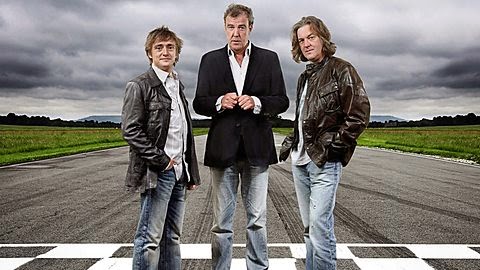
As I said earlier, Top Gear is one of those programmes that some people will watch but probably deny. It is irredeemably silly at times, a bit like Last Of The Summer Wine with cars. A famous comedy double act were once described as consisting of an idiot and another idiot who thinks he is clever and that is pretty much the impression that Messrs Clarkson, May and Hammond have cultivated; each thinks that they are cleverer than the other two, but all three exhibit moments of rank stupidity, and you actually have to be pretty smart to pull that off week after week, which they do.

Left to right, James May, Jeremy Clarkson and Richard Hammond

Having started life as a staid car programme, Top Gear has transmogrified itself into a light entertainment show with some relatively serious car reviews. Knowing the way that shows like this are made it is obvious that some of the stunts, particularly the races between car, boat, bike and public transport are carefully stage managed and are far from as spontaneous as they may appear. Then there are the moments of sheer lunacy like customising police cars or ambulances or converting a combine harvester into a snow plough that are played purely for laughs. It is formulaic, but it generally gives the public what they want, which is three middle aged men acting the fool. As I say, like Last Of The Summer Wine with cars. But never forget that Summer Wine ran its course because there are only so many times you can pull the same stunts, tell the same jokes, and keep the public amused; Top Gear may have gone the same way regardless of Jeremy Clarkson and his contentious remarks.

Left to right: Clegg, Foggy and Compo

It has been suggested that certain events in Jeremy Clarkson's private life have in part been responsible for his increased volatility and involvement in greater controversy and it could equally be that as with others before him in many walks of life he has thought himself bombproof, allowing him to feel that he can push the boundaries further than other people without fear of reprisal. After all he has survived previous controversies, perhaps he will survive this one too, only time will tell. If the Beeb let him return maybe he will be contrite, maybe he will tone things down; we shall see.

If truth be told there have been occasions when I've watched Top Gear and winced at one of Clarkson's insensitive remarks, and admit to a certain amount of uneasiness over the apparently casual way in which he makes them. In some ways he reminds me of the small child that learns a rude word and delights in the discomfort he causes in others each time he trots it out. Sometimes I really don't think that he believes that his remarks cause the offense they do, that they are just a bit of fun and is surprised at the commotion that follows them. Jeremy Clarkson is in many ways the ultimate unreconstructed man, an idea he obviously subscribes to in part, having described himself in his newspaper column as "a dinosaur."

Everyone deserves a second chance, but Jeremy Clarkson has had more than one; this latest episode may be a bridge too far. If he goes Top Gear may demise too rather like the band that cannot really replace the lead singer who leaves to pursue a sole career, but never forget that Russell Brand and Jonathon Ross appear to have been rehabilitated and forgiven for their prank call to Andrew Sachs.  It isn't beyond the realms of possibility that Clarkson will return.


Thursday, 12 March 2015

Anyone Want Tickets?

A common sight outside the venue for major sporting events or rock concerts are the touts, those men (it always seems to be men) enquiring if anyone has any spare tickets or, perhaps would like to buy one? There was a time, years ago, when these men were considered parasites but now they are pretty much an endangered species as their role has been largely overtaken by the secondary market websites such as Viagogo,  Get Me In! and StubHub.


The secondary market, the traditional way. Photo: Lincolnshire Echo

Now opinion is divided on these websites. On the one hand they provide an opportunity for fans to get their hands on tickets for sold out events but on the other hand the fact that tickets on these sites go for prices that are often more than double the face value opens them up to much criticism. The fact that Get Me In! are a Ticketmaster company, and Ticketmaster are a primary seller immediately makes them a target for accusations that some tickets never actually make it onto the primary market and go directly to the secondary market. My experience of buying tickets online does not give me mush assurance that that is not the case. Last year I booked tickets for a gig by Architects at The Roundhouse for my daughter. Logging on to Ticketmaster at 9am on the Friday morning, tickets were not yet on sale. After refreshing the page several times, tickets became available to book, but were sold out, but guess what, they were instantly available on Get Me In! at vastly inflated prices. Fortunately I was able to buy tickets at face value from The Roundhouse website, where they had gone on sale slightly later than at Ticketmaster.

The Roundhouse

Now the people who run the secondary market websites claim that most tickets they sell are those bought by genuine punters who subsequently realise that they cannot attend the event, but this does not explain why they appear on their sites so soon after the original sale. No one buys tickets and then realises immediately that they cannot go, so either these tickets are appearing so soon on secondary sites because they bypass the primary market altogether or because buyers are purchasing them with the sole intention of selling them on for profit.


The secondary market providers also make the comparison between tickets and cars or houses, claiming that as the owner of a house or a car has the right to sell their property or vehicle, so should a ticket holder. To my mind it's a spurious analogy. Sure, house prices have tended to rise and sellers make a profit, but most people sell to buy another property. Cars, on the other hand depreciate from the moment that you take ownership, but concert tickets or Cup Final tickets are a totally different market and the secondary market makers know this, bumping up prices accordingly. Look, if I want a second hand Volkswagen Golf there are dozens, even hundreds to choose from, but for tickets to see Paul McCartney in Liverpool (face value between £71 and £135) my choice is distinctly limited, as is my chance of getting one on the primary market, but they are on the Viagogo website for up to £1,400 for the sole purpose of making the seller a thumping great profit.

If tickets are in fact bypassing the primary market and this is deemed legitimate practice then the secondary market sellers should be upfront about this and it should be made clear to the public that this is occurring. If it is happening then I believe it is unfair to the general public and should be outlawed. New rules have been introduced to make sellers on the secondary market declare the original ticket price, factors such as age restrictions and limited view but frankly these rules do not go far enough and in any case things like restricted views apart, most of these facts would be known to buyers anyway from their attempts to buy tickets on the primary market.

Back in 2009 the then CEO of Ticketmaster in the US, Irving Azoff, told the US Senate "I don't believe there should be a secondary  market at all. I believe that scalping and resale should be illegal." Harvey Goldsmith, the producer and promoter of rock concerts, Charity events and television was interviewed on radio last week calling for more control of the secondary market. While acknowledging that there is a need for a secondary market (people will always find themselves with tickets to events they then cannot attend), Goldsmith believes that the price of tickets on the secondary market should be regulated to allow only a nominal mark-up, say 10% and I make him right on that.

Irving Azoff. Photo: Forbes

I have to admit to having used secondary market websites to buy tickets in the past. If they have one use it is in sometimes being able to buy better seats than one can acquire when tickets first go on sale, but I have to confess that I have done so through gritted teeth and had to put the fact that I have paid through the nose to the back of my mind. The fact is that I cannot set aside my feelings that I am lining the pockets of either an intermediary company, who have done little to earn my money, or an opportunist who sees that a quick buck can be made.

The England and Wales Cricket Board (ECB) are one of a few organisations that frown on the resale of tickets. Their website says plainly that, " The ECB is against ticket touting, and is committed to eradicating it wherever possible. The ECB monitors online auction and ticket re-sale sites, and will cancel tickets in breach of terms and conditions: i.e. tickets that are sold on above face value are in breach of ticket conditions, and may be cancelled – leading to refused entry into the ground." Hats off to the ECB, who authorise an official ticket exchange for fans to sell unwanted tickets to other fans at face value. It would be nice if other organisations followed suit, but I won't hold my breath.

Most tickets one buys online come with the purchaser's name and address printed on them, and some venues check that against photo ID when you turn up for the event. At some venues this is easier to enforce than at others, but it is something I'd be happy to comply with if necessary. An argument put forward by the secondary market providers, that they enable fans to get tickets they otherwise could not have bought, just won't wash. If Viagogo or StubHub or Get Me In! were regulated more stringently, for example only being able to add 10% to the face value, more people would be able to get tickets on the primary market. Oh, and don't get me started on "processing fees," or postages, or the fact that some charge you for the privilege of printing your ticket at home because all of those add insult to the injury done to your bank balance when you buy your precious ticket in the first place.


In an ideal world we would all boycott the secondary market , which would collapse if people were stuck with tickets they couldn't sell, but as long as sell out events exist there will be a market and there will be people prepared to pay silly prices for the privilege of seeing their favourite team or their favourite band. I'm just hoping that someone comes along with some rules that have a bit more bite than those that have just been introduced.

How England Were Nearly Denied The 1966 World Cup

In 2017, during the bidding process to determine who would host the 2026 World Cup, FIFA President Gianni Infantino addressed the travel ba...