Showing posts with label A Midland Odyssey. Show all posts

Wednesday, 2 September 2020

A Midland Odyssey - Part Thirteen - Leadership Challenge

It is a couple of years since I last posted a blog about my time working for Midland Bank/HSBC, and if I am to write any more of them, I probably need to do so quite soon, before my memory fails me, so here is one on what I can remember of an unsurprisingly mundane management course that spawned a couple of memorable and rewarding voluntary exercises. As you’ll see, some of the details are a bit sketchy.


I have written before that over the years the courses that the bank ran changed from focusing on the technical aspects of particular roles - whether that was cashiering, or foreign work, or anything else - to dealing with soft skills like leadership and managing people. The course I’m featuring here was called Leadership Challenge, and to go with the day’s activities, there was something extra that followed and required working as part of a small team in planning and delivering a project.


It is quite scary to think that the Leadership Challenge was now nearly a decade ago, which is why some of my memories of it may be somewhat vague and lacking in detail! For starters I cannot remember whether this was a bank-wide course, UK bank specific, or simply just for Payments Department, where I was working in 2011. My suspicion is that it was the last of these.


What I do remember is that there was a day of activities at the bank’s sports ground in Beckenham that featured the normal round of events that are a cross between role playing exercises and parlour games. Frankly I always had a hard time with these sorts of events, I really struggled to take them seriously, and – and this may be because I take things too literally at times – found them difficult to relate to the real world. The main memories I have of the day were learning from the office of an outage on the system for which I was, in part, responsible. Gary Cook, my colleague with whom I worked on that system was with me on the course, meaning that a hefty percentage of the team were out of the office. One of my few memories of the activities was some exercise in which we had to spot objects that were scattered in trees and bushes; quite what the purpose of that was I cannot recall.


HSBC's sports ground at Beckenham

As part of the course we were placed in groups of six people, and after the day’s events each group was asked to put together a proposal to work with a local or national charity to raise funds for them, or contribute in some other way. At the time – and I really hope that this is still the case – the bank allowed staff time off to contribute to charitable events, not something many people were aware of, hence the fact that I cannot recall anyone ever doing so other than in connection with the Leadership Challenge.


Our group’s initial meetings after the day of the course concluded that we did not want to just do some fund raising, especially since another group had become involved with the highly popular armed forces charity, Help for Heroes. Founded in 2007, Help for Heroes raised over £40 million in its first three years of work. We decided instead to volunteer our time to a charity local to where we worked in Southwark.


After a false start or two, we identified Bankside Open Spaces Trust (BOST), an environmental and volunteering charity to work with. Set up in 2000, BOST aims to improve people’s health and wellbeing by making where they live and work greener and more beautiful, protecting, preserving and enhancing parks, gardens and other amenities in London SE1 and surrounding areas. [1]


The idea was that in partnership with BOST, we would decide on some tasks that we could undertake, and that the bank would give us a day off to do the work. But first we were supposed to prepare a presentation for management of what we would do. In part, and in terms of the course we had been on, this was probably supposed to be as important as the end result, providing an example of how we could work together (and we were by no means a group who worked together on a day-to-day basis) to devise and create a project and presentation. Although we worked on doing this, we never did get to deliver our presentation. We did however, follow through with our proposal and work with BOST, on not one, but two projects, which was more worthwhile than any presentation.


Our first project, which took place in June 2011, was on Waterloo Millennium Green, and involved clearing debris, weeds and other detritus from the pond and water feature there. My colleagues Paul Land, Anna Martyr, Gary Cook, Solidea Cocciatelli, and I [2] spent a whole day removing rubbish and weeds, and clearing away the overgrown vegetation from the pond, which had been drained in advance. It was hard work, and at one point, when I removed the two pairs of gloves I was wearing (one pair latex, one pair fabric), I had to pour away about half a pint of sweat from each, but it was very rewarding and at the end of it, the pond looked a lot better. A few weeks later I took a stroll over there to see what it looked like after it had been refilled, and very pleasant it was too. Sadly, I don’t have any photos of it before or immediately after.


Waterloo, Millenium Green 


The following year, in 2012 (I think it was February as it was during the school half-term holiday), the same group of us contacted BOST again and found a voluntary job, working for a day at a school in Southwark (again, I cannot remember which one, although I’m pretty sure it was in Redcross Way, so it was either St Joseph's R C Primary School, or The Cathedral School of St Saviour & St Mary Overy - I really ought to have written this sooner after the event!). This time our task involved installing raised flower beds for the children’s vegetable garden. Hard work again, but no less rewarding.


What other groups did – apart from those who raised money for Help for Heroes – I cannot say, and how many ever delivered their presentations I don’t know either, although my recollection is that the presentations were an idea that petered out somewhat.


Of all the courses I ever went on, the Leadership Challenge event was right up there with the most tedious, average and predictable (frankly it was a waste of a day out of the office), but I would not have passed up the opportunity to crawl around in a pond on Waterloo Green, pulling up weeds and putting empty beer cans in black plastic sacks, nor the chance to build some raised flower beds on a cold winter’s day, so there were compensations. I just wish I could remember it all better.


[1] https://www.bost.org.uk/about-1

[2] I am sure there was a sixth person, but for the life of me I cannot remember who it was! If it was you dear reader, all I can do is apologise!

Thursday, 12 July 2018

A Midland Odyssey Part Twelve - Spanish Pesetas and Travellers Cheques

Every year, as the end of July approaches, I inevitably think back to my days as Foreign Clerk at Midland Bank in Barking during the 1980's, and the panic that set in as the Fords shutdown approached. Factory shutdowns in the summer have long been a characteristic of manufacturing industries, and with Ford having a major plant just down the road at Dagenham, the end of July - beginning of August period would see literally thousands of residents of Barking and Dagenham simultaneously on holiday. As many as 40,000 people worked at Ford's in 1953, and although this number has steadily fallen over the years - to just over 3,000 today - as recently as the 1980's Fords were a major employer in the Barking and Dagenham area.

Ford's plant at Dagenham. Picture: Lars Plougmann - Flickr: 164945157

So, each July, as the end of the month edged closer, thousands of Fords employees began contemplating their fortnight on one of the Spanish Costas, or one of the Greek islands and that meant picking up their Pesetas, or Drachmas, and their Travellers Cheques. And whereas today it's possible to just wander into a bank, or bureaux de change, travel agents, or the Post Office and buy your currency over the counter, back then at Barking branch we were not allowed to hold stocks of currency and therefore most customers wanting their foreign money had to order it in advance.  The plus side of this as far as I was concerned was that I knew for any given day, how many foreign money orders I would have to make up; the downside was that I knew exactly how busy and increasingly frazzled I would be on those days, and inevitably it was Fridays that most customers seemed to want to collect their orders.


Each morning during the summer months, one of my first tasks would be to make up the travel orders before we opened for business at 9.30am, but no matter whether there were twenty orders, or just five or six, it was inevitable that the customers who arrived for their travel money first were the ones whose orders had not yet been made up, while those orders where the cash had been counted, the Sterling equivalent calculated and all of the vouchering completed, would lie in the dual-control drawer until sometime in the afternoon. And handing out that currency was a time consuming job too, since in addition to their cash, most customers bought travellers cheques which I had to watch as they signed them, and then run through my customary patter about keeping the receipt separate from the cheques so that in the event of their loss or theft, they had a record of the serial numbers for any insurance claim.


One year I decided to take holiday during this particularly busy time, and my good friend and colleague Keith Markham was moved from his normal role on the Securities desk to cover me. I think that the trauma of stays with him still, as he often mentions the experience when we meet up. While he may have forgiven me, he certainly hasn't forgotten!

Today, if you go into a bureau de change to buy your foreign currency, you will be served by someone with a computer in front of them, and your receipt will be printed out complete with currency amount, exchange rate, Sterling equivalent and commission amount (if any). In my technologically impoverished day, the conversion was performed on a calculator and the customer's copy and associated accounting vouchers were written out by hand, and also unlike today, each transaction attracted commission. I very much doubt there are many places that charge commission charged today, but it was the norm in the 1980's. But that doesn't necessarily mean today's travellers aren't paying commission, it's just that today the rates are loaded to account for it, and the spread (between buying and selling rates) is much larger.

Those exchange rates today are usually on view in banks and other exchanges in some form of digital display, but they weren't in Midland Bank, Barking circa 1985,! In the banking hall there was a light box with the names of the various currencies that we bought and sold on it, with columns showing the rates - buying and selling - for notes and coins (although in practice we rarely, if ever dealt with coins) and for cheques. And each morning I would stick little plastic numbers on that light box in accordance with the rate sheet that had arrived in the Head Office Letter that day. In theory, when an exchange rate update was advised during the day, I would have to go out and amend the display, and also change the calculation on any unsold orders. In practice, this was observed in the breach unless the rate in question had moved dramatically, and dramatically enough to get me out there would be if someone had devalued their currency! The rates were rarely accurate anyway, due to the propensity for those plastic numbers to drop off the shiny surface of the light box; the only way to have any chance of them adhering was to dab them with saliva, not the most wholesome of practices!

It wasn't just the sale and purchase of foreign currency that was labour intensive in 1980's branch banking. While Midland Bank had moved away from the iconic Burroughs TC-500 computer terminal to the rather slicker Nixdorf machines, on the foreign desk the pen, calculator, books of record and the typewriter still reigned supreme, and the typewriter on the foreign desk was especially busy. There were Credit and Debit Advices galore to be typed, with one customer - a record exporter - receiving numerous payments from overseas during the day, which printed from the Nixdorf terminal and had to be transposed onto a Credit Advice and sent out in the mail. And that same customer issued numerous Foreign Bills for Collection, the forms for processing which were seven-part monsters that necessitated the use of six pieces of carbon paper to complete. It goes without saying that typing using that amount of carbon paper required quite a heavy touch to make sure that the seventh copy (the one retained in the Branch) was legible, but also required an accurate touch as corrections were a total nightmare!


It seemed in those days that almost everything one did had to be recorded in a book, whether it was foreign currency transactions, issuing travellers cheques, processing payments, or processing bills; just about everything had its own book or ledger. And those books stood on a shelf in front of me, the face of which was plastered with stickers on which I had typed the addresses of customers and account numbers of the accounts I used most frequently. It would not be allowed today of course, data protection regulations would put paid to that time-saving hack - actually I'm not even sure I ought to have done it even thirty years ago, and I'm vaguely aware of some point in time when I was required to remove them all to avoid bringing down the wrath of the inspectors.

I can't find a picture of Midland Bank, Barking so here it is in later years rebranded HSBC.


I spent five and a bit very happy years at Midland in Barking; when I started there I knew only a little about foreign work - a job that became my favourite and shaped the rest of my time in the bank - by the time I left I wouldn't say I was an expert, but I certainly knew a bit about virtually everything, and I had the task of making up foreign money orders down to a fine art.


Thursday, 21 September 2017

A Midland Odyssey Part Eleven - You Must Be Barking!

I was saddened to hear recently of the death, in February this year, of John Groom, who was one of my managers during my years working at Midland Bank in Barking; he was 83.

John Groom - or Jack as he was usually known - was what we might now describe as a bank manager of the old school, wise and knowledgeable, he acted in his customers best interests - his loyalties were as much with them and his staff as they were with his employers. He was a man of generous spirit who, in those days when customers would shower bank managers with Christmas gifts (chiefly wine and spirits), would make sure that every member of his staff went home at Christmas with something, even if it meant dipping into his own pocket to do so. He once bravely threw his home open for the staff Christmas party when there was no other venue to be had. In addition to his work with Midland Bank, Jack Groom was heavily involved with his local church, Holy Trinity in South Woodford, and was a magistrate, sitting regularly at Highbury Corner Magistrates Court.

Jack Groom (centre in dark jacket and tie), watches as Eddie Moody tops up my glass of champagne on the occasion of my leaving Barking branch in 1986. Sitting next to Jack is his secretary, Lesley Clarke.

Jack Groom was not the manager at Midland Bank's Barking branch when I first walked through its doors, that was his predecessor, Peter Cross, who was quite different from the man who replaced him. Peter Cross was a more outgoing, ebullient man who delighted in lunching with customers. I went from Romford branch to Barking at a time when it had something of a reputation. I am not sure why it had developed the reputation that it had, but it was - in football terms, perhaps - regarded by some people (almost exclusively people who had never worked there, it seemed) as the equivalent of Millwall FC, and certainly there was a sort of "No one likes us, we don't care," attitude among the staff when I was there, an attitude driven largely by the unfairness of the reputation the place seemed to have.  

I was unable to find a picture of Barking branch in its Midland Bank days,
so here's a picture of it taken a few years back and branded HSBC

The reputation that Barking had was grossly unfair and the five or so years I had there were among my happiest and the most enjoyable I had working for Midland Bank, and it was during that time that I met people whom I remain good friends with to this day. It's true that when I first went there it was difficult; I was sent there as Foreign Clerk and the limited amount of foreign work I had done at Romford was not the best preparation for what was a busy foreign desk at Barking, and at times it was probably the busiest desk I have worked on. I cannot say I left Barking as an expert in all aspects of foreign work, but the variety of tasks that I did there -inward and outward payments, bills for collection, foreign currency and travellers cheques, drafts and foreign exchange, among other things - gave me a very broad range of knowledge that was invaluable as I went on to specialise in other aspects of the job at other offices later in my career.

"The Vic"


If there was one thing that the people at Barking branch at that time did, it was embody that old saying, "Work hard, play hard." Perhaps it was because I was young, free, and single - as were many of my colleagues at the time - that the social life I enjoyed at Barking was probably the best that I experienced during my working life. On many a Friday evening I would repair to our favoured pub - The Victoria - with colleagues, Paul Calvert, Gerry Baker, and Keith Markham among them, I still meet those three regularly. And when we do meet, we generally pick up pretty much where we left off the last time, and frequently our conversations turn to the old days at Barking, much to my wife's frustration, since when I return home after an evening with my old friends and she asks after their respective wives and children, I have to admit that barring the fact that they are well, I know nothing as we had spent most of the evening wallowing in 1980's nostalgia! Some of that nostalgia will relate to the boating holidays we had on the Norfolk Broads and the Staffordshire & Worcestershire Canal, Then in 1987 and 1988 we went on what was for me, a first foreign holiday - we went to Majorca both times - after which Paul and I found ourselves in relationships (not with each other, I hasten to add!) which brought our holiday making to an end.


The top picture shows (from left to right) Keith Markham, me, Gerry Baker and Paul Calvert on our boating holiday on the Norfolk Broads in 1985. The picture below shows us a good few years later at Keith's wedding. Only Gerry has been able to keep a full head of hair!

At the risk of simply compiling a list of members of staff at Barking branch in the 1980's, I cannot omit from this piece the names of some other stalwarts of the place who were good friends of mine. Norman Evans the chief Securities Clerk, who features briefly in one of my early blogs, The Obedience Of Fools (http://rulesfoolsandwisemen.blogspot.co.uk/2013/01/the-obedience-of-fools.html) was something of a legend at the place, as was Eddie Moody, the Accountant. Eddie was not one to suffer fools in silence, and was frequently scathing and inquisitorial when anyone phoned in sick: he would scoff at anyone who said they had the flu but would be in the next day, telling them that would be off for at least a fortnight if they actually did have flu. There was young Robbie Smith, who had come over from Northern Ireland and who it has to be said was not everyone's cup of tea, but who I really got on well with. He was frequently strapped for cash, and would be lured out by us some Friday nights "Just for one," and would usually still be there at last orders. Tragically he was killed in a hit-and-run accident near his home in Barking some years after I had left the branch.

Me, looking slightly trepidatious (front right) before a sponsored swim in 1985 with colleagues from Barking: Back Keith Knight and Andrew Graves, and front, Claire Bennett.

We had three typists at Barking - Lesley Clarke (who was the Manager's secretary), Janice Blackwell and Wendy Gudgion. In addition to those three battering the keyboards, there were at least four others of us whose jobs required a significant amount of typing as well, namely the Securities Clerks, the Control Clerk, and me on Foreign. In particular, I suffered the Foreign Bills for Collection forms, seven-part documents that required six pieces of carbon paper to complete and quite a heavy hand when typing to ensure that the bottom copy - the one that was retained in the branch - was legible. Carbon paper, Tippex and typewriter ribbons were a major part of every stationery order in the 1980's, items which one imagines are as rare as hen's teeth in most offices today.

No mention of Barking branch during the 1980's would be complete without mention of the 'arrest' of a student customer from North East London Polytechnic (where the bank had a sub-branch) who had defaulted on her borrowing. When called into the branch to discuss the matter, the student in question was asked to remain in an interview room, and while she was left alone in there, the police were called. This all happened before I transferred to Barking and the first I knew of it was when I saw it in the papers - it even warranted a cartoon by the Daily Mail's Mac - and pretty soon, the branch was besieged by journalists. The Manager's Assistant - who was the poor guy who had interviewed the student and (on instructions from Head Office) called the police - had to be smuggled out of the fire exit and driven away undercover at the end of the day.


I wouldn't swap my experiences working at Barking for anything, and this blog has merely scratched the surface of my memories of the place; perhaps before too long, I'll come back for another trip down Memory Lane.

Thursday, 2 March 2017

A Midland Odyssey - Part Ten - The Diploma

When I joined Midland Bank in 1976 inflation was running at 16.5%, and even before I started work I got a double-digit pay increase, and I also received an increase - albeit a more modest one - for passing my A-levels. Having A-levels also made me eligible for Day Release to study for my Institute of Bankers (IOB) exams, and as it was often said that with an IOB qualification one's promotion prospects would be improved, I decided to sign up for the course. Except that my A-levels meant that I was exempt from part of the first stage and would have to take a Conversion Course instead and the only local college offering it - Redbridge College - ran it on Fridays, and the branch accountant was not willing to let me be absent every Friday. Instead I ended up at North East London Polytechnic in Barking taking a Higher National Certificate in Business Studies (HNC), which I was assured would be accepted by the IOB as equivalent to the Conversion Course.


North East London Polytechnic in Barking as was: it has subsequently been converted to housing.


I passed the HNC but did not pursue the IOB exams; by the time I was twenty I felt I had had enough of studying and resented the Wednesday evening classes and having to miss nights out to do homework, so I dropped out.

Fast forward to 2004 and I learned that HSBC ran - in conjunction with the IFS School of Finance[1] - a course which led to a Diploma in Business Analysis and Operations (DipBAO) and since my job title was Business Analyst, it seemed an appropriate course to study. The other members of my small team also expressed an interest, but in the end it was only me that signed up. And I did so not because I thought that gaining this qualification would enhance my career prospects - at the age of 46 and comfortable in my role I wasn't really looking for a drastic step up the ladder - but because I thought it would be interesting and, after nearly thirty years after undertaking any academic study, I wanted to know if I still had the skills to learn a subject and pass exams.


The course was split into four modules: Managing People In Organisations, Managing Information, Business Analysis, and Project Management. The first two elements comprised distance learning, and to pass required completing two assignments and taking a formal exam. The second two elements required taking HSBC courses in the subjects and then producing an assignment.


The course textbook and other resources for Managing People In Organisations arrived in the post, and one Saturday afternoon in the summer of 2004 I sat down and started work. Other books were purchased - second hand through Amazon - and I quickly realised that the amount of commitment required was not insignificant. And when the football season started, Saturday afternoons were not a practical time for study, so learning became a weekday evening pursuit - not easy after a full day at work and having spent the early evening cooking and doing other chores. By the time it came to start revising for the exam - the first I had taken in three decades - it became obvious that I could either get a full night's sleep or study, but not both. I would start revising at about ten o'clock and go on till two or three the next morning, fretting all the time that nothing seemed to be going in. What I found remarkable was that while I was getting my few hours sleep, my mind would somehow order my thoughts and lo and behold, come morning there was more that I could recall than I would have thought possible when I went to bed. Of equal concern as whether or not I could retrieve the necessary information in the exam room, however was, could I write for three hours without getting writer's cramp? Nowadays I rarely use a pen to write anything longer than a shopping list, and even twelve years ago, I was using a keyboard much more than a biro, so part of my exam practice was simply sitting down and writing for long periods; it is harder than you imagine.

As it happens, the exam seemed to go quite well. Our course tutor - whom we only actually met twice - was on the ball in predicting which areas of the syllabus would be likely to come up (more so than the tutor for the second module, Managing Information, whose advise I by and large ignored, and was glad I did) but even so it was with some trepidation that I logged on to the IFS website some time later to find out my result. To my surprise and delight, I had not only passed, by I was awarded a Distinction. It was my best result, as although I passed each of the other modules, it was not with such good scores. In part I would put that down to my having no experience of managing people, and I was therefore able to treat the subject as a purely academic exercise, whereas with the others - Business Analysis in particular - I had preconceptions and my own ideas that did not necessarily fit with the course objectives.

The Business Analysis and Project Management courses took place at the bank's offices in Hoyle Street, Sheffield and their training centre at Bricket Wood in Hertfordshire (neither of which the bank occupies any longer). The courses were hard work - at Bricket Wood we had to work evenings and one weekend - but the effort paid off, because I passed.

HSBC's former offices in Hoyle Street, Sheffield. Photo: Terry Robinson


My HSBC colleagues who also received their diplomas were:
Heather Batson, Fakhra Brisby, Andy Clark, Martin Cleary, Maria Coulson, Emma Frith,
Michael Griffin,  Jo Haskins, Owen Hatton, Glynn Neale, Simon Mitchell, Ross Neads
Julie Parsons, Cathy Patton, Jenny Penn, Jeremy Ransom, Paul Richardson

In the picture above are (left to right) Jenny Penn, Fakhra Brisby and Mike Griffin. Unfortunately the name of my colleague standing immediately to my left escapes me.


And then I had to rent a gown and mortar board (not cheap!)so that on  Friday 16th March 2007, I could go to Southwark Cathedral and receive my diploma - not the real thing, that arrived some months later after some issue with printing the hologram on the actual certificate - enabling me to add the letters DipBAO, after my name. Technically, I can't use the letters since I am no longer a member of the IFS (I declined their offer to pay an annual membership fee of over £100 for that right, plus their magazine).


My qualification did not translate into any career advancement,  although the bank did give me a decent bonus that year (not anywhere near monstrous sums that the press love to pillory the profession for, of course). More than anything else after I finished my studies, I was left with a gratifying sense of achievement, and I would say to anyone who later in life and many years after they finished their years of formal study, considers studying for any sort of qualification, go for it - the lack of sleep is worth it.


[1] Formerly the Chartered Institute of Bankers (CIB) and subsequently IFS) IFS is/was the Institute of Financial Services.

Thursday, 6 October 2016

A Midland Odyssey - Part Nine - Stranger In A Strange Land

In 1998 I was working in the Midas Team in St Magnus House, Lower Thames Street in London. Midas had been developed as a PC based query system for Multicurrency Payments Department (MPD), the area that processes all of the UK Bank's payments, home and abroad[1]. My role was to liaise with the business, gathering requirements, handling their questions and testing the application. It was hard work, but enjoyable, and I must have been pretty good at it, because when the Bank decided to install a version of the application in HSBC's Correspondent Banking Department in Hong Kong, I was chosen to not only test it, but also to travel to Hong Kong and help with the implementation in January 1999.

But as Christmas 1998 approached, my wife Val and I were plunged into a nightmare. Our daughter, Sarah - who was fifteen months old - fell ill. She was fractious and restless, cried all the time and was sleeping poorly. The doctor could not tell what was wrong, and when her condition failed to improve, we took her to the hospital. Again, the doctors were unsure what was the matter, but one of them said - and I will always thank him for this - that we were not taking her home until he had discovered what was wrong. Eventually he asked permission to perform a lumbar puncture - just to rule some things out, he said. When he came back he gave us the devastating news that Sarah had meningitis. I have never been so scared in my life, but fortunately the diagnosis was made in time to get her the treatment she needed and she ultimately made a full recovery, but while she was in hospital - and both Val and I spent nights there, sleeping in uneasy chairs - any thoughts of a trip to Hong Kong were far from my mind.

HSBC Headquarters, Queens Road Central, Hong Kong

Sarah's recovery meant that I was able to fly out to Hong Kong, but not without a sense of apprehension at leaving Val alone with her - and some trepidation at the prospect of two weeks in a strange place, together with the prospect of dealing with the Midas implementation alone, albeit with support from the UK - six thousand miles away and six hours behind.


As I was still a Grade 5 clerk at the time (I think that is GCB7 in the new structure), the Bank didn't exactly push the boat out when they booked my flight and I was shoehorned into Economy for the twelve hour flight, which left at 9pm instead of the scheduled 6pm and meant that I landed in Hong Kong at three o'clock on a Sunday afternoon. And rather than stump up for a hotel, the Bank billeted me with Chris Doyle, a manager in the Correspondent Banking team at his flat in Happy Valley. I don't think that I properly thanked him for his hospitality; as a stranger in a strange land, not having to spend a fortnight in a lonely hotel room, but having some company and being included in the social life of Chris and his fellow ex-pats was something I was grateful for. Chris thoughtfully gave me a piece of paper with his address written in Cantonese and a phonetic English translation (something like "pow ma day surn gayling fong") that was of immense assistance the night I got a cab home alone with a driver who spoke little or no English.

View from The Peak

Hong Kong was a mixture of the familiar and the alien. Out for a walk one lunchtime, I passed well known stores and restaurants; Marks & Spencer, Louis Vuitton, McDonalds, and then, turning a corner into a less well trodden side street, I saw a man with a stick, driving a dozen chickens before him! And this contrast was apparent in the office too. One evening I was involved in a call with my manager in the UK, Raj Soni and the manager of Correspondent Banking in Hong Kong, Geoff Armstrong, who had been my boss at Threadneedle Street International Banking Centre. Having been in a meeting with people I had worked with at home, it seemed odd to walk out of the office that night into Queens Road Central rather than Lower Thames Street. That mixture of the recognisable and the unrecognisable is one thing that makes Hong Kong so alluring, and although I suffered some pangs of home-sickness, the familiar sights and the work made it less painful, even if I suffered chronic jet-lag. Many an evening I would doze off in an armchair, my book falling to the floor with a thud that woke me up, only to find myself unable to sleep once I got to bed, dozing fitfully until the alarm went off, by which point I felt exhausted.

Pictured on her visit to London some months later, Maria Ng from HSBC Hong Kong's Correspondent Banking Department and yours truly.


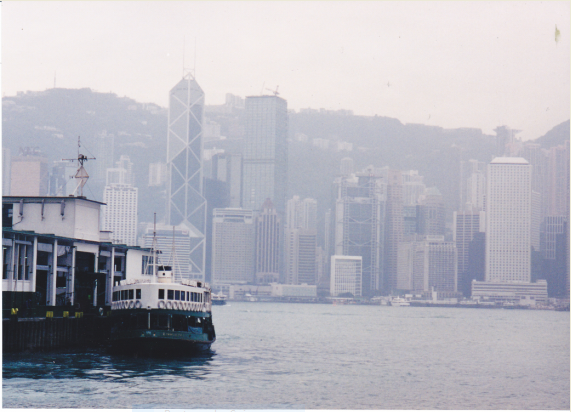
Although I was only there for two weeks, I saw enough to recognise a subtly different working culture. While in the UK I was used to people arriving at nine, working in a blur until five or five-thirty and then leaving, in Hong Kong I would get to the office just after eight in the morning to find most desks occupied, and leave at six in the evening with people still working. One evening I was still there at 8pm and hardly anyone had gone home. But between times, whereas my colleagues in MPD or the Midas Team would be flat out almost all day, in Hong Kong the daily grind was more laid back. I'm not saying they did less work, just that they seemed prepared to allow the work to progress at a more leisurely pace. Since I was there for two weeks, I had opportunities for sightseeing. I went to The Peak. The famous Peak Tram runs from Central to Peak where there are brilliant views of the city and harbour. I took the equally renowned Star Ferry to Kowloon and the bustling Wan Chai.

Looking across the harboir from Kowloon


Apart from Hong Kong, the furthest I ever had the chance to travel on bank business were Sheffield and Livingston in Scotland, and the trip to the former British colony (it was handed over to the People's Republic of China in July, 1997) was one I'll never forget. The implementation went as well as could be expected - a few minor glitches, but generally it was rated a success - and I had the chance to see a part of the world I might otherwise have not. I would recommend anyone who gets the opportunity to visit Hong Kong to go, it really is a different world.


Thursday, 30 June 2016

A Midland Odyssey - Part Eight - Technical Irregularities

How often do you write a cheque? Not very often, I'd guess. From the days when writing one was the most common way to withdraw cash from your bank account and the most usual way of paying for many goods and services, cheques are now approaching something of novelty status. From a peak in 1990 when Britons issued four billion cheques, their use fell to 558 million by 2015, and speaking for myself, I probably write less than a dozen each year. Val tells me it is at least a year since she wrote a cheque and I don't think that either of my daughters even have cheque books. In 1978 it was very different...

Like many people who joined Midland Bank (and probably most other UK banks) during the 1970's, I found that my first job was by turns bewildering, boring, nerve-racking, mundane and actually quite important, despite my very junior position. Most of it seemed to involve cheques in one way or another. First task of the day was listing the incoming cheques, i.e. those drawn on our branch's customers and presented at other banks and branches, which had arrived in the clearing. Then throwing them out into three sections, which at Gants Hill were (surnames) A to K, L to R and S to Z. Other branches had more sections, and some would have whole sections dedicated to a single corporate customer who issued large numbers of cheques. Then each section would be fine sorted alphabetically by surname, then initial. Next, each section had to be cancelled, which means identifying which cheques could not be paid, either due to lack of funds or because of a technical irregularity, and which ones could.

An example of a paid and cancelled cheque, complete with Paid and Crossing stamps and cancelled (initialled through the signature in red ink). This is actually for sale on eBay, though why anyone would want it escapes me.


The ones where funds were an issue would be identified by the manager (at Gants Hill in 1976 a bluff Yorkshireman named Mr Hindley - I never knew his first name, and had I known it would not have dared used it). The Control Clerk would pull them out and return them with the reason, 'Refer to Drawer' or 'Refer to Drawer, Please Represent,' the latter meaning that if the payee chose to pay the cheque in at a later date, it might get paid (fingers crossed). Cheques could be returned for any number of technical irregularities; for being unsigned, for being undated, because the amounts in words and figures differed, because it had been stopped by the drawer, because it was mutilated, because it had been crossed by two bankers, and so on and so forth. Cheques that were paid were 'cancelled' by initialling over the signature in red ink and being stamped 'Paid.' Coloured biros were an important part of daily banking life; red for cancelling cheques, green for checking account numbers and blue or black for everything else.


What you couldn't do, of course, was 'bounce' a cheque for lack of funds if it had a Cheque Card number on the back. Cheque guarantee cards demised in 2011, but in 1978 they were highly important. Shops and tradesmen knew they could accept a cheque without worrying it might be unpaid, and they were sought after by customers, not all of whom were deemed credit worthy enough to have one. Amazing when you think that today Debit Cards are almost ubiquitous, yet by 1976 standards a significant number of customers would not be granted one.


After listing, sorting and cancelling the clearing, most of the rest of the day was then spent dealing with cheques paid in over the counter. Separating those drawn on our customers from those drawn on customers of other Midland branches and other banks, listing them, encoding them with the amount and sending the latter two categories off to Head Office. Manual processing was the order of the day when I started work; over the years automation and centralisation resulted in many of the jobs that I learned in my first few years being centralised or disappearing altogether.

If you could look around Midland Bank, Gants Hill in 1976 you would understand why banking then was so labour intensive. There were few automated processes and most work harked back to the days when hand-written ledgers were the norm (and there were some members of staff there for whom those ledgers were fresh in the memory). In short, what you would notice would be the limited amount of technology and how primitive that technology actually was: the legendary Burroughs TC-500 was the most sophisticated piece of kit we had. We didn't even have a photocopier; any copying we needed to have done involved someone trotting over the road to a firm of solicitors, whose machine we could borrow. The number of copies we made would be recorded in a washing book and the solicitors would invoice us every quarter for their costs.

The legendary Burroughs TC-500. Picture:acbm.com


Not that everything we wanted a copy of could be photocopied though. There were many, many documents that we were not allowed to remove from the premises, ledger copies of customer statements being one of them. Every time a customer had a statement issued, a ledger copy would be delivered to the branch. These did not arrive in alphabetical order - goodness knows why they could not have been delivered in order - perhaps it was to give the branch junior something (extra) to do. It always seemed that laborious, manual tasks were considered 'good for the soul.' The ledger copies had to be sorted and then filed in bins held in a wheeled trolley. Half-yearly (or was it quarterly?) these would be bound up and filed. The ledger copies could not be removed from the branch, let alone photocopied, so it was with a sinking feeling that I would have to deal with a request from a customer for a duplicate statement. That process would involve typing the details from the ledger copy onto a specific card. This would then go off in the overnight bag to Head Office. A few days later the duplicate statement would arrive. But this could not be sent directly to the customer yet because for reasons that were probably due to the limitations of the technology available at the time, many details would be excluded from the copy statement, such as the first three digits of cheque numbers, and these would have to be typed onto the duplicate.

The height of technology in 1976, the microfiche reader!


 A rare example of labour saving came in the form of microfiche copies of statements; Gants Hill branch were chosen to pilot the process and instead of a wad of ledger copies arriving each day, a single fiche would be delivered, reducing filing time from an hour or so to about thirty seconds!

Everything that a customer now receives from their bank, from new cheque books, paying in books, credit and debit cards, is sent from a central location. In 1978 all of those things were first sent to the branch. Huge boxes of cheque books would arrive periodically: naturally these were not in any sort of order and had to be sorted and filed in cabinets awaiting a request from the customer for a new book. And paying in books were received in blank and had to have customer details added by the use of an Adrema plate printer, the repetitive thumping sound of which was a daily soundtrack to life in a small branch!


There were fourteen staff at Gants Hill when I worked there, many doing jobs that would today either not exist or have been centralised; were it still open today, it would probably have no more than five or six staff. But while a lot of the work there was labour-intensive and monotonous, I learned things there that stayed with me throughout my thirty-six years. I reckon I could still fine sort and cancel a section of cheques to this day!


Thursday, 24 March 2016

A Midland Odyssey - Part Seven - The Interview

Like thousands of other teenagers up and down the country, my younger daughter is currently preparing for her A levels, just as I was forty years ago. But while Sarah intends going to university after she leaves Sixth Form, in 1976 I was looking for a job. And like many of my peers I had applied for a job with a bank - well, two actually, National Westminster and Midland.  Both offered me interviews; the first one I went to was with Nat West. It did not go well. I got lost on the way from Liverpool Street Station to Goodman's Fields, where the interview took place, and was a nervous wreck throughout. I was not offered a job.

My second interview was with Midland Bank, on a grey, damp Friday morning in the Spring. I donned my new Burton's suit - grey check, two buttons, wide lapels and flared trousers, as was the fashion back then - and set off, making sure that I was in good time and had a map of my destination, Suffolk House in Laurence Pountney Hill, EC4. In an early example of my fear of being late, I was ridiculously early when I got off the train at Liverpool Street, from where Suffolk House is but a fifteen minute walk. Having time to kill, I walked to London Bridge and then back and forth across the river in the drizzle a couple of times before deciding that it was now not too early to get to my interview. Despite the fact that forty years have passed, there are some things that I remember quite vividly from that interview; not so much the meeting itself, but a couple of odd coincidences that sprung up.


Laurence Pountney Hill. Suffolk House is long gone.

Some people say there is no such thing as coincidence, that what we see as coincidence is actually just the Law of Attraction or the Frequency Illusion in action, but there were two incidents at my interview that I think can only have been coincidental, in fact downright spooky. The first came when I sat in a reception area with a number of other equally nervous teenagers, waiting to be called in to be interviewed. An interviewer emerged from somewhere; "Mr Woods?" she asked. "Yes," I answered...and so did someone else. "Oh, so we have two Mr Woods. Mr Michael Woods?" she asked. "Yes," I replied...and so did the same someone else. Puzzled, she consulted her form again. "Michael Grant Woods?" she asked and this time I had to shake my head. Off trotted my namesake for his interview. I often wondered if he got a job with Midland. I accept that my name is not exactly uncommon, and years later I came across others in the bank who shared my name, but the odds on encountering one's namesake at a job interview, in a pool of less than a dozen other people must be very long indeed.

The second coincidence occurred when it came to my turn to be interviewed. I sat down opposite the interviewer and realised that I had met him before. Back in the 1970's, when all the banks seemed to recruit on an industrial scale at the end of each school year, Midland Bank would visit schools in an effort to encourage school leavers to apply for jobs with them, and when the Bank's caravan had visited my school, Forest Lodge in Collier Row, one of the members of staff who came with it was now sitting on the other side of the desk from me. I cannot recall anything about the interview itself, although it must have gone much better than the one at Nat West - or perhaps Midland were not so picky - because I was offered a job. Of course it might have been that the job should have been offered to the other Michael Woods, or perhaps it could have been that the interviewer was simply impressed by the fact that my memory was good enough to have remembered him from his visit to my school. In any event, by the time I came to sit my A levels, I knew that come August I had a job to go to.
Like Suffolk House, my old school - Forest Lodge - is also no more.

Nowadays the idea of a job for life is becoming less and less common; one in three workers stay in a job for no longer than two years apparently, but in 1976 there were certain industries, and banking was one of them, where long service was the norm. And whereas my parents were both factory workers - they were employed by Thorns (later Ferguson), my Dad as a French polisher and Mum on a production line assembling television circuit boards - my getting a job in a bank carried with it a certain cachet, more so than nowadays I suspect. The fact that my parents worked in a factory (although my Mum had been a secretary with a firm of solicitors before I came along), that we lived in a council flat and I went to a comprehensive school made me consider our family to be firmly working class. Today, notions of class distinction are much more blurred - if they exist at all - and they aren't something to which I pay attention anymore; at best they are irrelevant, at worst divisive, demeaning even.

In 1976 the rate of inflation stood at 16.50%, down slightly from the whopping 24.20% which it reached the year previously, and even before I had started work I received a letter confirming that my starting salary would see a double digit percentage rise following negotiations between the National Union of Bank Employees and the bank. And even before I had set foot in a branch, I was transferred! My initial letter confirming my employment as a Grade One clerk (subject to the usual six month probationary period) advised me that I would start at Midland Bank 126 High Road, Ilford but hard on the heels of that letter came another transferring me to the strength of the bank's staff at 412 Cranbrook Road, Gants Hill (just over a mile away).


Midland Bank, Gants Hill is now a pizza restaurant.

So in August 1976, after a week's Induction Course at Midland Bank's Training Branch in Holborn (see A Midland Odyssey Part Four), I took the 247A bus from Collier Row -where I lived at the time - to Gants Hill to embark on what might loosely be called a career with Midland Bank. Funny to think, had my interview with Nat West turned out differently, or had there not been two Michael Woods at Suffolk House that Friday, or had I not known my interviewer, I might now be looking reflecting on a very different past.

Thursday, 18 February 2016

A Midland Odyssey - Part Six - The Midas Touch

It is difficult now to remember what for many people work was like before personal computers became ubiquitous, but less than twenty years ago many people went through their working day without having to use one. Oh yes, dumb terminals had been part of our working lives for many years, the famed Burroughs TC500, the Nixdorf terminal, and for me, having moved into international banking, IBM terminals to access payment and the wholesale banking systems. Having spent some time on admin I'd also been exposed to early incarnations of Windows, but working on  the queries team in Multicurrency Payments Department (MPD) and sharing one PC between thirteen of us (used fitfully to log stats and produce the odd letter), paper still ruled supreme.
Nixdorf terminal

The "green screen" 


MPD comprised three sections[1]. Ref 18, Sterling Payments (payments in GBP within the UK and incoming from overseas), Ref 24, Currency Disposals (payments in any currency within the UK and from overseas) and Ref 52, Outward Payments (payments in any currency, including GBP, going overseas) - which was where I worked. Everything was done on paper in Ref 52. Payment instructions came in from branches on Telegraphic Transfer or Mail Transfer forms, payments from other banks arrived by SWIFT [2]or telex and were printed and re-input manually and all queries involved writing out vouchers or SWIFT messages which were then entered into the relevant systems by a separate team. On average we must have had four or five hundred live files on the go (and thousands that were closed), all represented by paper, at various stages in the process of being prepared, worked on or waiting to be filed. Finding one you wanted among these could be a very time consuming and frustrating process (a phone call from a branch or customer asking for the current state of play on a particular query could often result in a protracted search, often fruitless). A solution was needed and so in 1996 (ish, I'm a bit hazy on dates this far on) The Midas Project was conceived.

Midas (it's not an acronym, just a name) was a project comprising IT staff and people from the business, some who became involved in the build and some, like me, who acted as subject matter experts and testers. Initially I joined the team on a six month secondment; somehow I never really went back to MPD and at some time during the following six years I ended up as full time member of the team.  It was a completely different world from the one I was used to. Gone were the daily deadlines (hourly even) and instead there were deadlines of weeks or even months to complete certain tasks. It was exciting, rewarding, stressful and baffling at times and one thing I learned was that you had to be flexible, especially over working hours. Early mornings, late nights, weekend working and all nighters came with the territory, especially in the run up to a software release or during contingency testing.

Midas Team cartoon, courtesy of Mus Huseyin


To build a computer system that could replicate the manual processes in place at the time the first requirement was to define the existing processes. This meant mapping out somewhere in the region of twenty query types[3] then designing workflows requiring users answering a series of questions and generating messages or accounting entries or payments based on the answers. Generating SWIFT messages to other banks systemically was relatively straightforward; creating accounting or payments not so. Initially the best we could do was generate more paper that had to be input into the appropriate systems; generating entries and payments directly to those systems was something that came along many years later. Naturally we had to have a query type for those that didn't readily fit into the usual pigeon holes; we called it Miscellaneous (original, eh?) and it had no workflow attached, it had to be worked in what we called "free format." This resulted in a conversation with a department manager which sort of foresaw the move towards proceduralising everything and devaluing common sense, expertise and experience. " How," I was asked, “does the user know how to resolve these queries?” I replied that they had to use their experience and judgement. “Oh dear,” came the response, “we can’t have that.” The movement towards procedures and guidelines outweighing experience and expertise had started.

I'm middle, right in this one.

While we now take for granted the PC, the mouse, copy and paste and toggling between windows, for the average query clerk in MPD in 1997 (the year Midas went live), these were a mystery. Believe it or not, courses had to be run to teach people about "point and click" and navigating on screen menus, and for some this came far from naturally. When it came to teaching the department's staff how to use the system we had built I was in for a shock as our manager dispensed with the services of the two people originally tasked with planning and delivering the training and asked me and my colleague Fakhra Brisby to take it over less than a week before the first session. We cobbled something together and it seemed to go down quite well, although how much of it was of any use and how much sank in, I'm not sure.


Midas went live in October 1997 and it is safe to say there were some issues at first. It was a complete culture shock for everyone; inevitably most people hated it. Some bits of it worked better than others and some coding changes and software releases were necessary to address some of the problems. Probably the best thing you could say about it was that it was no longer possible for files to go missing. But considering our lack of experience or a benchmark to measure ourselves by, it went rather better than we actually thought at the time, so much so that Midas was still going strong when I left the bank in 2012 (and as far as I know, still is), resisting attempts to replace it with anything else. The fact that it is now nearly twenty years old and runs on software ten years older says something creditable about it I suppose.

Working on Midas was one of the most satisfying things I did in HSBC, helped to no small degree by working with some great people, like Gavin Warner, Paul Mills, Steve Tucker, Steve Giles, Gary Cook, Mus Huseyin, the late Ron D'Castro and Raj Soni, to name but a handful of them (if I carry on this will be like an Oscar acceptance speech).

If you now spend your working day in front of a computer you take it for granted, but just think, a little over twenty years ago you would have been working in an office where copy probably required carbon paper and paste had something to do with glue.


[1] Technically I suppose there was a fourth, Ref 62, Drafts, but somehow they were on the periphery.
[2] SWIFT - Society for Worldwide Interbank Financial Telecommunication see, www.swift.com
[3] Typical queries included Beneficiary Claims Non-Receipt, Unable to Apply Credit, Unable to Apply Debit, Amendment (of payment).

How England Were Nearly Denied The 1966 World Cup

In 2017, during the bidding process to determine who would host the 2026 World Cup, FIFA President Gianni Infantino addressed the travel ba...