Thursday, 20 August 2020

A Trip To The Seaside

In 2019 Val and I went on holiday to Cyprus (twice), on a cruise in Norway, on short breaks to Norwich and Folkestone, and we also went on our now traditional weekend to Center Parcs. Val went away to Tenerife with our younger daughter in January this year, but we had made no holiday plans for the rest of 2020 before coronavirus came along.


Bergen, where we started our Norwegian cruise in 2019 

As lockdown started to ease, Val started hankering after going away somewhere, preferably somewhere hot, although by the start of August it was hot enough at home that that didn’t mean going abroad, even if anyone who has ever spent a summer in this country knows only too well, reliability and consistency are not the hallmarks of an English summer.


Having a holiday abroad this year is by no means impossible, but frankly it doesn’t seem worth the hassle at present, what with restrictions at airports and resorts, and possible quarantine requirements on returning home that might even be imposed while you are away. The staycation (or ‘holiday’ as I like to call it) has become the fashion this summer, heck even Prime Minister Boris Johnson has gone to Scotland – conveniently missing out on the fall-out from the ‘A’ level debacle – and so last week we booked a short break in Eastbourne.


I last went on holiday to Eastbourne when I was 15 and still at school, with my parents. We stayed in a guest house – sadly I can’t remember the name, otherwise I would have looked it up when Val and I were in town. What I do remember is that almost without exception, it was misty in the mornings I spent in Eastbourne in 1973, although generally it turned out fine by lunch time. This year the weather at home had been scorching in the days before we went – up to 33˚C – but the forecast was not promising, with every day of our four day stay predicting rain, rain, heavy rain, and thunderstorms.


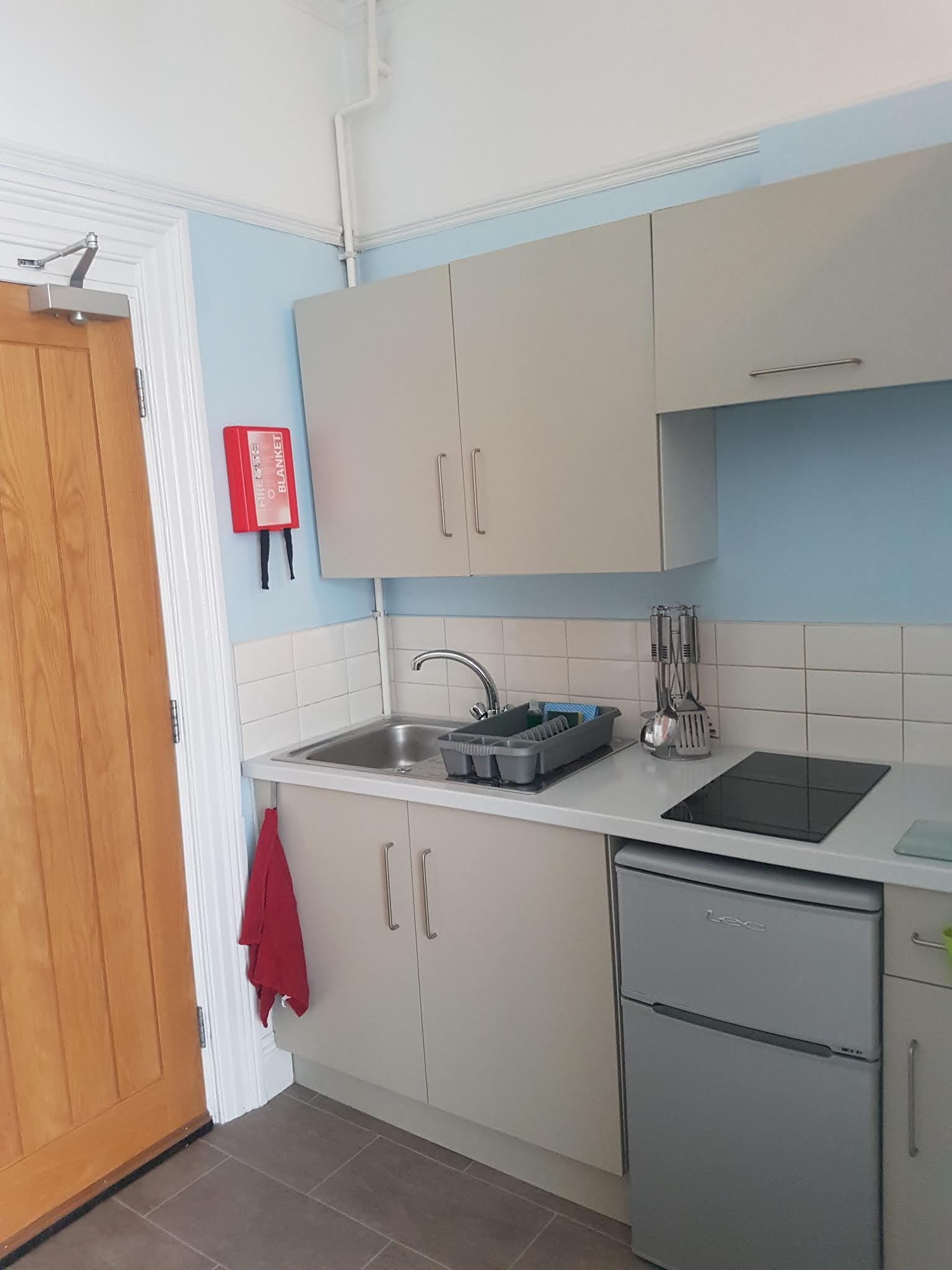
For our Eastbourne excursion, we booked an apartment on the seafront. Choosing accommodation in the time of a pandemic is interesting, one’s criteria are slightly different from normal. The apartments we booked – Beachside – declares itself compliant with all of the current Covid-19 guidelines, and their website confidently lists all of the precautions they are taking, together with a risk assessment. No doubt other hotels and guesthouses are doing the same. The proof of the pudding however…


As it turned out, we were reassured when we arrived at Beachside as the owners – John and Emma – have clearly been extremely thorough in their preparations. The apartment was immaculate – I don’t think I’ve ever stayed anywhere so obviously and meticulously cleaned. The bathroom looked as though it had only been installed that morning, even though it was eight years old.


Having somewhere so obviously well prepared put our minds at rest and made our stay completely relaxing. The apartment – which was on the ground floor and at the back of the property – lacked a sea view (something which Val is normally very keen on – it’s been known to heavily influence where we have stayed in the past), but since this time we had decided that a ground floor room was a priority, it mattered less.


The room could best be described as compact, but it had everything necessary. A small kitchen area with a hob, microwave oven, and toaster; a living/sleeping area with a huge bed, settee, dining table and TV, plus a wardrobe that had been sourced from a local antique shop and reminded me very much of my childhood, with matching bedside cabinets. And, of course the immaculate bathroom (shower room really, as there was no tub).


Would I recommend Beachside for a short break? Without hesitation. Would I recommend Eastbourne for a holiday? Yes. I’d not been there other than on a day trip since that holiday with my parents in the 1970s, and the resort has a sort of God’s Waiting Room reputation (there’s a joke that half the population are over 65 and the other half are poodles), but it seemed more lively than I had expected. And, if some of the regional accents and football shirts on display were anything to go by, holiday makers from various far-flung parts of the country had decided that it was a good place to visit.


Many of England’s seaside towns are in decline, and have been for a number of years. Eastbourne hasn’t avoided the effects and there are a number of empty and boarded up shops including a long since defunct TJ Hughes, and a more recently closed branch of Debenhams. There is however, a fairly vibrant main street, and a bright shopping centre – The Beacon – with many popular retailers represented. Eastbourne is not a seaside resort teeming with amusement arcades, and sadly the pier is closed at present, but the front is thronged with hotels and guesthouses, and there are plenty of places selling food and drink along the promenade. Compared with some resorts – Folkestone, for example, where Val and I spent a few days last year and which looks very down at heel – Eastbourne seems to be thriving, although according to a report on local TV news, visitor numbers have been down this year. That didn’t seem to be the case when we were there; steady rather than packed I’d say, and more people in the pubs and restaurants than I might have expected.


Since lockdown began, the number of miles that Val and I have walked has fallen dramatically. Before lockdown I was averaging 5.03 miles a day. Since March this year, that average had fallen to 4.93 miles, and my average during lockdown was even lower at 4.08. Our four days in Eastbourne pushed the average up slightly. We started with a trip to Birling Gap on Friday, and we walked 11.86 miles that day. On Saturday we did 14.07, dipped below ten to 9.19 miles on Sunday (the only day we had rain), but pushed the average up to 11.73 miles for the four days by completing 11.80 miles on Monday.


Monday was the hardest day. We walked from Eastbourne to Beachy Head; not a particularly long way in itself (from Eastbourne Pier it is only 3.5 miles), but there are two routes to walk there, one is fairly gentle (which was the way we came back), one is not so easy. There is one path we took that has such a steep gradient that looking back is vertigo inducing. I really thought at one point that I would not make it to the top, my thighs and calves were on fire.


Holidays in England have always suffered in comparison with trips to Spain, or Cyprus, or more distant locations due to the vagaries of domestic weather: A common factor in holidays I took as a child in this country was arriving somewhere that had allegedly not seen a cloud in the sky for months, and then having to spend a week dodging the rain, until the day we travelled home, which inevitably would be hot and sunny.


That comparison hasn’t changed, but this summer we have been fortunate in having generally good weather, a blessing in the circumstances: a cold, damp English summer would have restricted what people could do, although with the numbers thronging the beaches at Bournemouth and Brighton, potentially spreading the virus, perhaps that was a mixed blessing.


I am as happy to go on holiday in this country as I am to go abroad – happier, probably what with not having to negotiate airports – so long as the weather is reasonable, which is not something that England can guarantee; if it were I probably wouldn’t bother going abroad again.


Saturday, 8 August 2020

A Game of Two Halves – Football’s Haves and Have Nots

On the first Saturday of August 2020, when the 2020-21 FA Cup competition ought to have been kicking off, the 2019-20 version lurched to a conclusion with Arsenal beating Chelsea 2-1 at an empty Wembley Stadium, absent of fans due to COVID-19.


Immediately after Arsenal’s victory, speculation began as to whether they would be able to retain the services of captain and winning goal scorer Pierre-Emerick Aubameyang, whose current contract sees him earn £180,000 a week. At the same time rumours began about the players that Arsenal would want to sign during the transfer window with Chelsea’s Willian and Barcelona’s Ousmane Dembele among the names mentioned:  Neither would come cheap.


Arsenal were in the news again a few days later, when they announced 55 redundancies among the club’s non-playing staff as a cost-cutting measure. To justify this, the club cited significant reductions in income from broadcasters, and from matchday and commercial activities. But winning the FA Cup earned the club £6,795,00 in money they would not have budgeted on receiving, a sum that amounts to more than £123,000 for each of the employees they are making redundant.                 


Rightly, there is indignation that Arsenal continue to fork out top-dollar to their playing staff while dispensing with the services of more than fifty less generously rewarded back-room personnel. It’s true that like players at many other Premier League clubs, the majority of Arsenal’s playing squad accepted a pay cut recently - 12.5% in their case – and those sort of savings (on Pierre-Emerick Aubameyang’s salary alone it works out at £2,250 per week, and he isn’t even Arsenal’s top paid player) ought really to have staved off the need for these redundancies.


Arsenal are owned by billionaire Stan Kroenke, whose net worth is estimated to be in the region of £6 billion. He – and the club - could absorb the costs of those 55 employees (there’s that £6.7m FA Cup windfall for a start), by adjusting their playing budget accordingly, causing little hardship to their playing staff in the process. But they won’t, because that is a move that the top clubs make only in extremis, and we aren’t there yet.


Football’s finances can be mind-boggling, the difference between the haves and the have nots widening all the time. Just as Arsenal’s playing budget versus their redundancies is extreme, Manchester this week provided another startling comparison.


On Wednesday, Manchester City paid £40m for AFC Bournemouth defender Nathan Ake. The following day, Droylsden FC, a club located just three miles up the road from the Ethihad Stadium, announced that they had resigned from the Northern Premier League and this season’s FA Cup and FA Trophy competitions. The club made a statement in which they said, “The closing of the social club and its function rooms  since the start of the pandemic, the main income source with no indication of any restart on viable trading terms along with a loss of income from the club’s main sponsor  has left the club with no visible alternative income stream during the crisis.”


The transfer fee that Manchester City paid AFC Bournemouth would sustain a club like Droylsden for many, many years – decades even – illustrating that the gap between the top of the game and its lower reaches is so great that it is almost incomprehensible.


As I already said, as substantial as the prize money that Arsenal collected for winning the FA Cup is, it isn’t money that the club would have budgeted on receiving when the season started, and when you consider that it is less than half what they pay Mesut Orzil in a year (they pay him £350,000 per week), it becomes almost insignificant, despite the fact that it represents riches beyond compare for clubs at Droylsden’s level, the eighth tier of the English game. At that level income streams can be precarious. Most clubs rely on income from their bars and function rooms and the generosity of owners, directors and supporters, and when deprived of that income, their position becomes perilous. Gate receipts can be low, sponsorship money (if any) may be just a few thousand pounds - unlike the £64m Chevrolet pay Manchester United - and there are no lucrative TV deals. FA Cup prize money is not a given either, nor when received is it as generous as it would be for a club like Arsenal.


The £6m that Arsenal earned winning the FA Cup required them to win six matches. A club starting in the first round of the FA Cup last season - the Extra-Preliminary Round - and winning six matches would have earned £46,390,  a not inconsiderable sum – I know of clubs whose annual turnover is less than that – but for 2020-21, the ravages of COVID-19 mean that the prize money has halved; a club winning the first six rounds will earn just £23,194 this season.


To make matters worse, the first two rounds of this season’s FA Cup – the Extra-Preliminary, and Preliminary Rounds – are scheduled for 1st September and 12th September. With the Government not yet prepared to allow spectators at sporting events – recent trials of limited numbers of fans at cricket, horse-racing, and snooker were postponed – these games are likely to go ahead behind closed doors. For clubs of the status playing in the early rounds of the FA Cup, this will be expensive. Despite having no income from paying customers, they will still incur significant expense, as these genuine figures from one of last season’s FA Cup ties show:

  • Gate receipts: £557.60
  • Match officials’ expenses: £171
  • Away team expenses: £336
  • Other expenses: £64
  • Loss: £13.40


That same game this season, with no gate receipts, would result in a loss of £571 for the home club. In the Extra-Preliminary Round, the winners will receive £1,125 from the competition prize fund and so a side winning at home in our example would actually be £554 ahead, but if these expenses were incurred by a team losing at home (who would receive just £375), they would be £196 out of pocket. (For the sake of this argument I am assuming that clubs will still be expected to meet away teams’ expenses this season, although that could change).


In a further example of the difference between the haves and have nots, the rules of the FA Cup require clubs to pay the fees of the match officials in the qualifying rounds, although The FA pay the fees in the competition proper. This means that while AFC Liverpool of the North West Counties League would have to stump up for the ref’s expenses in a home FA Cup tie played behind closed doors with no income, their Premier League neighbours, Liverpool and Everton – who would likely receive TV income even if no gate receipts - would not. Does that sound fair to you?


On top of these costs, clubs have players’ wages (even if modest), plus rent, rates, utility bills, and sundry other expenses to cover from little or even no income.


I have little sympathy with Arsenal pleading poverty and trying to justify 55 redundancies that using their FA Cup prize money could avoid, instead I’ll save my sympathy for 500-odd non-League clubs who will embark on their 2020-21 FA Cup campaigns in September, and will pay handsomely for the privilege.


Thursday, 6 August 2020

Working From Home - Whose Home?

Despite the fact that as early as June 2014 Zoom had 10 million users, you would have been hard-pressed before March this year to find anyone who didn’t associate the name with an ice lolly, or a song by Fat Larry’s Band rather than a technology company. Since March that has changed and Zoom seems to have become the application of choice for anyone organising an online meeting or exercise class.


Many people who were not familiar with Zoom would probably have heard of Skype, however, yet Zoom seems to have completely eclipsed it as the preferred video conferencing solution for virtually everyone, despite the fact that Skype was around for a decade before Zoom emerged. A couple of years ago, Val’s employers tried to set up a system to use Skype for meetings, and I got roped into trying to help to get it to work at home. It was not a success. Now, although Val’s employment status has changed, she still attends one work related meeting per month, and since COVID-19, those meetings have been online using Zoom; Skype has been abandoned in the meantime.


The effect that the COVID-19 pandemic has had on the workplace has required employers and employees to adopt new and innovative solutions to keep their businesses running, and working from home is the most obvious. Working from home (WFH) has been vital during the pandemic, but as lockdown eases, the case for having people work from home rather than return to their offices diminishes.


Although there is now less of an argument for people working from home, that does not mean that it is a given that everyone will go back to their offices. In the past, there was an argument that working from home enabled people to skive, that the productivity and performance of home workers was difficult to monitor. In fact, that argument seems to still hold with some people. On LBC, radio host Nick Ferrari last week said, "People need to go back to their places of work. Do you know why we have offices? So you can do some damned work. What do you think is going to get this country going again? You sitting in your jim-jams not doing anything all day long?”  I would argue that while by the law of averages there must be some people who do little when they work from home (apparently the Sitel  employees, engaged by the government for the track-and-trace process are among them, making on average 0.14 calls per agent, per day according to a report on the Guardian website [1]) the majority of people are gainfully employed and productive.


Nick Ferrari


I’d say that Ferrari’s comments are based on prejudice and stereotyping and he has absolutely no evidence that people are lounging around in their pyjamas, doing nothing (apart from the contract tracers, but that is scarcely their fault). There again, I have a bit of a prejudice myself…against LBC. The bulk of the content on the station (which I am old enough to remember being launched back in 1973 as the London Broadcasting Company) seems to be phone-ins, for which I have no great love. My aversion to phone-ins and LBC goes back to the 1970s when my father listened to interminable call-in programmes on the station in which well-meaning but ill-informed and/or excruciatingly inarticulate callers would betray their own prejudices in calls inevitably prefaced with a statement that they were ‘a first-time caller.’


Like Ferrari, Tory MP Iain Duncan Smith would like people to return to their normal places of work. Last month he called on employers to get their staff back in the workplace, contradicting the advice of the Scientific Advisory Group for Emergencies (SAGE), who recommended that WFH measures should stay in place. Duncan Smith said that SAGE had no right to tell employers what to do because “most of them have never run a business.” Duncan Smith has never run a business; his career outside politics consists of six years in the armed forces. This government’s enthusiasm for ‘following the science’ seems only to apply when the science supports its own agenda.


Iain Duncan Smith

Given Duncan Smith’s statement this week about the EU Withdrawal Agreement, which he voted for, having assisted in hurrying it through Parliament on the basis that it had been sufficiently scrutinised, but which he now claims costs too much, denies us true independence and contains stuff that has been buried in clauses no one (including him!) has read, it’s probably just as well he has never run a business, it’s difficult to imagine he would have made a success of it.


The remarks by both Ferrari and Duncan Smith reveal the conflict inherent in releasing the lockdown, and the pace at which it is released – it’s a question of Health v Wealth, and there’s obviously more to it than getting workers out of their pyjamas, off their sofas, out of Zoom meetings and back into their offices. Those working from home pay no fares, buy no morning coffee, spend no money on lunch from Pret, don’t pop into the pub with colleagues after work, generally they are not spending or consuming as much as before. The fact that many people working from home are likely to be spending a good deal less than normal is a factor in the contraction of the economy, and regardless of your political hue, that cannot be a good thing.


If you can do your job at home as well as you can in the office (some can, some can’t), it may seem that it makes little sense to go back. But, those who would prefer to continue working from home might like to consider that if they do their job from home, then so could someone else, in their home, but not necessarily in this country. For the employer, this may have the benefit of being in a country where labour is cheaper, where there are no pension contributions, where holidays are fewer and where workers’ rights are generally weaker.


It’s a logical extension of offshoring and outsourcing that the jobs that remain in the UK that it has been proven can be done as effectively from home as in an office, can be equally effectively performed from a home, regardless of where that home is. Perhaps getting off that sofa and back into the office might not be a bad idea after all.


Tuesday, 21 July 2020

The Hill You Die On

In 1973 it became compulsory for motorcyclists in the UK to wear crash helmets. This was decried as a ‘gross infringement of personal liberty’ in Parliament, although almost 88% of motorcyclists in the country were wearing helmets anyway. My Dad wore one during the 1960s, when he owned a moped which was quaintly, if highly inappropriately, called an NSU Quickly (its top speed was just 25mph). The helmet saved his life when, in what must have been a bizarrely slow-motion event, he came off the bike and cracked his head on the kerb.


When the government brought in legislation in 1983 to make the wearing of seat belts in the front of cars compulsory, motorists protested that it removed their right to have their rib cages crushed by the steering wheel in the event of a collision, and the rights of their passengers to be hurled through the windscreen in similar circumstances. It was only in 1991 that it became mandatory for passengers in the rear of vehicles to wear seat belts. These passengers were more sanguine; few complained.


It’s now rare to see someone in a car not wearing a seatbelt, and rarer yet to see anyone on a motorbike not wearing a helmet; the protests about the laws that made them compulsory are now long forgotten. But now we have the controversy and opposition to the wearing of a face mask or other face covering in shops as of Friday, 24th July 2020, to go with the requirement already in place to wear one on public transport.

Opponents of wearing face masks fall into a number of different camps. There are people who seem to believe that wearing a face mask will dangerously reduce oxygen levels in the wearer, potentially causing death by hypoxia. Were this the case, one would expect doctors, surgeons, other health care professionals, and those whose work environments require them to wear masks for long periods to have been dropping like flies over the years, but I cannot find any evidence to support this.


Some people feel that wearing a mask infringes their human rights, and while I haven’t gone into The Human Rights Act 1998 in detail, there are probably parts of that act which would support that argument. The rights we are afforded under the act may be restricted or withdrawn under certain circumstances however; to prevent disorder, or protect public safety or health for example. Relying on ‘rights’ may not be as watertight as many may think, and not just with regard to masks.


A woman protests against face masks in Hyde Park last Sunday.

A woman in Hyde Park protesting against face masks last Sunday.

I have always believed that the individual has what might best be described as a contract with society. In exchange for the rights an individual has, they have responsibilities. Unfortunately, it seems that those who shout the loudest about their own rights are the most careless in considering the rights of others. In this case, the right not to wear a mask must be balanced against the responsibility to avoid potentially infecting others. And, if someone believes that they have a right not to wear a mask, it is only reasonable for them to respect the rights of shopkeepers not to admit them to their premises without one.


There is an argument that face masks do not offer a degree of protection that makes them worth wearing, and it’s true, wearing a mask is not going to categorically prevent the wearer from contracting coronavirus. It will, however, reduce the risk, and more importantly, it will significantly reduce the risk of the wearer transmitting the virus to others. In Vietnam, a country of 97 million people which has a land border with China, an early lockdown and the compulsory wearing of facemasks has meant that the country has had a grand total of 382 cases of coronavirus and precisely no deaths whatsoever.


Ah, you might say, Vietnam is a one-party state, where the rule of the Communist Party will brook no opposition. The compulsory wearing of face masks (or muzzles as some commentators have tediously taken to dubbing them) in the UK would be just the first step on the road to totalitarianism (apparently). This train of thought must go hand in hand with the ‘plandemic’ theory that posits that Covid-19 is a hoax, part of a global conspiracy with population control at its heart. This sort of theory assumes a level of competence on the part of the UK government, and a degree of co-operation between governments the world over that frankly is not supported by even the most casual observation.


I wonder if those who subscribe to the idea that making us wear masks is part of a conspiracy to control us have ever considered that it is just as possible that they are being influenced into not wearing them as part of a plan to increase the rate of infection in pursuit of the dubious herd immunity theory?


Some say that people aren’t wearing face masks properly, thereby reducing their effectiveness, and there is truth in that. The idea is supported by Professor Susan Michie, a member of Government scientific advisory group Sage, who told the Evening Standard that she had seen people wearing masks that didn't cover their nose, or removing them by pulling on the front, rather than the straps. The idea that because people do not wear masks correctly there is no point in making anyone wear them is comparable to saying that because some drivers do not observe speed limits, we might as well abolish them. Better, as Professor Michie went on to say, to teach people how to wear masks correctly.


It has been said that making the wearing of masks mandatory now, some four months after lockdown began, and now that it is being relaxed, is the ultimate in shutting the stable door after the horse has bolted and is actually about ‘maintaining the fear factor.’ More likely, it is that had we been required to wear masks from 23rd March when lockdown began, demand would have outstripped supply in the same way it did with toilet rolls, as we saw shelves in supermarkets stripped bare. And, as lockdown eases and people are being encouraged to return to the shops, to their normal place of work, and to use public transport more, social distancing becomes more difficult. As people spend more time in closer proximity to others, the need to wear masks becomes more important, not less.


Some opponents of face masks believe that making them compulsory will stop people from going to the shops, that it will be the death of the High Street. A more probable potential cause of the demise of the High Street is another lockdown if cases spike again; wearing masks is actually more likely to save the High Street than kill it.


Wearing masks is widespread and taken for granted in many countries but even during this pandemic, when in April, 83% of Italians and 63% of Spaniards wore them, just 25% of us Brits did. It makes me wonder if there is an element of British exceptionalism at work here.


I admit that in previous weeks I have worn a mask only rarely (it was required when I made a visit to the doctors’ surgery), but I have started wearing one to the shops recently, and I will wear one when shopping from Friday onwards.  I don’t feel that I am being coerced nor being turned into a ‘servile dehumanised automaton’ by doing so, not for the hour or so I spend in shops each week. I haven’t used public transport since March, and don’t have any immediate plans to do so, but I’ll happily wear a mask if and when I do.


The opposition and hysteria that surround mask wearing seem completely disproportionate, but for some people it seems to be the hill they are prepared to die on…perhaps literally.


Saturday, 18 July 2020

"Illegal activity on your broadband account"

When lockdown began, I noticed a significant decrease in the number of unsolicited phone calls I was receiving. Like almost everyone else on the planet who owns a mobile phone or has a landline, I’ve become used to one or the other of them ringing from time to time and, upon answering it, being greeted by some opening remarks that can only preface a junk, or scam call. During lockdown, they stopped.


Now that lockdown has started to ease, the calls have started again; presumably the call centres where the calls originate from have begun reopening (no home working for their workers, obviously).


There is a fairly wide variety of scam, junk, fraud, or nuisance calls (call them what you will) in addition to the phishing emails and text messages that arrive periodically. A good many years ago I registered our home landline with the Telephone Preference Service (TPS), which cuts out a lot of the cold calls, but not all of them. The TPS website can be found at https://www.tpsonline.org.uk/


At one point we were getting three or four calls a week, usually seemingly harmless calls purporting to be surveys. Without exception, there was an actual human being at the other end of the line, and I used to make it my business to so thoroughly piss them off that they would hang up before I did; on one occasion I was even accused of wasting their time. As I pointed out, it was they who had rung me, not the other way round.


I like to think that I am sufficiently sceptical to not be taken in by the scam callers, although as I recounted in a previous blog, I was once taken off guard by someone purporting to be from BT and revealed rather more personal information than was wise. That was a question of being hit at the right (or rather, wrong, time) and proved to me how easy it is to get scammed. Fortunately, no harm was done, and I still have no idea what the purpose of the call was. That call proved to me that when people blame victims of scams for their naivety, they may well be being unreasonable. It can happen to anyone.


Almost without exception, the calls I now get on my mobile are of the “We understand you have been involved in an accident that wasn’t your fault,” nature. These all start with a recorded introduction these days, and I refuse to engage with them, just hang up and block the caller’s number. I’m not sure that blocking numbers has any effect though, since all the calls seem to come from different numbers that have presumably been spoofed.


I know that there are apps to block calls from withheld numbers or numbers not in your phone’s contact list, but I do receive genuine calls from such numbers, so this would have the effect of me not getting calls I do want to receive.


Considering their apparent frequency, I have yet to receive either a call purporting to be from Windows/Microsoft telling me that my computer has some sort of virus, or one of the courier fraud calls. We did get one of the Amazon Prime scam calls recently. I was out of the house at the time, and Val took the call which works by telling the victim that a fraudster has impersonated them to sign up to Prime. The caller then claims that they need remote access to the victim’s computer to fix a security flaw. Val phoned me when she received the call, and I was sufficiently sceptical to tell her to hang up (I hadn’t heard of the specific type of fraud, but it just sounded wrong.) We had a further similar call a week or so later, so I hung up and touch wood, have not had any more.


Last week we started getting plagued by automated calls from a series of unusual numbers – and some withheld numbers – that start with a recorded message claiming that action is needed on our part to prevent our broadband from being disconnected within 24-48 hours due to illegal activity on the account. We had six of these calls in just two days, and by some bizarre coincidence, when the first one came in, our desktop computer decided to spontaneously shut down, which spooked Val sufficiently for her to give some credence to the call. Given that we get very, very few legitimate calls on our landline I turned the handset to silent. Genuine callers could leave a voicemail.


Clearly these calls are nothing more than a scam, designed to either obtain bank details, either by asking for a one-off payment to maintain your account, or aimed at gaining remote access to your computer. Either way, the most appropriate response is obviously simply to hang up. Enough people are sufficiently taken in or are scared enough to follow through on the call, and if you think it can’t happen to you, think again. You might not be taken in by this one, but at some point you may well get a call that catches you unaware, or as I was with the supposed call from BT years back, gets you just at the right time. In the same way that security services have to get it right all the time, and terrorists only need to get it right once, so it is with the scam calls.


Since scammers are now adept at spoofing telephone numbers, when your phone rings and the caller claims to be your bank, or your internet provider, or anyone with whom you have dealings, the number displayed that they are ringing from is no proof, nor even a guide, that that is the number calling you. I have long felt that just as your bank or internet provider require you to identify yourself when you call them, so they ought to have to confirm that they are who they say they are when they call you. If your bank calls you, it is normal practice for them to take you through security questions so they know that the person answering the phone is the account holder, but only by deliberately getting one wrong would you have any inkling that the caller wasn’t genuine. And, as I have found out, if you do so, they rightly won’t proceed with the call (although you do at least know it was genuine!)


What I would like to see is a system whereby when you set up telephone banking, or create an account with an internet service provider, or your mobile phone network, that along with the password and security questions that enable them to identify you, a reciprocal system is put in place where you give them a different password which, when they call you, they have to provide to prove that yes, it is your bank, or ISP, or whoever. It probably wouldn’t be fool proof, but it would be a lot better than nothing, which is what we have now.


The scam internet disconnection calls seem to have tailed off, either due to my reporting them on BT’s website (https://www.bt.com/consumer/edw/scams/) or through TPS kicking in. We’ve gone more than 24 hours without getting a call now (and our internet hasn’t been cut off), so perhaps I can take the phone off silent mode.


Tuesday, 14 July 2020

Counter Intuitive World

When Donald Trump used the phrase ‘far-left fascism’ in a speech at Mount Rushmore recently, my first instinct was to believe that he had misspoken. Left-wing fascism sounds like a contradiction in terms after all, what with fascism being normally defined as ‘far-right, authoritarian ultra-nationalism characterised by dictatorial power, forcible suppression of opposition,’ and being principally associated with Nazi Germany, and Italy under Mussolini.


Having Googled it, I find it turns out that left-wing fascism is an actual thing. The term was coined by sociologists Jürgen Habermas and Irving Louis Horowitz, and identifies traits in left-wing politics more normally associated with the far-right, such as intolerance of political opponents, suppression of free speech, and a lack of respect for democratic principles.


Since Trump has previously railed against antifa, it’s probable that they were one of the groups he was referring to, and given the recent return to prominence of the Black Lives Matter (BLM) movement, it’s likely he was including them in his remarks as well.


The resurgence of the BLM movement, concomitant with the killing of George Floyd in Minneapolis, has not been without controversy. To some, BLM is a Marxist, anti-police, radical organisation, hell-bent (in the USA at least) on tearing the country down. To others, it stands as support for the concept of racial justice and opposition to police brutality, which is how it started in 2013 following the shooting of black teenager Trayvon Martin, and the subsequent acquittal of the man who shot him.


Deliberately or misguidedly, there are many people on social media conflating the organisation – Black Lives Matter – with the principle – black lives matter.  Saying, “black lives matter” often gets met with “all lives matter” as though saying that black lives matter suggests that they matter more, which so far as I can see, no one is saying. As a rejoinder, “all lives matter” fails to acknowledge the prejudice and discrimination that many black people suffer, but there again, as even a cursory glance at social media (Twitter in particular) shows, there are plenty of people who believe that racism does not exist. Those who say “all lives matter” may think they are being inclusive, but it sounds dismissive of black lives having any value. And I’m sure that some who say it actually believe that they are in some way being discriminated against by the concept that black lives matter, that somehow it means that black people are being treated more favourably than they are.


There’s a perverse logic at work here that seems to say, give other people the same rights as me, and I am disadvantaged, my rights are diminished.


In fact, as a tweet I saw this week shows, there are people who believe that footballers taking the knee, and wearing the Black Live Matter logo on their shirts is racist in itself. That’s as obtuse as it would be if I stole your lunch every day, refused to accept that I was a thief for doing so, but accused you of being one on the day you took it back from me. But there again, complaining about racism is seen by some as worse than racism itself.


Amplified by social media, we now live in a world where no good deed goes unpunished, where good intentions are framed as offensive, where almost everything is counter-intuitive, and where two people can view the same event and reach diametrically opposite conclusions. You only have to look at the reactions to Prime Minister’s Questions to see proof of that.


Writing in The Spectator, author Anthony Horowitz explained why he has lost belief in the Conservatives: “What is the word for it when the entire country sees what is obviously true but is repeatedly told that it isn’t? And when the person telling you doesn’t really care?” That is the point we have reached, when a politician can say today that 2 + 2 = 4, but tomorrow says that 2 + 2 = 5, that 2 + 2 has never equalled 4, and they never said it did. This applies to most politicians but is amplified when it is the government doing it.


When found to be obfuscating, of covering up the truth, a politician’s immediate response will invariably be, “We have been perfectly clear and transparent,” despite having been anything but. Last Sunday, after Boris Johnson had said there would be no checks on goods moving between Northern Ireland and mainland Britain, Michael Gove contradicted him on TV by saying that there would be. When pressed by interviewer Andrew Marr to say which of those statements was incorrect, Gove said “Let’s not be over semantic,” which is stretching the definition of semantics beyond breaking point.


How did we end up in a world where everything is found so offensive? I am not a great fan of Starbucks, although 30,000 stores serving 100 million customers across 78 markets prove their popularity, but I feel sorry for them as they appear to have managed to upset everyone on all sides of the black lives matter debate. When they banned employees from wearing t-shirts with ‘black lives matter’ on them, #BoycottStarbucks started trending. When one of their baristas gave a Muslim woman a drink with ‘ISIS’ written on it, #Boycott Starbucks trended again. And when they announced that they were printing 250,000 t-shirts with ‘black lives matter’ printed on them, #BoycottStarbucks trended once more. If you ask me, a more valid reason to boycott them is that the company is highly adept at avoiding paying tax; in 2018 they paid just £4m of tax in the UK, despite making £387m worth of sales.


Hand in hand with the boycott is cancel culture, the practice of withdrawing support for public figures and companies after they have done or said something considered objectionable or offensive. Similarly, there is no-platforming - the practice of refusing someone an opportunity to make their ideas or beliefs known publicly, because you think these beliefs are dangerous or unacceptable. Both of these practices are justified on the basis that it is wrong to give legitimacy to racism or fascism, but what was that definition of fascism again, the suppression of opposition, and of free speech?


The way in which we have traditionally defined people, – by gender, by political opinion, by race, by sexuality, or by any other single, or simple characteristic – has become inadequate, and in many instances, offensive to some. And as people increasingly become defined by multiple adjectives, and become split into smaller and smaller groups, rather like the multiplicity of Judean activist groups in Monty Python’s Life of Brian, so the opportunities to offend – and be offended – multiply.


The idea that everyone is entitled to an opinion is under threat. In the name of free speech, unpopular opinions are suppressed and it is no longer enough to disagree with a point of view, it is now necessary to be mortally offended by it and to discredit and vilify the person expressing it. Somehow, we have become so easily triggered that the idea of scrolling past something with which we disagree without commenting is impossible.


The world is becoming increasingly counter-intuitive, increasingly intolerant, and increasingly inclined to blame victims when they have the temerity to protest that they are being discriminated against, disadvantaged, or marginalised. The mantra, “If you can’t say anything nice, don’t say anything at all,” much repeated by our mothers and grandmothers in years gone by seems to have gone by the board, but the world would be a much better place if we returned to it.


Thursday, 9 July 2020

Behind Closed Doors

Since the Premier League returned to action in mid-June, a month when the Football Association’s rules normally prohibit the game being played in England, I have only watched some brief moments of play from the live games that have been televised, and one episode of Match of The Day. It has been unusual, to say the least.


I saw some of was last Sunday’s encounter between Southampton and Manchester City. Saints were 1-0 up when I switched on just after half-time, and they somehow they retained that lead to record a slightly surprising victory against a City side that spent the entire second half camped just outside the home team’s penalty area. It was fascinating to watch, even if it did resemble an Attack v Defence training session.


Southampton take on Manchester City behind closed doors at St Marys. Picture: Reuters

The decision to play out the rest of the 2019-20 season, but without spectators, followed much discussion about the most appropriate method of putting the season to bed. Some options, null and void, leaving the table as it stood, calculating a final table on a Points Per Game (PPG) basis, all had their proponents and opponents. Actually playing the outstanding games was clearly the fairest option and you would have to have an extremely hard heart not to accept that Liverpool’s crowning as champions was merited, and authenticated, having been achieved on the pitch rather than a spreadsheet.


Every Premier League game since matches resumed is being televised, with Sky and BT Sports duopoly set aside. The BBC have screened games (the Southampton – Manchester City game was watched by 5.7 million viewers, the largest Premier League audience ever), and Sky have broadcast matches on their free-to-air channel, Pick, while Amazon Prime have also enabled non-subscribers to watch games on their channel. This has resulted in an even wider variety of kick-off times than usual (this coming Saturday there are games kicking off at 12.30pm, 3pm, 5.30pm, and 8pm).


The variety of kick-off times, along with the added crowd soundtrack, are just two of a number of features that are noticeably different about Premier League football during this time of coronavirus. In addition, the Premier League sanctioned a change to allow teams to make five substitutes from a bench of seven from the June restart, and drinks breaks half way through each half have been introduced in the name of player welfare.


Manchester City players take a drinks break.

Also noticeable has been the apparently spontaneous growth in the number of insignia on players’ shirts. Aside from their name on the back, the sponsors’ logos, and the club badge, teams are now sporting a Black Lives Matter logo (having initially had those words in place of players’ names), and one for the NHS. Those last two are obviously topical, and one would imagine, temporary due to the exceptional times in which we find ourselves, but temporary and exceptional changes have a habit of becoming the norm; how many of the changes that we have seen in the Premier League will become permanent, and how far down English football’s pyramid might they extend?


The International Football Association Board (IFAB) are expected to sanction the five substitutes rule for the 2020-21 season, a move already criticised by managers of the Premier League’s lesser lights on the basis that it favours the better sides, which inevitably it will. A permanent extension to five substitutions being allowable could mean those five selected from seven on the bench, or even from the whole of a team’s squad, as happens in the World Cup. Five substitutes is a change that I’d expect to see adopted permanently, and one that would probably filter down to the lower echelons of the game; opening up games to more players would be beneficial in keeping fringe players more engaged.


I am sure that drinks breaks are something that the broadcasters could get behind. Forty-five minutes is a long time for commercial networks to go without ad breaks and the idea of splitting games into thirds or quarters has raised its head in the past, so drinks breaks in Premier League, Championship, and FA Cup games that feature on TV are going to happen, even if some managers aren’t keen. Jurgen Klopp likes them, Frank Lampard and Pep Guardiola are less enthusiastic, but as we have seen before, it’s not really up to them, what with the broadcasters holding sway. Elsewhere in the game they are less likely to become commonplace, except on exceptionally hot days.


Flexible kick-off times, fixed solely for the benefit of broadcasters, have been a feature of top-flight football for many years. Now that even more flexibility has been introduced since those annoying spectators don’t have to be accommodated, expect that flexibility to extend as a permanent feature. While it’s unlikely that three o’clock kick offs on a Wednesday afternoon will become commonplace (Millwall are playing Middlesbrough in the Championship in a game that kicked off at that time as I write this), I would anticipate that increasing reliance on income from broadcasters will necessitate clubs accepting ever more extreme kick-off times. Broadcasters will probably also push for an end to the 3 o’clock blackout (no games can currently be televised on Saturday afternoons between 2.45 pm and 5.15 pm to avoid a detrimental effect on attendances elsewhere).


Although the Premier League and Championship have resumed for 2019-20, and the National League is scheduled to complete its play-offs in July and early August, there is no date set yet for the start of the 2020-21 season at any level. The prospect of non-League football being played without spectators has been ruled out, and I am sure that the Premier League would be reluctant to start the new season without fans, but guidance is presumably required from the Department for Digital, Culture, Media and Sport. The start of the Premier League season will be delayed as the current season will not end till August, but when it starts my guess would be that crowds will be limited to allow for social distancing, probably allowing home fans only, and possibly only home season ticket holders at that. While behind closed doors games are a necessary compromise to allow the season to finish, there won’t be an appetite to start a new season on that basis.  With limited crowds, and a slightly subdued atmosphere, perhaps piped cheers and applause are here to stay.


The socially distanced crowd at a game in Denmark.

Playing behind closed doors has been ruled out in non-League football, and with many clubs outside the Football League relying heavily on income from social activities and their bars, where the precautions and protocols adopted by pubs will be harder to replicate, non-League football is going to need all of the fans through the turnstiles that it can muster. Perhaps fortunately, the fact that at many non-League grounds even the best attendance of the season will represent perhaps only 30% of the ground capacity, this may not be an insurmountable problem.


I’m not sure whether to be reassured or worried by the lack of any proposed protocols that would cater for a second wave of coronavirus happening at some point during the 2020-21 season, whenever it may start. If none are in place when we kick off again in earnest, then we risk repeating the chaos and confusion that began in March when the season was suspended.


Tuesday, 30 June 2020

Lockdown Library

“‘So, Inspector, you can see, the only person who could have done all these murders is the man sitting over there’. So saying, Johnny Oxford pointed his finger at…’Men are you skinny? Do you have sand kicked in your face?’ Wait a minute, that’s not right! There’s a page missing! The last page is missing!” – From The Missing Page by Ray Galton & Alan Simpson

As I’ve mentioned before, one of my favourite episodes of Hancock’s Half Hour is The Missing Page. Having borrowed Lady Don’t Fall Backwards by Darcy Sarto from his local library, Hancock is incensed to find that the last page is missing…or so he thinks. It turns out that the author died before finishing the book, which has been published without a last page (hence it skips to the Charles Atlas advert). Frustrated by his experience, Hancock abandons books and the library in favour of a new hobby, the gramophone, which would have suited him now, what with the libraries being closed.


The announcement last week (23rd June 2020) that lockdown restrictions are being eased from 4th July means that libraries can re-open from that date. Whether they do so or not, and what services they will provide will depend on local councils. Some libraries have been offering limited services during lockdown, legislation having allowed “digital library services and those where orders are taken electronically, by telephone or by post (for example no-contact Home Library Services)” and it has been the digital services that I have been using.


I have never been much of a library user, but I have borrowed more books during lockdown (three) than I had during the previous forty years. I rejoined the local library last year after several decades away, and started browsing the website to see what ebooks were available. Like millions of other people, I have mostly read books on my Kindle for the last twelve years, and even if it had been possible to go and borrow a physical book from my local library, I would still have preferred to borrow an ebook.


Borrowing an ebook ought to be pretty straightforward; download the library’s app on a phone or tablet, find a book, download it and read it. Not quite. There are four apps used by my local library; BorrowBox, Libby, RBdigital, and Overdrive: as yet I’ve not worked out why there are four, but there are. I’d guess that the reason is that different apps offer different functionality and different user experiences, and that no one app delivers all of the required services. This may be due to licencing issues, file formats, system compatibilities and the usual fact that as new services and functionality come along, it’s sometimes easier for developers to come up with a new app rather than trying to shoehorn it into an existing one.


For instance, in addition to books, RBdigital has a wide range of magazines and comics that can be borrowed (696 magazine titles, and 1,508 comics, ranging from The Economist to Spiderman). But a book that I have borrowed using the library website, and read using Overdrive, does not return any result when searched for on RBdigital. The magazines that are on RBdigital are not on the other apps, nor the library website. It’s slightly frustrating, and the part of me that used to test things like this for a living has an urge to start writing some test scripts to get to the bottom of which app does what. Fortunately, I have managed to supress that urge!


When lockdown started, I decided that I did not want to read books with a contemporary setting, but rather historical stuff, or books set in a slightly off-kilter version of today; escapism rather than gritty realism. I mostly read books on my Kindle, but a friend lent me three paperbacks back in March, which I have read in the last few weeks (well, two of them; one - With One Lousy Free Packet of Seed by Lynn Truss - proved to be too over-written, too annoying, and too cliched for me to be able to plough through it). Of the others, Ben Elton’s The First Casualty was hugely enjoyable, if a little predictable in places.


One book that I bought and read on my Kindle was Dissolution, the only book in the Shardlake series by CJ Sansom that I had not yet read. Dissolution is the first in the series, and Shardlake was markedly different compared with later books, in which his character had clearly and realistically aged and evolved.


Then I remembered another series of stories, one or two of which I had read years ago, about the slightly oddball detectives Bryant & May, of whom Christopher Fowler has written fifteen novels. Deciding to start with Bryant & May’s first case, I bought and read Full Dark House, but having decided to read some more in the series, it occurred to me that rather than buy, why not borrow? The second book in the series – The Water Room – was not available to borrow from the library (just like physical books, there’s a finite number of copies of ebooks, defined by the number of licences purchased by the library, I assume), so I skipped to the third, Seventy-Seven Clocks.


I wanted to borrow The Second Sleep by Robert Harris because I’d read some reviews and been intrigued. The reviews were mixed – disappointment with the ending being the main criticism – but I’ve generally enjoyed Harris’s books in the past (Fatherland is a masterpiece, for example) and wanted to make up my own mind. Sadly, the library’s copy was out, so I bought it on my Kindle, and thoroughly enjoyed it, although I’d agree with those who thought that the ending was a bit of a let-down. What did surprise me was that in none of the reviews that I’d read did anyone acknowledge the debt it clearly owes to Walter M Miller’s A Canticle for Liebowitz.


Next on my reading list is a revisit to Christopher Priest’s The Space Machine, a mash-up of The Time Machine and The War of the Worlds. I must have read it a year or so after it first came out, as whenever I think of it I’m taken back to the staff room at Midland Bank in Gants Hill – where I started work in 1976, the year the book was published – reading it while eating a crusty cheese roll from Barton’s The Bakers that I’d bought for my lunch. Odd, how memory works.


How England Were Nearly Denied The 1966 World Cup

In 2017, during the bidding process to determine who would host the 2026 World Cup, FIFA President Gianni Infantino addressed the travel ba...