Tuesday, 17 January 2023

To The Letter of The Law, But Outside Its Spirit

There was unanimity among those I was standing with while watching the Manchester derby in the bar before the Jersey Bulls v Romford game last Saturday that United’s equaliser by Bruno Fernandes should have been disallowed for offside against Marcus Rashford, and there was incredulity when the goal was allowed.

It was widely held that Rashford was both seeking to gain an advantage and was interfering with play, but in saying so, most people were quoting from a half-remembered version of the offside law that no longer applies. The offside law has changed so frequently in recent years that very few of us have been able to keep up with those changes. But none the more for that, there were good reasons why the goal should have stood…but reasons why it should not have too. With offside calls, it’s possible for the decision to be simultaneously wrong, and right.

The concept of gaining an advantage has changed over the years such that this is deemed to have occurred only when a player who is in an offside position plays the ball after it has rebounded off a post, or bar, or an opponent, but not merely by their lurking in an offside position.

As for interfering with play, Rashford could only have been deemed to have been doing so if he had touched the ball – which he didn’t - or if he prevented an opponent from playing the ball, or made an action that impacted on the ability of an opponent to play the ball, and he didn’t do either of those things, so therefore he was unequivocally not offside. Or was he?


Two eminent former referees could not agree on the decision in the aftermath. Keith Hackett had no doubt; “Rashford is offside,” he wrote in The Sunday Telegraph. “To allow Fernandes’s goal to stand is a total nonsense.”

Being in an offside position is not an offense in itself of course, but Hackett goes on to say that Rashford was offside because he was “clearly attempting to play a ball which is close” (Law 11, section 2). Hackett also rightly pointed out that Darren McCann, the assistant who flagged Rashford offside, is one of the most experienced in world football. McCann has given more offside decisions than most of us have had hot dinners and got the vast majority of them right too. Hackett would therefore have supported McCann’s decision.

Meanwhile, speaking on Sky Sports, another former top-class referee, Dermot Gallagher opined that had he been the man in the middle, he would have stuck by assistant Darren McCann’s flag and called Rashford offside. But he then went on to say that referee Stuart Attwell would, from the view that he had, have formed the opinion that Rashford had not impacted on his opponents and was therefore not offside, hence him allowing the goal.


Gallagher also said that this was not a factual offside, but was a subjective one. Which tends to support a view that I have held for a long while: Offside decisions can be given that are technically correct, but which are morally, ethically, and subjectively, completely wrong. To avoid that conflict, and to return to Keith Hackett, “The law is awful and requires a complete rewrite.”

In this instance, because Rashford does not touch the ball, he is not technically offside. The ball however, is clearly within playing distance – defined in the laws as “(the) Distance to the ball which allows a player to touch the ball by extending the foot/leg or jumping,” and as it was within Rashford’s playing distance, there is a strong argument that he was in possession of the ball and therefore technically offside as well as subjectively so.

The Twitterverse has come up with a number of examples from seasons past where players in similar positions to Rashford’s have been given offside, but these are largely irrelevant as the laws have changed since some of these incidents occurred.

Although I would agree with Darren McCann’s decision to raise his flag and say that the goal ought to have been ruled out, I can see both sides of the argument in much the same way as Dermot Gallagher did. I suppose the acid test is, if my team conceded an identical goal, would I accept it graciously, or would I argue in favour of it being disallowed? The answer is that I would be spitting feathers! 

As a result, we’re back to the subjectivity of it all, and the biggest problem with that is – and I’ve said this before – that football is quite precious about having laws, and laws should not be contradictory, laws should not be subjective. To put it bluntly, laws must be objective, so in this I fully support Keith Hackett’s point of view; the law is an ass and needs a rewrite.

One could sum up this decision by say that while it was correct within the letter of the law, it was clearly not within its spirit, a consideration that the laws say that referees must apply when making a decision.

One controversial decision in one game in one country is unlikely to be enough to prompt a change in the law. It could result in a change in the way it is interpreted in England, although the fact that the Professional Game Match Officials Limited (PGMOL) - the body responsible for referees in the Premier League - have backed Stuart Attwell’s decision suggests that that might not be the case.

At some point in the near future, the offside law will change – again – and just about the only thing we can be certain of is that the change won’t add clarity but will simply produce more grey areas and more subjectivity to the decision making. That’s something to look forward to.


Monday, 16 January 2023

Strike!

Workers in the UK banking industry have never been particularly militant. During the thirty-six years I worked for Midland Bank/HSBC, there were, to the best of my knowledge, only two disputes that led to strike action. Largely this was due to the fact that the trade union was weak; the majority of staff were not union members.

At some point during the late 1970s or early 1980s, a union rep from what was then either the National Union of Bank Employees (NUBE), or the Banking, Insurance and Finance Union (BIFU) – the name changed in 1979 – came to the branch I was working at in Romford as part of a recruitment drive. He was told to leave by the branch manager and not darken our doors again after he called non-union members “f*****g parasites” for accepting pay rises that the union negotiated.

The only times strike action that I can recall being taken during my time in work came in the late 1970s, and then in the mid-1980s, and that second one was somewhat feeble to be honest. In the late 1970s, workers at Midland Bank’s data centre in Brent, north London, went on strike for two days a week (Tuesdays and Thursdays) for a while. The majority of customers would have been blissfully unaware that any industrial action was being taken, but for those of us who worked in branches, it was pretty inconvenient.

At some point during the 1980s there was a dispute over working on Christmas Eve. When 24th December fell on a weekday, we closed at mid-day, but one year when the last working day before Christmas was not actually Christmas Eve, and we were expected to work a full day, the union decided to flex its muscles and a ballot was called to see if union members were in favour of striking and walking out at lunchtime.

The ballot having been called, the vote went in favour of strike action. I recall that at Midland Bank, Barking – where I was working at the time – the majority of union members voted in favour of striking, but some were somewhat reluctant to follow it through. In the end, I was one of those that walked out at mid-day. To be honest, it was pretty insignificant and a full day’s work in similar circumstances became the norm in later years.

I was always of the opinion that had there been any further disputes in the bank, then a work to rule would have been much more effective than a strike. Most employers rely on workers going the extra mile, doing unpaid overtime and shortcutting processes in order to get the job done. I worked in a number of departments where, had everyone decided to do their jobs exactly by the book, work their contracted hours only, and work strictly in accordance with their job descriptions, then the bank would have ground to a halt. I’m sure that many workers, in many other industries, would say the same.

The 1970s were rife with strikes in many industries and it was almost an act of faith by Prime Minister Margaret Thatcher to reduce the power of the trade unions, and as a result, membership fell from 13 million in 1979 to around 7.3 million in 2000. We have therefore become used to a period of some decades in which industrial action and strikes have become a rarity. Now, however, many industries are seeing strike action; railway workers, nurses, ambulance workers, junior doctors, university lecturers, and teachers are all striking or threatening to.


The very people who were applauded at the height of the covid pandemic, the very people who were lauded as heroes, the key workers without whom we wouldn’t have got through lockdown, are now being vilified because they are striking in pursuit of reasonable pay rises. I mentioned the former editor of The Sun, Kelvin McKenzie, in my last blog as he called the men and women who drive ambulances as “vile shitbags.” He has subsequently decided that the NHS is full of vile people, that firemen are more interested in their other jobs (pretty sure that this is an outdated, urban myth), and that he looks forward to unions being fined and public sector workers being sacked when they strike.

I’m not picking particularly on McKenzie, it’s just that his vitriolic tweets keep appearing in my Twitter timeline, despite my not following him (coincidence or not, but since Elon Musk bought Twitter, my timeline now seems full of people I don’t follow), and his views seem representative of a section of society – and members of government – who have decided that fighting for a reasonable pay increase is a heinous offense. There have been suggestions that – as McKenzie alluded to – the government may legislate to sack public sector workers who strike. This of course is a bonkers idea; imagine an industry in which workers like nurses or paramedics, or doctors, need several years of training and cannot be replaced overnight, and having those very workers dismissed for going on strike. That really would improve the level of service.

The language used in describing some of these disputes is interesting. “Hard working people” will be unfairly affected if certain workers strike, they say. But the strikers are hard working people too, hard working people who would like to be fairly rewarded for their labours. And as for nurses and others in the health service, there’s a suggestion that what they do is less a job, and more a vocation, the implication being that that somehow that justifies poor salaries, that these workers should be selfless and regard a job well done as reward itself. None of which puts food on the table nor pays energy bills.

It’s difficult to be envious of people with extreme wealth sometimes, but the man next door, who normally earns the same as you but who suddenly gets a generous pay rise, is fair game for our jealousy and resentment, or at least that is how we have been programmed to think by the government and the media.

It’s true that strikes inconvenience ordinary members of the public as much, if not more, than the employers, but in the disputes currently taking place it seems that there is a lot more sympathy among members of the general public than is often the case. In most of these disputes, it seems that the public recognise that the striking workers have legitimate grievances. It also helps that in the dispute on the railways, RMT union leader Mick Lynch is a much more reasonable and measured figure than his predecessor, the late Bob Crow, who was much more combative.

One way or another, the current disputes we are seeing will be resolved. What sort of reaction this provokes from the government in terms of legislation to limit union powers even further than Margaret Thatcher’s did remains to be seen. Perhaps if striking becomes more difficult, then unions may have to look to alternative forms of action, like the work to rule, because surely you can’t be punished for doing your job properly, can you?


Sunday, 1 January 2023

Motivated Reasoning

I haven’t written a blog for more than three months now; the last one that I published was just after the death of the Queen. It means that 2022 was my least productive year in terms of blogs with just 13 published, the lowest since 2018.

There are a couple of reasons for this. Firstly, I’ve been busy writing other stuff. You may know that I write for Romford FC’s programme, which entails three pieces (two of 800 words each, and one of about 500) for every home game, and between August and Christmas, there have been twenty-two programmes to write for; in the same period last season, it was ten. On top of that, I’ve been writing articles and match reports for the football club’s website, which amounts to about 2,500 words a week, so time available to write blogs has shrunk.

Secondly, and probably more pertinently, I’ve run out of inspiration. More than once I’ve written an opening paragraph and then not even bothered saving it because I got bored, or because I’ve written something similar in the past. Then there are some subjects that, no matter how I feel about them, I have consciously decided to avoid, politics in general and Brexit in particular, and Covid (especially the conspiracy theories and again, the politics of it all).

When it comes to these subjects (among others), it seems that views, once set and entrenched, are difficult to change. The tribalism that exists in say, which football team you support, is equally evident in politics and recently, in views on the industrial action being taken by nurses, postal workers, and railway workers. Look at people like Kelvin McKenzie, former editor of The Sun, who I’m certain was among the cheerleaders of the NHS staff during the pandemic, but who recently described some of them as ‘vile shitbags,’ or Isabel Oakeshott (journalist) who seems to believe that nurses don’t deserve a pay rise because she believes that they spend all their time standing around and drinking tea, but who would have been leading the Thursday night clapping back in 2020.


There are people – and McKenzie and Oakeshott may well be among them – who don’t accept the lived experience of others if they don’t conform to their own beliefs. And it’s no use countering prejudice and opinion with facts because these people have formed an opinion, found one fact (or more likely, factoid), that supports their position and stick rigidly to it, despite a veritable cornucopia of evidence against. This is particularly applicable to the outcome of Brexit. On TV programmes such as the BBC’s Question Time it’s possible to find an audience member bemoaning the negative impact that Brexit has had on their business only to be told by a member of the panel (usually a Tory MP, often Jacob Rees Mogg) that they are wrong, that their perception of their lived experience is wrong.

Politicians are at the head of the queue of people with limited expertise or knowledge of a given subject who will pontificate and pronounce with absolute certainty, even though they are completely wrong.


Some nurses may earn £30,000 a year, some nurses may use food banks, and some may not be good at managing their finances, but Anderson confidently asserts that the majority of nurses fall into all three categories, even though it is highly improbable he could find any evidence to support the statement.

People who will not be swayed, or are unwilling to change their minds when faced with facts that discredit, debunk, or disprove their position are usually displaying motivated reasoning, where emotional biases lead to justifications or decisions based on their desirability rather than an accurate reflection of the evidence. This commonly manifests itself when someone who denies that something like Anthropogenic Climate Change exists, and rejects all facts and research that support it, homing in on anything that supports their view. Climate change is an interesting subject in that many people without any scientific qualifications (nor it seems, any significant knowledge of any science whatever) feel able to express opinions on the subject and be taken seriously, purely because they aren’t convinced or believe that it’s all part of some conspiracy.

A lot of this becomes evident through the BBC and it’s aims of impartiality, balance and objectivity. To quote Emily Maitlis, the former Newsnight presenter when speaking at the MacTaggart Lecture at the Edinburgh TV Festival last August, “It might take our producers five minutes to find 60 economists who feared Brexit and five hours to find a sole voice who espoused it. But by the time we went on air we simply had one of each; we presented this unequal effort to our audience as balance. It wasn’t.”


As a result, it’s not unusual to find an expert in a particular subject, be it climate change, Brexit, Covid, or whatever, debating their specialism with someone who holds a contrary view based on limited understanding of the topic, but whose voice is given equal weight, even if their sole argument is “I’m not convinced.”  There’s an element of Dunning Kruger at play here, with being unconvinced shorthand for “I’m a clever person, but I don’t understand this, therefore it cannot be true.”

In this way, the BBC have pitted climate scientists with decades of experience in the field against the likes of Nigel Farage or Nigel Lawson in their quest for ‘balance’ on the subject, despite the fact that the broadcaster had to admit that in 2017, they had allowed Lawson to lie, unchecked, about the subject in an interview on the Today programme on Radio 4.

It’s very rare to find anyone changing their mind in TV or radio debates, or on social media. You’ll be hard pressed to find someone whose opinion, which may be based on prejudice and little knowledge, change their standpoint because a well marshalled argument, backed up with evidence, is presented to them. In the same way, once we form an opinion of a media figure, we are unlikely to change that either.

Nigel Farage and Piers Morgan are probably the ultimate Marmite men of British broadcasting. If you disagree with Farage’s views on Brexit and immigration, you will probably be hard pressed to agree with him on other topics, so when he recently expressed the perfectly reasonable view that travellers from China arriving in the UK should be tested for Covid, his critics’ knee-jerk reaction was to disagree, even if they fundamentally would have agreed with the idea had it been espoused by someone they admired.

Piers Morgan has so many opinions on so many topics, that I imagine many people simply expect to disagree with everything he says and do so on principle. The problem with that is that when he says something sensible (it happens, honestly) it can be hard to agree because of who he is and not for what he said.

If 70% of what someone says (or a newspaper publishes, or is broadcast on TV or radio) is offensive or we simply disagree with it, reasonable views and content that they promote get lost in the noise. We may feel unable to agree with one position that actually chimes with our own standpoint because we may feel tainted by association with someone whose views on other matters we find abhorrent.

Too few people change their minds, even in the face of overwhelming evidence. Personally, I've never had a problem admitting that I'm wrong - and I've had plenty of opportunities!


Monday, 12 September 2022

End of Reign Stops Play

That this country has a Royal Family is often a controversial topic. I know people who are staunch supporters of the Royal Family, but I also know people who would be more than happy if we no longer had a monarchy.

I am by no means a royalist, but neither am I a republican. I guess that on the subject of the Royal Family, I am agnostic, but on balance, I’d probably say that having a Royal Family is a good thing.

Whatever your view on the monarchy, you would have to have a heart of stone not to have been affected by the recent death of Her Majesty, Queen Elizabeth II. The story that broke about The Queen’s health on the morning of Thursday 8th September was ominous. The fact that family members were said to be travelling to Balmoral was even more portentous. Tweets from various MPs about the atmosphere in Parliament suggested that this was serious indeed, so when the news finally broke that the Queen had died, the shock - while still palpable - was tempered to a degree; I suspect that most of us knew what was coming.

Despite my ambivalence about the Royal Family, I can’t say that I wasn’t affected a little when I heard that Queen had died, and it’s really rather bizarre what made me a little teary. It wasn’t any of the archive footage of Her Majesty, or anything any of the commentators said, it was actually this video of The Queen and James Bond making their entry at the Opening Ceremony of the Olympic Games in 2012, in London.


But there again, there’s a lot associated with the 2012 Olympic Games that makes me a bit emotional, especially Mo Farah’s Gold medal winning run in the 10,000 metres (see One Night In Stratford - An Olympic Retrospective). It saddens me that the euphoria, the joy, and the pride in being British that the Games of the XXX Olympiad brought to the nation has evaporated in the last ten years.

The Queen’s death left many organisations with decisions to make about whether to continue with their normal activities or to cease temporarily. Among them was The Football Association, and whatever decision they made, they were not going to please everyone. Had The FA decided that football continued as normal, marking Her Majesty’s death with the usual formalities of black arm bands and two-minute silences, half the country would have been up in arms, muttering about ‘disrespect.’

The fact that the Queen was Patron of The FA, and her grandson, Prince William, is its current President, must have influenced their decision to cancel everything from the Premier League down to grassroots football, but that decision inevitably provoked indignation and rage in the Twitterverse (some of which bordered on hysteria) especially since some other sports like Rugby League, ice hockey, and cricket opted to continue. There were suggestions that just one weekend of postponements could threaten the very existence of some clubs and cause severe hardship for people who earn a living from the game. Clubs may well have lost money – and so will fans who booked transport and overnight accommodation to attend games that were postponed - but of course that happens week in, week out during the winter months due to the weather, and often with even less notice.

Presented with the binary choice as they were, The FA were always going to make the wrong decision in the eyes of some. The only decision they could have reached that would have been worse than the alternatives would have been to leave the choice to the individual leagues or clubs, which seemed ominously possible when the hours until an announcement was made grew and grew.

Completing the day’s programme, but observing the usual niceties, would have been preferable in my view, but the decision to postpone matches was understandable, although it was surprising that no formal protocol already existed. Most organisations have disaster recovery or contingency plans for events like this, and it is something that I would have expected The FA to have concrete plans for, and if they had, they could have kept speculation to a minimum, kept everyone off tenterhooks, and put themselves in a position where they could have informed everyone earlier than mid-day on Friday.

It has often been said that these days society has less respect for the monarchy, traditions and customs than was once the case, and that in years gone by, postponing entertainment and sport would have been the default position when the monarch died: Not entirely true. Although virtually all sport was cancelled for a fortnight after the death of Queen Victoria, The FA’s decision to postpone matches then was not met with universal approval within the game.

The Football League were not happy that The FA had taken this decision without considering the financial implications for its clubs and some wanted to play in protest. On 26th January 1901, four days after Queen Victoria’s death, some matches did go ahead. There were games in both divisions of the Football League and in the Southern League, with some clubs bringing forward league fixtures to fill the gap left by cancelled FA Cup-ties.

But after the Queen’s father, King George VI, died on 6th February 1952 there was a full programme of football matches on Saturday 9th February with games preceded by a minute’s silence and with players wearing black armbands. Notable games in the First Division that day saw Chelsea beaten 4-1 at Sunderland, and Arsenal winners 2-1 at Tottenham. 

Football results for 9th February 1952

That particular Saturday was also the date of the Third Round of the FA Amateur Cup, and eight games took place, with some famous old names taking part. Scores included Barnet 4, Bromley 2; Briggs Sports 4, Brentwood & Warley 0; Leyton 4, Dulwich Hamlet 2, Crook Town 4, Romford 4 and Tilbury 0, Walthamstow Avenue 2.

Grimsby Town manager, Bill Shankly, third left, at Blundell Park on 9th February, 1952

As is so often the case, there were some who felt that rules did not apply to them when The FA announced their blanket suspension of football on 10th September. Sheffield International of the Sheffield & District Fair Play League decided to play a friendly. They were subsequently charged by The FA with bringing the game into disrepute. Whatever you may think about The FA’s decision to suspend football, nothing confers the right to pick and chose which of their rules you abide by.


Meanwhile Eton School played two matches against Rossall School. Eton is of course, famous for providing Britain with twenty Prime Ministers, starting with Robert Walpole in 1721, and most recently, Boris Johnson. All over the rest of the country however, schoolboys and girls who would otherwise have been playing football were left to find other amusements.

Clearly, the art of breaking rules that bind the rest of the country but which Etonians find inconvenient or tiresome is on the curriculum at that school.


Tuesday, 30 August 2022

Winter Is Coming.

It seems to me that most people who wax nostalgic about the 1970s were either very young, or not even born during that decade. I became a teenager in the early 1970s, so I was insulated by my parents from a lot of the problems the country faced then, but I know that Mum and Dad had many struggles.

With inflation in double digits and a litre of diesel costing nearly £2, with prices of gas and electricity soaring, supermarkets putting security tags on everyday items like cheese, and Sainsburys charging £7 for a box of fish fingers, there’s no denying that we are currently experiencing a cost of living crisis.

Add in some industrial unrest on the railways and at Royal Mail, the searingly hot weather we had in July that was even more extreme than 1976, water shortages, hosepipe bans and sewage dumped into the sea and anyone looking back with fondness at the 1970s has recently had the opportunity to experience much of what that decade was like. All we need is Abba to hit number one with a re-release of Dancing Queen (it was number one for six weeks in September/October 1976) and we really will be back there. The prospects are that winter 2022-23 will top anything that the 1970s produced in terms of awfulness.

 As I wrote in one of my blogs about the 1970s[1], “The 1970's are remembered by some as a sort of Golden Age in England. But for all that the 1970's produced some great music, it was a decade that style forgot when it came fashion, and it was a decade probably best remembered for the Winter of Discontent, rampant inflation, unparalleled industrial strife, IRA atrocities, and Britain being dubbed 'The Sick Man of Europe.' It was the decade of my teenage years, and although there is much to look back on with fondness, there was much about the 1970's that was a struggle and not all that pleasant.”

We are told that this winter, pensioners and others on low incomes will have to choose between eating and heating. This is nothing new; back in 2012, Culture Secretary Nadine Dorries tweeted that very sentiment.[2] Pretty soon, the eating v heating dilemma will be one faced not just by pensioners, but by many people who have never had to face it in the past.

According to Chancellor of The Exchequer Nadhim Zahawi, even those earning £45,000 a year will struggle as energy bills go up by an anticipated 80% this year, and even more in 2023. For once, a Tory politician is not suggesting that if people cannot pay their bills they should simply get a better paid job, perhaps realising this time, that that is not a realistic solution.


Chancellor Nadhim Zahawi admits that even those earning £45,000 will struggle with their energy bills. Fortunately for him, MP's can claim heating costs for second homes on expenses, and can even try to pay to heat their stables at the public's expense.

If an annual income of £45,000 is not enough to keep people from struggling, how will pensioners survive? The full rate of the current State Pension is £185.15 per week, or £9,627.80 per year. The predicted gas and electricity price increases suggest that even if the annual pension goes up to £10,600 in 2023 as is expected, pensioners could be left with as little as £10.92 a day for food, transport and other essential living costs. Essentials include Council Tax bills, and if we assume a bill of £1,500 then that leaves only £6.80 per day for food and other living costs; a Council Tax bill of £2,000 leaves just £5.43 per day for everything else.

What is the answer? I’m sure I don’t have one. Money saving guru Martin Lewis (below) doesn’t have one; he said in an interview recently, “There is NO cutting back. There is NO Money Saving Expert. You could put me into one of those households and do every trick in the book and I wouldn't even get close to scratching the sides of what is needed.” 


Some people seem to think that they have are answers, although they are not especially useful ones. Baroness Hoey – formerly plain Kate Hoey, once Labour MP for Vauxhall - said, “Those of us brought up before central heating wore extra jumpers when winter came.” A lot to unpack in those fourteen words. I was brought up in a house that had neither central heating nor double glazing. The metal framed windows would be covered in ice on the inside on winter mornings. Neither our bathroom nor separate toilet had any heating at all. I often wore nearly as many clothes in bed as I wore when I went out, my dad never slept without a woolly hat on, and the winter cold triggered my Mum’s neuralgia. Waking up, exhaling, and seeing your breath condense is not a pleasant experience, and one not solved by putting an extra jumper on.

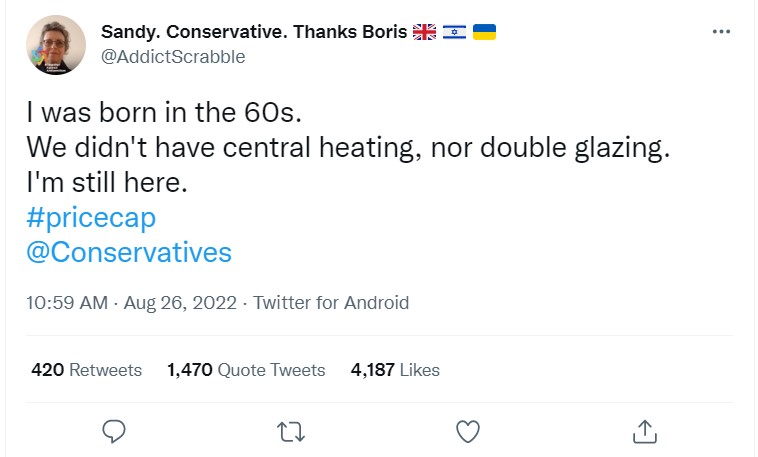
There’s a tweet from Sandy, a Conservative (naturally), who Thanks Boris (again, naturally) and says that they didn’t have double glazing or central heating in the 1960s but are still here. They didn’t have energy bills that represented over 60% of their income either. 

People – if indeed they are real people, and not bots – who tweet this sort of stuff presumably think that just surviving is all we should aspire to. Perhaps they think sending barefoot young children to work in factories, up chimneys and down mines would also be acceptable today because the Victorians did it. They’d probably consider it character building.

Ominously, a lot of businesses have been tweeting their expected energy bills for the coming year. This from The Rose & Crown pub, is frightening. The number of businesses that could go under in the coming months is very scary indeed. And when businesses go bust, people lose their jobs, and when people lose their jobs they will struggle even more to meet their food and energy bills.


The Daily Mail has a competition to win your energy bills paid for a year, energy company Ovo suggest doing star jumps and cuddling our pets to keep warm (assuming you can afford to keep a pet), while This Morning’s consumer expert Alice Beer suggests saving money by eating mouldy food rather than throwing it away. All of these, plus the idea that we should not be squeamish about drinking sewage water speak of a country that simply has given up.


Now I agree that in this country we throw away a lot of food that is perfectly edible, but Alice Beer’s advice is potentially dangerous. The Food Standards Agency says, while it is possible that removing the mould and a significant amount of the surrounding product could remove any unseen toxins that are present, there is no guarantee that doing so would remove them all”. 

There’s a saying that if I owe my bank £1,000 I have a problem, but if I owe them £1,000,000 they have a problem. Similarly, if I owe my energy supplier £1,000 then I have a problem and will be disconnected if I can’t pay, but if the 28 million households in the UK each owe their energy suppliers £1,000 then can they cut all of them off?  Probably not, but they can – and will – continue putting prices up. 

Perhaps our prospective Prime Minister, Liz Truss, has the answer.


Winter is coming. Put another jumper on.


[1] See https://rulesfoolsandwisemen.blogspot.com/2019/01/the-1970s-part-one-decade-that-style.html

[2] In 2012 Dorries was not yet Culture Secretary. That year she had the Conservative whip removed after appearing on the TV show, “I’m A Celebrity, Get Me Out of Here.” Some of the recent tweets attributed to her appear to have been faked, but whether or not this is a real one, the eating v heating dilemma has been a real one for many people for many years.

Wednesday, 6 July 2022

Champagne Socialists and Brown Ale Tories

When Dominic Raab – standing in for Boris Johnson at Prime Minister’s Questions – winked at his opposite number, Angela Rayner, and said, “She was at the Glyndebourne music festival sipping champagne, listening to opera. Champagne socialism is back in the Labour Party,” two thoughts hit me.

First, I was reminded of the Harry Enfield sketch, Women: Know Your Limits! and secondly, I recalled how, back in May 2020, then Health Secretary Matt Hancock told Shadow health minister Dr Rosena Allin-Khan to watch her “tone” after she asked a question about covid testing.

Matt Hancock and Shadow health minister Dr Rosena Allin-Khan

It is depressing (if predictable) that women MPs are condescended to and patronised in Parliament, especially if they are competent, but the “Champagne socialism” jibe is interesting. There’s much cognitive dissonance at work when it is thought that people from working class backgrounds should not enjoy the arts while simultaneously holding that if they do, they cannot be proper socialists.

I lived in a council flat when I was young, I went to a comprehensive school, I enjoy opera and ballet and I enjoy rock concerts. This doesn’t make me anything other than ordinary and having a taste for different things, but perhaps Dominic Raab would question my going to the Royal Opera House because of my working class roots. As for my politics, I used to vote Conservative, but no more; while I have drifted left, the Tories have lurched disconcertingly further and further to the right.

It’s absurd that people are only expected to enjoy things that are appropriate for the class they are perceived to belong to. Perhaps Raab would be more comfortable if the poor and the socialists stuck to brown ale and whippet racing.

Heaven forbid that someone should be quite well off, or even wealthy, have an interest in the arts and espouse socialist views; obviously they should immediately impoverish themselves. Then, and only then, can they have an opinion on social inequality, one allowed only for victims of it. Bonus points if they then have to claim benefits, for their critics can then label them scroungers.

Overuse of phrases like ‘Champagne socialist’ as insults ends with them losing their meaning. The phrase was originally used by socialists themselves to describe those of a more centrist persuasion (the first Labour Prime Minister Ramsay MacDonald was labelled a ‘champagne socialist’,’ and his lavish lifestyle and mingling with high society was believed to be the corrupting influence that ended the Labour administration in 1931) but is now simply used by the right-wing to have a pop at Labour politicians for not being true to the working class archetype.

Ramsay MacDonald, the original 'champagne socialist'

In a similar manner, ‘woke’ is a word which has had its meaning corrupted. Originally used in the sense of being well-informed and up-to-date, it is now more usually taken to mean alert to racial or social discrimination and injustice. It has been hijacked - mostly by right-wing pundits and media – and used as a pejorative term when they see or hear something that doesn’t chime with their world view. So, when a supermarket runs an advertising campaign that doesn’t exclusively feature white people, ‘woke’ is thrown at them as an insult and Twitter is suddenly awash with #Boycott (insert name of store).

It’s tiresome and it’s lazy, but it’s pernicious and nasty too, because using it as an insult says, in effect, that discrimination should be tolerated, that being indifferent to - or positively in favour of - racism, discrimination, and injustice are acceptable.

There’s a commonly used phrase, “Go woke, go broke,” that suggests that companies that are woke will go out of business as non-woke folk boycott them. To the best of my knowledge, this has not happened yet.

In or around the same ball park is ‘snowflake’. This one crosses the political divide and is used by left and right as an insult to anyone who is offended by a particular point of view, usually on the basis that it is unreasonable that they are offended. Those using the term judgementally frequently have limited arguments to back up their position. In fact, using their own definition, they are often themselves snowflakes.

‘Gammon’ is similar, and like woke and snowflake, is just thrown out as an insult to people who have a different point of view. The view may be objectionable, but debate it rather than throw insults. All of these are simplistic, formulaic responses used for want of cogent arguments.

While George Orwell’s 1984 is the place to go to see language corrupted, how the meaning of words can be twisted so that virtue becomes vice, and vice becomes virtue, there are plenty of real life examples today. As with ‘woke,’ so with ‘elite.’ Defined as “the richest, most powerful, best educated, or best trained group in a society,” its meaning has been turned on its head, so when you hear a politician sneering about the “elite” you can bet your bottom dollar that they don’t mean the richest or the most powerful members of society: They especially don’t mean themselves. The irony of Donald Trump, or Boris Johnson, or Nigel Farage accusing others of being the elite is off the scale.

To return to Angela Rayner and the accusation of her being a champagne socialist; the former head of English National Opera John Berry was quoted in the Observer as saying,It’s incredibly sad and embarrassing. Coming under attack for going to an opera is ridiculous.”


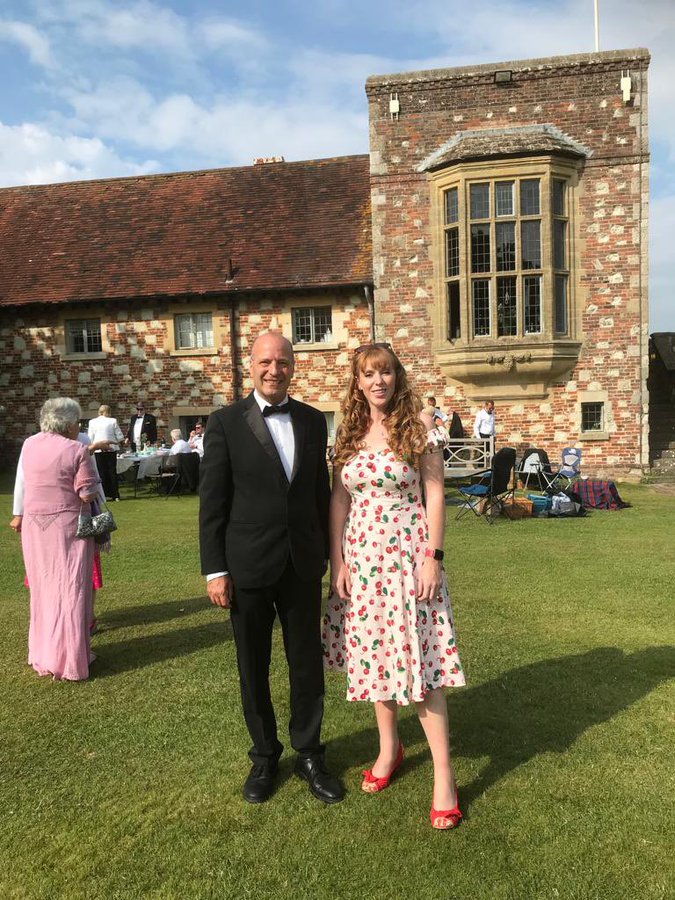
In photos that appeared online, Angela Rayner looked perfectly at ease at Glyndebourne, unlike many politicians taken out of their normal milieu and pictured in places alien to them, doing things that are not normal for them. Nigel Farage’s natural home may be the pub with a pint in hand, but for many other right-wing politicians, attempting to connect with ‘ordinary folk’ is fraught. Who can forget David Cameron eating a hot-dog with a knife and fork? America’s NBC was among news networks at home and abroad that could not resist poking fun at what they called Cameron’s “cutlery awkwardness.”


So, if a champagne socialist is a Labour politician who enjoys a wealthy and luxurious lifestyle, what is a right-winger who wants to make out that they are one of the boys, a working class hero: A brown ale Tory, perhaps?


Thursday, 16 June 2022

Arsene Wenger and The Kick Ins

I doubt that Arsene Wenger watched much non-League football in England during the 1994-95 season – he was managing Monaco in France and Nagoya Grampus Eight in Japan during those years – so he will have missed the experiment conducted in the Isthmian League (then known by its sponsor’s name, the Diadora League) that season when kick-ins were trialled as an alternative to the throw-in.

Arsene Wenger

It wasn’t just in England that kick-ins were trialled. They had been tried previously in Japan, and further trials took place in Belgium and Hungary alongside the Diadora League experiment. Whatever the Belgians and Hungarians thought of it, they can’t have been keen, as the experiment did not lead to the universal adoption of the idea. The Diadora League clubs had to complete a questionnaire at the end of the season, from which it had become clear that managers didn’t like them, players didn’t like them, and fans didn’t like them.

A kick-in taken during the Chertsey Town v Dorking Diadora League match in 1994-95

As a keen student of the game, I would have thought that Arsene Wenger would have done his research into the experiments with kick-ins though, but if he has, there is no reference to it in press reports of his proposal – which the International Football Association Board (IFAB), the body responsible for football’s laws – have agreed to trial (again).

What’s wrong with kick-ins? you may ask. After all, it’s football we are talking about, does it not make sense for the ball to be returned to play from the touchline with the foot, rather than with the hand? Maybe, but the fact that the previous experiment with the idea was quickly abandoned suggests that there are issues with it.

I confess to not having watched any Diadora League football during the 1994-95 season (my football watching was confined to the Essex Senior League with Romford and the Football League with Leyton Orient that season), so I do not have first hand experience of seeing the kick-in in action, but everything that I have read on the subject suggests that it was a resounding failure. In fact, it was so unpopular with some, that then St Albans City manager Alan Cockram threatened to sack any of his players who adopted the kick-in.

Rory Delap of Stoke City launches a long throw into the opposition penalty area. Cynics say that the problems these throws caused Arsenal back in the day are responsible for Arsene Wenger's thinking!

A major drawback with kick-ins was that many teams simply took them as a means of lumping the ball into the opposition penalty area, reducing games to a constant stream of aerial penalty area battles, particularly with there being no offside from a throw-in, and therefore not from a kick-in, either. In a similar way, an experiment with not having offsides from free-kicks, conducted in the Alliance Premier League (now the National League) in England in the 1990s, was another abject failure as it resulted in a tedious procession of long free-kicks hoofed into the opposition penalty area with a dozen or more players crowding the goalkeeper as they fought for the ball. In one game that I saw at Enfield featuring this rule, virtually every free-kick pumped into the box resulted in a free-kick to the defending team for a foul on the goalkeeper. The experiment was abandoned after a season.

Kick-ins at most levels of the game are unlikely to improve the game as a spectacle; quite the opposite in fact. In the rarefied atmosphere of the Premier League, La Liga, and Serie A, kick-ins will probably work. Teams in the top leagues across the world generally want to keep the ball on the ground and pass, so kick-ins are likely to be quick, short, and aimed at keeping possession. The idea that kick-ins will speed up the game may even work in those leagues, but those leagues only represent a tiny fraction of the global game, and in more pedestrian levels of the game the effect will be quite the opposite, as teams delay taking kick-ins while their players trot into the opposition penalty area, before delivering a high ball into the box.

IFAB seem to tinker with some aspect of football’s laws almost incessantly; I can’t think of any other sport that does so, so frequently. Some changes are better than others. Sin bins in grassroots football have proven successful in reducing dissent; changes to the offside law and handball have been less popular. Goal-line technology has fitted in pretty seamlessly, but VAR has raised almost as many problems (some would say more) as it has solved, so you must pardon my scepticism about kick-ins, especially in light of the failed experiment of thirty years ago.

I have similar reservations about the idea that has been mooted on more than one occasion – and which has raised its head again recently – that football matches should be reduced to two halves of thirty-minutes each, but with the clock stopping whenever the ball goes out of play.

The most famous clock in English football was at Highbury. 

The rationale behind the idea is sound; in the average Premier League match the ball is in play for fewer than 60 of the allotted 90 minutes, but adopting the idea raises a number of questions. How long is the elapsed time between kick-off and final whistle likely to be? In the Premier League, where the ball is returned fairly quickly, it could be that a game lasts no longer than it currently does, end to end. Elsewhere, in non-League and park football, where retrieving the ball can take longer and other delays inevitably ensue, it may be much longer. Not knowing the approximate time that a game ends will bring its own set of issues for players, fans, and officials.

In the 1930s, Arsenal had a clock that showed game time, but it was banned by The FA

Another question is, who keeps time? Sports like American football and ice hockey have taken responsibility for keeping time away from the on pitch officials, and no doubt, football would want to do the same. Which would work fine in the game’s top echelons, but not so well in grassroots football where not all games even have a neutral referee, and finding someone to keep time would be difficult and the absence of a game-time clock would create its own issue. Giving a hard-pressed park football referee (especially a club volunteer) the additional responsibility of stopping and restarting their watch to ensure 60 minutes of actual play seems onerous and unreasonable.

As an aside, I was at a game last season where the unexpected amount of additional time played at the end of one half was attributed by some people to have arisen from the referee having neglected to restart his watch after a lengthy stoppage for an injury. One would worry that if the referee was sole timekeeper and had to ensure 60 minutes play by constantly stopping and restarting their watch, this might become commonplace.

Despite my doubts, Arsene Wenger’s kick-ins idea may turn out to be a success, but honestly, given the failure of the previous experiment, I feel it will likely prove the aphorism that those who fail to learn from history are doomed to repeat it.


Thursday, 9 June 2022

Rail Strikes: This One Is Personal

In less than two weeks we face the prospect of the most widespread and disruptive industrial action on Britain’s railways since the 1980s. Since 1989 in fact, when Britain’s rail unions withdrew their members’ labour in pursuit of a pay claim in excess of the rate of inflation, which was then over 8%.

Rail strikes will mean scenes like these at many bus stops.

The unions eventually accepted a rise of 8.8% back then, but not before engaging in industrial action on no fewer than six occasions. At the conclusion of the strikes in 1989, Roger King, MP for Birmingham, Northfield, told Parliament that “the dispute revealed for all to see the sheer incompetence of British Rail's management and the bone-headed stupidity of the NUR (National Union of Railwaymen).” He was by no means alone in holding that view.

While 1989’s dispute was purely about pay, the current dispute - which is likely to see no rail services on 21st, 23rd, and 25th June, with London’s Underground workers set to strike on 21st June as well – is because Network Rail and the train operating companies have “subjected their staff to multiyear pay freezes and plan to cut thousands of jobs which will make the railways unsafe”” according to the National Union of Rail, Maritime and Transport Workers (RMT).

Based on the typical Daily Mail rhetoric that depicts the railway workers as greedy, hard-left malcontents who aim to cripple the country, the knee-jerk reaction is to side against them on this occasion. Sympathy for the striking workers is in short supply when one reads that train drivers can earn in excess of £60,000 per annum, and that their unions, the last remaining powerful ones in the country it seems, appear to take industrial action frequently, at the drop of a hat, and as a first response rather than a last resort.

No surprise which mast the Daily Mail has nailed its colours to.

It seems that this strike is not about the well paid drivers however, but rail workers in other, less generously remunerated roles; about job losses and concomitant safety issues, and potential negative impacts on pensions.

The bottom line is that there are likely to be no rail services on three days in June, and most people’s position on the strike is going to be based on how that affects them.

When London Underground workers went on strike on 7th June, it had a minor impact on Val and I, as we were going to see a BBC Radio recording of Alone at The Shaw Theatre in Euston Road. As it was only the Tube that was affected, getting there and back home again was not badly affected; we used the rail services that were running and walked the rest. While we were there, it dawned on me that the next strike, affecting all rail services and the Tube, could be much more inconvenient for me.

Alone is a BBC Radio comedy starring Angus Deyton. Series 4 is on air from August.

On 21st June I am due to see Yes in concert at the Royal Albert Hall. The show has been rescheduled a couple of times due to covid, and my attendance this time is going to be somewhat tricky if the strikes go ahead. The Royal Albert Hall is about 17 miles from where I live, so about an hour and fifteen minutes by public transport when everything is running fine. Without tubes and trains, I could get a bus – about three hours, although with the inevitable increased traffic, I can probably add an hour to that. Or I could get the Uber boat from the new Barking Riverside Pier to Westminster and then easily walk the remaining two and a bit miles. At a pinch, I could walk all the way, after all I did nearly that distance when I walked from Romford to Tilbury in 2015 (see The long Walk To Tilbury).

Yes at London Palladium in March 2018

Whatever means I use to get to the Royal Albert Hall, the bigger issue will be getting home again. According to Transport for London (TfL)’s Journey Planner, leaving the Royal Albert Hall at about 11pm and using just buses to get home will actually be quicker than the journey there by the same means (it would mean getting home in the wee small hours and having to use the infamous Night Buses though).

You’ll notice that I have dismissed driving; London will probably be gridlocked that day, plus there are the Congestion Charge and parking costs to factor in, so taking the car will be a last resort.

In 1989, when the trains and tubes went on strike back simultaneously, I was working in the City at Threadneedle Street. The bank that I worked for – Midland Bank at that time – laid on coaches for workers in Central London, and on the morning of the first strike, June – then my girlfriend, later my wife (who worked in the same office as me) and I arrived at the pick up point in Chadwell Heath at about 6.45am. The coach arrived, already nearly full. “Stay at the back of the queue,” June insisted, “we may not get on!” Which was how it turned out as the remaining seats on the coach quickly filled up.

Less hyperbole from the Daily Mail when it covered the 1989 rail strike on the Summer Equinox.

Someone at the head of the queue asked when the next coach would be along, but apparently this was the only one. To varying degrees of disappointment (June was delighted!), those unable to board went home.

The following week – there were strikes, one a week for six weeks, remember – the bank was better prepared. There were more coaches and we were able to board one. I seem to remember that having left Chadwell Heath at 6.45am, we didn’t get to work till about 10.15am: Three and a half hours to do about eleven miles. At 3pm we had to leave work and do it all in reverse, getting home at about 7pm, so out of the house for more than 12 hours to work for less than five.

The lengthy journeys became routine however, with people taking advantage of the time to read or catch up on some sleep. Imagine the shock then, when on the last day of the strike our coach diverted from its usual route and drew up at Royal Wharf, from where a boat took us to Tower Pier. Much to many people’s dismay (June among them) we arrived at work earlier than many would have done on a day with no rail strikes.

In the evening, on the return trip from Tower Pier, we had to fend off a number of tourists who thought that the boat was a regular service and not exclusively for Midland Bank staff, although why they would have gone to Beckton is anyone’s guess.

During my commuting years rail strikes seemed to come along with monotonous regularity, but that’s probably the frequency illusion and my faulty memory. These days strikes are fewer, further between, and they affect me less, although I am not best pleased about the upcoming strike on 21st June. Having seen so many gigs go for a Burton thanks to covid, to have another in jeopardy due to industrial action is a big pain in the posterior.

Wednesday, 1 June 2022

Words That Make Me Go "Aaaargh!"

Sticks and stones may break my bones, but words will never hurt me. But there are words that offend me, or rather they irritate and annoy, infuriate and exasperate. There are some words and phrases that make me want to yell “aaargh!” whenever I hear or read them. These are some of them.

“Not the result we wanted. We go again.”

This one pops up frequently on Twitter, invariably posted by a footballer, to express their disappointment at a particular result. Usually it appears after a defeat, but sometimes it comes after a drawn game the tweeter expected to win. Since the object of most sports is to win, “Not the result we wanted” is clearly a truism. “We go again,” says no more than they will try and win the next game. We can therefore boil this down to “We lost today, but we’ll try and win the next game,” which in the immortal words of Basil Fawlty, is “stating the bleedin’ obvious.”


“Time to draw a line under it and move on.”

We’ve been hearing this a lot recently, what with the daily dose of Tory misdeeds sometimes involving more than one scandal of some description or another. In the aftermath of Wallpapergate and Partygate, and after the PPE procurement shenanigans and the eye-watering cost of the Test and Trace app, we are all implored to draw a line under events that embarrass politicians and the government and move on.

Tony Blair, attempting to draw a line under the WMD fiasco.

In fairness to the current government, this is nothing new: I’m pretty sure we heard similar after the Iraq war/Weapons of Mass Destruction debacle, for example. Time to move on has been wheeled out by politicians of all persuasions, seemingly since time immemorial and means, “Please, for the love of God, stop talking about this, I know I’m bang to rights but I’m not going to resign or apologise.” The regularity of the expression’s use is as tedious as it is objectionable, the belief of the entitled that their transgressions are too trivial to be pursued.

“Partygate”

Not Partygate itself, although goodness knows that is outstandingly bad enough, but the suffix “-gate” when added to some sort of scandal, outrage, or misdeed. Since the original Watergate affair, named for the Watergate Office Building in which the Democratic National Committee’s offices were burgled, there have been just shy of 300 '-gate' scandals or controversies, according to Wikipedia, and probably countless more that haven't been widely publicised. It is without doubt, time to draw a line under the expression, stop using it, and move on.


If we don’t stop, we might find that were Andrew Marr involved in some scandal, we’d have to call it Marrgate. If there were some outrage in the Kent seaside town of similar name, that would be Margategate. If Kew Gardens were embroiled in controversy, we’d have to call it Gardengate. And, if there was a further scandal centred around the Watergate Building, would we have to call it Watergategate?[1] Thankfully, when Bill Gates and his wife Melinda announced their intention to divorce, there was no Gatesgate, although inevitably that did get wheeled out to describe the story that some Americans thought that Gates wanted to use the coronavirus vaccine to microchip them.

Adding “-gate” to the controversy over incidents like the cost of decorating the flat in Downing Street (Wallpapergate), or Keir Starmer’s beer and curry in Durham (variously Currygate or Beergate), the parties in Downing Street (Partygate), and Boris Johnson diving into a fridge to avoid a reporter (Fridgegate), is lazy, trite, hackneyed, and so outmoded that it really needs to stop.

I imagine that many hacks who use’-gate’ are too young to remember Watergate, and genuinely think it is normal English usage – and perhaps now, it is (sadly).

“Let me be perfectly clear about this/We’ve always been perfectly clear about this.”

As soon as someone says “Let me be perfectly clear about this,” then you can be fairly sure that what follows will be opaque at best, will contain much obfuscation, and may be a downright lie. In the same way, “We’ve always been perfectly clear about this” will lead to a statement that claims to be in complete accord with previous pronouncements on the subject, but which totally contradicts them. In certain circumstances this leads to someone denying ever saying something even after being shown video evidence of them saying it, as you can see from the video embedded in this article on The Guardian website: https://www.theguardian.com/us-news/2017/dec/23/us-ambassador-netherlands-apologises-fake-news-interview-muslim-no-go-zones)

The counter intuitive stuff

I’m not talking about any particular phrase or expression here, but rather the explanation that defies logic, the statement that bends facts into something so breath-takingly egregious that you have to pinch yourself to be sure you actually heard what you thought you heard.

It has been reported in the media in recent days that there are fears there could be power cuts this winter. A "reasonable" worst-case scenario predicts major gas shortages in winter if Russia cuts off more supplies to the EU, which could lead to power cuts for up to six million households. It’s easy to imagine a government spokesman spinning this as a positive rather than a negative, explaining that power cuts will help those on low incomes to budget their fuel bills more efficiently by reducing their energy consumption by as much as 180 hours per month, resulting in considerable savings.

In much the same way, in the event that there were food shortages and rationing had to be introduced (unlikely, I hope), then I have no doubt that, in answer to TV interviewers saying that this was a terrible state of affairs, some minister would proclaim that on the contrary, the British people were grateful for this opportunity to better balance their diets, to eat more healthily, and to have the strain on their budgets eased by being given the opportunity to buy less food.

Like Humpty Dumpty, when politicians use a word it means what they want it to mean, not what we mere mortals usually expect it to mean. Last week Chancellor Rishi Sunak said, with a completely straight face, that his ‘temporary, targeted, levy’ on the energy companies was not a windfall tax, but  actually a tax on windfall profits. Interviewer Chris Mason’s incredulity when Sunak said this was palpable.

Rishi Sunak - It's a tax on windfalls, not a windfall tax!

So inured have we become to alternative facts, fake news, and barefaced lies, that the Prime Minister lying to Parliament, or a government minister spouting falsehoods in TV interviews has become so completely unremarkable we don’t even notice most of the time, and nor do many interviewers, who seem content to allow such nonsense to be spouted, unchallenged.

For that reason, I believe that the time has come to have teams of full-time, real-time fact checkers in the House of Commons, and present in radio and TV studios, who could sound a QI style klaxon every time a falsehood is uttered. It would make PMQs very entertaining indeed!


[1] If I thought that my idea here was original, but a quick Google search shows that David Mitchell and Robert Webb got there first (and funnier). 


How England Were Nearly Denied The 1966 World Cup

In 2017, during the bidding process to determine who would host the 2026 World Cup, FIFA President Gianni Infantino addressed the travel ba...