Thursday, 16 June 2022

Arsene Wenger and The Kick Ins

I doubt that Arsene Wenger watched much non-League football in England during the 1994-95 season – he was managing Monaco in France and Nagoya Grampus Eight in Japan during those years – so he will have missed the experiment conducted in the Isthmian League (then known by its sponsor’s name, the Diadora League) that season when kick-ins were trialled as an alternative to the throw-in.

Arsene Wenger

It wasn’t just in England that kick-ins were trialled. They had been tried previously in Japan, and further trials took place in Belgium and Hungary alongside the Diadora League experiment. Whatever the Belgians and Hungarians thought of it, they can’t have been keen, as the experiment did not lead to the universal adoption of the idea. The Diadora League clubs had to complete a questionnaire at the end of the season, from which it had become clear that managers didn’t like them, players didn’t like them, and fans didn’t like them.

A kick-in taken during the Chertsey Town v Dorking Diadora League match in 1994-95

As a keen student of the game, I would have thought that Arsene Wenger would have done his research into the experiments with kick-ins though, but if he has, there is no reference to it in press reports of his proposal – which the International Football Association Board (IFAB), the body responsible for football’s laws – have agreed to trial (again).

What’s wrong with kick-ins? you may ask. After all, it’s football we are talking about, does it not make sense for the ball to be returned to play from the touchline with the foot, rather than with the hand? Maybe, but the fact that the previous experiment with the idea was quickly abandoned suggests that there are issues with it.

I confess to not having watched any Diadora League football during the 1994-95 season (my football watching was confined to the Essex Senior League with Romford and the Football League with Leyton Orient that season), so I do not have first hand experience of seeing the kick-in in action, but everything that I have read on the subject suggests that it was a resounding failure. In fact, it was so unpopular with some, that then St Albans City manager Alan Cockram threatened to sack any of his players who adopted the kick-in.

Rory Delap of Stoke City launches a long throw into the opposition penalty area. Cynics say that the problems these throws caused Arsenal back in the day are responsible for Arsene Wenger's thinking!

A major drawback with kick-ins was that many teams simply took them as a means of lumping the ball into the opposition penalty area, reducing games to a constant stream of aerial penalty area battles, particularly with there being no offside from a throw-in, and therefore not from a kick-in, either. In a similar way, an experiment with not having offsides from free-kicks, conducted in the Alliance Premier League (now the National League) in England in the 1990s, was another abject failure as it resulted in a tedious procession of long free-kicks hoofed into the opposition penalty area with a dozen or more players crowding the goalkeeper as they fought for the ball. In one game that I saw at Enfield featuring this rule, virtually every free-kick pumped into the box resulted in a free-kick to the defending team for a foul on the goalkeeper. The experiment was abandoned after a season.

Kick-ins at most levels of the game are unlikely to improve the game as a spectacle; quite the opposite in fact. In the rarefied atmosphere of the Premier League, La Liga, and Serie A, kick-ins will probably work. Teams in the top leagues across the world generally want to keep the ball on the ground and pass, so kick-ins are likely to be quick, short, and aimed at keeping possession. The idea that kick-ins will speed up the game may even work in those leagues, but those leagues only represent a tiny fraction of the global game, and in more pedestrian levels of the game the effect will be quite the opposite, as teams delay taking kick-ins while their players trot into the opposition penalty area, before delivering a high ball into the box.

IFAB seem to tinker with some aspect of football’s laws almost incessantly; I can’t think of any other sport that does so, so frequently. Some changes are better than others. Sin bins in grassroots football have proven successful in reducing dissent; changes to the offside law and handball have been less popular. Goal-line technology has fitted in pretty seamlessly, but VAR has raised almost as many problems (some would say more) as it has solved, so you must pardon my scepticism about kick-ins, especially in light of the failed experiment of thirty years ago.

I have similar reservations about the idea that has been mooted on more than one occasion – and which has raised its head again recently – that football matches should be reduced to two halves of thirty-minutes each, but with the clock stopping whenever the ball goes out of play.

The most famous clock in English football was at Highbury. 

The rationale behind the idea is sound; in the average Premier League match the ball is in play for fewer than 60 of the allotted 90 minutes, but adopting the idea raises a number of questions. How long is the elapsed time between kick-off and final whistle likely to be? In the Premier League, where the ball is returned fairly quickly, it could be that a game lasts no longer than it currently does, end to end. Elsewhere, in non-League and park football, where retrieving the ball can take longer and other delays inevitably ensue, it may be much longer. Not knowing the approximate time that a game ends will bring its own set of issues for players, fans, and officials.

In the 1930s, Arsenal had a clock that showed game time, but it was banned by The FA

Another question is, who keeps time? Sports like American football and ice hockey have taken responsibility for keeping time away from the on pitch officials, and no doubt, football would want to do the same. Which would work fine in the game’s top echelons, but not so well in grassroots football where not all games even have a neutral referee, and finding someone to keep time would be difficult and the absence of a game-time clock would create its own issue. Giving a hard-pressed park football referee (especially a club volunteer) the additional responsibility of stopping and restarting their watch to ensure 60 minutes of actual play seems onerous and unreasonable.

As an aside, I was at a game last season where the unexpected amount of additional time played at the end of one half was attributed by some people to have arisen from the referee having neglected to restart his watch after a lengthy stoppage for an injury. One would worry that if the referee was sole timekeeper and had to ensure 60 minutes play by constantly stopping and restarting their watch, this might become commonplace.

Despite my doubts, Arsene Wenger’s kick-ins idea may turn out to be a success, but honestly, given the failure of the previous experiment, I feel it will likely prove the aphorism that those who fail to learn from history are doomed to repeat it.


Thursday, 9 June 2022

Rail Strikes: This One Is Personal

In less than two weeks we face the prospect of the most widespread and disruptive industrial action on Britain’s railways since the 1980s. Since 1989 in fact, when Britain’s rail unions withdrew their members’ labour in pursuit of a pay claim in excess of the rate of inflation, which was then over 8%.

Rail strikes will mean scenes like these at many bus stops.

The unions eventually accepted a rise of 8.8% back then, but not before engaging in industrial action on no fewer than six occasions. At the conclusion of the strikes in 1989, Roger King, MP for Birmingham, Northfield, told Parliament that “the dispute revealed for all to see the sheer incompetence of British Rail's management and the bone-headed stupidity of the NUR (National Union of Railwaymen).” He was by no means alone in holding that view.

While 1989’s dispute was purely about pay, the current dispute - which is likely to see no rail services on 21st, 23rd, and 25th June, with London’s Underground workers set to strike on 21st June as well – is because Network Rail and the train operating companies have “subjected their staff to multiyear pay freezes and plan to cut thousands of jobs which will make the railways unsafe”” according to the National Union of Rail, Maritime and Transport Workers (RMT).

Based on the typical Daily Mail rhetoric that depicts the railway workers as greedy, hard-left malcontents who aim to cripple the country, the knee-jerk reaction is to side against them on this occasion. Sympathy for the striking workers is in short supply when one reads that train drivers can earn in excess of £60,000 per annum, and that their unions, the last remaining powerful ones in the country it seems, appear to take industrial action frequently, at the drop of a hat, and as a first response rather than a last resort.

No surprise which mast the Daily Mail has nailed its colours to.

It seems that this strike is not about the well paid drivers however, but rail workers in other, less generously remunerated roles; about job losses and concomitant safety issues, and potential negative impacts on pensions.

The bottom line is that there are likely to be no rail services on three days in June, and most people’s position on the strike is going to be based on how that affects them.

When London Underground workers went on strike on 7th June, it had a minor impact on Val and I, as we were going to see a BBC Radio recording of Alone at The Shaw Theatre in Euston Road. As it was only the Tube that was affected, getting there and back home again was not badly affected; we used the rail services that were running and walked the rest. While we were there, it dawned on me that the next strike, affecting all rail services and the Tube, could be much more inconvenient for me.

Alone is a BBC Radio comedy starring Angus Deyton. Series 4 is on air from August.

On 21st June I am due to see Yes in concert at the Royal Albert Hall. The show has been rescheduled a couple of times due to covid, and my attendance this time is going to be somewhat tricky if the strikes go ahead. The Royal Albert Hall is about 17 miles from where I live, so about an hour and fifteen minutes by public transport when everything is running fine. Without tubes and trains, I could get a bus – about three hours, although with the inevitable increased traffic, I can probably add an hour to that. Or I could get the Uber boat from the new Barking Riverside Pier to Westminster and then easily walk the remaining two and a bit miles. At a pinch, I could walk all the way, after all I did nearly that distance when I walked from Romford to Tilbury in 2015 (see The long Walk To Tilbury).

Yes at London Palladium in March 2018

Whatever means I use to get to the Royal Albert Hall, the bigger issue will be getting home again. According to Transport for London (TfL)’s Journey Planner, leaving the Royal Albert Hall at about 11pm and using just buses to get home will actually be quicker than the journey there by the same means (it would mean getting home in the wee small hours and having to use the infamous Night Buses though).

You’ll notice that I have dismissed driving; London will probably be gridlocked that day, plus there are the Congestion Charge and parking costs to factor in, so taking the car will be a last resort.

In 1989, when the trains and tubes went on strike back simultaneously, I was working in the City at Threadneedle Street. The bank that I worked for – Midland Bank at that time – laid on coaches for workers in Central London, and on the morning of the first strike, June – then my girlfriend, later my wife (who worked in the same office as me) and I arrived at the pick up point in Chadwell Heath at about 6.45am. The coach arrived, already nearly full. “Stay at the back of the queue,” June insisted, “we may not get on!” Which was how it turned out as the remaining seats on the coach quickly filled up.

Less hyperbole from the Daily Mail when it covered the 1989 rail strike on the Summer Equinox.

Someone at the head of the queue asked when the next coach would be along, but apparently this was the only one. To varying degrees of disappointment (June was delighted!), those unable to board went home.

The following week – there were strikes, one a week for six weeks, remember – the bank was better prepared. There were more coaches and we were able to board one. I seem to remember that having left Chadwell Heath at 6.45am, we didn’t get to work till about 10.15am: Three and a half hours to do about eleven miles. At 3pm we had to leave work and do it all in reverse, getting home at about 7pm, so out of the house for more than 12 hours to work for less than five.

The lengthy journeys became routine however, with people taking advantage of the time to read or catch up on some sleep. Imagine the shock then, when on the last day of the strike our coach diverted from its usual route and drew up at Royal Wharf, from where a boat took us to Tower Pier. Much to many people’s dismay (June among them) we arrived at work earlier than many would have done on a day with no rail strikes.

In the evening, on the return trip from Tower Pier, we had to fend off a number of tourists who thought that the boat was a regular service and not exclusively for Midland Bank staff, although why they would have gone to Beckton is anyone’s guess.

During my commuting years rail strikes seemed to come along with monotonous regularity, but that’s probably the frequency illusion and my faulty memory. These days strikes are fewer, further between, and they affect me less, although I am not best pleased about the upcoming strike on 21st June. Having seen so many gigs go for a Burton thanks to covid, to have another in jeopardy due to industrial action is a big pain in the posterior.

Wednesday, 1 June 2022

Words That Make Me Go "Aaaargh!"

Sticks and stones may break my bones, but words will never hurt me. But there are words that offend me, or rather they irritate and annoy, infuriate and exasperate. There are some words and phrases that make me want to yell “aaargh!” whenever I hear or read them. These are some of them.

“Not the result we wanted. We go again.”

This one pops up frequently on Twitter, invariably posted by a footballer, to express their disappointment at a particular result. Usually it appears after a defeat, but sometimes it comes after a drawn game the tweeter expected to win. Since the object of most sports is to win, “Not the result we wanted” is clearly a truism. “We go again,” says no more than they will try and win the next game. We can therefore boil this down to “We lost today, but we’ll try and win the next game,” which in the immortal words of Basil Fawlty, is “stating the bleedin’ obvious.”


“Time to draw a line under it and move on.”

We’ve been hearing this a lot recently, what with the daily dose of Tory misdeeds sometimes involving more than one scandal of some description or another. In the aftermath of Wallpapergate and Partygate, and after the PPE procurement shenanigans and the eye-watering cost of the Test and Trace app, we are all implored to draw a line under events that embarrass politicians and the government and move on.

Tony Blair, attempting to draw a line under the WMD fiasco.

In fairness to the current government, this is nothing new: I’m pretty sure we heard similar after the Iraq war/Weapons of Mass Destruction debacle, for example. Time to move on has been wheeled out by politicians of all persuasions, seemingly since time immemorial and means, “Please, for the love of God, stop talking about this, I know I’m bang to rights but I’m not going to resign or apologise.” The regularity of the expression’s use is as tedious as it is objectionable, the belief of the entitled that their transgressions are too trivial to be pursued.

“Partygate”

Not Partygate itself, although goodness knows that is outstandingly bad enough, but the suffix “-gate” when added to some sort of scandal, outrage, or misdeed. Since the original Watergate affair, named for the Watergate Office Building in which the Democratic National Committee’s offices were burgled, there have been just shy of 300 '-gate' scandals or controversies, according to Wikipedia, and probably countless more that haven't been widely publicised. It is without doubt, time to draw a line under the expression, stop using it, and move on.


If we don’t stop, we might find that were Andrew Marr involved in some scandal, we’d have to call it Marrgate. If there were some outrage in the Kent seaside town of similar name, that would be Margategate. If Kew Gardens were embroiled in controversy, we’d have to call it Gardengate. And, if there was a further scandal centred around the Watergate Building, would we have to call it Watergategate?[1] Thankfully, when Bill Gates and his wife Melinda announced their intention to divorce, there was no Gatesgate, although inevitably that did get wheeled out to describe the story that some Americans thought that Gates wanted to use the coronavirus vaccine to microchip them.

Adding “-gate” to the controversy over incidents like the cost of decorating the flat in Downing Street (Wallpapergate), or Keir Starmer’s beer and curry in Durham (variously Currygate or Beergate), the parties in Downing Street (Partygate), and Boris Johnson diving into a fridge to avoid a reporter (Fridgegate), is lazy, trite, hackneyed, and so outmoded that it really needs to stop.

I imagine that many hacks who use’-gate’ are too young to remember Watergate, and genuinely think it is normal English usage – and perhaps now, it is (sadly).

“Let me be perfectly clear about this/We’ve always been perfectly clear about this.”

As soon as someone says “Let me be perfectly clear about this,” then you can be fairly sure that what follows will be opaque at best, will contain much obfuscation, and may be a downright lie. In the same way, “We’ve always been perfectly clear about this” will lead to a statement that claims to be in complete accord with previous pronouncements on the subject, but which totally contradicts them. In certain circumstances this leads to someone denying ever saying something even after being shown video evidence of them saying it, as you can see from the video embedded in this article on The Guardian website: https://www.theguardian.com/us-news/2017/dec/23/us-ambassador-netherlands-apologises-fake-news-interview-muslim-no-go-zones)

The counter intuitive stuff

I’m not talking about any particular phrase or expression here, but rather the explanation that defies logic, the statement that bends facts into something so breath-takingly egregious that you have to pinch yourself to be sure you actually heard what you thought you heard.

It has been reported in the media in recent days that there are fears there could be power cuts this winter. A "reasonable" worst-case scenario predicts major gas shortages in winter if Russia cuts off more supplies to the EU, which could lead to power cuts for up to six million households. It’s easy to imagine a government spokesman spinning this as a positive rather than a negative, explaining that power cuts will help those on low incomes to budget their fuel bills more efficiently by reducing their energy consumption by as much as 180 hours per month, resulting in considerable savings.

In much the same way, in the event that there were food shortages and rationing had to be introduced (unlikely, I hope), then I have no doubt that, in answer to TV interviewers saying that this was a terrible state of affairs, some minister would proclaim that on the contrary, the British people were grateful for this opportunity to better balance their diets, to eat more healthily, and to have the strain on their budgets eased by being given the opportunity to buy less food.

Like Humpty Dumpty, when politicians use a word it means what they want it to mean, not what we mere mortals usually expect it to mean. Last week Chancellor Rishi Sunak said, with a completely straight face, that his ‘temporary, targeted, levy’ on the energy companies was not a windfall tax, but  actually a tax on windfall profits. Interviewer Chris Mason’s incredulity when Sunak said this was palpable.

Rishi Sunak - It's a tax on windfalls, not a windfall tax!

So inured have we become to alternative facts, fake news, and barefaced lies, that the Prime Minister lying to Parliament, or a government minister spouting falsehoods in TV interviews has become so completely unremarkable we don’t even notice most of the time, and nor do many interviewers, who seem content to allow such nonsense to be spouted, unchallenged.

For that reason, I believe that the time has come to have teams of full-time, real-time fact checkers in the House of Commons, and present in radio and TV studios, who could sound a QI style klaxon every time a falsehood is uttered. It would make PMQs very entertaining indeed!


[1] If I thought that my idea here was original, but a quick Google search shows that David Mitchell and Robert Webb got there first (and funnier). 


Tuesday, 17 May 2022

Still Shirking From Home

Back in 2013 I wrote a blog about working from home (see Shirking From Home), in which I wrote that, “Some people are opposed to home working on principle and in my experience these people’s prejudices are based on their conception of how effective other people are when they work at home” and recent comments from journalists, radio and TV presenters, and politicians have given me no reason to change that view; if anything, it has reinforced it.

There remains a perception that working from home means skiving and shirking, that workers are more productive in an office, and management can only effectively monitor what is being done, and by whom, in an office environment.

The interesting thing about the negative and critical statements being made about working from home is that by and large, the comments and views are not being expressed by employers, but by commentators and politicians.

Thus, we have LBC presenter Nick Ferrari criticising civil servants for continuing to work from home and 'staying in their pyjamas,' and telling someone who called in to his show that they should be paid less because they weren’t working as hard at home as they would in the office. His fellow LBC radio show host, and sister of the Prime Minister, Rachel Johnson claimed on her programme that working from home actually meant being people were “on their pelotons” and “watching Netflix.”


On Good Morning Britain, Richard Madeley told viewers that workers need to be back in the office so that managers can monitor their work, while in a bizarre flight of fancy, Camilla Tominey, writing in The Telegraph, claimed that “Home working is a middle-class Remainer cult.”

As far as I am aware, Ferrari, Johnson, Madeley, and Tominey are not employers, nor do they provide any evidence to back up their comments. They are passing their opinions and prejudices off as fact in much the same way as a saloon bar bore regales his audience with ‘facts’ that are nothing more than the product of their febrile imagination.

We have heard from one employer however, Lord Sugar, who echoed Rachel Johnson by saying “It's time for everyone to get off their backsides — and their Pelotons — and get back to work.” According to Lord Sugar, the pandemic has unleashed a workshy, entitled culture in which people demand — and are allowed — to work from home. It’s true that the coming of covid accelerated the trend for working from home, and it’s just as well that it was possible for so many people, otherwise the effects of the pandemic might have been even more severe for businesses and commuting workers alike.


People who have spent most of the last two years working from home quite efficiently and effectively, should not be bullied into returning to offices by chat show hosts and journalists. Some employers will want to carry on as they are, some will want workers back in the office, and others will adopt hybrid schemes with some home working and some office working. All of these approaches are valid, and which is adopted should be on the basis of the best interests of employer and employee alike.

The idea that working from home is a skivers charter, that home workers are all on their pelotons or watching Netflix instead of working is a lazy and inaccurate trope. Okay, so some possibly are. There probably are people who work from home and don’t pull their weight, but they are also likely to be the sort of people who would do the same in the office.

In fact, I would argue that it is easier to look busy but do very little in a busy and fully staffed office than it is at home. It seems not to have occurred to Sugar, Johnson, Madeley and Tominey that the managers of people working from home monitor their output.

Naturally though, there are people who will take advantage of working from home to do the bare minimum, people who are easily distracted and wander away from the task in hand to do something not work related. Here’s what one man, whose home is also his office, had to say on the subject: “My experience of working from home is you spend an awful lot of time making another cup of coffee, and then you know, getting up, walking very slowly to the fridge, hacking off a small piece of cheese, then walking very slowly back to your laptop and then forgetting what it was you're doing.” Worryingly, the man who said that is our Prime Minister.

Perhaps the culture the Prime Minister describes is more prevalent in the public sector in general, and his office at home in particular, than it is in the private sector. It certainly seems to be the case that civil servants have been getting it in the neck for not wanting to return to the office, with Jacob Rees-Mogg recently touring his own department and leaving messages on the desks of absent workers lamenting their absence and looking forward to seeing them in the office soon. 


Mogg's tactics did not find favour even with some of his Cabinet colleagues as both Grant Schapps and Nadine Dorries – who appropriately called Mogg’s approach ‘Dickensian’ – disagreed with the Minister for Brexit Opportunities and Government Efficiency, not that we seem to have seen much in the way of Brexit opportunities, and – like military intelligence – Government Efficiency is an oxymoron if ever I heard one.

Mogg has hinted that civil servants who refuse to return to the office could see their pay cut, and that echoes Nick Ferrari’s comments. It could be argued that without the cost of commuting, home workers are better off than their office bound counterparts, but the home worker needs to heat and light their home and pay for broadband and office peripherals that they would normally be supplied with. You may remember that when the pandemic started, MPs were allowed to claim up to £10,000 to cover additional office costs incurred as a result of the coronavirus such as buying laptops and printers, a benefit not afforded to the majority of workers whom the government implored to work from home.

Working from home – either full-time or in a hybrid format – is here to stay, no matter what the Johnson’s and Rees-Mogg (who apparently doesn’t have a computer on his office desk and has the air of a man who requires his staff to transcribe emails onto parchment with quill pens for him to read) may say.


Pre-pandemic, views on working from home were, as I said back in 2013, based on commentator’s perception of other people, and the view – formed and enhanced more by opinion and prejudice than fact – has crystallised, but I would bet that those saying such things would, were they working from home, have a more favourable view of their own effectiveness while doing so.

Tuesday, 26 April 2022

The Nurse and the Chancellor

Elon Musk’s purchase of Twitter has set the cat among the pigeons (or perhaps that should be the Mountain Bluebirds, for that is the bird the Twitter logo is based on) with concerns raised that in the name of free speech, Musk’s version of the social media platform will mean less moderation and the reinstatement of previously banned individuals like Donald Trump, Katie Hopkins, and Steve Bannon.

A Mountain Bluebird

Musk has described himself as “a free speech absolutist,” which infers that Twitter will indeed reduce moderation and reinstate those previously banned Twitterers; absolutism suggests that nothing is off limits, and that in the name of free speech, anything goes.

Elon Musk is paying $45billion for Twitter. Picture: Financial Times

What constitutes free speech depends, to an extent, on who is saying what, and who is hearing it. One man’s free speech is another’s hate speech; free speech is not the right to say whatever you like about whatever you like, whenever you like.

Just as free speech must allow the publication and promulgation of views that are not universally popular, so it must also bar hate speech, viz the incitement to violence and racial, sexual, and religious discrimination. Musk’s absolutist stance does not automatically infer that Twitter will no longer moderate or remove such posts, as some are claiming, although the extent to which Twitter’s policies in this area changes, if it changes at all, will no doubt be closely monitored.

Social media allows anyone to express an opinion on absolutely anything; one might say it positively encourages and provokes people to express opinions on any subject, even those of which they are particularly ignorant.

A lack of knowledge of a subject is no bar to expressing an opinion, it actually seems to be a positive incentive for some people. Thus, Bob, a retired bus driver from Barrelmouth-on-The-Woe, feels perfectly comfortable – entitled and obliged, even – to post his views on subjects as diverse as gender identity, Brexit, covid, Partygate, the tax affairs of the Chancellor’s wife, or the relative merits of Lionel Messi and Christiano Ronaldo. Funnily enough though, as soon as someone like Gary Lineker or Gary Neville posts an opinion on politics, Bob will tell them to “stick to football,” on which basis of course, Bob ought only to post on the subject of bus driving. *

For many people, being an ex-professional footballer means you can't comment on politics

Bob is wrong about the Garys, they have every right to make comments on any subject they wish, as does Bob. I suppose that Bob’s point would be that Gary Lineker (8.4m followers), and Gary Neville (5.1m) have much more reach than Bob (102 followers), but there is plenty of balance to views that Bob finds objectionable.

Meanwhile, Bob will post his views on topics like covid – perhaps on the effectiveness of masks or vaccines – and will do so in a thread started by an expect (an epidemiologist or virologist, perhaps), and will challenge that expert’s view. If Bob and his ilk are themselves challenged, they will doubtless claim that they have “done their research,” by which they mean they have searched online until they have found a random article from someone who is probably equally as unqualified in the subject, but which supports their point of view. This, they believe, adequately rebuts the argument of an eminently qualified and experienced expert. Google allows everyone to believe that they are an expert on a subject from reading a single webpage. In 1984, George Orwell wrote that “ignorance is strength” – he might equally have said that ignorance is knowledge.

Another interesting Twitter phenomenon relates to what might be called poverty shaming, whereby anyone who is finding it hard to makes ends meet is instantly blamed and shamed for their situation. A recent BBC news item about a part-time nurse who cannot afford enough food for her and her three children, meaning that she sometimes has to go without, provoked a predictably hostile response from some Twitter users. “She should go full-time, then“ wrote one. Another asked where the children’s father was, another suggested that she could adequately feed her family for 50p per day by eating nothing but Asda’s budget pasta, and that they would love to know what she spent her wages on, implying that they were being spent on fripperies rather than essentials.

Similarly, despite the cost of living crisis and the spiralling house prices that make it increasingly difficult for first time buyers, Kirsty Allsop thinks that giving up Netflix and take-away coffee will enable people to save enough to get on the property ladder, and plenty agree with her. I do take her point; giving up Netflix and a Starbucks a couple times a week ought to save you enough for a deposit on a one bedroom flat in my area – provided you’re prepared to wait 35 years.

People in the situation the BBC’s nurse find themselves in are often berated for owning a flat-screen TV (is there any other kind these days?), a smartphone (increasingly an essential rather than a luxury), and having a broadband connection (try working from home or having your children do their school homework without broadband). Perhaps our nurse and her children should come home from work and school and entertain themselves with books and board games until the lack of natural light forces them to go to bed sustained only by 50 grams of plain pasta.

Those who criticise our nurse and her ilk are probably just one pay packet away from being in the same situation themselves. The poverty shamed often find themselves in their situation through little fault of their own. Perhaps they have separated from their partner and had to reduce their working hours to look after their children, and now they are faced – as are we all – by an increase in the cost of living unlike any we have seen for fifty years. The poverty shamed are often depicted as feckless wastrels, demanding to be provided with luxury on benefits, but many are honest and hardworking, and have just fallen on hard times. That fact that 40% of Universal Credit claimants work FULL-TIME suggests that the problem lies elsewhere, and as costs rise and wages don’t keep up, this issue will get worse.

Oddly, those who criticise our impoverished nurse are equally likely to laud multi-billionaires like Elon Musk and Chancellor of The Exchequer, Rishi Sunak, and to admire the fabulously wealthy and their canny manipulation of tax laws to reduce their liabilities.

It has been suggested that instead of paying $44 billion for Twitter, Musk would have better used his money to give every one in America a million dollars; he would still have had $7 billion left. That was never going to happen, but now he has spent that money he will probably want to see a return on his investment, will we see some changes to the platform, like the introduction of adverts, or a fee to skip them, as is the case with Spotify and YouTube? (Edit: It has been pointed out to me that this maths is way, way out! To give everybody in America $1m, you'd need over 300 trillion Dollars. In my defence, these weren't my maths, but I should have checked rather than take them at face value. All a bit irrelevant in that no one is ever going to give everyone in a country a slice - no matter how large or small - of their fortune).

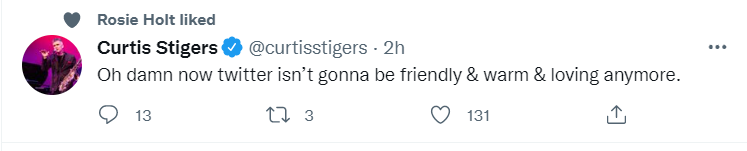
Finally, for those concerned about changes to Twitter, especially the platform’s policy on free speech, I leave you with these words from Curtis Stigers: “Oh damn now twitter isn’t gonna be friendly & warm & loving anymore.”

* Bob is a fictitious character, of course, but I'm sure we've all come across Bobs. 


Monday, 4 April 2022

Living With Covid

Government policy in England is now that we live with covid. If the success of that policy is measured by the number of people who are indeed living with it – that is to say, they have covid – then it has been a remarkable success.

One in thirteen people in England had covid during the week to 19th March, that’s a whopping 4.9 million people, a record number for the pandemic.


When the next set of weekly figures are released, I would guess that that the number will be even higher. In all, there have been 21.2 million cases of covid in the UK since the pandemic began and the number of people we know who have it will soon be greater than those who have not. You'll be a member of a minority group if you haven’t had it. At present I know of more people who have covid, or who have recently had it, than at any time since the pandemic began in March 2020.

It came as little surprise to me that, after two years of successfully dodging covid, I succumbed a week or so ago, and I have a pretty good idea where and when I picked it up.

I first thought that I had something on Friday 25th March, when I woke up with a sore throat. Whenever I get a cold, it starts with a sore throat, and I had a cold a few weeks ago that started with a dodgy throat. That cold was the mildest I can remember, but I had taken the precaution of doing a lateral flow test then, which had been negative.

On this particular Friday I was keen not to be positive as in the evening I was due to see Genesis at The O2. Having paid a princely sum for my ticket, and having had the show cancelled twice already, it was with some trepidation that I dropped the fluid into the LFT device, and waited. To my enormous relief, it came back negative, although I was quite probably positive already. Apart from the sore throat, which abated during the day, I felt perfectly fine.


I apologise profusely to anyone I may have I passed covid on to at The O2; clearly I must have had it, because the following morning, when I took another LFT, it came back positive.

The next step was to book a PCR test – a week later and that would have been more difficult, since free LFTs and PCRs have now been withdrawn, and all the testing centres have closed. Donald Trump was rightly ridiculed at the start of the pandemic when he said that the only reason the USA had record case numbers was because they were doing more tests than anyone, and our government seems to have taken that view on board – make it harder for people to test, and watch the case numbers tumble (or not, it seems).

Booking a PCR was simple, and half an hour after logging on to the government website, I’d booked a test, driven there, taken the test, and driven home again. Twenty four hours later I got an email – the PCR was positive, which was no surprise.


By any measure, I have been lucky. On the Saturday I was blowing hot and cold, had a sore throat, and a cough, and felt a bit weary, a bit like a cold.

Over the next few days, the sore throat abated, I felt less weary, and the only real symptom was the occasional cough. Unlike coughs I’ve had with colds, this one at least did not keep me awake. Not actually feeling tired did that. Sleeping was fitful to say the least. Overall, the symptoms have been very mild, for which, I thank the vaccines.

Unfortunately, having covid coal boxed things that I had planned. A recording of the BBC show, The Infinity Monkey Cage, and concerts by Simple Minds and 10CC all had to be missed.

Nine days after the original LFT, and I’m still coming up positive. I need two consecutive days with negative LFTs before I can officially stop isolating, but the NHS app says that I can stop on 5th April, which is likely to be earlier (just), anyway.

I reckon that I caught covid at the Backyard Comedy Club in Bethnal Green on 22nd March when I saw Paul Sinha’s radio show being recorded (see The Perfect Pub Quiz). Hardly anyone wore a mask at the venue, very few did on the trains and tubes going there and back.

The Backyard Comedy Club is owned by Lee Hurst, an outspoken critic of vaccinations, lockdowns and masks; the irony that I probably caught covid there is not lost on me. While Hurst is entitled to his views, I am sure that without the vaccine I would have been much more ill; had everyone at his venue worn masks, I probably would not have caught covid anyway.

Hurst is not alone in his opposition to masks. Many others are frequently on radio and TV repeatedly expressing similar views, some on the basis that masks don’t do any good; some believe that masks are a tool of government to control us. I am in favour of their continued use in some settings; public transport, shops, theatres, or indoor settings where people are in close proximity. It cannot be coincidence that case numbers have surged since mask mandates were relaxed.

Masks aren’t effective, some people say. I wonder, do those people use tissues, or handkerchiefs when they sneeze or cough? If so, why? If a mask doesn’t stop transmission, what use is a crumpled piece of Kleenex? Frankly, why not just sneeze in other people’s faces?

If masks are no use, then presumably, this age old advice can be ignored?

I confess that I have been wearing masks less since the rules were relaxed – there’s a sort of peer pressure, I suppose – and I now think that I was wrong to do so. To that extent, catching covid is possibly my own fault.

No matter how careful we are, the relaxation of restrictions, concomitant with a more transmissible strain means more and more people becoming infected. The degree to which they fall ill will depend on a number of variables, but there can be no doubt that if the percentage of infected people becoming seriously ill and possibly requiring hospital treatment remains unchanged, the actual number of people falling into those groups will continue to climb.

The herd immunity strategy proposed by the government in March 2020 was quickly discredited and dropped, but given that at that time it was held that it would be achieved once 60% of the population had become infected, increasing case numbers mean we seem to have readopted the policy, albeit by inertia.

Whatever the policy – and government seems not to have any sort of proactive covid policy at all now – we have without doubt reached the point where covid is regarded in much the same way as the common cold.

How appropriate a course of action this is for the unvaccinated or for the immunosuppressed remains to be seen: I have my doubts.


Wednesday, 23 March 2022

The Perfect Pub Quiz

You’ll be able to hear me on the radio soon, although you’ll have to pay careful attention because my appearance is brief. It’s during an episode of Paul Sinha’s Perfect Pub Quiz (Radio 4, some time in April, then on the BBC Sounds app), in which the audience ask him questions and he asks questions of them.


While most of his questions elicited a simultaneous response from many of the audience, it seemed that I was the only one who knew the answer to his question about two properties on a Monopoly board. That said, there were quite a few questions I couldn't answer!

The question was not untypical pub quiz fare, which was sort of the point of the show, to highlight the difference between the standard pub quiz questions and the slightly more obscure ones.

The point of pub quizzes – any quiz in fact, with the possible exception of University Challenge – is to pitch questions at a level where most people can take an educated guess, or – as Sinha himself said – they will at least have heard of the answer when they are given it.

I have always been a great fan of quizzes. Years ago, I used to take part in a monthly quiz at The Chichester Hotel in Rawreth, near Wickford, run by the local Rotary Club to raise money for charity. It was always very well attended, and very competitive. The team I was in won on quite a few occasions; we had some very intelligent people, with knowledge of a broad range of subjects.

Going back even further, in my teens and early twenties I played for the Romford FC Supporters Club team in a quiz league based on football (see Who Play At Annfield? And Other Questions). We used to take that quite seriously at times, going as far as to revise and practice during the season we actually won the league.

The football quizzes were all based on information in the Rothmans Football Yearbook, and access to the internet was not as ubiquitous as it is today when I stopped quizzing at The Chichester, so the questions were compiled from reference books. The internet has made quizzes easier, and harder. Compiling a set of quiz questions – and I’ve done it a few times – is easier with the internet, but somehow less satisfying. Even with the internet, verifying that you have the right answer to a question – assuming you’re not downloading an off the peg set but are actually making them up yourself – requires some patience and perseverance because, as we know, just because something appears on more than one website, that doesn’t make it right.

Having not taken part in a quiz for some time – years, maybe – I was at one with friends and family last Saturday. We came second (out of twelve teams). How close a second I don’t know, as the scores weren’t revealed, but we might have come closer had we known that a Jaffa Cake is a cake, not a biscuit (those binary choice questions are harder than they sound – well, they are if you don’t actually know the answer), or the name of Benedict Cumberbatch’s recent film, The Power of The Dog (I knew it was the something of the dog, but frustratingly couldn’t recall the full title).

Paul Sinha’s Perfect Pub Quiz, although a BBC show, was not recorded at the BBC Radio Theatre in Broadcasting House, but at the Backyard Comedy Club in Bethnal Green, a more informal venue that better lends itself to the sort of audience participation the show thrives on.


The Backyard Comedy Club was founded and is owned by Lee Hurst, who those of you with long memories will remember as a panellist on the light hearted sports quiz, They Think It’s All Over, in the 1990s. Hurst has some forthright views on covid, and in 2021 he was banned from Twitter for sharing abusive tweets about England’s Chief Medical Officer, Professor Chris Whitty. His many covid-sceptic, and often wildly ill-informed, tweets have frequently provoked ridicule, like this one likening covid to the plague:


Given those forthright views - he opposes masks, vaccinations and lockdowns, for instance, and seems to think that covid is a hoax - I wonder how he feels about the BBC’s requirement that everyone attending provides proof of a negative lateral flow test (LFT) taken within the previous 24 hours when attending their shows, even at his venue?

I guess that the BBC – and other venues that have similar requirements – will have to stop asking for proof of a negative LFT soon, as the provision of free tests ends at the end of March 2022, and I believe that the government website stops accepting such test results then as well (although I may be wrong on that, I can’t find definitive proof either way).

Some people will have no choice but to pay for tests. NHS frontline workers – among others – will likely still be required to take regular LFTs after 1st April, at a cost of around £50 per month. At a time when many people’s finances are being squeezed to the bone by paltry pay rises and rapidly increasing energy, fuel, and food prices this could be the straw that breaks the camel’s back for many.

On the other hand, I have little doubt that our Members of Parliament, whose pay will increase by £2,200 in April, and who – if they represent seats outside London – can claim the cost of their electricity and gas on expenses (in 2020-21, 316 MPs claimed for their energy bills, many claiming more than the average household’s bill of £1,100), will get their LFTs free if they need them.

Energy prices have got so out of hand that, according to Iceland supermarket boss Richard Walker, some food banks are rejecting potatoes and root veg because people ‘can’t afford the energy to boil them.’

Meanwhile, despite the widespread belief that covid is behind us and that we really no longer need masks, social distancing or testing, cases and deaths remain stubbornly high. As at 23rd March, the last week has seen 592,459 new cases (up 20%), and 836 deaths (up 122). Is covid over? Seems not; saying it is does not make it so.


Having veered somewhat off-topic, I’ll finish with a thought about quizzes that will have no doubt occurred to many of you.

There are only so many questions that can reasonably be posed in quizzes – especially TV game shows with members of the public as contestants – and only so many question setters for those shows.

As a result, questions get recycled over and over again – it’s not unusual to hear the same question, modified slightly perhaps, but still the same question – in different shows, even two shows on the same evening.

As the blurb for Sinha’s show explains, ‘The problem with quizzes is that the same questions keep coming up… the more quizzes you do the more predictable they get.’ The show ‘kindly explains why the questions are a bit rubbish, before offering up not only a better question, but also the fascinating stories behind the answer’.

For those reasons, I recommend you have a listen to Paul Sinha’s Perfect Pub Quiz, and not just because you’ll hear me.

Thursday, 24 February 2022

Music In Cars

Back in the day when I first started driving, car stereos were stolen from cars with alarming regularity. It was just as easy to buy a car stereo in a dodgy pub car park as at Halfords at one time.

We had the stereo removed and stolen from our old Vauxhall Astra once. My brother-in-law was borrowing the car at the time and was mortified, but the funny thing was, the tape deck had packed up and we were about to replace it, so the insurance paid for a new one rather than us having to!

These days the theft of car stereos has dwindled, and car stereos are no longer just radio/cassette players anyway, motor manufacturers now call them infotainment systems, and as well as playing music, they incorporate your sat nav, and depending on your make and model, include all sorts of apps and features that connect to your phone and the broader internet.


Personally, I wouldn’t be without the sat nav in my car. There wasn’t an integral one in my previous car, so I used a TomTom attached to the windscreen instead, except it had a habit of falling off and rolling around the footwell at crucial moments, so I was very pleased when my new car (I say, new it’s seven years old now) came with an inbuilt sat nav.

I was slightly less pleased that whereas my old car had a six CD changer, my new one takes just a single disc, but chances are that if I bought a new car now, it wouldn’t have a CD player as standard, at all. The music industry has pretty much decided that owning physical copies of music is old hat, and only for collectors of oddities, like vinyl, and that we all want to stream or download our music, and motor manufacturers seem to have agreed. Well, I don’t.

Car infotainments systems come with a DAB radio and a means of connecting to your phone and hence Spotify, or Deezer, or whatever streaming service you favour, but maybe no CD player, and certainly no cassette deck!

As far as listening to music in cars is concerned, the audio cassette is the best method there has been, and the best there will be, I’ll brook no argument on that. CDs are great, but cassettes were the peak of in-car musical entertainment.

The best thing about cassettes was making a mix-tape specifically for the car. I did have a small collection of pre-recorded cassettes, but most were either old ones that I later replaced with CDs, or were from bargain bins – the 99p for 20 Great Electronic Hits of the 80s sort of thing – most were carefully curated from my CD collection, and usually had some sort of theme to them.

One might be proggy – Yes, Genesis, Pink Floyd, Peter Gabriel et al – and another poppy – ABC, Human League, Duran Duran – but many were an eclectic mix where Dire Straits would rub shoulders with Luther Vandross, while Kate Bush would ride in on the coat tails of Michael Jackson. Then there would be the live album featuring all the bands I’d like to see in a single setting.

My favourite though, was a mixture of covers and their originals, and different songs with the same title.


It included Comfortably Numb by Pink Floyd, and the Scissor Sisters’ cover version; Lay Your Hands on Me, two different songs of the same name, by Peter Gabriel and Thompson Twins; and Doctor, Doctor, also different songs, by Thompson Twins again, and UFO.


There was an art to fitting as close to 45 minutes of music onto one side of a C90 cassette without chopping off the end of the last track or leaving two minutes of dead tape. And when recording had to be done in real time, there was much more of a personal investment than just creating a playlist in Spotify.

Goodness knows how many of these I happily filled with music over the years.

Spotify is perhaps a necessary evil, personally I use it for two reasons only. Either to sample artists I’ve been recommended, and to then buy their CD if I like them, or occasionally to play stuff I want to listen to, but I only do this if I already own the physical material. It’s relatively cheap, I suppose - £9.99 a month for Premium (which I won’t pay, so I’ll tolerate the ads, thanks) – but that is reflected in the insultingly small amounts that Spotify pay the artists. Not that they are alone, as the table of royalty rates below, shows.

In 2021, Spotify generated revenue of over 9.67 billion, up from 7.88 billion in the previous year, so their sponsorship deal with Barcelona, worth 340 million over five years won’t make much of a dent in their profits, but there again, neither do royalties.

Streaming sites royalties, pitifully small...


...so that this sort of sponsorship deal can be finaced.

Bands in the UK have been hit by a triple whammy in recent years. Derisory royalties from streaming services, Brexit, and now covid (the latter two have ripped the heart out of touring in Europe for most bands). I read recently of one musician who made more money from merchandise at the first live gig he had been able to play after lockdown than he had in the previous twelve months of streaming service royalties put together.

Income from merchandise is vital for many bands, and I tend to buy a t-shirt  when I go to a gig (hence I have a cupboard groaning at the seams with them). Sadly, even this income stream is being squeezed as many venues now charge bands a percentage of merchandise sales, and I’ve even heard of headline acts charging support acts for merchandise sales, which if true, is completely outrageous!

My preference for a physical copy of the music I listen to means I’ll only download if that is the only format available, and I’ll buy my CDs either direct from the band, or an outlet like Burning Shed or Inside Out before I go to Amazon or HMV, even if it means paying a couple of quid more.


I can understand the appeal of Spotify (I’m using it to listening to Luminol  from The Raven That Refused To Sing, by Steven Wilson as I type – but I do own the CD), but as recent events have proven with artists like Neil Young and Joni Mitchell removing their material from the platform, and the fact that some bands are not represented at all – Prince, The Beatles, Adele, and Coldplay among others – it’s not as comprehensive as a proper music collection, and never can be, and it’s so much more enjoyable to listen to music from a physical source.

No matter how listening to music evolves in the coming years, the joy of creating a mix-tape cassette and playing it in the car will never be beat, and that’s a fact.


Tuesday, 1 February 2022

"So long as it is safe to do so"

The introduction to The Highway Code says,” It is important that all road users are aware of The Highway Code and are considerate towards each other. This applies to pedestrians as much as to drivers and riders.”  While HGV drivers and car drivers will have read The Highway Code, horse riders and cyclists should have read it, and so too should have pedestrians, it is probably only the drivers of motor vehicles who actually have done so (and most only read it so far as was necessary in order to pass their driving test).


I’d go as far as to say that if you polled a random sample of a thousand non-drivers, you would be lucky to find ten who have actually read The Highway Code, even though everyone should be aware of it and abide by it.

Although The Highway Code is something that everyone has a vague awareness of, it doesn’t often come to the fore, except when there is some fundamental change, and fundamental change is what we have recently had.

Last weekend, a number of changes to The Highway Code came into force. There is now a Hierarchy of Road Users, ranked as follows:

  1. Pedestrians
  2.  Cyclists
  3. Horse riders
  4. Motorcyclists
  5. Cars and taxis
  6. Vans and minibuses
  7. Large passenger vehicles or courier vehicles like buses and HGVs.

Fairly uncontroversial, that: Makes perfect sense, doesn’t it? Pedestrians are obviously the most vulnerable group of road users, although in some ways I’d think that horse riders are even more vulnerable than cyclists, after all a horse is unpredictable and its rider more exposed than a cyclist, but I guess that’s moot and a matter of opinion. This hierarchy may upset some cyclists however, as I’m sure we have all observed some who believe that they are the most important and entitled of road users.

 More contentious however, is the change in priority for pedestrians and drivers at junctions and zebra crossings. Drivers, motorcyclists, horse riders and cyclists should now give way to pedestrians crossing or waiting to cross a road into which or from which they are turning. Road users should also give way to pedestrians who want to use a zebra crossing. The previous rules were that pedestrians only had priority when they had actually started to cross the road.


I do hope that any cyclists who have become aware of these changes to The Highway Code take note and stop for pedestrians who want to cross the road, as I’m sure we’ve all experienced the cyclist whizzing past by a hair’s breadth as we cross on a zebra crossing. It would also be nice if cyclists refrained from cycling on pavements, except where mixed use is allowed, and where that is the case, give priority to pedestrians; that would be a novelty.

Naturally the change that requires motorists entering or leaving a side road to give way to pedestrians waiting to cross has provoked many people to voice the opinion that if a motorist turns into a side road and has to stop sharply to allow a pedestrian to cross, they are in danger of being rear-ended by a vehicle that may have followed them round the corner, and thus this new rule may cause more accidents than it prevents. That was my immediate thought on learning of the change, but I think (and hope) that the problem has been overstated.


One of the things about driving, or riding a bike, or simply being a pedestrian, is that our behaviour is ingrained; changing how we behave will take time, hence I’m inclined to think that there will not be vast numbers of pedestrians modifying their behaviour and stepping out into the road with the expectation that motorists will simply stop for them. I’d better caveat that though, since in my experience (and probably yours if you are also a car driver), there is, and has always been, a risk that a pedestrian will blithely step off the pavement and into the road and expect motorists to have predicted this and act accordingly.

Anyone who has driven for any length of time will have quickly reached the conclusion that every other road user is an idiot, likely to do something unpredictable and dangerous at any time, and that it is therefore your responsibility to be aware of that, to predict what they will do, and take the necessary action to prevent an accident. Having said that, I am of course not immune from making errors of judgement on the road, and when I do, other road users may mistake those for being dangerous or unthinking, even though I’m not,

If there’s one change I can certainly get behind, it is the one that bans the use of mobile phones for any purpose. The use of mobile phones for calling or texting was banned in December 2003, but as the number of functions on smartphones grew, this created a loophole as things like scrolling through social media, or taking pictures or videos were not expressly forbidden. Now, use of any mobile device is banned, except for hands free phone calls. Given how often I see other motorists looking down at their phones, engrossed by them and not paying any attention to the road, this can only be a good thing – assuming anyone takes any notice of it.

The Highway Code changes received remarkably little publicity until about a week before they came into force, and when they did appear on newspaper websites they were treated somewhat sensationally. Take this clickbaity headline from the Evening Standard:


Referring to the so-called Dutch Reach, in which a driver – or passenger for that matter – opens their car door with their hand furthest from the handle, the paper implies that failure to do so will automatically result in a fine, which is blatantly untrue. It is important to read exactly what The Highway Code says, which is:


The purpose of this is to make anyone opening a car door more likely to see a cyclist or motorcyclist and avoid them either riding into the door, or swerving to avoid it. Even before the change it was and offence to open a car door so as to cause injury, punishable by a maximum fine of £1,000 but that doesn’t make such a sensational headline.

While some people have reasonably sounded a note of caution about the changes to The Highway Code - there has been some hysteria in the media, as the Standard headline proved - but what it all boils down to is taking the rules and applying the caveat that appears in more than one place within the Code, which is that whatever you do, you should do it only “if it is safe to do so.”

The last couple of years of covid have proven that British common sense, so often praised by our politicians, is often in short supply, but The Highway Code is largely based on common sense, and if all road users were to apply it a little more, be more considerate to other road users, and apply the “if it is safe to do so” caveat a little more, the roads would be a much safer place. I’ll not hold my breath.


How England Were Nearly Denied The 1966 World Cup

In 2017, during the bidding process to determine who would host the 2026 World Cup, FIFA President Gianni Infantino addressed the travel ba...