Monday, 4 April 2022

Living With Covid

Government policy in England is now that we live with covid. If the success of that policy is measured by the number of people who are indeed living with it – that is to say, they have covid – then it has been a remarkable success.

One in thirteen people in England had covid during the week to 19th March, that’s a whopping 4.9 million people, a record number for the pandemic.


When the next set of weekly figures are released, I would guess that that the number will be even higher. In all, there have been 21.2 million cases of covid in the UK since the pandemic began and the number of people we know who have it will soon be greater than those who have not. You'll be a member of a minority group if you haven’t had it. At present I know of more people who have covid, or who have recently had it, than at any time since the pandemic began in March 2020.

It came as little surprise to me that, after two years of successfully dodging covid, I succumbed a week or so ago, and I have a pretty good idea where and when I picked it up.

I first thought that I had something on Friday 25th March, when I woke up with a sore throat. Whenever I get a cold, it starts with a sore throat, and I had a cold a few weeks ago that started with a dodgy throat. That cold was the mildest I can remember, but I had taken the precaution of doing a lateral flow test then, which had been negative.

On this particular Friday I was keen not to be positive as in the evening I was due to see Genesis at The O2. Having paid a princely sum for my ticket, and having had the show cancelled twice already, it was with some trepidation that I dropped the fluid into the LFT device, and waited. To my enormous relief, it came back negative, although I was quite probably positive already. Apart from the sore throat, which abated during the day, I felt perfectly fine.


I apologise profusely to anyone I may have I passed covid on to at The O2; clearly I must have had it, because the following morning, when I took another LFT, it came back positive.

The next step was to book a PCR test – a week later and that would have been more difficult, since free LFTs and PCRs have now been withdrawn, and all the testing centres have closed. Donald Trump was rightly ridiculed at the start of the pandemic when he said that the only reason the USA had record case numbers was because they were doing more tests than anyone, and our government seems to have taken that view on board – make it harder for people to test, and watch the case numbers tumble (or not, it seems).

Booking a PCR was simple, and half an hour after logging on to the government website, I’d booked a test, driven there, taken the test, and driven home again. Twenty four hours later I got an email – the PCR was positive, which was no surprise.


By any measure, I have been lucky. On the Saturday I was blowing hot and cold, had a sore throat, and a cough, and felt a bit weary, a bit like a cold.

Over the next few days, the sore throat abated, I felt less weary, and the only real symptom was the occasional cough. Unlike coughs I’ve had with colds, this one at least did not keep me awake. Not actually feeling tired did that. Sleeping was fitful to say the least. Overall, the symptoms have been very mild, for which, I thank the vaccines.

Unfortunately, having covid coal boxed things that I had planned. A recording of the BBC show, The Infinity Monkey Cage, and concerts by Simple Minds and 10CC all had to be missed.

Nine days after the original LFT, and I’m still coming up positive. I need two consecutive days with negative LFTs before I can officially stop isolating, but the NHS app says that I can stop on 5th April, which is likely to be earlier (just), anyway.

I reckon that I caught covid at the Backyard Comedy Club in Bethnal Green on 22nd March when I saw Paul Sinha’s radio show being recorded (see The Perfect Pub Quiz). Hardly anyone wore a mask at the venue, very few did on the trains and tubes going there and back.

The Backyard Comedy Club is owned by Lee Hurst, an outspoken critic of vaccinations, lockdowns and masks; the irony that I probably caught covid there is not lost on me. While Hurst is entitled to his views, I am sure that without the vaccine I would have been much more ill; had everyone at his venue worn masks, I probably would not have caught covid anyway.

Hurst is not alone in his opposition to masks. Many others are frequently on radio and TV repeatedly expressing similar views, some on the basis that masks don’t do any good; some believe that masks are a tool of government to control us. I am in favour of their continued use in some settings; public transport, shops, theatres, or indoor settings where people are in close proximity. It cannot be coincidence that case numbers have surged since mask mandates were relaxed.

Masks aren’t effective, some people say. I wonder, do those people use tissues, or handkerchiefs when they sneeze or cough? If so, why? If a mask doesn’t stop transmission, what use is a crumpled piece of Kleenex? Frankly, why not just sneeze in other people’s faces?

If masks are no use, then presumably, this age old advice can be ignored?

I confess that I have been wearing masks less since the rules were relaxed – there’s a sort of peer pressure, I suppose – and I now think that I was wrong to do so. To that extent, catching covid is possibly my own fault.

No matter how careful we are, the relaxation of restrictions, concomitant with a more transmissible strain means more and more people becoming infected. The degree to which they fall ill will depend on a number of variables, but there can be no doubt that if the percentage of infected people becoming seriously ill and possibly requiring hospital treatment remains unchanged, the actual number of people falling into those groups will continue to climb.

The herd immunity strategy proposed by the government in March 2020 was quickly discredited and dropped, but given that at that time it was held that it would be achieved once 60% of the population had become infected, increasing case numbers mean we seem to have readopted the policy, albeit by inertia.

Whatever the policy – and government seems not to have any sort of proactive covid policy at all now – we have without doubt reached the point where covid is regarded in much the same way as the common cold.

How appropriate a course of action this is for the unvaccinated or for the immunosuppressed remains to be seen: I have my doubts.


Wednesday, 23 March 2022

The Perfect Pub Quiz

You’ll be able to hear me on the radio soon, although you’ll have to pay careful attention because my appearance is brief. It’s during an episode of Paul Sinha’s Perfect Pub Quiz (Radio 4, some time in April, then on the BBC Sounds app), in which the audience ask him questions and he asks questions of them.


While most of his questions elicited a simultaneous response from many of the audience, it seemed that I was the only one who knew the answer to his question about two properties on a Monopoly board. That said, there were quite a few questions I couldn't answer!

The question was not untypical pub quiz fare, which was sort of the point of the show, to highlight the difference between the standard pub quiz questions and the slightly more obscure ones.

The point of pub quizzes – any quiz in fact, with the possible exception of University Challenge – is to pitch questions at a level where most people can take an educated guess, or – as Sinha himself said – they will at least have heard of the answer when they are given it.

I have always been a great fan of quizzes. Years ago, I used to take part in a monthly quiz at The Chichester Hotel in Rawreth, near Wickford, run by the local Rotary Club to raise money for charity. It was always very well attended, and very competitive. The team I was in won on quite a few occasions; we had some very intelligent people, with knowledge of a broad range of subjects.

Going back even further, in my teens and early twenties I played for the Romford FC Supporters Club team in a quiz league based on football (see Who Play At Annfield? And Other Questions). We used to take that quite seriously at times, going as far as to revise and practice during the season we actually won the league.

The football quizzes were all based on information in the Rothmans Football Yearbook, and access to the internet was not as ubiquitous as it is today when I stopped quizzing at The Chichester, so the questions were compiled from reference books. The internet has made quizzes easier, and harder. Compiling a set of quiz questions – and I’ve done it a few times – is easier with the internet, but somehow less satisfying. Even with the internet, verifying that you have the right answer to a question – assuming you’re not downloading an off the peg set but are actually making them up yourself – requires some patience and perseverance because, as we know, just because something appears on more than one website, that doesn’t make it right.

Having not taken part in a quiz for some time – years, maybe – I was at one with friends and family last Saturday. We came second (out of twelve teams). How close a second I don’t know, as the scores weren’t revealed, but we might have come closer had we known that a Jaffa Cake is a cake, not a biscuit (those binary choice questions are harder than they sound – well, they are if you don’t actually know the answer), or the name of Benedict Cumberbatch’s recent film, The Power of The Dog (I knew it was the something of the dog, but frustratingly couldn’t recall the full title).

Paul Sinha’s Perfect Pub Quiz, although a BBC show, was not recorded at the BBC Radio Theatre in Broadcasting House, but at the Backyard Comedy Club in Bethnal Green, a more informal venue that better lends itself to the sort of audience participation the show thrives on.


The Backyard Comedy Club was founded and is owned by Lee Hurst, who those of you with long memories will remember as a panellist on the light hearted sports quiz, They Think It’s All Over, in the 1990s. Hurst has some forthright views on covid, and in 2021 he was banned from Twitter for sharing abusive tweets about England’s Chief Medical Officer, Professor Chris Whitty. His many covid-sceptic, and often wildly ill-informed, tweets have frequently provoked ridicule, like this one likening covid to the plague:


Given those forthright views - he opposes masks, vaccinations and lockdowns, for instance, and seems to think that covid is a hoax - I wonder how he feels about the BBC’s requirement that everyone attending provides proof of a negative lateral flow test (LFT) taken within the previous 24 hours when attending their shows, even at his venue?

I guess that the BBC – and other venues that have similar requirements – will have to stop asking for proof of a negative LFT soon, as the provision of free tests ends at the end of March 2022, and I believe that the government website stops accepting such test results then as well (although I may be wrong on that, I can’t find definitive proof either way).

Some people will have no choice but to pay for tests. NHS frontline workers – among others – will likely still be required to take regular LFTs after 1st April, at a cost of around £50 per month. At a time when many people’s finances are being squeezed to the bone by paltry pay rises and rapidly increasing energy, fuel, and food prices this could be the straw that breaks the camel’s back for many.

On the other hand, I have little doubt that our Members of Parliament, whose pay will increase by £2,200 in April, and who – if they represent seats outside London – can claim the cost of their electricity and gas on expenses (in 2020-21, 316 MPs claimed for their energy bills, many claiming more than the average household’s bill of £1,100), will get their LFTs free if they need them.

Energy prices have got so out of hand that, according to Iceland supermarket boss Richard Walker, some food banks are rejecting potatoes and root veg because people ‘can’t afford the energy to boil them.’

Meanwhile, despite the widespread belief that covid is behind us and that we really no longer need masks, social distancing or testing, cases and deaths remain stubbornly high. As at 23rd March, the last week has seen 592,459 new cases (up 20%), and 836 deaths (up 122). Is covid over? Seems not; saying it is does not make it so.


Having veered somewhat off-topic, I’ll finish with a thought about quizzes that will have no doubt occurred to many of you.

There are only so many questions that can reasonably be posed in quizzes – especially TV game shows with members of the public as contestants – and only so many question setters for those shows.

As a result, questions get recycled over and over again – it’s not unusual to hear the same question, modified slightly perhaps, but still the same question – in different shows, even two shows on the same evening.

As the blurb for Sinha’s show explains, ‘The problem with quizzes is that the same questions keep coming up… the more quizzes you do the more predictable they get.’ The show ‘kindly explains why the questions are a bit rubbish, before offering up not only a better question, but also the fascinating stories behind the answer’.

For those reasons, I recommend you have a listen to Paul Sinha’s Perfect Pub Quiz, and not just because you’ll hear me.

Thursday, 24 February 2022

Music In Cars

Back in the day when I first started driving, car stereos were stolen from cars with alarming regularity. It was just as easy to buy a car stereo in a dodgy pub car park as at Halfords at one time.

We had the stereo removed and stolen from our old Vauxhall Astra once. My brother-in-law was borrowing the car at the time and was mortified, but the funny thing was, the tape deck had packed up and we were about to replace it, so the insurance paid for a new one rather than us having to!

These days the theft of car stereos has dwindled, and car stereos are no longer just radio/cassette players anyway, motor manufacturers now call them infotainment systems, and as well as playing music, they incorporate your sat nav, and depending on your make and model, include all sorts of apps and features that connect to your phone and the broader internet.


Personally, I wouldn’t be without the sat nav in my car. There wasn’t an integral one in my previous car, so I used a TomTom attached to the windscreen instead, except it had a habit of falling off and rolling around the footwell at crucial moments, so I was very pleased when my new car (I say, new it’s seven years old now) came with an inbuilt sat nav.

I was slightly less pleased that whereas my old car had a six CD changer, my new one takes just a single disc, but chances are that if I bought a new car now, it wouldn’t have a CD player as standard, at all. The music industry has pretty much decided that owning physical copies of music is old hat, and only for collectors of oddities, like vinyl, and that we all want to stream or download our music, and motor manufacturers seem to have agreed. Well, I don’t.

Car infotainments systems come with a DAB radio and a means of connecting to your phone and hence Spotify, or Deezer, or whatever streaming service you favour, but maybe no CD player, and certainly no cassette deck!

As far as listening to music in cars is concerned, the audio cassette is the best method there has been, and the best there will be, I’ll brook no argument on that. CDs are great, but cassettes were the peak of in-car musical entertainment.

The best thing about cassettes was making a mix-tape specifically for the car. I did have a small collection of pre-recorded cassettes, but most were either old ones that I later replaced with CDs, or were from bargain bins – the 99p for 20 Great Electronic Hits of the 80s sort of thing – most were carefully curated from my CD collection, and usually had some sort of theme to them.

One might be proggy – Yes, Genesis, Pink Floyd, Peter Gabriel et al – and another poppy – ABC, Human League, Duran Duran – but many were an eclectic mix where Dire Straits would rub shoulders with Luther Vandross, while Kate Bush would ride in on the coat tails of Michael Jackson. Then there would be the live album featuring all the bands I’d like to see in a single setting.

My favourite though, was a mixture of covers and their originals, and different songs with the same title.


It included Comfortably Numb by Pink Floyd, and the Scissor Sisters’ cover version; Lay Your Hands on Me, two different songs of the same name, by Peter Gabriel and Thompson Twins; and Doctor, Doctor, also different songs, by Thompson Twins again, and UFO.


There was an art to fitting as close to 45 minutes of music onto one side of a C90 cassette without chopping off the end of the last track or leaving two minutes of dead tape. And when recording had to be done in real time, there was much more of a personal investment than just creating a playlist in Spotify.

Goodness knows how many of these I happily filled with music over the years.

Spotify is perhaps a necessary evil, personally I use it for two reasons only. Either to sample artists I’ve been recommended, and to then buy their CD if I like them, or occasionally to play stuff I want to listen to, but I only do this if I already own the physical material. It’s relatively cheap, I suppose - £9.99 a month for Premium (which I won’t pay, so I’ll tolerate the ads, thanks) – but that is reflected in the insultingly small amounts that Spotify pay the artists. Not that they are alone, as the table of royalty rates below, shows.

In 2021, Spotify generated revenue of over 9.67 billion, up from 7.88 billion in the previous year, so their sponsorship deal with Barcelona, worth 340 million over five years won’t make much of a dent in their profits, but there again, neither do royalties.

Streaming sites royalties, pitifully small...


...so that this sort of sponsorship deal can be finaced.

Bands in the UK have been hit by a triple whammy in recent years. Derisory royalties from streaming services, Brexit, and now covid (the latter two have ripped the heart out of touring in Europe for most bands). I read recently of one musician who made more money from merchandise at the first live gig he had been able to play after lockdown than he had in the previous twelve months of streaming service royalties put together.

Income from merchandise is vital for many bands, and I tend to buy a t-shirt  when I go to a gig (hence I have a cupboard groaning at the seams with them). Sadly, even this income stream is being squeezed as many venues now charge bands a percentage of merchandise sales, and I’ve even heard of headline acts charging support acts for merchandise sales, which if true, is completely outrageous!

My preference for a physical copy of the music I listen to means I’ll only download if that is the only format available, and I’ll buy my CDs either direct from the band, or an outlet like Burning Shed or Inside Out before I go to Amazon or HMV, even if it means paying a couple of quid more.


I can understand the appeal of Spotify (I’m using it to listening to Luminol  from The Raven That Refused To Sing, by Steven Wilson as I type – but I do own the CD), but as recent events have proven with artists like Neil Young and Joni Mitchell removing their material from the platform, and the fact that some bands are not represented at all – Prince, The Beatles, Adele, and Coldplay among others – it’s not as comprehensive as a proper music collection, and never can be, and it’s so much more enjoyable to listen to music from a physical source.

No matter how listening to music evolves in the coming years, the joy of creating a mix-tape cassette and playing it in the car will never be beat, and that’s a fact.


Tuesday, 1 February 2022

"So long as it is safe to do so"

The introduction to The Highway Code says,” It is important that all road users are aware of The Highway Code and are considerate towards each other. This applies to pedestrians as much as to drivers and riders.”  While HGV drivers and car drivers will have read The Highway Code, horse riders and cyclists should have read it, and so too should have pedestrians, it is probably only the drivers of motor vehicles who actually have done so (and most only read it so far as was necessary in order to pass their driving test).


I’d go as far as to say that if you polled a random sample of a thousand non-drivers, you would be lucky to find ten who have actually read The Highway Code, even though everyone should be aware of it and abide by it.

Although The Highway Code is something that everyone has a vague awareness of, it doesn’t often come to the fore, except when there is some fundamental change, and fundamental change is what we have recently had.

Last weekend, a number of changes to The Highway Code came into force. There is now a Hierarchy of Road Users, ranked as follows:

  1. Pedestrians
  2.  Cyclists
  3. Horse riders
  4. Motorcyclists
  5. Cars and taxis
  6. Vans and minibuses
  7. Large passenger vehicles or courier vehicles like buses and HGVs.

Fairly uncontroversial, that: Makes perfect sense, doesn’t it? Pedestrians are obviously the most vulnerable group of road users, although in some ways I’d think that horse riders are even more vulnerable than cyclists, after all a horse is unpredictable and its rider more exposed than a cyclist, but I guess that’s moot and a matter of opinion. This hierarchy may upset some cyclists however, as I’m sure we have all observed some who believe that they are the most important and entitled of road users.

 More contentious however, is the change in priority for pedestrians and drivers at junctions and zebra crossings. Drivers, motorcyclists, horse riders and cyclists should now give way to pedestrians crossing or waiting to cross a road into which or from which they are turning. Road users should also give way to pedestrians who want to use a zebra crossing. The previous rules were that pedestrians only had priority when they had actually started to cross the road.


I do hope that any cyclists who have become aware of these changes to The Highway Code take note and stop for pedestrians who want to cross the road, as I’m sure we’ve all experienced the cyclist whizzing past by a hair’s breadth as we cross on a zebra crossing. It would also be nice if cyclists refrained from cycling on pavements, except where mixed use is allowed, and where that is the case, give priority to pedestrians; that would be a novelty.

Naturally the change that requires motorists entering or leaving a side road to give way to pedestrians waiting to cross has provoked many people to voice the opinion that if a motorist turns into a side road and has to stop sharply to allow a pedestrian to cross, they are in danger of being rear-ended by a vehicle that may have followed them round the corner, and thus this new rule may cause more accidents than it prevents. That was my immediate thought on learning of the change, but I think (and hope) that the problem has been overstated.


One of the things about driving, or riding a bike, or simply being a pedestrian, is that our behaviour is ingrained; changing how we behave will take time, hence I’m inclined to think that there will not be vast numbers of pedestrians modifying their behaviour and stepping out into the road with the expectation that motorists will simply stop for them. I’d better caveat that though, since in my experience (and probably yours if you are also a car driver), there is, and has always been, a risk that a pedestrian will blithely step off the pavement and into the road and expect motorists to have predicted this and act accordingly.

Anyone who has driven for any length of time will have quickly reached the conclusion that every other road user is an idiot, likely to do something unpredictable and dangerous at any time, and that it is therefore your responsibility to be aware of that, to predict what they will do, and take the necessary action to prevent an accident. Having said that, I am of course not immune from making errors of judgement on the road, and when I do, other road users may mistake those for being dangerous or unthinking, even though I’m not,

If there’s one change I can certainly get behind, it is the one that bans the use of mobile phones for any purpose. The use of mobile phones for calling or texting was banned in December 2003, but as the number of functions on smartphones grew, this created a loophole as things like scrolling through social media, or taking pictures or videos were not expressly forbidden. Now, use of any mobile device is banned, except for hands free phone calls. Given how often I see other motorists looking down at their phones, engrossed by them and not paying any attention to the road, this can only be a good thing – assuming anyone takes any notice of it.

The Highway Code changes received remarkably little publicity until about a week before they came into force, and when they did appear on newspaper websites they were treated somewhat sensationally. Take this clickbaity headline from the Evening Standard:


Referring to the so-called Dutch Reach, in which a driver – or passenger for that matter – opens their car door with their hand furthest from the handle, the paper implies that failure to do so will automatically result in a fine, which is blatantly untrue. It is important to read exactly what The Highway Code says, which is:


The purpose of this is to make anyone opening a car door more likely to see a cyclist or motorcyclist and avoid them either riding into the door, or swerving to avoid it. Even before the change it was and offence to open a car door so as to cause injury, punishable by a maximum fine of £1,000 but that doesn’t make such a sensational headline.

While some people have reasonably sounded a note of caution about the changes to The Highway Code - there has been some hysteria in the media, as the Standard headline proved - but what it all boils down to is taking the rules and applying the caveat that appears in more than one place within the Code, which is that whatever you do, you should do it only “if it is safe to do so.”

The last couple of years of covid have proven that British common sense, so often praised by our politicians, is often in short supply, but The Highway Code is largely based on common sense, and if all road users were to apply it a little more, be more considerate to other road users, and apply the “if it is safe to do so” caveat a little more, the roads would be a much safer place. I’ll not hold my breath.


Wednesday, 12 January 2022

Thank You For The Music

Going to gigs was what I missed most during the 2020 lockdown. In the few weeks before the country closed down in March that year, I managed to attend two musical events, neither of which were the type of thing that I normally go to see, so it was a relief to get back to seeing the live music that I enjoy in 2021.

Covid naturally made it all a little weird. At the Eventim Apollo I had to show proof of vaccination or a negative PCR or lateral flow test; the Royal Albert Hall asked me if I could prove my vaccination status if I was asked (which I wasn’t). At the Royal Albert Hall, many people were wearing masks – including those sitting next to me – so I wore one too, as I did at the Apollo.

This isn’t a review of the shows I saw, more a brief impression of the year, and in some small way, to say thank you for the music and the bands that played it.

First up, in September 2021, was Fischer-Z at Nell’s in Kensington, a small venue where the audience was quite sparse; not great for the band, but comfortable for my first indoor live event for over a year.  It was just so good to hear live music again, even if the set list featured a lot of tracks from albums I don’t own, but The Worker formed part of the encore, and it was worth going just for that. The only real fly in the ointment was the journey home – it’s a long way on the District Line, and a mile and a half walk home at the end of it.

Fischer-Z

A week later I was at The Congress Theatre in Eastbourne for Go West, who were supposed to be supported by T’Pau, who didn’t appear due to illness and were replaced by Katrina (of Katrina & The Waves). This gig was my wife’s choice and I know only a few Go West Songs (The King of Wishful Thinking, Faithful, and We Close our Eyes, all of which, fortunately, they played), but they were enjoyable, if a little repetitive. Katrina was better. Playing a varied set of her own material – old and new – and covers, I could have happily sat through a whole evening listening to her and her band.

Katrina (& not The Waves)

Go West

Having gone over a year without live music, it was three gigs in ten days as Steve Hackett brought his Genesis Revisited tour to the London Palladium, playing a selection of his solo material, plus the whole of Seconds Out, the seminal Genesis live album. With his band in fine form and singer Nad Sylvan in best Gabrielesque voice, it was – as expected – a brilliant concert. It’s funny though, how frequent exposure to some songs changes one’s attitude to them. I’d never before been a great fan of Shadow of The Hierophant, but for the first time, I really enjoyed it that night. Oddly, Supper’s Ready, a glorious song that all Genesis enthusiasts love, may just have outstayed its welcome – the novelty of hearing it live has worn off a bit - but it featured at The Palladium and it will feature on Steve’s 2022 tour too, as he’ll be reprising Foxtrot.

Steve Hackett

At the end of October it was off to The Royal Albert Hall for Level 42, supported by Johnny Hates Jazz

Johnny Hates Jazz

Level 42 are not a band I know especially well – or so I thought. On the night they basically played their greatest hits, and there was little I didn’t at least recognise. They finished their set (pre encore) with Heaven In My Hands, a song that for very personal reasons, I can’t listen to without having a little weep, as I did on the night. Other songs likely to have the same effect, and for the same reason, are A Groovy Kind of Love by Phil Collins, and Marillion’s No One Can (more of which later).

Level 42

From the cavernous Royal Albert Hall to the somewhat smaller and more intimate Chinnery’s in Southend, for my next gig, Lifesigns, at the end of November. Southend sea front in November is a bit bleak, there’s no getting away from it, but the venue – which I’d not been to before – was really rather nice. 

Lifesigns

These days I much prefer a standing venue to sitting – three of 2021’s seven shows were standing – and  this this was my favourite gig of the year. Then again, Lifesign’s most recent album – Altitude – was one of my top two albums of 2021 (Nad Sylvan’s Spiritus Mundi, an at first sight unpromising musical adaptation of the poems of WB Yeats, runs it a close second). I feel a little proprietorial about Altitude, it has to be said, as I made a pledge towards its production.  On the night, John Young and his band played some old material and then the whole of Altitude – glorious stuff. The economics involved in producing an album (even without Brexit and Covid, both of which have seriously affected many bands) and especially for bands like Lifesigns, who are not signed to a major label, make pledges and crowdfunding important means of raising the capital to finance making records.

My favourite new albums of 2021

The night after Lifesigns it was off to my all-time favourite venue, the Eventim Apollo – or the Hammersmith Odeon as I still prefer to call it – to see Marillion (with support from Antimatter). Included in their set was No One Can (mentioned above), a song that has the power to move me to tears. When June died in 1993, the song somehow became inextricably linked with that event, and the wonderful, emotional power of music means that 28 years on from June's death, it made me cry, and amazingly, I'm grateful for that (I’m tearing up just writing this).

Marillion

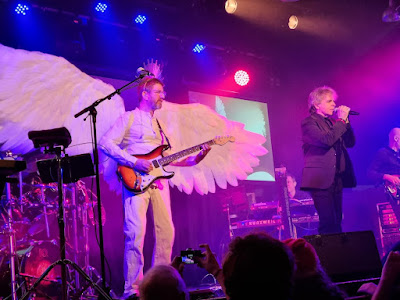
To round off the year it was a venue that is new to me, 229 The Venue, at the top of Great Portland Street. Another standing venue, and I have to say, one I look forward to visiting again in the near future. IQ were the band I went to see, and as usual, guitarist Mike Holmes donned the angel wings for part of the set.

IQ

I rarely go to gigs without buying some merchandise – usually a t-shirt – and this year was no exception, with additions to my wardrobe from the shows involving Steve Hackett, Level 42, Marillion, and IQ (I already have most Lifesigns t-shirts, and there were none to be had at the other shows, although it’s doubtful I would have bought a Go West shirt even had there been one to buy).

If all goes according to plan, then 2022 should see me at shows from The Musical Box, John Mitchell, Genesis, Sparks, Frost*, Yes, Transatlantic, Steve Hackett, Level 42, and the eagerly awaited return of Porcupine Tree.

Five of those shows have been rescheduled from 2021 – or even 2020 – and, I think you’ll agree, are a somewhat eclectic mix of bands and musical styles – add a ballet and an opera into the mix, and I’m not sure that even eclectic does it justice. My fingers are firmly crossed that they all go ahead.


Sunday, 19 December 2021

The Quiet Desperation of Christmas Present Buying

On a scale of 1 to 10, where 1 is woefully unprepared and 10 is putting the sprouts on over a low light, how ready are you for Christmas?

Me, I’m about 2, edging 3. The Christmas cards are posted and the decorations are up, which is an improvement on this time last year when, although the decorations had been put up, no cards had yet been written.

There is a trend these days towards not sending cards. Many people prefer to make a donation to charity instead, and from next year, that is what I will be doing, although there may be a few distant and elderly relatives to whom I will still send a card. I said this last year too, but this time I mean it.

Christmas cards mainly benefit the card manufacturers and the Royal Mail. Most years I buy charity cards, but out of the twenty-odd quid I spent on them this year, I suspect that only a tiny percentage actually reached the charities concerned; far better to cut out the middleman and donate directly to the charities.


And the cost of stamps! A First Class stamp is 85p these days (the price of stamps always comes as a shock as I only buy one or two books a year before December). This year I spent over £50 on stamps, money that would be much better employed going to charity.

In these covid affected days it’s nice to receive cards from people you don’t see for months (or years) on end, as at least you know they are still alive (I know that that is terribly cynical, but sadly, it’s true). Less nice is opening a card and half a pound of glitter falling out: If I had my way, glitter would be banned from Christmas and birthday cards, it’s probably not good for the environment anyway. Any pleasure there might be in opening the cards is offset by the immediate need to get the vacuum cleaner out to clear up the mess.

There’s a lot of brinkmanship involved in Christmas card sending as well. This year you didn’t send one to Fred and Nora because they didn’t send one to you last year, when lo and behold, one turns up from them, provoking a scramble to see if there are any cards left you can send and hoping you’ve not missed the last day for posting.

So, bottom line: If you got a card from me this year you’re unlikely to get one in twelve months, and it’s nothing personal. If you didn’t get a card and you usually do, it’s lost in the post I’m afraid, although given that the cards I got the other day had about five different dates in the postmarks, it’s more likely just delayed: I imagine that the Royal Mail are under even more pressure than usual this Christmas.

When it comes to presents, my major problem is a complete lack of imagination. I don’t mind spending the money, but I have a problem with wasting it on presents bought simply ‘for the sake of it,’ or for things that people simply don’t need, or want. We have all felt that quiet desperation of browsing shops with an increasing sense of despair, trying to find a present for someone when we have no idea what they want. Just ask them what they want, you might offer. But half the time people don’t know what they want.

With more and more people downloading or streaming music and films, my old standbys of CDs and DVDs have rather gone out of the window, while online shopping and low prices enabling people to get what they want, when they want it, means that come Christmas, they have most things they need, and can’t tell you what they want. And me, I don’t even know what I want, so how does anyone else? This explains why socks, toiletries, chocolate, and alcohol feature heavily when I open my presents, but all of these things are good, because they will all get used.

Up and down the country there must be millions of pounds spent every year on presents that, once opened, rarely see the light of day again. You know the thing; stores like Debenhams used to have shelf after shelf of gifts that were overpriced novelties, bought by shoppers (including me some years, it has to be said) desperate to buy something for someone for whom they otherwise had no idea what to buy.

The sort of 'hilarious' novelty bought in desperation on Christmas Eve.


Despite (or perhaps because of) Boris Johnson’s best efforts to save it, last Christmas ended up being all but cancelled (unless you worked at 10 Downing Street). How many families up and down the country obeyed the rules and avoided visiting friends and family, only to lose loved ones to covid, meaning that this year, restrictions or not, they will have lost their last chance to see them? Johnson is at it again this year, but as someone tweeted as early as September, “Boris battles to save Christmas 2 is the sequel no one wanted.”

'Boris battles to save Xmas 2020'


'Boris battles to save Xmas - 2021, The Sequel'


We all hoped that this year would be better than 2020, our defence mechanisms couldn’t countenance it not being back to some semblance of normal, but it doesn’t look like our hopes will be fulfilled. A second covid struck Christmas makes one wonder, will it always be like this now?

News of parties in Downing Street and at other Tory locations means that should the government go beyond Plan B this Christmas, the patience of the British public will be sorely tested. Or, to put it another way, if it is announced that Christmas is cancelled again, most people will stick two fingers up and do their own thing, and who can blame them?

I shall be exercising that thing that various politicians laud the British public for having (in spite of overwhelming evidence to the contrary in many cases), and that is common sense, and will be spending Christmas accordingly.

Meanwhile, Dr Nikki Kanani, medical director of primary care for NHS England, is among those who have suggested people limit their interactions with others in the run-up to Christmas. Despite there being no legal limits on crowd sizes (although in stadiums with capacities of more than 10,000 covid passports are required), Dr Kanani advised supporters to stay away from football stadiums. People are advised to ‘prioritise events that matter to them.’ For the diehard football fan, going to the game is the event that matters to them, of course. Going to football, and Christmas with your friends and family - anything emotive in fact – doesn't always go hand in hand with common sense and pragmatism. There are no easy answers and like 2020, Christmas 2021 is going to be hard for many people.


Anyhoo, this is my last blog of 2021 so it only remains for me to wish you all as Merry Christmas as is possible, a Happy New Year, and let’s hope that things improve in 2022.

Wednesday, 10 November 2021

When Cash Was King

My parents didn’t have bank accounts when I was growing up, they had no need of them. They were paid in cash, and they paid with cash. On the odd occasion that they needed to send anyone any money in the post, they went to the Post Office and bought a Postal Order.

Postal Orders appeared frequently in the schoolboy fiction I read back then. Bunter and Jennings seemed to forever be in receipt of them, and now and again, at birthdays or at Christmas, I might get one too. Usually, they were uncrossed and could be cashed at the Post Office, although I remember that once we received a crossed one, and had to endorse it and ask a relative who had a bank account to pay it in for us.


When my Mum did finally open a bank account she kept a note book with all of her transactions listed, and every month she would check it against her statement. One time it differed; “It must be added up wrong,” I offered. In all seriousness, she asked, “Do banks do that often?” I had to gently point out that it was her arithmetic that was more likely in error.

Having a bank account and a debit card are pretty much essential today, but even in 1976, when I started work at Midland Bank, an account was more a privilege than a right; prospective account holders had to supply references even then. Being issued with a Cheque Card, guaranteeing payment of cheques up to £30, was by no means certain, and credit cards were afforded to only the most respectable of customers. Cash remained very important to most people for most purchases.

Today, it's different. Unimaginable as it might have seemed only a year or so ago, it is now possible to go places and find signs saying things like, “Cash not accepted,” or “Contactless payment only.” Perhaps the fear of COVID-19 transmission through banknotes was overstated, but the pandemic has been a major factor in the shift towards card payments being accepted in more and more places.

Contactless payment doesn’t only mean waving a debit or credit card over a reader; we pay with our phones and even our wearables – Apple and Samsung watches support it, as do some Fitbits – and around 9.6 billion transactions (1 in 4) were carried out contactlessly in the UK in 2020. At the same time, we are using less cash: In 2019 there were 2,608.4 million Link ATM transactions; in 2020 that figure had fallen to 1,642.6 million. I am probably typical, and between March and September last year, I barely used an ATM at all.

The value of ATM withdrawals has fallen dramatically since the pandemic started.

Contactless payments have been around for longer than you might think, since 2007 in fact. Initially, only credit cards could be contactless but that was extended to debit cards in 2009. In September 2007, Barclays launched the ‘Barclaycard OnePulse’ the first UK card that combined Chip and PIN, contactless payment and Oyster functionality, allowing card holders to pay for goods, and pay their fares on the Transport for London network.


I recall seeing a Barclays contactless reader in a pub in Southwark around that time, and at first wondered what it was. I never saw anyone use one to pay for anything at that time, although commuters passing through Canary Wharf tube station were frequently seen using their Barclays Bank cards to operate the barriers. Unbelievably, it was in that same year -2007 - that PayPlus trialled the world's first NFC-enabled phone, the Nokia 6131 NFC, in New York.

The Nokia 6131 NFC, the first phone with contactless payments enabled

Contactless payments and Chip and PIN are a far cry from the 1970s, when buying something in a shop with a Visa or Access card required a machine which used carbon paper to emboss the customer’s card details onto a form which they would then sign to authorise payment. Shops would pay the vouchers in at their bank, who would process them manually; no instant debits in those days.

An ancient Credit Card imprinter

It is not so long ago that many retailers placed a minimum limit of £5 or £10 on card transactions because of bank charges, but now many small and unlikely outlets are not just happy to accept card payments, they positively encourage it. Shops like WH Smith sell contactless card readers for just £30. These connect via WiFi or mobile data, and although there’s a 1.65% transaction charge to the retailer, it’s still a cheap, convenient and safe method to collect electronic payments.

Contactless payments are booming, and it may be just as well that devices like the SumUp card reader have become available for people like market traders as our increasing preference in using cards and smartphones to make payments is going hand in hand with banks making cash transactions less attractive and less accessible.

Take my local branch of HSBC in Romford Market Place for instance. When I worked there in the 1980s (it was Midland Bank at the time of course) the counter was very busy. We had pubs, shops, and market traders coming in all day long, paying in takings and changing notes for coins (see https://rulesfoolsandwisemen.blogspot.com/2014/06/a-midland-odyssey-part-two-shot-coin.html), but that looks like it is becoming a thing of the past. I recently walked past the branch and saw that it had been closed for refurbishment since mid-September, and will only reopen in mid-November, and when it does it won’t have any sort of counter service at all.

HSBC's Digital Service Branches have no counter service, a far cry from the days when
 the counter service was the focal point of almost every bank branch

HSBC now have three different types of branches: Full Service Branches, Digital Service Branches, and Cash Service Branches, and Romford Market Place is set to reopen as a Digital Service Branch, which means that when I eventually get round to bagging up all the loose change I’ve accumulated but have not done anything with since before the pandemic started, I’ll have to find another branch to take it off my hands. A minor inconvenience to me, but a pain for local traders who bank with HSBC, I’d imagine. No doubt other banks have similar non-cash handling branches.

The explosion in cashless payments, banks removing cash handling, and it generally becoming harder for people to access and use cash are grist to the mill for conspiracy theorists who believe that moving consumers away from cash will enable corporations and governments to control us. Imagine, the conspiracy theorists say, if every payment you make and every product you buy are tracked by governments , along with your location, eroding your privacy, and meaning that the state could control what you can buy and who you can buy it from.

It’s pretty far-fetched to believe there is a conspiracy to withdraw all cash and control us through the only payment systems available, but there is a genuine concern that those who rely on cash and have little or no access to digital payment methods could become increasingly marginalised in a society that is gradually finding cash superfluous.

A logical extension to apps like Google Pay or Apple Pay would be the ability for users to receive money through them as well as pay money away. When that day comes, then cash will definitely no longer be king.


Tuesday, 12 October 2021

Living In The Past

I recently did something that I hadn’t previously done for more than ten years – probably about fifteen years, actually - I bought a suit.

For over thirty years I wore a suit every day at work. In my last few years, the dress code in my office became more and more relaxed, from casual clothes on special occasions (usually with a donation to charity attached), to dress down Fridays, to dress down every day.

The last suit that I owned before retiring – worn since only for weddings, christenings, and funerals – gave up the ghost a few years back, and I have been relying on a black blazer and (sort of) matching trousers for formal occasions. It didn’t look as smart as I would have liked, so when my daughter’s university graduation ceremony was imminent, I decided to buy a new suit.

At around the time that I was making this decision I came across news revealing that Marks & Spencer, the shop that is the first port of call for men like me when we want to buy a reasonably priced, good quality suit, had stopped selling them in more than half of its 254 stores.

Only 110 larger M&S stores, like this one at Bluewater, still sell men's suits.

Fortunately, my local store was still stocking them, although the choice was quite limited, but clearly my purchase made me part of a falling number of suit buyers. Unsurprisingly, covid was largely responsible for the drop-off in sales that saw M&S sell just 7,500 suits during the first two months of the pandemic, 80% fewer than in the same period twelve months before.

The number of people working from home was growing even before covid; the pandemic accelerated that number and even now, with some people beginning to drift back to their offices, employers are embracing the idea of hybrid working with staff spending some working from home, and some time in the office, with benefits accruing to both employer and employee. In such circumstances, the demand for suits inevitably falls.

On the last couple of occasions when I have ventured into the City of London, the lack of commuters has been quite noticeable and equally so, the fact that many sandwich bars and coffee shops were closed – some merely having closed earlier in the day than they would have a couple of years ago, but some clearly closed permanently.

The detrimental effect on the local economy, and the businesses that rely on city workers who are now working from home is undoubtedly a driver for the government encouraging people to get back to the office. Just this weekend, Iain Duncan Smith (a supposedly intelligent man who regularly does a convincing impersonation of a stupid one) drew the tiresome and irrelevant comparison between covid and the Second World War when he said that workers still went to the office in 1940, even when the Luftwaffe were bombing London.


The comparison is pointless because not only are bombings not contagious, while covid is, few people had telephones at home in the 1940s and the internet hadn’t been invented, so working from home wasn’t an option. But he was actually wrong anyway. In 1940 the Inland Revenue began relocating to Llandudno, 5,000 civil servants from the Ministry of Food moved to Colwyn Bay, and the Bank of England moved to Staffordshire.

Living in the past, and particularly in WWII, is a bit of a national obsession in England. Had that conflict not taken place, I wonder what comparable event people like Duncan Smith would use as an alternative? The Great War? The Napoleonic Wars? And for how long will people born long after the event continue to reference the war? Will our great-grand children’s generation be doing so, or will some other event (Covid, perhaps?) supplant it?

Also living in the past, and like IDS, waxing nostalgic about a time before she was born, Clare Foges recently wrote a piece in The Times under a headline, “Don’t bet on a hard winter toppling Johnson,” in which she claims that “a large chunk of the population doesn’t just endure national crises like these but rather enjoys them.” Claiming that tracking down petrol and grabbing the last bag of pasta in a supermarket confers a thrill on those compelled to do so, she concluded that, “When those who were there in the Seventies speak of it, of three-day weeks and candles burning during the blackouts, their recollections are often tinged with nostalgia.”


There speaks a woman who was born in 1981. I was a teenager during the 1970s and while I didn’t suffer the stresses that my parents did in trying to keep their jobs during the three-day week, put food on the table during the various shortages while coping with the rampant inflation and power cuts, I don’t feel nostalgic for much of what happened in that decade. If those of us who were alive during the 1970s remember them with any degree of nostalgia it’s because we have blotted out the sheer awfulness of much of the decade. As I wrote a couple of years ago, “it was a decade probably best remembered for the Winter of Discontent, rampant inflation, unparalleled industrial strife, IRA atrocities, and Britain being dubbed 'The Sick Man of Europe.' It was the decade of my teenage years, and although there is much to look back on with fondness, there was much about the 1970's that was a struggle and not all that pleasant.” (See https://rulesfoolsandwisemen.blogspot.com/2019/02/the-1970s-part-two-strikes-shortages.html)

We had potato shortages, bread shortages, milk shortages; we had strikes by tanker drivers, local government workers meaning that the bins weren’t emptied for weeks in some places, and the dead weren’t buried. We had petrol shortages, water shortages, power cuts and IRA bombs. Oh yes, plenty to be nostalgic about.

I can’t help agreeing with Clare Foges about one thing though: The Conservatives are supremely skilled at taking no responsibility and pointing the finger of blame elsewhere, and, if mentioning Brexit at all, placing all blame on the EU for our current woes. I resolved earlier this year not to write about Brexit (the zealots on both sides of the debate aren’t changing their minds after all), and while it’s wrong to blame Brexit for all this country’s ills, especially when many are shared with other nations, Brexit has undoubtedly exacerbated a lot of our problems.

In 1979, the so called Winter of Discontent led to a vote of no confidence in the Labour government and its leader, James Callaghan. Margaret Thatcher won the subsequent General Election and ushered in seventeen years of Tory rule. Despite everything that has happened since Boris Johnson was elected leader of the Conservatives, I somehow doubt that our seemingly Teflon coated Prime Minister will suffer Callaghan’s fate, even with the evident similarities in their situations.

People like IDS and Clare Foges are keen to invoke the mythical Blitz spirit as though Britain is a nation of stoics rather than one in which people dial 999 because KFC or Nandos have run short of chicken, who hoard toilet rolls, clog petrol stations as they brim their already nearly full fuel tanks, and have hissy fits when asked to wear a mask during a pandemic. 

Don't panic! Motorists queue for fuel at Tesco in Ashford. Photo: PA

Blitz spirit? Whimsical longing for a return to the 1970s?  Don't make me laugh! It’s about as realistic as expecting future generations to wax nostalgic about the coronavirus pandemic.


How England Were Nearly Denied The 1966 World Cup

In 2017, during the bidding process to determine who would host the 2026 World Cup, FIFA President Gianni Infantino addressed the travel ba...