Friday, 30 October 2020

You Always Remember The First Time

Our first day at school; our first day at work; the first time we watched the sports team that we still follow, donkey’s years later. All memorable events, all occasions we remember to some degree or another.


I remember my first day at secondary school if only for one thing. At break time our teacher – Mrs Lovegrove – told us to go and get our milk before remembering that it was no longer provided to secondary school pupils thanks not, as you might imagine, to Margaret Thatcher (‘Thatcher, Thatcher, milk snatcher’ as the popular refrain dubbed her) but to Labour Secretary of State for Education and Science Edward Short. While Short withdrew it for secondary school pupils in 1968, Conservative Education Minister Mrs Thatcher took it from children over seven in 1971. Another Labour politician – Shirley Williams - did away with it for all children of school age in 1977.[1]      


This man stole my school milk.

I remember the first time I saw my team, Romford FC play. 10th February 1968, the opponents were Guildford City, and Romford won 1-0 (see my blog Romford 1 Manchester United 0).


I remember my first day at work, if only for my feelings of trepidation and the pale grey checked suit from Burton’s that I wore, with its near bell-bottomed trousers and lapels almost as wide as an aircraft carrier’s flight deck.


No matter how much - or how little - we remember of the first time we did something, we all knew at the time that it was the first time we had done that particular thing, whether we hated it or loved it.


The last time we do something can be very different.


There are some things that we know, when we do them, we will never do again; there are some we don’t.


We know, at the time we leave school, that that is the last time we’ll go there (as a pupil at least). We probably know the time we leave work for the last time. Some people may retire, or be made redundant and subsequently return to work, but we generally know when we have done our last day in a particular job, or with a particular employer.


There are some things that we never know at the time we do them, that we will never do again, and while some are relatively inconsequential, some are highly significant.


I remember in 1978, ten years after I had watched Romford play for the first time, that I went to their game against Aylesbury United not knowing that it would be the last time I saw them play. The club folded at the end of the 1977-78 season, and I did not manage to get to the last game the club played, which was at Folkestone, not that I would have known then that it would be the club’s last match either, as it was expected (or at least hoped) that the club would survive to compete in 1978-79.[2]


Supporters of football clubs like Bury, and Macclesfield Town will likewise have had no idea that a certain game they watched would be the last one in which they see their team play, in that particular guise anyway. The last game that Bury played was on 4th May 2019, and no one in the 6,719 crowd would have known that they may not see them play again (plans to relaunch the club are in the pipeline, but whether they will succeed is moot. A breakaway club – AFC Bury – have started playing, but they are a separate entity).


Bury supporters celebrate promotion in 2019. Will they ever see their team again?
Picture: Andy Whitehead

And, in light of the current pandemic that means that clubs from the Premier League down to the National League’s North and South divisions are having to play behind closed doors, none of the supporters of those 159 clubs can know with any certainty whether they will ever see them play in the flesh again.


In the grand scheme of things - and as important as sport is to so many millions of people - seeing your team play for the last time – whether you know it or not – is something you get over (any Bury supporters reading this might not believe it, but I assure you it’s true). Death, however is another matter.


We rarely know, when we see someone, that it will be the last time we see them alive. Christmas Day 2014 was the last time I saw my Mum. After lunch I took her home as she was feeling tired; she died of a heart attack a few days later. At least the last time I spent with her was a happy time for her, with the rest of the family. I didn’t get to speak to her again – we often went a few days without calling one another, nothing unusual or untoward in that – and of course I had no idea when I said goodbye to her that Christmas afternoon that we’d never see each other or speak again.


It is probably just as well that we don’t usually know, to be honest. I can’t imagine how sad and bewildering it would be to say goodbye to someone apparently in good health, knowing that you’d never see them again.


To return to less maudlin matters, all of us will have things we did before COVID that we may now wonder if we will ever do again. For me, that’s principally going to the BBC to see radio shows recorded, and going to gigs. I had twenty-odd gigs and shows booked for 2020, and I saw two before lockdown. The last time I went to the BBC was back in February for a recording of Brain of Britain.


Brain of Britain host Russell Davies

Have I been to the Radio Theatre at Broadcasting House for the last time? If I have, I certainly didn’t know it when I saw that recording of Brain of Britain. Have I been to my last gig? I hope not. The majority of the shows I was supposed to see in 2020 have been rescheduled, although I’m not particularly sanguine about the ones I have booked for April and May next year, and there are already shows in 2021 that have been put back to 2022. In an act of either optimism or stupidity, I bought a ticket this week for a gig in November 2021. I’m not sure if it will go ahead as scheduled; if I’m honest, I suspect not.


Joe Stilgoe's was the last live show I saw

I haven’t been to a pub since March or a restaurant since even longer. I haven’t been on a plane or to a different country for over a year. There are friends I haven’t seen for months, and don’t know when I’ll see them again. There are so many things that I haven’t done for so long that I’m beginning to wonder if I will ever do them again.


I’m not complaining, goodness knows I’m a lot better off than a lot of people in many, many ways, but I’ll be sad if there are things that I never get the opportunity to do again.


[1] If I hadn’t checked I would have just have assumed that my secondary school milk was a victim of Margaret Thatcher. It’s quite interesting that Labour was responsible for the withdrawal of milk from more children than Thatcher was, yet that she is the only one who gets mentioned when the subject crops up.

[2] A new Romford FC formed in 1992, and I’m watching them to this day, but technically it isn’t the same club.

Friday, 23 October 2020

The Congestion Charge - Coming To A Road Near You Soon?

Every time I have to drive south of the river, I thank goodness that I don’t have to do it very often. If you live, or work, and have to drive in South London on a regular basis then you have both my admiration and my sympathy.


While much of the North Circular is dual carriageway with parts that actually move at an average speed greater than walking pace, I have never been entirely clear where its South London equivalent – the South Circular – actually is, and the parts of it I have apparently used seem to be a motley collection of joined up suburban High Streets.


The North Circular...

Perhaps this is merely prejudice and lack of knowledge on my part, after all there are parts of London in my neck of the woods where traffic is slow moving and there are regular bottle-necks, but the supposed reluctance on the part of cabbies to venture over London’s bridges in a southerly direction may be as much to do with the road network as it is with the alleged impossibility of getting a fare in the opposite direction.


...and the South Circular

In pre-M25 days (London’s orbital motorway opened in 1975 and was completed in 1986), the North Circular was the most viable means of getting from where I live, in Romford, to the start of the M1 (sometimes it’s still a more attractive proposition than the M25, depending on traffic) even though little of it featured the six lane dual carriageway that now dominates the road’s 25 mile length. In contrast, the majority of the 20 miles of the South Circular is single carriageway, and a much less enticing alternative to the M25.


From my home, most journeys to South London are most efficiently completed by crossing the QEII Bridge at Thurrock and using the M25 before heading ‘inland,’ even though this requires paying the toll on the bridge and driving perhaps nearly twice as many miles; under normal circumstances the longer route will be quicker. How practical this is may change however, if the dreaded London Congestion Charge zone becomes extended, as seems to be becoming a very real possibility.


The Congestion Charge was introduced in 2003, covering the approximate area within London’s Inner Ring Road (not to be confused with either the North and South Circulars, or the M25) with a charge of £5 Monday to Friday between the hours of 7am and 6pm. Now, largely due to COVID-19 requiring Transport for London (TfL) to make up for lost revenue due to their being fewer paying punters using their services, it runs from 7am to 10pm, seven days a week and costs £15 per day. Residents living within or very near the charging zone receive a 90% discount, although currently the discount scheme is closed to new residents, and someone using the zone for an average of 230 days in a year would pay £3,500 for the privilege.


The possibility of the Congestion Charge zone extending to include everywhere within the North Circular and South Circular Roads has been mooted because of the losses suffered by TfL in the last few months, and extending the scheme may be the price that the Mayor of London Sadiq Khan and the Greater London Authority have to pay for receiving Government support.


Prime Minister Boris Johnson this week attacked Mayor Khan in Parliament, claiming that TfL was effectively bankrupted by the Mayor, even before COVID-19. Khan responded that he had cut the operations deficit by 71% since 2016, and increased reserves by 16% in the same period, but that a 90% reduction in income from fares meant that TfL needed the bailout he was asking for. Johnson also attacked Khan over the closure of Hammersmith Bridge, which is in desperate need of repair.


It is of course important to note that Khan took over as Mayor from Johnson, who was responsible for the TfL deficit which Khan had been reducing, and who preferred to spend money on imaginary bridges - £53 million on the failed Garden Bridge project – than on real ones, like Hammersmith. During his time as Mayor, Johnson also presided over the introduction of the highly anticipated, but ultimately largely unloved, new Routemaster bus, and the purchase of water cannons, intended for crowd control in the wake of the 2001 riots, which were sold off in 2018 at a loss in excess of £300,000. 


Johnson was also Mayor when the Emirates Airline cable car from the Greenwich Peninsular to the Royal Docks began operations. It has singularly failed to meet expectations in terms of passenger numbers. In all, the projects that Johnson initiated during his eight year tenure cost Londoners £900 million, and much of that was poor value for money.


An artist's impression of the proposed Garden Bridge - £53m well spent?

Even the relative success of the so-called ‘Boris bikes’ is a tad over-rated, especially since it wasn’t his idea, the concept having been proposed by his predecessor, Ken Livingstone. Interestingly, although the bikes were originally sponsored by Barclays Bank, and are now branded with the name of another financial institution – Santander - operation of the scheme is contracted by TfL to Serco, who appear to be the ‘go to’ company when national or local government contracts are being handed out.


The Emirates Air Line - the little used cable car was another of Johnson's pet projects as Mayor

In exchange for a bail out for TfL, it is thought that in addition to the Government wanting to extend the range of Congestion Charge as mentioned earlier, there would likely be an above inflation fares increase in London, and a new council tax precept charge for an as yet unspecified amount.


Most commuters are used to swingeing annual fare increases, but the proposed council tax precept charge on top of above inflation fare increases could mean London’s commuters paying twice over in the coming months. This will hit hardest at the low paid, and those whose jobs do not allow them to work from home – largely the same group – while extending the Congestion Charge zone would impact them financially at other times, for example when going shopping.


But extending the Congestion Charge zone outwards to the North and South Circular roads may not be the end of the matter. Once that comes to pass the day will not be far behind when someone decides that including all of London’s thirty-two boroughs within the charge zone would be a good wheeze, and with 2.66 million cars in the capital in 2018, a lucrative source of toll road income to boot.


The M25

But why stop there? The logical extent to which London’s Congestion Charge zone could stretch is the M25, and on the day that happens the majority of motorists within it will be trading in their cars for something cheaper, like a bike or roller skates.


Further reading: The Spectator has a piece on Johnson, Khan, and TfL funding that is worth a look. https://www.newstatesman.com/politics/devolution/2020/10/who-s-blame-tfl-s-funding-crisis-it-s-not-sadiq-khan


Sunday, 11 October 2020

Indistinguishable from Magic

I recently discovered The Boys on Amazon Prime. I’m binge-watching it at present and started writing this when I’d got to the penultimate episode in the first season; by the time you read this, I will probably have finished the second season. *


The Boys has been described as a superhero show for people who don’t like superheroes, and I wouldn’t dispute that, although I happen to like superheroes (well, some). Much has also been made of Karl Urban’s accent in the show. Urban plays Billy Butcher, a former member of the British special forces who is on a mission to bring down the superheroes (‘supes’) - especially Homelander, who he believes is responsible for the disappearance of his wife - and his accent lurches alarmingly from Urban’s native New Zealand to Mockney in a manner that suggests it’s probably deliberate.


The supes in The Boys are the antithesis of the archetypical superhero. Corrupt, lawless, and controlled and monetised by Vought International, whose goal is to integrate The Seven (their top superheroes, analogous to DC Comics’ Justice League) into the US military. Butcher’s rag-tag band of vigilantes aim to bring them down, turning the usual superhero tropes on their head: the bad guys are the good guys, and vice versa.


Creators of superheroes inevitably build into their characters some flaw or vulnerability. Superman’s inability to penetrate lead with his x-ray vision and his weakness against kryptonite for example, without which his character would be unbeatable. Actually, Superman’s near invulnerability makes him the dullest and most boring of all the superheroes in the DC or Marvel universes. Batman and Ironman, who have no superpowers but rely on their wits and technology are the most interesting of all the heroes.


Much popular science fiction, or fiction that features superheroes or wizards has a fundamental problem. The only rules that restrict the heroes are the ones imposed by the creators. Technically, science fiction ought to abide by the laws of physics, but as we have yet to develop faster than light travel, time travel, teleporters, etc, etc, we have to suspend disbelief and go with the ‘near science’ that writers invent to explain away their complete disregard for nature’s laws. In fairness, there are some writers – Arthur C Clarke, James Blish, Isaac Asimov, and Larry Niven to name a few – whose works are characterized by a concern for scientific accuracy and logic, but others…


Arthur C Clarke

Take Star Trek. I can remember watching and thoroughly enjoying the original series when it first appeared on TV screens in Britain, although the corny lines and cheap special effects were apparent even then; who can forget the episode featuring Kirk versus the Gorn? The Next Generation (TNG) has its moments – episodes featuring The Borg are particularly enjoyable – but where Next Generation really gets on my nerves is with the jury-rigged enhancements made to the USS Enterprise that are – to borrow from Arthur C Clarke’s third law – “indistinguishable from magic.”


Kirk v The Gorn

Clarke’s third law states that “Any sufficiently advanced technology is indistinguishable from magic,” and in Star Trek TNG it seems that almost every single episode features Chief Engineer Geordi La Forge creating – as if by magic – a solution to a seemingly insoluble problem.


Less Engineer, more Wizard

Usually, there is some requirement for the Enterprise to travel faster than the supposed safe upper limit of warp 9, or for the ship to travel through time, or to become cloaked, or to become capable of some other hitherto unthought-of functionality. Thus, La Forge, or Data, or the two together, will come up with some gibberish about reconfiguring the warp core and concatenating the frequency modulations with the energy field created by some stellar object, which will enable the ship to travel at speeds in excess of warp9/travel through time/become cloaked/all of these (delete as appropriate).


And once this has been successfully implemented and the mission accomplished, this groundbreaking technological achievement is never mentioned again. Until the next time the Enterprise needs to travel at speeds in excess of warp9/travel through time/become cloaked/all of these, in which case La Forge, or Data, or the two of them together, will come up with some new solution to the problem.


Did Captain Picard never have to give feedback to Starfleet Command? Does he never get asked how the Enterprise managed to travel at speeds in excess of warp9/travel through time/become cloaked/all of these? You would think that these wondrous technological advances would be seized upon by Starfleet, developed and refined, and then rolled out across the fleet, but no, they remain the Enterprise’s amnesic little secret.


These sort of narrative devices – the modern-day equivalents of the “with one bound he was free” trope – diminish any sense of jeopardy and are thoroughly boring. Back in the 1960s, the Batman TV series starring Adam West and Burt Ward made a feature out it by having Batman and Robin left in some fiendish trap at the end of one episode, from which they would escape by some highly implausible, but highly ingenious trick in the next. One I especially remember is the dynamic duo using some discarded chewing gum to block the air hole of the altimeter in the basket of a hot air balloon in which they are slowly rising and from which they would have plunged to their deaths had they reached a certain altitude. 


It worked in Batman because the whole thing was played for laughs – each week I would try to guess how the duo would escape the trap they found themselves in; I never guessed one – but in TNG, or Harry Potter to name another, it’s a bit ho-hum. The characters in Harry Potter get themselves out of trouble by waving a wand and muttering some incantation, but even that is less of a cop-out than Star Trek’s introduction of magical technology.


Accepting that a fantastical subject, be it science fiction, magic, or superheroes, requires a huge suspension of disbelief and at no point in The Boys did I think “that’s ridiculous” because the whole thing is ridiculous, but it follows its own internal logic.


Despite the gore (the body count is alarmingly high, there’s claret and dismembered bodies all over the place), and the language, which is definitely suitable for post-watershed viewers only, The Boys has its tongue firmly in its cheek, and all the better for it.


* I have.


Monday, 5 October 2020

Troubled Minds

Harry Potter creator JK Rowling found herself in hot water recently after a remark that she made was deemed by some people to be transphobic. I have no idea what she said, nor do I have any intention of finding out, but whatever it was, it provoked some of those with minds troubled enough to be offended to post pictures of them burning their Harry Potter books and vowing never to read anything by her again.


Rowling’s latest novel in the Cormoran Strike detective series, Troubled Blood, written under her pen name of Robert Galbraith, attracted similar criticism for apparent transphobia. Some of the criticism came in reviews written by critics who later conceded that they had not actually read the book, although this is a quote from a review posted on Amazon by someone who claims to have done so. “To see this novel contain a man dressing as a woman as a murderous and dangerous killer is an awful and tired trope in story writing. These type of portrayals increase people's prejudice against people and fuel the idea that they are malicious, perverted individuals.” Troubled Blood is nearly 900 pages long; the reference to a convicted serial killer who admits to having worn a woman’s coat and “a wig, bit of lipstick … they think you’re harmless, odd … maybe queer” to lull his victims into a false sense of security covers less than one paragraph. To frame a whole book as transphobic on that basis is laughable.


That reviewer also slates the book for being awfully written, for having predictable characters. They say they struggled to read it and did not enjoy it, which makes me doubt that they read it at all; why persevere with a book you so obviously hate, and probably decided you would hate before embarking on reading it? I admit that I was a little daunted by the page count before I started Troubled Blood, but I raced through it and having read all of Rowling’s Strike novels, I have to say that this was the one I enjoyed the most.


It’s unlikely that Troubled Blood is the only thing that has offended the reviewer on Amazon recently since we now live in a world in which taking offence at things seems to be the default position for many people, and expressing it in reviews or on social media an almost everyday event. When the concept that black lives matter came to prominence on social media recently it was responded to by many with the refrain, “all lives matter.” I see many of those same people now promoting “blue lives matter” without any apparent difficulty. If all lives matter, where is the need to say that blue lives matter?


A lot of people on social media are currently offended by the fact that October is Black History Month. “When is white history month?” they cry, in much the same way as they greet International Women’s Day with the question as to when is International Men’s Day, or, in response to Gay Pride, when Straight Pride takes place. Those who are offended by Black Lives Matter seem also to be very exercised by black faces in TV adverts for companies such as Argos, and to return to Black History Month, Sainsbury’s have rather got it in the neck from actor Laurence Fox who says he will boycott the store due to their support. I cannot find him leading a boycott of the National Health Service, which is also celebrating Black History Month, but presumably he will be deregistering himself from his GP and/or dentist as we speak, and will eschew any NHS services should he fall ill in the future.


Laurence Fox seems, from other tweets and in articles that feature him, to be perpetually angry and offended. I can understand him deciding to stop shopping at Sainsbury’s because they are too expensive, or don’t stock items he wants, or because he thinks the quality of their products isn’t up to scratch, but other than offending his sensibilities, I struggle to see how he is adversely affected by their support of Black History Month. Presumably the fact that the Prime Minister, the Leader of the Opposition, and of the Lib-Dems also support Black History Month was a driver in his decision to form his own political party.


The Sainsbury’s Twitter account eloquently rebutted one twitterer asking about white history day, and to those offended by the presence of black actors in TV ads, just ask yourself this: If you find it so objectionable to see someone of different ethnicity on TV, how do you think those still under-represented groups of our society feel when the default on TV is white, straight, and largely male? One also has to ask, why do people find it so objectionable, why are their minds so troubled by people different from them? I fear that many responses would start, “Well, I’m not racist, but…”


It is true to say that most people have a tendency to follow social media accounts that reflect their own interests, beliefs, and opinions. Social media creates bubbles in which one’s own views, prejudices, and opinions are reflected, and reinforced, and in which anything critical or in opposition to those positions is characterised as being woke (my goodness, there is a word I detest), or virtue signalling by people commonly characterised as snowflakes. On the other hand, there are accounts on social media that people follow with which they perpetually disagree, and while it is good to expose oneself to views that differ from one’s own, to do so merely to dismiss or insult these positions is as bad as immersing oneself in the echo chambers.


Frankly, I marvel at the stamina of some of those people who maintain a constant stream of criticism of social media posts that offend them; I find it tiring enough just reading them. It is often the case, however, that I come across something on Twitter or Facebook with which I disagree, or which I know is factually inaccurate, and am tempted to respond. Sometimes I get to the point of typing a response; more often than not, although my mouse may hover over the reply button, I delete the comment and move on. Largely this is because it is apparent from the post or comment that the other person has views so deeply entrenched that they will brook no argument; mostly it is because my life is better for ignoring it and moving on.

Tuesday, 22 September 2020

As Simple As ABC

I have usually voted Conservative at General Elections in the past, but find it difficult to imagine doing so again any time soon.

I was quite surprised when my father told me at some point during the early 1970s that he was a Conservative voter; he seemed to me to be an almost archetypal Labour man. He had never owned his own home – we lived in council housing when I was young, although an inheritance enabled my parents to buy a house of their own during the late 1980s – and his employment situation was always precarious. A French polisher by trade, he had a series of short-lived jobs during the 1950s and 1960s (some lasted less than a week), and my mother had to keep a notebook with details of all of them otherwise they would never have been able to complete his tax returns.


The Labour party, having grown out of the trade union movement and with their well-known support for the disadvantaged and the working man, seemed a natural fit for my dad, but no, he was of the view that he was always better off under a Conservative government. My parents were not well off when they married. When I was born and my mother stopped working, making ends meet was a struggle. It made sense to my dad to vote Conservative if it improved his family’s standard of living by even a tiny amount.


My dad and I rarely spoke about politics, and although if he had lived long enough for us to be able to discuss Brexit, I have a feeling we might not have agreed on the subject, I am fairly sure that he would have reached the conclusion that the whole process has descended into farce. But this is not about Brexit. Equally, I am fairly confident that he would have had an opinion on coronavirus and the government’s response to it, and I doubt it would have been complimentary. But this is not about coronavirus either.


The General Election in 1979 at which Margaret Thatcher became Prime Minister, was the first in which I was able to vote. Thatcher’s victory ushered in a decade when Britain became galvanised. The sick man of Europe suddenly became prosperous and thriving. Privatisation made shareholders of virtually everyone. The right to buy made home owners of council house tenants who had never previously been able to get onto the property ladder (the first house that I owned had previously been a council property). The grey, drab 1970s with its shortages and terrible fashions were replaced by the vibrant 1980s in which even the music got better (and music had been a rare high spot of the 1970s).


My parents and I were much better off in the 1980s than we had been a decade earlier. My dad’s belief that the Conservatives were better for him and his family rang true. There are many who will never forgive Thatcher for some of the things she did, but even some (many) Labour voters must have liked what they saw because in 1997, when Labour regained power what they really voted for was the Tories in a red tie.


I’m fairly sure that Margaret Thatcher would despair of the current Tory government. This administration is without parallel among incompetent governments that this country has produced, and it starts at the top. While Boris Johnson wanted to be Prime Minister it does not seem that he is very interested in actually being Prime Minister. This is apparent every time he is asked a question. Hamstrung by a complete absence of any knowledge of any subject he is being questioned on, he merely concocts some puffery as a response that bears scant resemblance to reality. It’s not so much lying as making stuff up on the hoof to give the appearance of understanding and knowledge. In that respect Johnson is merely Donald Trump with a wider vocabulary; the American President – in the absence of any knowledge or understanding of a subject – merely makes things up too.


Johnson reminds me of managers I have worked for in the past whose lack of product or industry knowledge results in them promising clients the moon on a stick, leaving others to extricate them from proposals that are impractical, unethical, possibly illegal, sometimes impossible. Johnson’s performance in interviews (his shambolic interview with Andrew Neil when he displayed his ignorance of WTO rules being a case in point) and at Prime Minister’s Questions suggest that outside the rarefied Westminster environment or the journalistic old-boys network, he would be lucky to find employment.


While I have never had much truck with people whose knee-jerk reaction to anything the Conservatives do is to label them ‘Tory scum’ or ‘the Nasty Party,’ after the last couple of years the truth is inescapable; the majority of them are incompetent or offensive, and many are both. Even people who were severe critics of Margaret Thatcher during her Premiership are quoting her on the duty of government to uphold the law in light of this administration’s unconventional approach to international law vis a vis their reluctance to comply with their own Brexit withdrawal agreement, the one they trumpeted as a triumph and whizzed through Parliament with little scrutiny last year.


One might have thought that Jacob Rees-Mogg would have taken note of the criticism he received after his ill-chosen remarks about the Grenfell residents following the fire there, which were uncalled for and thoughtless if we are charitable, despicable if we are more honest.  Apparently not, since after his colleagues had previously assured the public that anyone who needed a coronavirus test could get one, he stood in the House and chastised those same people who fear they are infected, saying that they need to be “reasonable” and stop their “endless carping” at the lack of testing capacity, a lack of capacity that his own Government is responsible for even while it boasts at the number of tests it claims to be processing. Rees-Mogg ended his speech by saying we should be proud of what the government has achieved; another parallel with Trump, who feels he deserves praise for his response to coronavirus despite it being a total disaster.


The Secretary of State for Work and Pensions, George Smith (or Iain Duncan Smith as he prefers to style himself), has chastised US Presidential candidate Joe Biden for his warning that “Any trade deal between the U.S. and U.K. must be contingent upon respect for the (Good Friday) Agreement and preventing the return of a hard border (in Ireland).” With Brexit looming and a new trade deal with the US of such importance, I’m sure that George has a master plan to secure a deal that is entirely predicated on insulting the man with whom that deal may be conducted – but probably not.


The next scheduled General Election in 2024 is a long way off, but what with the chaotic manner in which the Tories have handled the pandemic, and depending on how well (or badly) Brexit turns out, you’d think that the Labour party might have a chance next time round. To the outsider, Labour look like two separate parties however, more at war with each other than with the Conservatives. The Tories who – for all their many and various faults– at least look united. At present, and despite everything, I’d give Labour little chance of forming a government any time soon, possibly not even within my lifetime.


Goodness alone knows what the state of the nation will be next time we go to the polls, but if you were to ask me right now who I would vote for, the answer is as simple as ABC – Anyone but Conservative.


Wednesday, 2 September 2020

A Midland Odyssey - Part Thirteen - Leadership Challenge

It is a couple of years since I last posted a blog about my time working for Midland Bank/HSBC, and if I am to write any more of them, I probably need to do so quite soon, before my memory fails me, so here is one on what I can remember of an unsurprisingly mundane management course that spawned a couple of memorable and rewarding voluntary exercises. As you’ll see, some of the details are a bit sketchy.


I have written before that over the years the courses that the bank ran changed from focusing on the technical aspects of particular roles - whether that was cashiering, or foreign work, or anything else - to dealing with soft skills like leadership and managing people. The course I’m featuring here was called Leadership Challenge, and to go with the day’s activities, there was something extra that followed and required working as part of a small team in planning and delivering a project.


It is quite scary to think that the Leadership Challenge was now nearly a decade ago, which is why some of my memories of it may be somewhat vague and lacking in detail! For starters I cannot remember whether this was a bank-wide course, UK bank specific, or simply just for Payments Department, where I was working in 2011. My suspicion is that it was the last of these.


What I do remember is that there was a day of activities at the bank’s sports ground in Beckenham that featured the normal round of events that are a cross between role playing exercises and parlour games. Frankly I always had a hard time with these sorts of events, I really struggled to take them seriously, and – and this may be because I take things too literally at times – found them difficult to relate to the real world. The main memories I have of the day were learning from the office of an outage on the system for which I was, in part, responsible. Gary Cook, my colleague with whom I worked on that system was with me on the course, meaning that a hefty percentage of the team were out of the office. One of my few memories of the activities was some exercise in which we had to spot objects that were scattered in trees and bushes; quite what the purpose of that was I cannot recall.


HSBC's sports ground at Beckenham

As part of the course we were placed in groups of six people, and after the day’s events each group was asked to put together a proposal to work with a local or national charity to raise funds for them, or contribute in some other way. At the time – and I really hope that this is still the case – the bank allowed staff time off to contribute to charitable events, not something many people were aware of, hence the fact that I cannot recall anyone ever doing so other than in connection with the Leadership Challenge.


Our group’s initial meetings after the day of the course concluded that we did not want to just do some fund raising, especially since another group had become involved with the highly popular armed forces charity, Help for Heroes. Founded in 2007, Help for Heroes raised over £40 million in its first three years of work. We decided instead to volunteer our time to a charity local to where we worked in Southwark.


After a false start or two, we identified Bankside Open Spaces Trust (BOST), an environmental and volunteering charity to work with. Set up in 2000, BOST aims to improve people’s health and wellbeing by making where they live and work greener and more beautiful, protecting, preserving and enhancing parks, gardens and other amenities in London SE1 and surrounding areas. [1]


The idea was that in partnership with BOST, we would decide on some tasks that we could undertake, and that the bank would give us a day off to do the work. But first we were supposed to prepare a presentation for management of what we would do. In part, and in terms of the course we had been on, this was probably supposed to be as important as the end result, providing an example of how we could work together (and we were by no means a group who worked together on a day-to-day basis) to devise and create a project and presentation. Although we worked on doing this, we never did get to deliver our presentation. We did however, follow through with our proposal and work with BOST, on not one, but two projects, which was more worthwhile than any presentation.


Our first project, which took place in June 2011, was on Waterloo Millennium Green, and involved clearing debris, weeds and other detritus from the pond and water feature there. My colleagues Paul Land, Anna Martyr, Gary Cook, Solidea Cocciatelli, and I [2] spent a whole day removing rubbish and weeds, and clearing away the overgrown vegetation from the pond, which had been drained in advance. It was hard work, and at one point, when I removed the two pairs of gloves I was wearing (one pair latex, one pair fabric), I had to pour away about half a pint of sweat from each, but it was very rewarding and at the end of it, the pond looked a lot better. A few weeks later I took a stroll over there to see what it looked like after it had been refilled, and very pleasant it was too. Sadly, I don’t have any photos of it before or immediately after.


Waterloo, Millenium Green 


The following year, in 2012 (I think it was February as it was during the school half-term holiday), the same group of us contacted BOST again and found a voluntary job, working for a day at a school in Southwark (again, I cannot remember which one, although I’m pretty sure it was in Redcross Way, so it was either St Joseph's R C Primary School, or The Cathedral School of St Saviour & St Mary Overy - I really ought to have written this sooner after the event!). This time our task involved installing raised flower beds for the children’s vegetable garden. Hard work again, but no less rewarding.


What other groups did – apart from those who raised money for Help for Heroes – I cannot say, and how many ever delivered their presentations I don’t know either, although my recollection is that the presentations were an idea that petered out somewhat.


Of all the courses I ever went on, the Leadership Challenge event was right up there with the most tedious, average and predictable (frankly it was a waste of a day out of the office), but I would not have passed up the opportunity to crawl around in a pond on Waterloo Green, pulling up weeds and putting empty beer cans in black plastic sacks, nor the chance to build some raised flower beds on a cold winter’s day, so there were compensations. I just wish I could remember it all better.


[1] https://www.bost.org.uk/about-1

[2] I am sure there was a sixth person, but for the life of me I cannot remember who it was! If it was you dear reader, all I can do is apologise!

Thursday, 20 August 2020

A Trip To The Seaside

In 2019 Val and I went on holiday to Cyprus (twice), on a cruise in Norway, on short breaks to Norwich and Folkestone, and we also went on our now traditional weekend to Center Parcs. Val went away to Tenerife with our younger daughter in January this year, but we had made no holiday plans for the rest of 2020 before coronavirus came along.


Bergen, where we started our Norwegian cruise in 2019 

As lockdown started to ease, Val started hankering after going away somewhere, preferably somewhere hot, although by the start of August it was hot enough at home that that didn’t mean going abroad, even if anyone who has ever spent a summer in this country knows only too well, reliability and consistency are not the hallmarks of an English summer.


Having a holiday abroad this year is by no means impossible, but frankly it doesn’t seem worth the hassle at present, what with restrictions at airports and resorts, and possible quarantine requirements on returning home that might even be imposed while you are away. The staycation (or ‘holiday’ as I like to call it) has become the fashion this summer, heck even Prime Minister Boris Johnson has gone to Scotland – conveniently missing out on the fall-out from the ‘A’ level debacle – and so last week we booked a short break in Eastbourne.


I last went on holiday to Eastbourne when I was 15 and still at school, with my parents. We stayed in a guest house – sadly I can’t remember the name, otherwise I would have looked it up when Val and I were in town. What I do remember is that almost without exception, it was misty in the mornings I spent in Eastbourne in 1973, although generally it turned out fine by lunch time. This year the weather at home had been scorching in the days before we went – up to 33˚C – but the forecast was not promising, with every day of our four day stay predicting rain, rain, heavy rain, and thunderstorms.


For our Eastbourne excursion, we booked an apartment on the seafront. Choosing accommodation in the time of a pandemic is interesting, one’s criteria are slightly different from normal. The apartments we booked – Beachside – declares itself compliant with all of the current Covid-19 guidelines, and their website confidently lists all of the precautions they are taking, together with a risk assessment. No doubt other hotels and guesthouses are doing the same. The proof of the pudding however…


As it turned out, we were reassured when we arrived at Beachside as the owners – John and Emma – have clearly been extremely thorough in their preparations. The apartment was immaculate – I don’t think I’ve ever stayed anywhere so obviously and meticulously cleaned. The bathroom looked as though it had only been installed that morning, even though it was eight years old.


Having somewhere so obviously well prepared put our minds at rest and made our stay completely relaxing. The apartment – which was on the ground floor and at the back of the property – lacked a sea view (something which Val is normally very keen on – it’s been known to heavily influence where we have stayed in the past), but since this time we had decided that a ground floor room was a priority, it mattered less.


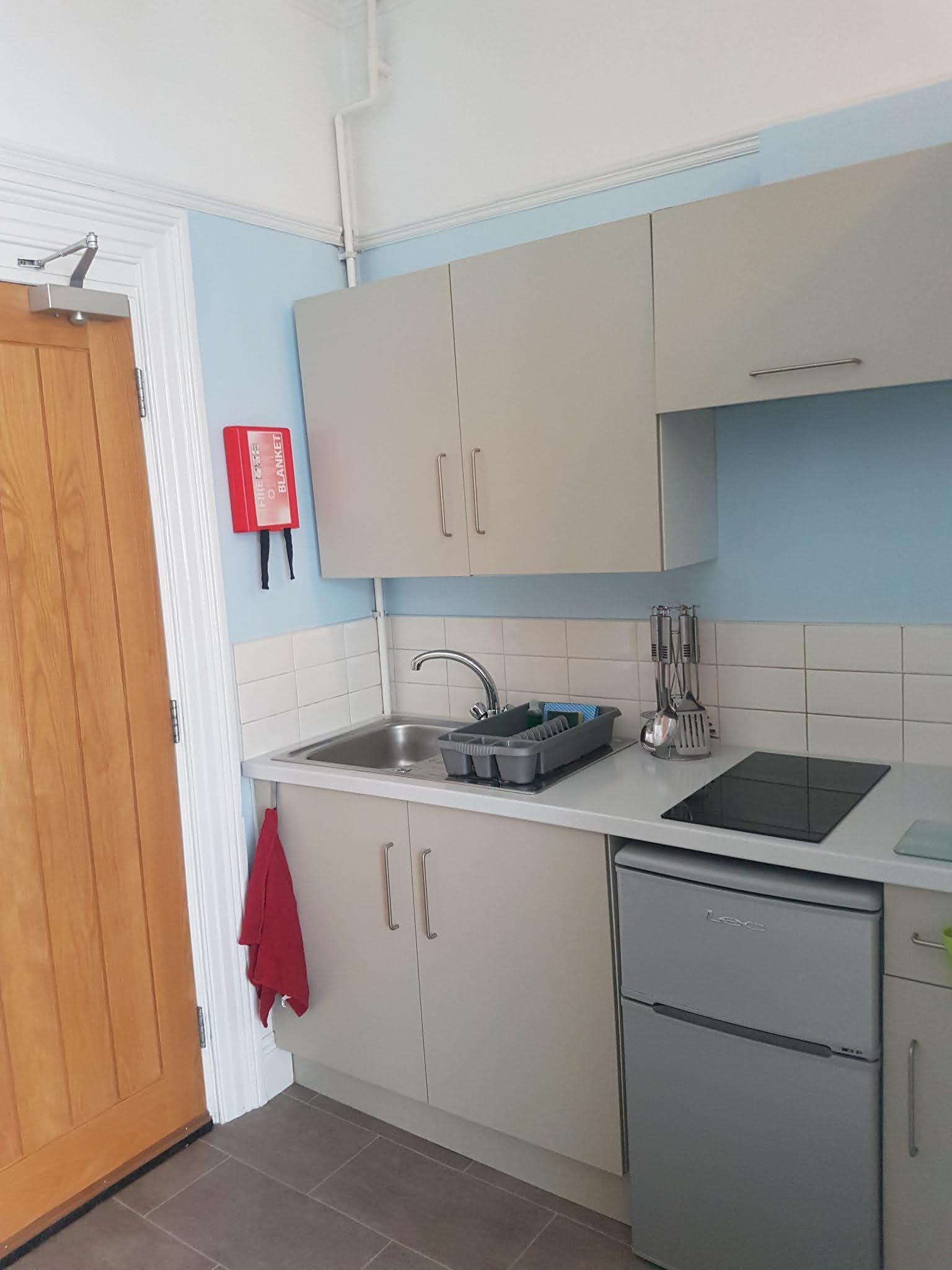
The room could best be described as compact, but it had everything necessary. A small kitchen area with a hob, microwave oven, and toaster; a living/sleeping area with a huge bed, settee, dining table and TV, plus a wardrobe that had been sourced from a local antique shop and reminded me very much of my childhood, with matching bedside cabinets. And, of course the immaculate bathroom (shower room really, as there was no tub).


Would I recommend Beachside for a short break? Without hesitation. Would I recommend Eastbourne for a holiday? Yes. I’d not been there other than on a day trip since that holiday with my parents in the 1970s, and the resort has a sort of God’s Waiting Room reputation (there’s a joke that half the population are over 65 and the other half are poodles), but it seemed more lively than I had expected. And, if some of the regional accents and football shirts on display were anything to go by, holiday makers from various far-flung parts of the country had decided that it was a good place to visit.


Many of England’s seaside towns are in decline, and have been for a number of years. Eastbourne hasn’t avoided the effects and there are a number of empty and boarded up shops including a long since defunct TJ Hughes, and a more recently closed branch of Debenhams. There is however, a fairly vibrant main street, and a bright shopping centre – The Beacon – with many popular retailers represented. Eastbourne is not a seaside resort teeming with amusement arcades, and sadly the pier is closed at present, but the front is thronged with hotels and guesthouses, and there are plenty of places selling food and drink along the promenade. Compared with some resorts – Folkestone, for example, where Val and I spent a few days last year and which looks very down at heel – Eastbourne seems to be thriving, although according to a report on local TV news, visitor numbers have been down this year. That didn’t seem to be the case when we were there; steady rather than packed I’d say, and more people in the pubs and restaurants than I might have expected.


Since lockdown began, the number of miles that Val and I have walked has fallen dramatically. Before lockdown I was averaging 5.03 miles a day. Since March this year, that average had fallen to 4.93 miles, and my average during lockdown was even lower at 4.08. Our four days in Eastbourne pushed the average up slightly. We started with a trip to Birling Gap on Friday, and we walked 11.86 miles that day. On Saturday we did 14.07, dipped below ten to 9.19 miles on Sunday (the only day we had rain), but pushed the average up to 11.73 miles for the four days by completing 11.80 miles on Monday.


Monday was the hardest day. We walked from Eastbourne to Beachy Head; not a particularly long way in itself (from Eastbourne Pier it is only 3.5 miles), but there are two routes to walk there, one is fairly gentle (which was the way we came back), one is not so easy. There is one path we took that has such a steep gradient that looking back is vertigo inducing. I really thought at one point that I would not make it to the top, my thighs and calves were on fire.


Holidays in England have always suffered in comparison with trips to Spain, or Cyprus, or more distant locations due to the vagaries of domestic weather: A common factor in holidays I took as a child in this country was arriving somewhere that had allegedly not seen a cloud in the sky for months, and then having to spend a week dodging the rain, until the day we travelled home, which inevitably would be hot and sunny.


That comparison hasn’t changed, but this summer we have been fortunate in having generally good weather, a blessing in the circumstances: a cold, damp English summer would have restricted what people could do, although with the numbers thronging the beaches at Bournemouth and Brighton, potentially spreading the virus, perhaps that was a mixed blessing.


I am as happy to go on holiday in this country as I am to go abroad – happier, probably what with not having to negotiate airports – so long as the weather is reasonable, which is not something that England can guarantee; if it were I probably wouldn’t bother going abroad again.


Saturday, 8 August 2020

A Game of Two Halves – Football’s Haves and Have Nots

On the first Saturday of August 2020, when the 2020-21 FA Cup competition ought to have been kicking off, the 2019-20 version lurched to a conclusion with Arsenal beating Chelsea 2-1 at an empty Wembley Stadium, absent of fans due to COVID-19.


Immediately after Arsenal’s victory, speculation began as to whether they would be able to retain the services of captain and winning goal scorer Pierre-Emerick Aubameyang, whose current contract sees him earn £180,000 a week. At the same time rumours began about the players that Arsenal would want to sign during the transfer window with Chelsea’s Willian and Barcelona’s Ousmane Dembele among the names mentioned:  Neither would come cheap.


Arsenal were in the news again a few days later, when they announced 55 redundancies among the club’s non-playing staff as a cost-cutting measure. To justify this, the club cited significant reductions in income from broadcasters, and from matchday and commercial activities. But winning the FA Cup earned the club £6,795,00 in money they would not have budgeted on receiving, a sum that amounts to more than £123,000 for each of the employees they are making redundant.                 


Rightly, there is indignation that Arsenal continue to fork out top-dollar to their playing staff while dispensing with the services of more than fifty less generously rewarded back-room personnel. It’s true that like players at many other Premier League clubs, the majority of Arsenal’s playing squad accepted a pay cut recently - 12.5% in their case – and those sort of savings (on Pierre-Emerick Aubameyang’s salary alone it works out at £2,250 per week, and he isn’t even Arsenal’s top paid player) ought really to have staved off the need for these redundancies.


Arsenal are owned by billionaire Stan Kroenke, whose net worth is estimated to be in the region of £6 billion. He – and the club - could absorb the costs of those 55 employees (there’s that £6.7m FA Cup windfall for a start), by adjusting their playing budget accordingly, causing little hardship to their playing staff in the process. But they won’t, because that is a move that the top clubs make only in extremis, and we aren’t there yet.


Football’s finances can be mind-boggling, the difference between the haves and the have nots widening all the time. Just as Arsenal’s playing budget versus their redundancies is extreme, Manchester this week provided another startling comparison.


On Wednesday, Manchester City paid £40m for AFC Bournemouth defender Nathan Ake. The following day, Droylsden FC, a club located just three miles up the road from the Ethihad Stadium, announced that they had resigned from the Northern Premier League and this season’s FA Cup and FA Trophy competitions. The club made a statement in which they said, “The closing of the social club and its function rooms  since the start of the pandemic, the main income source with no indication of any restart on viable trading terms along with a loss of income from the club’s main sponsor  has left the club with no visible alternative income stream during the crisis.”


The transfer fee that Manchester City paid AFC Bournemouth would sustain a club like Droylsden for many, many years – decades even – illustrating that the gap between the top of the game and its lower reaches is so great that it is almost incomprehensible.


As I already said, as substantial as the prize money that Arsenal collected for winning the FA Cup is, it isn’t money that the club would have budgeted on receiving when the season started, and when you consider that it is less than half what they pay Mesut Orzil in a year (they pay him £350,000 per week), it becomes almost insignificant, despite the fact that it represents riches beyond compare for clubs at Droylsden’s level, the eighth tier of the English game. At that level income streams can be precarious. Most clubs rely on income from their bars and function rooms and the generosity of owners, directors and supporters, and when deprived of that income, their position becomes perilous. Gate receipts can be low, sponsorship money (if any) may be just a few thousand pounds - unlike the £64m Chevrolet pay Manchester United - and there are no lucrative TV deals. FA Cup prize money is not a given either, nor when received is it as generous as it would be for a club like Arsenal.


The £6m that Arsenal earned winning the FA Cup required them to win six matches. A club starting in the first round of the FA Cup last season - the Extra-Preliminary Round - and winning six matches would have earned £46,390,  a not inconsiderable sum – I know of clubs whose annual turnover is less than that – but for 2020-21, the ravages of COVID-19 mean that the prize money has halved; a club winning the first six rounds will earn just £23,194 this season.


To make matters worse, the first two rounds of this season’s FA Cup – the Extra-Preliminary, and Preliminary Rounds – are scheduled for 1st September and 12th September. With the Government not yet prepared to allow spectators at sporting events – recent trials of limited numbers of fans at cricket, horse-racing, and snooker were postponed – these games are likely to go ahead behind closed doors. For clubs of the status playing in the early rounds of the FA Cup, this will be expensive. Despite having no income from paying customers, they will still incur significant expense, as these genuine figures from one of last season’s FA Cup ties show:

  • Gate receipts: £557.60
  • Match officials’ expenses: £171
  • Away team expenses: £336
  • Other expenses: £64
  • Loss: £13.40


That same game this season, with no gate receipts, would result in a loss of £571 for the home club. In the Extra-Preliminary Round, the winners will receive £1,125 from the competition prize fund and so a side winning at home in our example would actually be £554 ahead, but if these expenses were incurred by a team losing at home (who would receive just £375), they would be £196 out of pocket. (For the sake of this argument I am assuming that clubs will still be expected to meet away teams’ expenses this season, although that could change).


In a further example of the difference between the haves and have nots, the rules of the FA Cup require clubs to pay the fees of the match officials in the qualifying rounds, although The FA pay the fees in the competition proper. This means that while AFC Liverpool of the North West Counties League would have to stump up for the ref’s expenses in a home FA Cup tie played behind closed doors with no income, their Premier League neighbours, Liverpool and Everton – who would likely receive TV income even if no gate receipts - would not. Does that sound fair to you?


On top of these costs, clubs have players’ wages (even if modest), plus rent, rates, utility bills, and sundry other expenses to cover from little or even no income.


I have little sympathy with Arsenal pleading poverty and trying to justify 55 redundancies that using their FA Cup prize money could avoid, instead I’ll save my sympathy for 500-odd non-League clubs who will embark on their 2020-21 FA Cup campaigns in September, and will pay handsomely for the privilege.


How England Were Nearly Denied The 1966 World Cup

In 2017, during the bidding process to determine who would host the 2026 World Cup, FIFA President Gianni Infantino addressed the travel ba...