Thursday, 19 September 2019

The Value Of Nothing


Most of us take it for granted that we can pop along to a supermarket and buy pretty much whatever food takes our fancy, and increasingly we can do this at almost any time of day or night. I'll caveat that by saying that there are hundreds of thousands of people in the UK living in food poverty, that 1.8 million emergency food parcels were handed out in 2016/17, and there are over 2,000 food banks across the UK, which is nothing short of scandalous.


For those people who live in food poverty the bad news is that this year food prices have hit their highest rate of inflation in five years, 2.5% in March 2019 according to the BRC-Nielsen Shop Price Index. UK crops such as onions, potatoes, and cabbage showed the greatest increases, while increases in global cereal prices have led to increases in the cost of bread and cereals. Despite this, UK farmers increasingly find it hard to make ends meet, with the Department for Environment, Food and Rural Affairs (Defra) predicting that incomes are expected to fall across almost farm types in England in 2018-19 with pig farms likely to be the hardest hit.


Some sources predict that food prices will rise as a result of Brexit, although not everyone agrees. On his LBC Radio show, Nigel Farage told one caller who said as much that equally, prices could fall, due, he said "to terminology." Quite what he meant by that I have no idea; I'd be grateful if anyone could enlighten me. But whatever happens to food prices, one sector or another of the population will suffer. Increasing prices put even more pressure on those who rely on food banks, while falling prices squeeze farmers profits and will inevitably drive some out of business.


Wandering around my local supermarket, one could be forgiven for gaining the impression that we truly live in a land of milk and honey judging by the trollies laden with food of all types and from all nations. Sadly, a whole lot of the food that gets wheeled out of supermarkets gets binned, and a lot of that is food that isn't even partly used. Around 18 million tonnes of food, with a value of around £23 million ends up in landfill every year in the UK. In part, the relative cheapness of food (even in spite of the food inflation we are experiencing) is to blame. Simply put, too many people do not value the food they buy. In our house it causes almost physical pain for us to throw out uneaten food, although there are times when it is unavoidable. I have found that doing smaller, regular shops cuts down the amount of food that gets thrown out, although for many people the weekly bulk shop remains the default option, either through choice or necessity.

Food is not the only thing that we buy that we treat in a somewhat cavalier manner. Around 300,000 tonnes of clothing, worth £12.5 billion ended up in UK landfill sites in 2017, with one in ten people surveyed saying that the cheapness of clothing meant that they regularly threw clothes away after a few wears, with clothing considered 'old' after twenty washes or fifty days. Looking at the prices of retailers like Primark, it is easy to see why people would think that. According to a survey conducted for the charity Barnardo's, Britons will this year spend £2.7 billion on over 50 million summer outfits that will get worn just once. This will include £700 million spent on 11 million items bought for holiday trips that will then never be worn again.


Few people consider the environmental impacts of buying and discarding cheap items of clothing. A t-shirt from Primark can cost as little as £2, so it is little wonder that they will be bought, worn a couple of times and then discarded. I admit that is an attitude that I have adopted in the past. Back in 2007, we went on holiday to Tobago, and I bought some cheap polo shirts. They cost £2.50 each and my thoughts were that I wouldn't be heartbroken if I never wore them again, say if they were ruined in the sea or discoloured by sun-tan lotion. As it happens, brought home and washed, there was nothing wrong with them and I still have them, and still wear them. Which is probably just as well when one considers what goes into the production of the average t-shirt.  The production of one cotton t-shirt requires 2,700 litres of water in growing sufficient cotton (about the amount one person drinks in nearly three years). A pair of jeans requires about 7,600 litres. By throwing out perfectly wearable clothes, we are not only bunging the country up with landfill, we are wasting precious resources such as the water that is required to produce them in the first place. The low cost of clothing might give us incredible choice at affordable prices, but it does nothing to instil in us a sense of value of what we are buying.


I recently read Marie Kondo's book, The Life-Changing Magic of Tidying Up, from which I learned that I, like millions of other people, own too much 'stuff' and that includes clothes, so what I am about to say somewhat contradicts what I have just said about throwing stuff away,  especially clothes. Looking at the amount of clothing in my wardrobe, I know that there is plenty of stuff that I am unlikely to wear again. Like most people, I sometimes buy clothes to which I am attracted, but find that I have little occasion to wear, either because they do not really suit me, or there is little opportunity or justification. There is a school of thought that clothes one hasn't worn for a long time - usually a couple of years - are ripe to be disposed of. Kondo (pictured below) doesn't subscribe to that, preferring the idea that we should dispose of things that no longer give us joy. The problem with that is that it conflicts with the justification that most people have for keeping things, either the sentimental value attached to possessions, even if they will never be used again, or fear that as soon as they are thrown out, a need for them will be found.


There is a balance to be struck, whether it is in food or clothes that we buy. We should buy what we need, and value what we buy. Oscar Wilde said that a cynic is a man who knows the price of everything and the value of nothing; whether it is cynicism or not, as a society we are increasingly losing sight of the value of things.

Thursday, 5 September 2019

"And Here Is The Draw"


The FA Cup is probably the only sporting competition that has as much interest and mystique invested in its draw as it does in its matches themselves. The anticipation and excitement as the day of the draw approaches is palpable, and speculation about who players, managers, and supporters want to be drawn against puts all thoughts of league games, or any other competitions, to the back of everyone's minds. These days the draw becomes a TV spectacular once the competition reaches the First Round Proper (and where else other than in England would we deem a competition to have a 'proper' stage?)  Where possible this involves holding the draw in the bar of a non-League club that is still in the competition, with tenuous links that anyone at the club may have with a Premier League club drawn out for all they are worth, while young supporters wave tin-foil FA Cups around. It's all a bit of harmless hokum, but a million miles away from the gravitas that surrounded the FA Cup draw in days long gone past.


A draw made by ex-players like Ruud Gullit and Paul Ince, and overseen by someone such as Mark Chapman, is some way off, although the FA Cup will reach its third stage - the First Qualifying Round - this Saturday, when 232 teams will do battle; 344 teams have already been eliminated from the competition, and the cricket season hasn't even finished yet!

In these early stages of the competition, there is no glamour, nor pomp and circumstance to the draw. I don't know exactly how the Football Association administers it, but without the glamour of it being live on TV, it is quite possible that it is an unwelcome chore for some FA employee responsible for the competition's Preliminary and Qualifying Rounds, and who has other pressing concerns on the day. He (or she) will groan as their PC pops up a reminder "12.15pm, FA Cup draw, post online 1pm." They will then look around the office for a collaborator, and having found some unfortunate person whose eye they caught, will drag them off to a break-out area with a box containing three hundred and fifty odd-numbered pieces of paper representing the teams still in the competition. At the conclusion of the draw, there will inevitably be one team left over, which prompts a frantic search for the missing numbered piece of paper, which if not located, requires a process of elimination to determine which team will complete the final tie. That may not be the way it works, but the FA would endear themselves to me no end if there was a smidgeon of truth in this.


There was a time when the FA Cup draw took place religiously at one o'clock on Monday afternoon following the previous round's matches. In the days I'm talking about, all of the ties would have been played - if not settled - on Saturday afternoon, unlike today, when at least one tie will be outstanding when the draw is made. The BBC would announce that they were taking us over to FA Headquarters, then located at Lancaster Gate, saying "The first voice you will hear will be that of Ted Croker," whereupon he (Croker), the secretary of the FA, would announce, "Here is the draw for the Third Round of the Football Association Challenge Cup competition," and introduce two FA officials that no one outside the room from which the draw was being broadcast would ever have heard of, to make it. A rattle of the numbered balls in the velvet bag, and we were off, with football fans up and down the country, in offices and factories, listening intently to someone's transistor radio. Even for people with either little interest in football, or those who supported teams already knocked out of the cup, the draw on the radio - especially for the Third Round - was always a high spot of the football calendar.

Ted Croker

I know that times change and the FA Cup draw was always destined to move away from radio and on to television, but at least it still retains a degree of integrity, not least because the draw remains free of seedings.[1] The draws for the World Cup, and the Champions League, as well as having seedings, also have an excess of pomp and circumstance that makes them virtually unwatchable - except this year of course, when Eric Cantona brought an element of surrealism to the Champions League draw by (mis)quoting from King Lear. The only comparable performance to Cantona's is probably the time Rod Stewart assisted at the Scottish Cup draw having clearly been well refreshed beforehand.

Eric Cantona at the Champions League draw.

The Champions League format looks likely to change in future if the rumours are true. Instead of eight groups of four in the qualifying round, from which sixteen clubs will win through to the knock-out stages (the competition proper, if this were the FA Cup!), there is the very real possibility of four groups of eight. The upshot of this would be fourteen games for each team at the group stage, and a total of twenty-one matches needed to win the competition, as opposed to six, and thirteen respectively at present.

If this comes to pass, then the managers of English clubs playing in the competition will complain even more bitterly about congested fixture lists than they do now, and will place even less importance on the Carabao Cup and FA Cup than they do now. Chances are, they will be fielding entire sides lacking even a single first-team player in those competitions, or suggest that their clubs withdraw from them altogether. And four groups of eight might merely be the precursor to two groups of sixteen and an eventual European Super League, an idea that has been around for many years.

A well refreshed Rod Stewart at the Scottish Cup draw in 2017

It's probably fair to say that the BBC have managed to strike just about the right tone with the televised version of the FA Cup draw, with a nod to the gravitas of the draw when it was only on the wireless, and a dash of entertainment, but without the pomp and circumstance of the Champions League's effort. Mind you, if they want to hire Eric Cantona and Rod Stewart for a future draw, I'm sure it would do their viewing figures no harm at all.


[1] You may say that exempting teams from qualifying rounds and the fact that the Premier League sides don't enter until the Third Round proper is a form of seeding, but by my definition, the fact that in each round there is no filtering to prevent the supposedly two best sides left in the competition from being drawn against one another.

Thursday, 22 August 2019

The Wonder Of Woolies


When I was young there were only a few shops that I would willingly go to; at best I was indifferent about the majority of stores I was dragged to by either or both of my parents. The exceptions were WH Smith,  the Apex Libraries, and Woolworths. WH Smith needs little introduction, and it was there I would peruse the paperbacks and the stationery, making the odd purchase here and there when my meagre resources allowed. Apex Libraries was an independent bookseller in Romford's Quadrant Arcade and is likely the shop referenced in Ian Dury's song, Razzle In My Pocket. Apex Libraries had a different range of books compared with Smith's, I can remember there were paperback compilations of Batman comic strips that were not to be seen anywhere else, and apparently, they also stocked magazines that catered for niche interests which the more mainstream booksellers, like WH Smith, did not. 


I distinctly remember owning a copy of this.

For almost everything but books, however it was Woolworths that drew me in time and again. 

The last Woolworths store in the UK closed its doors for the final time in 2009, and there are still times when I feel its absence. Woolworths - or Woolies as we all knew it  -was one of those shops that was nice to just wander around, even if you didn't buy anything. Too many people doing that might well have been part of its downfall. Woolies didn't specialise in anything - again that might have been part of their problem - but you could buy almost anything there, from sweets (the almost legendary Pick 'n' Mix section was, for many people, good enough reason alone to visit Woolies) to televisions, from clothes to garden furniture.

It was at Christmas that Woolworths really came into its own, especially if you were buying for children, as its range of toys and games was almost unmatchable other than in speciality toyshops. One year, it must be about fifteen years ago now, Val and I went Christmas shopping at Lakeside and spent most of our time, and a large proportion of our festive budget, in Woolworths, buying presents for our children. Our children are now grown up, but I guarantee that if Woolworths were still going, a good number of their presents would still come from there, come Christmas.

Woolworths, Collier Row, shortly before it closed.


The Woolworths store in Collier Row, just ten minutes walk from my childhood home, was somewhere I visited regularly. School supplies - boring, but essential - were frequent purchases, with notebooks ('rough books' as they were known at my school), pens, pencils, rulers, protractors and compasses all being sourced there. 

Many of these were bought for school.

Then there were things to play with or more specifically, one thing that I played with a great deal, the famous Wembley Trophy Football. I used to spend hours kicking a ball around our back garden. We lived in a block of flats when I was young, it had a large communal garden with the back wall of a block of garages at one end, against which I would habitually kick the ball. While this was great fun, it did have a detrimental effect on the structural integrity of the plastic footballs, which inevitably would puncture, truncating my game and meaning that I had to abandon playing football until such time as I had saved up enough pocket money to buy a new one.


Apart from footballs, I would regularly purchase scrapbooks from Woolies. I was actually quite surprised when re-reading Fred Eyre's wonderful book, Kicked Into Touch, recently when the author said that when he embarked on his football career and wanted a scrapbook to keep his press cuttings, he had to search high and low in Manchester's stationers before finding one. Why, I wondered, did he not go straight to Woolies? I'm sure they must have had a branch in Manchester. 


My first scrapbook was purchased, from Woolies, in 1968 for a school project. The Olympic Games in Mexico was the subject, and my class was tasked with producing a scrapbook about the event, which I did assiduously. I think that I must have enlisted the help of my parents' work colleagues to supply me with daily newspapers to collect cuttings, as I won a prize, not so much for the quality of my work, but for what my teacher described as "the sheer volume" of it!

The year of the Mexico games was also the year I started going to watch my local football team (see Romford 1, Manchester United 0) and I started keeping scrapbooks. Over the years I collected almost every press cutting about Romford FC from our local newspapers, namely the Romford Recorder, the Romford Times (later, Express), and the Romford Observer, which was a bit of a latecomer on the scene, but had the novelty of including colour pictures. Occasionally there were small features to be found in the national press. I had an extensive collection of scrapbooks covering the ten years that I supported the football club until they folded in 1978, but at some point thereafter, with there seeming to be little or no point in keeping them anymore, I threw them all out. Now, with the football club having been resurrected in 1992, I dearly wish I had kept them.

Were I just starting to support a football team now, I doubt very much whether I would bother starting a scrapbook, especially for Romford, since local newspapers coverage of local sport has changed immeasurably over the last fifty years, and largely not for the better. Back in the 1960s, the Romford Recorder had match reports, features, previews and photographs galore of local football, but today the coverage is meagre. This week's edition has just four pages covering all the local teams, and a good deal of that is about the nearest Premier League side, West Ham United, which is syndicated in the Recorder group's newspapers that cover East London. The paper pretty much gave up including formal match reports years ago; a scrapbook of cuttings about Romford FC from its pages would be quite thin these days. That is an inevitable consequence of the changes to the way we consume news these days, not just sports news, but all news. 
Still going, but the Romford Recorder is but a shadow of the paper I remember from my youth.


In 1968, the local paper was an invaluable source of news; many is the time I would have to wait till the Recorder came out on a Friday to learn of Romford's result from a game they had played on a Tuesday; not so now. And the Recorder was legendary for its classified section, with pages and pages devoted to car adverts, job adverts, and estate agents' listings, yet more areas of our life where the internet has taken over from the print media as our primary source.

No doubt there are stationers up and down the country that sell scrapbooks, but even if I saw the point in buying one now, getting it from anywhere other than Woolworths just wouldn't seem right.  That was the wonder of Woolies.


Wednesday, 7 August 2019

And Then Came Mogg


The Roman Empire, the reign of Henry VIII, and the two World Wars of the 20th Century. Periods of history that have long intrigued and inspired historians and academics, novelists and playwrights. In Britain, if nowhere else, the 1939-45 conflict continues to affect our language, and dare I say, our relationship with the rest of Europe. The Battle of Britain, Dunkirk, the D-Day Landings and the Blitz spirit all get used as metaphors for football matches, the weather, and increasingly, Brexit. I imagine that in time, Brexit itself - from the day that David Cameron announced the referendum in 2015 to whenever Britain leaves the EU - will become a subject and a period that academics will revisit and about which they will write scholarly tomes analysing its causes and effects. And no doubt, there will plenty of fiction that uses Brexit as its premise.


If Brexit were a work of fiction I believe that many readers would describe the characters on the British side of the story as too farfetched[1]. There is Nigel Farage, the privately educated former commodities trader who is unable to get elected to any Parliament other than the one he professes to despise, a self-styled 'man of the people' who rails against a political elite of which, having been an MEP since 1999, he is a long-established part. Real-life Farage is very much a Marmite figure, and audiences would be equally ambivalent about a fictional version. Good guy, or a bad guy? You could make the case for either.


Next up, the New York-born Alexander Boris de Pfeffel Johnson. One can imagine an editor, on reading a first draft, demanding that 'de Pfeffel' go as it is an implausible name - ludicrous even - albeit it is a real one, with roots in Germany, and from which family Johnson is descended. Johnson has cultivated the persona of an amiable buffoon over the years, which would be all very well if it cloaked a razor-sharp intellect and a proven track record of success, but having been sacked from The Times for making up a quote, he admitted that when working for The Daily Telegraph in Brussels he invented negative stories about the EU. As Mayor of London, he spent over £50million on a bridge that got no further than the design stage, bought three unusable water cannons that were scrapped at a loss of £300,000 and introduced an updated and much-derided Routemaster bus to London's streets. He may talk a good game, but his failures speak even louder.[2]


And then comes Mogg. Jacob Rees-Mogg is beyond parody, impossible to lampoon. Here is a man who dresses like an extra from a Victorian melodrama, peppers his speech with Latin, and who has been dubbed "the Honourable Member for the 18th century." Rees-Mogg has been described as "the stupid kind of Tory’s idea of what a clever kind of Tory ought to sound like." Superficially, he appears an intellectual, a man of gravitas, although how much of this is mere affectation is moot. His recent book, The Victorians: Twelve Titans who Forged Britain  has been described as "12 turgid essays" and "mindless incoherent drivel." It is perhaps the only book I have seen reviewed on Amazon where there are more one-star reviews than all the others put together. He is, by all accounts, a learned student of parliamentary history, which will no doubt be of value in the coming weeks and months as the byzantine rules of engagement in parliamentary debate and procedure take on great importance in how Brexit is implemented, but of little practical value in helping the populace deal with the fall-out from it.


Rees-Mogg's recent appointment as Leader of the House of Commons coincided with his issuing a set of rules on style to be used by his staff. Were I working in his office I fear that I would frequently fall foul of his rules vis a vis banned words and phrases as most feature in my normal vocabulary. How, for example, he expects his staff to refer to the Equal Opportunity Act of 2010 when 'equal' is one of his banned words, I cannot imagine. I can, however, understand why 'lot' and 'very' may be irritants, these can be lazy variants substituted for specific, but perhaps unknown, amounts or quantities. 

What's the point in satire when real-life surpasses it?


A requirement to use double spacing after full stops (not fullstops) might have made sense in the days of manual typewriters but has little value today. Few writers of style guides favour a double space; most agree it makes writing look dated - which may be exactly what Rees-Mogg is trying to achieve.


Preferences on style and the use of certain words may be harmless matters of taste, but the rule that imperial measures should be used is somewhat unfathomable. I just checked my fridge and cupboards, and the only item that has an imperial measure is a bottle of milk, where both imperial and metric measures are shown. Will Rees-Mogg's younger staff - to whom some imperial measures may be a complete mystery - be expected to use conversion tables to refer to items measured in solely metric weights, volumes or distances by their imperial equivalents? Imagine the hilarity, not to say contempt, in another government department (for instance the Department for Transport) receiving a missive from Rees-Mogg quoting the price of petrol as being £5.72 per gallon instead of £1.26 per litre. Or why not go the whole hog, revert to pounds, shillings and pence,  and call it £5.14s.5d per gallon?


Britain has long been a country in which imperial and metric measures have caused controversy - remember The Metric Martyrs? - and both systems sit in uneasy juxtaposition. We measure distances in miles, and yards... until we get below three feet, when suddenly everything is metric. We dispense beer and milk in pints, but all other liquids in litres, including petrol, for which we quote fuel consumption in miles per gallon.  Rees- Mogg might be more comfortable in a world of imperial measures, but, like pounds, shillings and pence, it is a bygone age. Except that Britain has actually been going metric since the 1800s, with the introduction in 1849 of the florin (one-tenth of a pound) - the first step towards decimal currency - and  the Weights and Measures (Metric System) Act of 1864, which permitted the use of metric measures for ‘contracts and dealings.’

One of the Metric Martyrs. Personally, I buy bananas by number not weight anyway.


As I have my own quirks and foibles about the English language, it might be a bit rich of me to question Rees-Mogg's rules, except my quirks and foibles apply to me and me alone. It would be beyond arrogant of me to expect other people to conform to them. I agree with David Mitchell, who suggested in an article in The Guardian that Rees-Mogg is entitled to enforce these rules if they apply to letters written in his name, but unreasonable otherwise. Quite how Rees-Mogg would react to letters written by members of the public - or, heaven forbid, other departments within Government - that do not conform to his particular standards would probably be a joy to behold. One imagines - hopefully - that he would regard them as unacceptable and a disappointment and, should they lack double spaces after full stops, very much not fit for purpose.


[1] Aside from Jean-Claude Juncker, who has on occasion been accused of being drunk in charge of a continent, the EU officials who have been engaged with Brexit seem to be unremarkable in character; staid and bland even.
[2] Even the successful public bike hire scheme in London, sometimes dubbed 'Boris Bikes' was actually the idea of his predecessor, Ken Livingstone.

Thursday, 1 August 2019

Mind Your Language


Whenever I go abroad I am conscious of the fact that apart from a few words and phrases, I am completely ignorant of the local language, and therefore totally reliant on the ability of local people to speak English, which they almost universally do. Once, in Portugal, I came across a shop where the staff spoke no English, but somehow completed my purchase of a corkscrew by pointing and indulging in some charades. In Vigo, in northern Spain, I managed to order some drinks from a waiter who spoke only Spanish; fortunately, Coca-Cola is fairly universal, although my mangling of naranja (orange) caused first confusion, and then hilarity when it dawned on him what I actually meant. His subsequent enquiry would have been incomprehensible to me had I not recognised the word 'gas' as in 'con gas' in his reply. Both transactions would have been less painful if I had had a bit more knowledge of the local languages.


I have always justified my lack of foreign language skills - to myself, at least - on the basis that I have no aptitude for languages; that learning French would be of little use in Spain or Cyprus, just as learning German would be equally useless in Italy or Norway; and finally, when everyone else speaks English, where is the need? My lack of aptitude for languages I base on how useless I was at French at school, so useless that I abandoned any pretence of revising for my 'O' Level in the subject in the belief that no matter how hard I worked at it, the best I could hope for would be a poor pass, and to the detriment of other subjects, to boot. As a result, I got the lowest grade of fail in the subject, but later, in my work, I found that a better knowledge of French would have been beneficial. As it was, the rudimentary knowledge I had - little more than a store of common words and phrases - came in more than a little handy when having to deal with overseas banks who habitually sent SWIFT messages in French.[1] These banks were typically from North African countries, like Nigeria and Algeria.  French banks tended to correspond in English, and while English was the norm, there was no reason why banks in French-speaking countries should not use French, as I pointed out one time to someone who had sent a message to a bank saying that we didn't deal with messages in other languages, and asking them to repeat their message in English.


While there is a grain of truth that my lack of French is down to down to having no aptitude, it is possibly equally valid to say that it was to do with the culture at my old school, where learning French was quite low on the list of priorities, and, bizarrely, was also seen as a subject for girls rather than boys. Had I studied French harder, and passed an 'O' Level in the subject, it would have helped me much more than Physics, which I passed but have had no use for since; what I actually did learn in that subject was soon forgotten. The little I have retained enables me to answer the odd question on University Challenge, but has no other benefit. But, even if I were fluent in French, or at least could get by, that would be no use other than in French-speaking countries, surely. Except that plenty of people who don't speak English have French as a second language, and who is to say that, having learned French properly, I could not have taken up German or Spanish as well? The argument that learning one language is only of limited help falls down when one considers how many people are not just bilingual, but multilingual. Earlier this year, Val and I went on a cruise along the Norwegian coast. The crew were principally Norwegian, while there were passengers from the USA, Germany, France, and of course Norway and England. And almost without exception, everyone spoke English, while the Norwegians, in particular, were switching seamlessly from English to German to French to Norwegian, and back again, all in one conversation.

Beautiful Bergen. In Norway it seems that almost everyone speaks immaculate English.


In Norway, and many other countries for that matter, learning a foreign language - especially English - is something that children do from an early age. Learning a foreign language is the norm, taken for granted, whereas in England, it seems to be undervalued and in decline. In February this year, the BBC reported that "foreign language learning is at its lowest level in UK secondary schools since the turn of the millennium." 


The number of pupils taking GCSE language courses has fallen by between 30% and 50% in some areas of the country, and according to Mike Hill, principal at Carmel College in St Helens on  Merseyside, schools and pupils see languages as 'high risk' subjects, in which high grades are hard to achieve. A cynic might say that high grades are no more difficult to attain in foreign languages than they have ever been and that perhaps, other subjects have become relatively easier to do well in. The BBC's data is borne out by the fact that, in a table of countries where people aged between 15 and 32 can read and write in another language, the UK scores 32%, while the next lowest - Hungary - registers 71%, and seven countries score over 90%. Demark comes out top on 99%.


Perhaps a lack of interest in learning foreign languages goes hand in hand with greater insularity, except that Britons have no problem with the concept of 'abroad,' as apart from the 18 millions who visited Spain in 2017, some 310,000 UK citizens live there. There are 4.9million UK citizens living abroad, more than any other EU country. Given a reluctance to learn another language and a tendency to not integrate into local communities, UK citizens who have moved abroad seem to me to have done so purely because the weather is better, and merely want to transport their bit of their home country there with them. While I am sure that there are plenty who do integrate into the local community, I'm equally certain that the majority do not.

EU Citizens Living Abroad
Italy 2.9m
Romania 3.4m
Germany 4m
Poland 4.4m
UK 4.9m
Source: Metrocosm/UN Population Division

UK Citizens in the EU:
Italy 70k
Germany 100k
France 190k
Ireland 250K
Spain 310k
Source: Fullfacts.org/UN


The fact that as a nation we Brits are so reluctant to learn the local language when moving abroad is made all the more shameful considering how frequently we criticise immigrants to our own country who fail to integrate or learn English. During his successful campaign for the leadership of the Conservative Party, Boris Johnson said recently that  immigrants into the UK should learn to speak English, because there are “too many parts of the country where it is not the first language”.  And this week Johnson's Home Secretary, Priti Patel pledged that in future, immigrants will only be able to come here if they have "a job offer from an employer registered with the Home Office and if they can speak English.” Chances are that many will speak English as a matter of course; far more than would be the case if we were talking about English workers taking on jobs abroad and speaking the language, for example. Apropos to that, I wonder how many of our newly elected MEPs speak anything but English? 

In Auf Weidersehen Pet, a group of British builders travel to Germany to find work. Ok, it was fiction,
but I don't recall any of the characters learning the local language.


I am probably a bit too long in the tooth to start learning a foreign language, and in any case who knows how often I will go abroad in future, or indeed where? The fact remains, however, that I am now sorry that I didn't give French a bit more attention at school, at the expense of another subject. Physics could have gone for a start.


[1] SWIFT - Society for Worldwide Interbank Financial Telecommunication

Thursday, 25 July 2019

The Bookmaker And The Isthmians

As the 1970s dawned, the Isthmian League was one of English football's last bastions of the amateur game.  Formed in 1905, its champions received no trophy, and players received no medals as the league lived by its motto, honour sufficit, - 'honour is enough.' For many years the constitution remained fairly static - membership was by invitation only - and with only one division, there was nothing so vulgar as promotion or relegation to trouble its member clubs. But during the 1970s, the Isthmian League became innovators, and were in the vanguard of change in football below the Football League as the distinction between amateurs and professionals was removed and the game went 'open.'


The Isthmian League logo


In 1973, the league became the first to be sponsored. Prize money was offered to successful clubs, but in an attempt to improve sportsmanship, there were deductions for cautions. The League was the first to adopt 3 points for a win, and also the first to use goal difference instead of goal average. The league's first sponsors were the tobacco company, Rothmans of Pall Mall, who were also sponsors of the British Olympic team in 1992, and of a highly successful football reference book. Today, tobacco company sponsorship in the UK is no more - it was banned in 2005 - and the number of smokers in England has consistently declined in recent years, while just this week, the government published a green paper in which it pledged to end smoking by 2030. That is an ambitious target since, despite incontrovertible evidence that smoking is detrimental to health, there are still over fourteen million people smokers in the country. Rothmans' sponsorship of the Isthmian League ceased in 1977, but this summer the league announced a sponsorship deal with a company from another somewhat controversial sector of the UK leisure industry, as we will see.

The number of people smoking in England shows a consistent decline over recent years.


The advertising of alcohol and the sponsorship of sporting events and teams, while not banned in the same way as tobacco, has seen constraints and decline in recent years. The UK's regulations on the advertising of alcohol are among the strictest in the world, and the sponsorship of English football clubs by drinks companies, once so prodigious, has declined to the point that by 2017, not one Premier League club had a sponsorship deal with a brewery or other drinks company.

Liverpool's sponsorship deal with Carlsberg was one of the last between a football club and a brewer.


While the sponsorship of football teams and competitions by tobacco companies and alcohol companies has declined, through legislation or otherwise, companies involved in a third major vice - gambling - are becoming increasingly involved in sports sponsorship. In 2018, nine Premier League clubs and seventeen Championship clubs were sponsored by bookmakers. The English Football League's three divisions are sponsored by a bookmaker - Skybet - and this summer, the Southern League, the Isthmian League, and the Northern Premier League announced a sponsorship deal with BetVictor.

For those of you unfamiliar with the structure of English football, the Southern, Isthmian, and Northern Premier leagues cover the seventh and eighth tiers of the game - that's 228 clubs - and the sponsorship deal with BetVictor is strictly regulated; in fact, that strict regulation has been the subject of much comment and debate. While I have no information on the value of the deal, I imagine that it is a lucrative one for the three leagues, and no doubt BetVictor believe it will be beneficial to them. They are ranked twenty-third among online bookmakers in the country, and presumably, this deal is about increasing brand awareness. As with tobacco companies and brewers, such advertising as is allowed is less about getting people to enter the market, more about getting them to buy your product rather than that of your competitors. Most people who smoke, or drink alcohol, or gamble, don't generally start because of advertising, but once they are consumers, it is advertising that plays a significant role in which company's product they use. Hence BetVictor are probably banking on the thousands of players, officials and supporters of those 228 clubs using their company rather than Coral, William Hill, or Bet365.

Among the restrictions that relate to bookmaker's sponsorship is CAP Code, or to give it its full name, The UK Code of Non-broadcast Advertising, Sales Promotion and Direct Marketing, written and maintained by the Committee of Advertising Practice (CAP) and administered by the Advertising Standards Authority (ASA). This prevents anyone under the age of twenty-five featuring in marketing communications for a gambling brand (unless they are the subject of a bet being offered). Hence, earlier this year Spurs and William Hill found themselves in hot water for a tweet that featured a Spurs team line-up that included two under 25 year-olds, alongside a link to a page offering odds from the bookmaker.

A tweet like this saw Spurs fall foul of the CAP Code


Apart from the similar restrictions that will be imposed on the clubs in the three leagues now sponsored by BetVictor, the leagues have decided - possibly after some negative publicity - not to require clubs to feature adverts for the sponsors either in their programmes nor around their grounds, nor will clubs wear the sponsor's logo on their shirts, as was the case with Evo-Stik, Bostik or Ryman, who sponsored the various leagues in recent years. And - like Spurs - clubs cannot feature players who are under twenty-five on their websites, or on social media, on pages that include links to the sponsor's website.

Paul Dipre, chairman of Isthmian League side Carshalton Athletic, strongly disagrees with the sponsorship deal (you can read his statement here) and many supporters of clubs in the leagues have expressed their disquiet over it, especially since it is estimated by the Gambling Commission that in 2017 there were more than 2 million people addicted to gambling or at risk of developing a problem. Furthermore, the charity GambleAware found that problem gamblers face significant risks of suicidal thoughts, depression, substance abuse and financial problems. In 2013, Headingley AFC lost one of their players to suicide due to his gambling issues and the club are now sponsored by an anti-gambling charity. AFC Headingley play in the West Yorkshire League, so not one of the leagues sponsored by BetVictor. If they were, I imagine the league would be having an awkward conversation with the club over a conflict of interest.

Headingley AFC in shirts sponsored by the charity, Gambling With Lives.


Players, management, and officials of English football clubs in the top eight levels of the game are expressly prohibited from betting on football in any form; this means that a voluntary committee member at a club playing in English football's eighth tier cannot put a small bet on the outcome of the World Cup Final. While that may appear Draconian, it at least removes room for doubt; there are no grey areas, no loopholes, but for many people it smacks of double standards. Is it morally right for a sport that prohibits participants from betting on it, to be so intimately linked with the gambling industry?

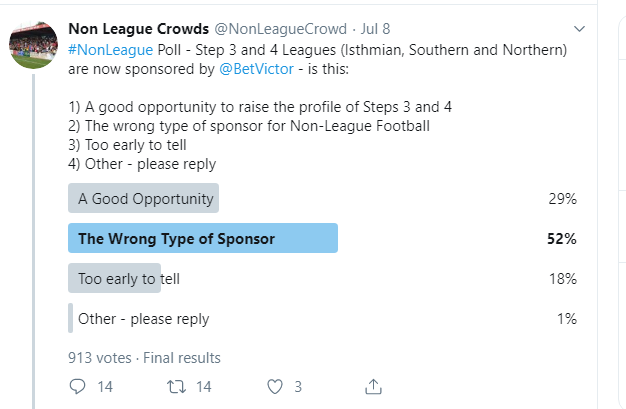
A Twitter poll showed the disquiet many people feel about bookmakers sponsorship in non-League football.


Or, since money-spinning sponsorship deals don't grow on trees - not for teams and leagues below the highest echelons in any sport - is the disquiet and criticism that the deal with BetVictor has occasioned a little unfair - ungrateful, even - especially since, at present, bookmaking firms are sponsoring football to such a degree that it is becoming the norm, rather than the exception. And, just as tobacco sponsorship was outlawed, and just as alcohol sponsorship has waned, the day may come when through legislation or because the industry no longer sees it as worth its while, bookmakers stop sponsoring football. Who can blame these leagues for taking advantage before it's too late?

Bookies sponsoring football is now so commonplace that Huddersfield Town and Paddy Power mocked
up shirts that contravened FA regulations on the size of sponsor's logos for some extra publicity.


Despite the moral and ethical qualms that people may have, sponsorship from bookmakers is legal, heavily regulated, and lucrative. The fact that BetVictor are sponsoring all three leagues at this level could work against the sponsors, as supporters may drop the sponsor's name entirely. BetVictor could find that awareness of their brand is spread less than they hoped. That said, any publicity - even controversial, slightly adverse publicity - gets a brand's name in the public eye, like Huddersfield Town's prank Paddy Power sponsored kit, so I doubt that BetVictor's executives will be losing too much sleep over it.


How England Were Nearly Denied The 1966 World Cup

In 2017, during the bidding process to determine who would host the 2026 World Cup, FIFA President Gianni Infantino addressed the travel ba...