Thursday, 23 February 2017

Basket Cases

The five stages of grief, as proposed by Elisabeth Kübler-Ross, are denial, anger, bargaining, depression and acceptance, sometimes known by the acronym DABDA. Originally used to identify the series of emotions experienced by terminally ill patients, these have been extended to cover bereavement, divorce (particularly as experienced by the children of a marriage), the loss of a relationship and substance abuse. It might seem fatuous to suggest that a similar range of emotions can be experienced by sports fans, but I think it is a theory that holds water. Viewed from afar, the range of emotions experienced by fans of Leicester City certainly could fit the Kübler-Ross model.


Leicester City celebrate their shock Premier League title last season.

The East Midlands club stunned the football world by winning the Premier League title last term but have been in free-fall this season, sitting just one place above the relegation zone and having won just one and lost eight of their last ten league games. While last season their fans will have been experiencing pleasurable disbelief at their team's success, this season they will undoubtedly have run through the gamut of emotions from D to D, even if they may not all have reached A.

The league table does not lie. This is where Leicester now find themselves.

For many fans of teams who look like they are relegation candidates, their journey starts with Denial, as in "We're too good to go down." It  is a phrase heard commonly in football, and having won the Premier League in 2016, Leicester fans could have been forgiven for thinking that at the start of this season. But as any football fan will tell you, the history of the game is littered with clubs who everyone thought were either too big or too good to get relegated, but when the final table is totted up, it is only points, not reputations nor the quality of the football you've played that determine whether or not you stay up.

Then comes Anger - Having seen their side slip to defeats to the likes of Hull City and Sunderland, there will be some supporters who are angry. Angry that the club allowed a player like N'Golo Kanté to move to Chelsea; angry that the players that swept Leicester to the title last season have under-performed so abysmally this campaign; angry that the club have not signed players to address the slide and angry that their team finds themselves where they are in the table.

Next is Bargaining - Leicester remain in the Champions League for now and there are probably desperate supporters offering trade-offs - "I'd happily see us out of Europe if it meant staying in the Premier League," that sort of thing. This stage is also marked by feverish calculations of what will happen if other clubs around them in the table win or draw and exactly how many wins are needed for survival. It's the sort of desperate straw clutching experience that deludes fans into thinking that despite having won only five out of the first thirty games, the team can win five of the last eight.

Then Depression sets in - There will be those who can see no possibility of staying up, so they give up hope: they may still go to the games or watch them on TV, but do so with a sense of futility - "I don't know why I bother, I know they are going to lose."

Finally, Acceptance - There will come a stage when relegation is unavoidable, or while mathematically still possible is so unlikely that it might as well be. Perversely, this is when - with the pressure off - teams suddenly start performing well and win a game or two. The fans, meanwhile have accepted their fate and started planning their trip to Cardiff instead of Manchester next season.

But as miserably as Leicester fans might view their future - and for supporters of the clubs below them it looks more miserable still - they can at least console themselves that the only real difference next season will probably be the division they find themselves playing in, and that they have the very real prospect of bouncing straight back up into the top flight. For some of English football's basket case clubs, both the present and the immediate future look bleak: for one in particular, relegation may be the least of their worries.

Coventry City fans protest about Sisu, the club's owners. Photo: Coventry Telegraph

Coventry City fans may have a trip to Wembley in the much maligned and much boycotted Checkatrade Trophy to look forward to, but relegation from League One seems to be a racing certainty as they sit nine points from safety. Fans have frequently protested against owners Sisu, whose stewardship has seen the club endure rows over unpaid rent (which resulted in a temporary move to Northampton), frozen bank accounts and transfer embargos. Next season Coventry will likely be playing league games in the same division as Morecambe, who were bought - somewhat improbably - by 35-year old Brazilian businessman Diego Lemos last September. Lemos has been seen rarely and as is fairly common in these sorts of cases, there are tales of unpaid wages, unpaid bills and the spectre of closure.

Photo: The Insider


But if you really want to see a club that are a basket case, just look to East London and Leyton Orient. In the 2013–14 season, Orient lost the League One Play-Off final at Wembley to Rotherham United on penalties.  Owner Barry Hearn sold the club to Italian businessman Francesco Becchetti, the club were relegated to League Two and now look likely to drop out of the league completely as they sit second from bottom having won just once in their last ten games. Becchetti's tenure has seen the appointment of eleven managers including four alone this season, which is one manager more than there have been home wins. The term 'Manager of The Month' has a totally different meaning at The Matchroom Stadium. Tales of Becchetti's interference in team matters and the alienation of long-time club employees abound and from the outside it is difficult to decide whether this stems from incompetence or deliberate and wilful actions aimed at taking the club out of existence; whichever is the case, the future of the club is clearly in jeopardy.

This season has seen four managers but only three wins in East London for Leyton Orient. Photo: Evening Standard.

It gives me no pleasure to see the miserable decline of Leyton Orient - after all I was a season ticket holder for over ten years, saw them first in the old Second Division, fall to the Fourth and win promotion, so I have a great deal of affection for them - but on the other hand, I do not I feel that I'm being unfair in describing them as a basket case. It comes to something when, by comparison, I feel blessed with the club I support now (if you want to know how and why I now support them, see http://rulesfoolsandwisemen.blogspot.co.uk/2013/04/romford-1-manchester-united-0.html), even though Romford do not own their own ground, nor play in the town that they are named for, do not have a playing budget and consider themselves fortunate to attract a crowd of more than 150.

The Leyton Orient faithful have almost certainly gone through all of Kübler-Ross's five stages of grief this season - many simultaneously -with anger and depression particularly prominent.  So concerned are the Leyton Orient Fans Trust (LOFT) that they have even acknowledged the possibility of setting up a phoenix club a la AFC Wimbledon[1]. Leicester City fans dismayed at the prospect of relegation to the Championship might like to remember - scant consolation though it might be - that there's always someone worse off than yourself.


Thursday, 16 February 2017

Without Let Or Hindrance

On the inside cover of my passport, it says "Her Britannic Majesty's Secretary of State Requests and requires in the Name of Her Majesty all those whom it may concern to allow the bearer to pass freely without let or hindrance, and to afford the bearer such assistance and protection as may be necessary." This evokes images of the British Empire, of moustachioed gentlemen, immaculately dressed in three-piece suits - and behatted of course -trailed by porters wheeling their steamer trunks down a gangplank as they disembark at some sun beaten foreign port in the vein of Phileas Fogg in Round The World In Eighty Days.  Waved through passport control and customs by admiring locals, they proceed imperiously on some diplomatic mission or to run the family's tea plantation. In reality its presence is more ornamental than of any practical use; I imagine that one would get fairly short shrift if you cited it to speed your journey through immigration at some foreign airport - or British airport come to that - as any traveller will be familiar with the queues that snake around arrivals halls at most airports, which can only be dealt with by allowing them to take their own sweet time to clear.

David Niven (left) as Phileas Fogg, the quintessential Englishman abroad.


The longest delay I can recall encountering was at Cancun airport a good number of years ago - if the pictures I have seen online are anything to go by, they seem to have tarted the place up a bit from how I recall it- where immigration took a couple of hours, time that was spent queuing in what can best be described as a superannuated shed. Of course even returning to the UK and landing at Stansted or Gatwick is not much better as you join what seems to be an endless line of travellers that ends at the automatic passport gate, where instead of some bored UK Border Agency official giving your document a cursory glance, you have to wait patiently, shuffling and turning your head at random angles to try to get the ePassport gate to recognise your photograph.


The reason for my mentioning all of this is because I recently renewed my passport, and the experience was very much different from either my previous renewal, and more especially, from the very first application I made for a passport back in the 1980's. Prior to then I had used a British Visitors Passport  for my occasional forays overseas (usually just day trips to France or Belgium).  The British Visitors Passport, which could be obtained from the Post Office, was valid for a year and was only accepted in Western Europe. It consisted of a single piece of cardboard, folded in three. It was dropped in 1995 as it did not meet security standards.

The British Visitors Passport

This time round, my application was processed completely online. The Passport Office kept me up to date by email and text, telling me that my old passport had been received by them, that my application was being processed, and that my new passport had been despatched. The first time I applied for a full passport, in 1987, staff at the Passport Office went on strike literally the day after I had posted off my application. My passport arrived in May, just weeks before I was due to go on holiday, but in the interim I had had no idea if I was going to get it in time to go on holiday. In 2007 we booked a holiday to Tobago and I suddenly realised that my passport needed renewing before we went. That time I went for the Premium service - you get your passport in one day, but have to go in person to a passport office and it is eye-wateringly expensive - which involved going to Victoria, having my application processed and then kicking my heels for a few hours while they produced the document.

First step in renewing my passport last week was obviously to get a new picture taken and it was probably naive of me to expect this to be trouble free. When Val renewed her passport a couple of years ago, her photo - which was a physical copy sent off with a paper application - was rejected by the Passport Office (they said she was smiling and smiling is not allowed as it makes it particularly difficult for ePassport gates to recognise you apparently) so despite the claims of stores like Timpsons or Snappy Snaps that they are experts at taking passport photos that comply with all the rules, I guess I should not have been so cavalier as to expect my photograph to be accepted without any problem. 

Sadly, Snappy Snaps' claims on their website proved over-ambitious.


The first attempt was, I admit, a bloody awful picture, but then again most passport photos are pretty terrible. Yes, I did look like an serial killer, but it was me, and it was taken professionally, so what could go wrong? I uploaded it - and it was rejected. "There's not enough space round your head," said the error message, before going on to say, "We can't find the outline of your head." Back I went to Snappy Snaps, but this time - in case the hooded sweatshirt top I had been wearing was partly responsible for the rejection - I wore something different. They took a new picture - which looked marginally less like a man bent on disembowelling someone with a rusty breadknife, but not much. I uploaded it - and it was rejected.  Apparently this time the software could find the outline of my head, but there was still insufficient space around it. As you can imagine, I was not a happy bunny, being forced to return to Snappy Snaps again. This time they manipulated the second photo and checked it online with the Passport Office to make sure it was compliant - why they didn't do that in the first place (and I didn't know they could) is beyond me. Naturally, this time when I uploaded my photo, it was accepted.

For the sake of your sensibilities, I have excised the offending picture from this screenshot of the website that rejected it. 

Even though the Passport Office website says that it will take three weeks to renew a passport, my application only took seven days, I did it all online and it was entirely hassle free, which is more than can be said for getting the new photograph that I needed for it in the first place. Because renewal applications can be done entirely online, there is no need to have a photograph printed, and if my experience is anything to go by, I would recommend that when you next need your passport renewed you get a friend or relative with a smartphone or digital camera to take your picture rather than get it taken professionally. Since the Passport Office website checks whether the photo complies with the rules,  you can keep taking photos and uploading them till you get one that is accepted. Or you can make multiple trips to Snappy Snaps, like I did. Given the choice, I would go for the first option.


Thursday, 9 February 2017

Gadgets and Gimmicks

Once one hits a certain age, it is inevitable that you will be asked some lifestyle questions by your doctor: Do you smoke? Do you drink (alcohol) and if so, how much? The patient who says they smoke the occasional cigarette and drinks a couple of pints a couple of times a week will probably have his doctor reckoning that they are a twenty-a-day man who has at least four pints every day, the conventional wisdom being that we all underestimate - or, to put more bluntly - lie about such things.

William Hague claimed he used to drink 14 pints a day...no one believed him.

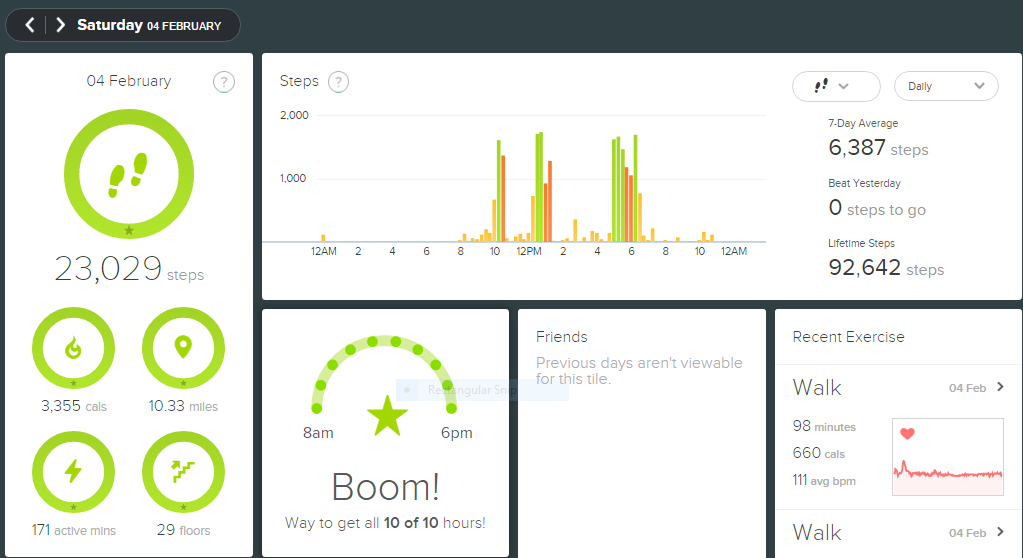
Equally, how accurate is the answer you give to the question about how much exercise you take? If you play sport, go to the gym or take exercise classes, the question should be fairly easy to answer, but if - like me - you do none of these things, how do you answer? There's a good chance you will wildly over - or under - estimate. These days the major form of exercise I take is walking, and when I decide that I'm going to take a walk of a decent length I will use the Map My Walk app on my phone, so I know how long were the walks I did from Herne Bay to Margate (12 miles) and Romford to Tilbury (16 miles - see my blog The Long Walk To Tilbury). But on days when I just walk to the shops or into town I have only a rough idea of how far I have walked, which is why I decided to buy a Fitbit activity tracker. I did consider buying one a while ago, but reckoned it was a bit of a gimmick for someone like me who does not exercise seriously, but having taken the plunge, I am impressed. In the eight days that I've had it, I've clocked up over 41 miles; but a lot of it is just pootling round the house or the supermarket, you might say, except that those walks include 341 'very active' minutes and 143 flights of stairs climbed, and include one day where I walked ten miles and two where I did seven. And now that I have an idea of how far I walk on a normal day, I can make sure I keep up the regime.


A word of caution however: research by the National University of Ireland in Galway suggests that these activity trackers can register false positives, and it is true that some mornings I wake to find that my Fitbit has registered more steps than can be accounted for by a nocturnal trip to the bathroom, but as the makers of the Fitbit say, their trackers ‘are not intended to be scientific or medical devices,' rather they monitor ‘overall health and fitness trends.’ On the whole, my Fitbit is giving me a pretty good indication of how much exercise I'm getting and is a darn sight more accurate than any estimates I might otherwise have been able to make. So despite any misgiving I might initially have had, at the moment I'll rate the Fitbit as a useful gadget rather than a gimmick.

What is the point of an internet enabled fridge?
I'll just leave this here, you can make up your own jokes.

There are, however plenty of gimmicky devices available, particularly among the Internet of Things. I cannot ever see the day dawning when I decide I need an internet enabled fridge - I'll rely on my own five senses to decide whether I need to buy more orange juice or if that bacon is past its best, thank you. And when I read stories like the one that appeared on the BBC website in 2014 - 'Fridge sends spam emails as attack hits smart gadgets'[1] - it makes me want one even less.  I'm sure there's a joke there about spam, but I can't be bothered to think one up. But if an internet enabled fridge might conceivably have its uses, I truly cannot think of any reason why anyone would want a wi-fi kettle. Last year The Guardian reported that ' Data specialist Mark Rittman spent an entire day attempting to set up his new appliance so that it would boil on command.' Frankly, if you want a gadget to avoid having to go switch the kettle on and wait for it to boil, get a Quooker: they may be expensive, but I guarantee they are a lot less frustrating.

Quooker's mean instant boiling water, so where's the need for a Wi-fi kettle?


Some gadgets come and go, often replaced by superior alternatives. The video recorder and the fax machine have been supplanted by hard disk drive recorders and -largely -by email respectively, but both had reasonably long and useful periods of use. Not so the 3D television, the first of which was produced in 1935, although it wasn't until 2010 that they became popular - albeit not that popular. When we bought our last TV in 2012, 3D capability was a major selling point as far as the retailers were concerned, although personally I felt that rather than making the viewing experience more life-like, it was rather unnatural, and it seems I was not alone as Sky TV dropped their 3D output and manufacturers like Sony, LG and Samsung have now largely stopped making sets with this functionality. History will record the 3D television as a gimmick.

Putting a digital watch in every conceivable device was popular during the 1980's


Years ago the Innovations catalogue was a treasure trove of gadgets - most were useless and many combined two gadgets in one: adding a watch to items like pens and far more unlikely devices was a staple of it. Pocket handwarmers, revolving wine racks and storage units for shoes and CD's (sometimes combined), and caddies for your remote controls were among the hundreds of essential items the magazine advertised, the majority of which turned out to be a waste of space and money - somehow they seemed much more useful when seen on the pages of the catalogue than they turned out to be in reality.

The kitchen is where you will find the sharpest contrast between the useful and the useless - or, if not useless, annoying. We have a Vitamix blender (see The Scariest Domestic Appliance In The World) which I thought might turn out to be a gimmick, but which we have used virtually every day since we bought it, but we also used to have a worktop grill like the ones that go under the George Foreman brand (I can't remember now what make ours was). It was such a faff to use and to clean that we binned it, although given the popularity of the Foreman ones, I imagine a lot of people would swear by them.

Ultimately, what to one man is a gimmicky disappointment is to another an indispensible gadget, and at the moment my Fitbit falls in that second category. Time will tell how long that lasts.


Thursday, 2 February 2017

The World of Ragle Gumm

Last week I went to see a recording of BBC Radio's satirical sketch show, Newsjack. Inevitably, two subjects dominated the skits and jokes: Brexit and Donald Trump. In many ways, it is a difficult time for writers of satirical sketches as reality is often weirder and more absurd than anything a script writer could devise, but on the other hand, there is material in bucket loads. Meanwhile, one of the twentieth century's greatest pieces of fiction - George Orwell's dystopian novel, 1984 -has apparently seen an upsurge in sales, prompting many people to wheel out that old saying, "1984 was not supposed to be an instruction manual."


It is true that certain aspects of politics seem to have taken an Orwellian turn in recent months, with both Brexit and Trump. The Orwellian sounding term 'Post truth' is not new (it was first coined as far back as 1992), but the EU referendum campaign - in particular the oft repeated and much debunked claim that EU membership cost the UK £350million per week - brought the expression into common usage. Writing in The Daily Telegraph, Michael Deacon said that in the culture of post truth, "Facts are negative. Facts are pessimistic. Facts are unpatriotic." Facts which do not fit with the preconceptions of a particular group or individual are, therefore deemed unreliable: somewhere there are better facts, facts that more readily support that group or person's position. It also strikes me that proponents of certain post-truth ideas are like many conspiracy theorists; the more vociferously their theories are denied and debunked, the more they believe them to be validated. Denial equals proof.

No matter how often the message on the bus was debunked, and even after Nigel Farage admitted it was a "mistake," this post-truth 'fact' was still oft quoted.


The media has often been accused of not letting the facts get in the way of a good story, but what exactly are facts? Years ago I worked for a manager who would refer to "true facts," which I always thought (but never said), was tautological: by definition, a fact must be true. A fact is a thing that is known, or proved, to be true, so what type of fact could there be, apart from a true one? Today that definition of a fact is under attack: opinions and downright falsehoods are being dressed up in fancy clothes and sent out into the world to masquerade as facts, and as Lenin said, "A lie told often enough becomes the truth." With the amount of news that we can access today - through television, radio, newspapers and the internet - a statement, regardless of its provenance, regardless of its accuracy, becomes a fact through repetition and through it being published through a multiplicity of sources. Fact checking using just the internet is unreliable: a wildly implausible statement cannot be treated as verified simply because two or three different outlets report it, but with our voracious appetite for 'news' and with the media's equally insatiable desire to be the first with a story, our critical faculties need to be heightened. Under the constant bombardment of post-truth stories, alternative facts and fake news, sifting the wheat from the chaff is more difficult than at any time in history. Simply put, we need to be less credulous and more sceptical.

If Orwell were writing 1984 today, he would probably quietly tear up his manuscript and never think of it again. He would undoubtedly concede that no work of fiction could compete with the absurdity, the contradictions and the downright cruelty of the world we now live in. Equally, he would be horrified that the ideas that he set out in his work have been treated less as warnings and more as guidelines. We now live in a world where, whether we know it or not, whether we like it or not, doublethink, hate crime, and doublespeak - to name but three of the concepts from 1984 - have become part of our normal life. The last of these is particularly prevalent  (just think of downsizing when used as a euphemism for redundancy) while doublethink is so ingrained in politicians and many of their supporters that most will not even recognise that they are guilty of it.

The twin concepts of post-truth and alternative facts have led us into a world where the President of the United States of America squabbles with an actress over social media because she had the temerity to criticise him in a speech at an award ceremony, and berates the press for publishing what he calls fake news simply because their reportage is uncomplimentary, while blithely making unverifiable statements about voter fraud and the size of his inauguration crowd.  If The Donald is that thin skinned, it bodes ill for the day he is attacked by a political heavyweight, or the day when one of his controversial policies fails. If it were not so serious it would be funny.


It remains to be seen whether a wall is ever built along the border with Mexico - and Trump does seem to have diluted his guarantee that Mexico would pay for such a wall to a suggestion that he will claw the money back somehow once it is built - and equally his executive order that halted the entire US refugee programme, indefinitely banned Syrian refugees, and suspended all nationals from seven countries may turn out to be short lived in light of legal opposition following a case filed by the American Civil Liberties Union (ACLU). But if we criticise Trump for his actions, we must at least concede that unlike many politicians, he is already making good on many of his campaign promises - no matter how objectionable many people think they are.

Just as Orwell's seminal work becomes more prophetic with each passing day, I cannot help but feel that we may be in a world that bears more than a passing resemblance to the sort of alternative realities that Philip K Dick created. Worlds like the one inhabited by Ragle Gumm in Time Out Of Joint, where the reality Gumm believes he exists in begins slowly to unravel and expose the real world outside. One can almost believe that one day soon we will pick up a discarded newspaper that was not supposed to be found, and find an obituary of John F Kennedy, who we will discover was not assassinated in 1963, but lived to be one-hundred years of age and died peacefully in a Florida nursing home. And from that discovery, our world will suddenly start to morph into one in which Donald Trump is a professional golfer with no political ambitions, the European Union never came into being and Nigel Farage is still trading commodities on the London Metal Exchange.

Philip K Dick

The late US senator Daniel Moynihan said - presciently, in 1994 - "Everyone is entitled to his opinion, but not his own facts," and a great deal of what are being presented as facts on all sides (where they are not downright falsehoods) are largely just opinion and speculation. Despite the opprobrium in which Trump is held and the intense opposition there has been to Brexit, time will judge Trump's Presidency and Britain's exit from the EU and may even do so more swiftly than any of us expect. Maybe, in years to come we will look back at Brexit and the election of Donald Trump more positively than we can currently imagine - personally I doubt it, but I could be wrong - but whatever history makes of this period, the time is ripe for 'true facts' to make a comeback.

Thursday, 26 January 2017

An Immutable Fact

It is an immutable fact that if you enter a store with the sole intention of browsing - perhaps because you just wanted to get out of the rain - you will be descended upon by assistants in the manner of vultures falling on carrion, whereas if you actually want someone to come and help you, they all disappear like snowflakes in June. And so it was in my least favourite store on Sunday. I may have mentioned before (probably more than once) that I really do not like Currys PC World in general and their branch in Romford in particular, however since there are now so few other, similar stores, we inevitably end up there from time to time, not necessarily to buy, but to look at things we may later purchase elsewhere or on-line. We walked in and hovered around the Fitbit display. Since no assistants were in the vicinity, I asked at the Customer Service desk - which is immediately next to the display - if someone could help us. "No, this is Customer Service," was the answer to my request.  I refrained from pointing out that I was a customer and wanted some service as I am certain that such a rejoinder would have gone over the assistant's head, and went off in search of someone more willing to help. In fairness, the chap who  eventually did come to talk to us was helpful and pleasant, which while they  may be fairly basic qualities in a shop assistant, are not guaranteed at this particular store in my experience.


But this is not about Currys PC World, it is however about some of the things they stock and the continual (and unstoppable, or so it seems) flow of more and more connectable devices that we are being told we simply must have. It is widely held that advertising creates artificial needs - one might go as far as to say that doing so is advertising's raison d'être- and smart running shoes, Amazon's Echo, Fitbits, Apple watches, and all manner of other wearables and devices that fall under the category of the internet of things are just some of the products that advertisers are currently bombarding us with and brainwashing us into believing that we simply must have. Not that we need much encouragement, and the fact is that today every home has a plethora of internet enabled devices; research shows that many households have eight or more devices connected to the internet. Alarmingly, the same research suggests that one in ten people in this country do not own a book. According to a study by the insurance company Aviva, about 6.5m people in Britain (one-in-10) to do not own any printed books, and in the 18-24 age range, the number increases to one-in-five people.


While shocking at first sight, these numbers do beg a couple of questions. How do the figures for book ownership compare with twenty years ago, when the internet was in its infancy? How many of these devices are e-readers, like the Kindle? And since figures from Nielsen Book Research show that in the first half of 2016, Britons bought 4m more books than they did during the same period in 2015, and the demise of the bookshop - widely predicted when e-readers first hit the market - does not seem to have come about, this research needs a bit more context before we hit the panic button.  Of some concern, however should be the fact that according to a report by the Organisation for Economic Co-operation and Development (OECD), about 16% of adults in England are "functionally illiterate" (they would not pass an English GCSE and have literacy levels below that of an 11-year-old) while young people in England are the most illiterate in the developed world. Again, a bit of context might be helpful here; how many of the people who make up that 16% do not have English as their first language, for instance? How does this figure compare with historical data on the subject? The answers to those questions would give us a better idea as to how concerned we ought to be.

Reading a book, whether it is a physical book or an e-book, remains one of life's great pleasures. The ability to become absorbed in a world created for us by a writer and our own imagination is something that we should treasure, and nurture in our children. The problem with reading a book - and I use 'problem' advisedly  - is that it requires greater concentration and staying power than idly flicking through some social media app on a tablet or smartphone, or watching a YouTube video, and the era of the smartphone has had a quantifiably detrimental effect on attention span. A study carried out in Canada a couple of years ago discovered that average human attention span had fallen from twelve seconds in 2000 to eight seconds and the link between a shorter attention span and a decrease in the number of people - and especially children - reading has been established following a survey by the publishers Pearson.

The upside of a reduced attention span - according to the Canadian research conducted by Microsoft - is an improvement in the ability to multi-task, although multi-tasking is seen by some people as a myth, and even if it is real, can be a mask for inefficiencies; in other words, creating the likelihood of performing two tasks poorly, rather than one task well. And anyway, the Microsoft study dubbed multi-taskers as people who " consume more media, are multi-screeners, social media enthusiasts." Flicking from a book on your tablet to your Facebook page, to a news channel, can scarcely be called multi-tasking and suggests a lack of concentration and short attention span rather than a positive attribute. It is the reason why, when I decided to buy a Kindle some years ago, I opted for the straight-forward version rather than the Kindle Fire: if I am reading a book and decide I want to visit a website, I have to put the Kindle down and pick up a tablet, or go into another room to use a computer.

Perhaps one reason we are reading less - if, indeed we actually are - is that we are writing more: whether anyone is reading what we are writing remains to be seen. In Nod, by Adrian Barnes, the narrator says of poets, "sensitive souls who submitted their work to literary journals outnumbered those who read those same publications by a margin of ten to one." It is so easy to publish now, be it a blog or through Amazon's Kindle Direct Publishing, that perhaps, everyone is busy tapping away on keyboards producing words no one will ever read.  But to write, one has to read, even if it is simply to research for one's writing, and therefore the art of reading will, we must hope, never die.


Despite the gloomy prognosis on literacy levels and reading in general, every now and then a book, or series of books - take J K Rowling's Harry Potter novels for instance - stimulates the imagination of the reading public of all ages, and for as long as people write, people will read. The time to start worrying is when the writers give up.


Thursday, 19 January 2017

The Partwork

Just after Christmas, and in the first few weeks of the New Year, commercial breaks on television feature adverts for a type of product that you rarely see during the other eleven months of the year. I refer to The Partwork, which in the UK are the fourth-best selling magazine type, being outstripped only by TV listing guides and weekly and monthly magazines aimed at the women's market.

Unlike the Radio Times, or Woman's Own, where it isn't critical if you miss an edition, Partworks rely on the purchaser avidly buying every issue, because as they always make crystal clear in their advertising, your Partwork will build into an ultimate collectors series, and being a collector means you must have every single one. And if you aren't building a collection, be it of classic novels or superhero figurines, you are buying these magazines to build a model of something, which could be a steam locomotive or a sailing ship.

Why not collect a set of Star Trek graphic novels which you will never read...


The current crop of Partworks include - among others - a series of magazine billed as "the ultimate guide to discover the secrets of happiness & wellbeing" called Mind Body Spirit; a series of graphic novels devoted to the Star Trek franchise,  and publications that (along with the accompanying magazines), include kits to build scale models of the DeLorean car from the Back to the Future movie and R2-D2, the droid from Star Wars.

...or start building a replica R2-D2 that you will never finish?


Collecting these Partworks - especially the ones that feature models that need constructing - requires patience, dedication and a significant financial investment. The DeLorean, for example runs to one-hundred and thirty weekly parts, or two and a half years, and will set you back an eye watering £1,157.70 while building R2-D2 necessitates the purchase of one-hundred weekly parts at an outlay of nearly nine-hundred pounds. The Star Trek novel collection and the Mind Body Spirit magazines would set you back the best part of £500 for each set: cheap, Partworks are not. No doubt many people start collecting a particular Partwork, but grow bored or conclude that it is too expensive, and drop out - how many incomplete collections of The Art of Quilting and part built models of Mallard there are up and down the country is anyone's guess. And of course the publishers encourage prospective purchasers to subscribe rather than buy through newsagents and other retailers in the hope that inertia will mean that rather than cancel, they will continue to receive their magazines and model parts, even if they simply gather dust in the corner rather than growing into a unique collection or faithful, half-scale model of a science fiction movie prop. But if you are going to collect a Partwork, getting it on subscription is possibly better than  trotting off to the newsagents on a weekly basis, since it has been reported that sometimes, copies arrive damaged and there is no replacement stock at the wholesaler. Sometimes it can take weeks or even months for retailers to get hold of back issues, causing annoyance and frustration to the customer.

Why not start building a model car for hundreds of times the price of a completed one from a toy shop?


On top of all that, and  if an outlay of a thousand pounds for what is effectively just a toy isn't bad enough, the publishers add optional extras, like binders for the magazines or premium 'upgrades' with the promise of gifts that could add a hundred pounds or so to whatever you are already forking out.

Only twice have I been tempted to start collecting a Partwork. About thirty years ago a series of classic novels and other works of literature were published: I bought a few - George Eliot, H G Wells, Shakespeare, Chaucer and the like, before realising that not only was it more expensive than simply buying the paperbacks, but I was building a collection of books that included many I had no desire to read - then gave up. But in the early 1970's I did complete the collection of Book of Football, a Marshall Cavendish publication that ran to seventy-five parts and built into an encyclopaedia on the sport that was a good deal more cerebral than other football magazines on sale at the time. And unlike magazines like Shoot! or Goal, which cost in the region of 9p, Book of Football was a hefty 23p per issue, big money for the schoolboy I was then. Every fortnight I would call in at the newsagents near my school, and instead of parting company with my meagre pocket money in exchange for Blackjacks, Fruit Salads or other penny sweets, would take home my purchase and read it, cover to cover. I actually kept the collection for a number of years, re-reading parts of it from time to time, until eventually consigning it to the bin. In all, it cost me the grand total of £17.25 and even now a complete collection can be bought on eBay for a fairly reasonable two-hundred and fifty quid. I would be quite fascinated to have the chance to read some of the features again, particularly the Fabric of Football articles which were quite prescient: the piece in the first issue was entitled 'The Affluence that spreads Football Poverty' while another predicted the coming of sponsorship in the English game and the effect it might have. My fascination does not extend to bidding online for the set, mind you.


Goal was 9p a week, Book of Football was 23p per fortnight, but a much superior publication.


The success of Partworks - and the fact that every year more and more are published suggests that they must be a lucrative line for the companies like De Agostini, Hachette, Marshall Cavendish and Eaglemoss Publications - can probably be in part explained by the fact that people - especially men it seems since the majority of these publications appear to be aimed at them - like to collect things, whether it is stamps, football programmes, coins or Beanie Babies, and once they start, vast numbers of people like to complete their collections. Apart from the cost, Partworks also sometimes come in for criticism when - particularly with the models - editions are unavailable, meaning that collections cannot be completed. Imagine spending months and hundreds of pounds building a scale model of RMS Titanic, only to find that the final instalment, containing a crucial part, like a funnel or one of the propellers, cannot be bought for love nor money!


Hobbies ought, by definition, to be fun, but for me, the potential for a set to remain incomplete creates more stress than enjoyment - I suppose that at heart I am something of a completist, and I would rather not embark on collecting something than have an unfinished collection. Quite apart from the extortionate cost, that reason alone means it will be a cold day in Hell before I start buying another Partwork.


Thursday, 12 January 2017

Too Much Of A Good Thing

It's possible to have too much of a good thing, even too much of 'The greatest show on earth' as the World Cup has been described (although not by me), and in 2026 the already bloated competition will be over-inflated to a mind-boggling forty-eight teams. Rumours had been circulating for some time that new FIFA president Gianni Infantino (who replaced the discredited and banned former incumbent, Sepp Blatter last year) favoured increasing the number of nations competing in the finals by fifty percent: "We have to be more inclusive," he said at a sports conference in Dubai in December 2016. Football federations were "overwhelmingly in favour" of the expansion, he said, adding that a 48-team tournament was the most "financially appealing," which rather gave the game away. Infantino maintains that the decision was "a football decision," and that, "Every format has advantages in financial terms. We were in a comfortable situation to take a decision based on sporting merit." Like his predecessor, Infantino is comfortable with the Orwellian double-speak much loved by bureaucrats and administrators, where language obscures, distorts, or reverses the meaning of words.


FIFA president Gianni Infanto


It was no surprise that this week FIFA voted to add sixteen new teams to the finals when they are held in 2026, increasing the total number of finalists to forty-eight and while part of the justification is that it allows more countries to make their dream of competing at the finals come true, my view is that it is about one thing and one thing only...money. For most of the sixteen extra countries that will qualify for wherever FIFA decrees that the 2026 jamboree will be held, this is going to be a chance to play in a World Cup Finals competition that they might not otherwise have had, but most will not be good enough to be able to really compete. And competition is what sport is about; without jeopardy, without the fear of defeat, then victories are cheap.

The current format may have grown - from sixteen in 1978, to twenty-four in 1982 and most recently, to thirty-two in 1998 - but has the competition got better, or is this just another case of 'never mind the quality, feel the width?' The current group stage format, with four teams in each group remains fairly interesting and competitive, but the new format raises the prospect of a group stage that will be a procession not a competition. FIFA's plan for a forty-eight team competition starts with sixteen groups of three countries, so it is entirely likely that in a group that consists of say, Spain, Chile and Senegal (with all due respect to Senegal), if both European nations beat Senegal and play each other in the last game, both know they will have qualified: potentially there are sixteen dead rubbers - one per group. Oh, FIFA have hinted that even group games will be played to an outcome, with penalty shoot-outs possibly deciding drawn games to avoid any non-aggression pacts allowing teams to play out toothless draws in their final games, but the reality is that this format promises more bland, uncompetitive games.

Naturally, increasing the number of finalists makes qualifying a bit less stressful too, but no decision has yet been made on how the extra sixteen places will be allocated, but it is possible that Europe would provide three additional teams, Africa an extra four and that six South American countries would qualify - at present four are guaranteed qualification, with a fifth competing in a play-off against an Asian country. CONCACAF (Central and North America) would gain one additional qualifier. But even three additional European nation still means that with UEFA having twenty-seven of the top fifty football nations in the world, there will still be some top sides watching rather than competing, while so-called minnows are able to take part. On the other hand, and as I already mentioned, making qualification easier takes away some jeopardy; the danger is that in making it harder not to qualify than to do so, the whole thing gets devalued further than it already has been.

The Mane Garrincha Stadium in Brasilia, Brazil (shown here in April 2014), was the most expensive of the stadiums — at a cost of $550 million — and is now being used to park buses.


And where is this shindig going to be held? We've already had immense controversy over the venues for the 2018 and 2022 World Cups, which are scheduled for Russia and Qatar respectively, and since those venues debar European or Asian nations from bidding for the 2026 finals, the smart money is on the USA hosting again although a three-national finals with Mexico and Canada also sharing the duties has been mooted. And frankly, the US are one of the few nations that could afford to host a 48 team finals, which would require a similar number of state-of-the-art training centres, and since twelve stadia were needed for the 2014 World Cup, one imagines that around sixteen stadia will be required for a forty-eight nation competition. The 2014 World Cup required Brazil to build seven new grounds; the 2010 World Cup in South Africa needed five new stadia, and the legacy for both countries has been debt and stadiums that are subsequently unused. While the last two World Cups have been significant financial burdens for the host nations, FIFA's gravy train carries on blithely however and sixteen additional teams in the finals means 80 matches instead of 64, which FIFA forecast will generate $1 billion extra income at current rates from broadcasting and sponsor deals, plus ticket sales, compared to $5.5 billion revenue forecast for the 2018 World Cup in Russia; an increased profit of $640 million. The fiction that these plans are driven by anything other than the pursuit of profit is entirely transparent, despite any claims to the contrary from Gianni Infantino.

With 48 squads of 23 players, the Panini sticker album for 2026 is going to be massive!


The World Cup finals used to be essential viewing, but in all honesty, I haven't watched a tournament with anything more than mere passing interest since Italy hosted the finals in 1990 and the prospect of a 48 team tournament does nothing to enthuse me. No doubt FIFA will declare the 2026 World Cup Finals a roaring success regardless, giving them an excuse to expand the tournament still further, until the point is reached when the number of nations reaching the finals exceeds the number not qualifying: fortunately by that point I should be unable to take any interest in it anyway!

England take on Germany in the 1990 World Cup Semi-Final


If FIFA really had the interests of the game at heart and were more concerned with the quality of their 'product' than the amount of money it generates, they would heed the expression, 'less is more' and reduce the number of teams in the finals. I'd like to see them go back to the sixteen nation format that served the competition so well in the days when it was about football and not profit, but sadly I know that there is no possibility of that happening.

Thursday, 5 January 2017

The Crossing We Bear

By road it is less than seventeen miles from my home to the Bluewater Shopping Centre in Greenhithe, a journey that ought to take no more than thirty-five minutes, and in fairness, it often takes little more than that to get there. Getting home, however is another matter. As anyone who has travelled north from Kent into Essex using the Dartford Crossing knows, what ought to be a simple matter of driving just a few miles can be immensely frustrating; delays are not only common, they seem to be compulsory. Returning home from Bluewater just last week, and having  found myself in a line of traffic that moved at one car's length every ten minutes or so, I took a detour through Dartford, along the A2, through the Rotherhithe Tunnel and home via the A13 rather than endure the interminable queue for the Dartford Tunnel. I doubt it took any longer than going the conventional way in the end.

Queues like this one, northbound for the Dartford Tunnel are the norm these days.


It didn't used to be this bad.  When the first, single bore tunnel at Dartford opened in November 1963, the toll was two shillings and sixpence (12.5p) and traffic was expected to be approximately two million vehicles annually; by 1970 it had reached eight million. The original two-way tunnel was supplemented by a further tunnel in 1980, and the Queen Elizabeth II Bridge which opened in 1991. By March 2014 the number of vehicles using the crossing annually had reached fifty-million and charges for cars had increased to £2, and £5 for multi-axled vehicles. Original suggestions that tolls would be abolished when the crossing had paid for itself never materialised - it was anticipated that the tolls would be removed on 1 April 2003 however the Highways Agency decided that the tolls would become a "charge." The charge - collected online now that the toll booths have been removed - now stands at £2.50 for cars, albeit that a discount can be had by paying through Dart Charge's auto top-up scheme. Removing the toll booths came with a major reorganisation of the road network on the Kent side of the crossing and it's probably fair to say that many people anticipated that their removal would improve traffic flow and speed up journeys. The reality (whatever the government might say - and more of that in a minute) is that while travelling south over the bridge is generally quite good, travelling back into Essex through the tunnels has become the stuff of nightmares.

The crossing with toll booths in place, pre-2014


Barely a day goes by without a report on local TV or radio of delays northbound: sometimes it's due to an accident, other times there appears to be no explanation, but whatever the cause the delays seem always to stretch for hours and the queues for miles. Some people have a choice - an alternative route or simply not travelling are options unless you commute that way, in which case you have to grin and bear it, like Mr Anand Surve from Orpington, who travels daily to his work in Brentwood via the crossing and says that he gets stuck in traffic for an hour at least twice a week. So frustrated has he become that he has started a petition to propose that just as commuters can claim compensation for seriously delayed rail journeys, drivers should similarly be compensated for delays at the crossing. As much as I can appreciate Mr Surve's frustration, I sadly don't think that he's going to get very far with his campaign, although if you have a mind to add to the number of signatories to his petition, you can find it here: https://petition.parliament.uk/petitions/174299

In with more of a chance of success is the petition started by Alan Pattison calling for an enquiry into the performance of the Northbound Dartford Crossing (you can find that one here: https://petition.parliament.uk/petitions/167168). The petition describes the changes that have been made as " a botched scheme which shows no evidence of improvement." In response, the government claims that the changes that were implemented in 2014 - altered road lay out, removal of toll booths, introduction of Dart Charge - have reduced journey times for drivers. I am sure that the government have statistics that prove this, and doubtless at three o'clock in the morning it's an absolute breeze passing through the tunnel, but for normal commuters and other travellers, claims that journey times have improved will be greeted with disbelief.

Highway England's own website makes the case for a lower Thames Crossing.


It always seems that new road schemes ultimately generate yet more traffic,  and the M25, the two lengths of which are joined by the Dartford Crossing, although now not new (it was completed in 1986, with parts having opened in 1975) is a prime example. Like Parkinson's Law (work expands to fill the amount of time available),  traffic volumes increase to fill the available roads. The M25 was supposed to reduce congestion, but as anyone who drives around it, or indeed the North Circular, South Circular or any other road within the confines of the orbital motorway knows, congestion in the London area is getting worse, not better and by the end of 2015 a five-mile journey through central London took, on average, nearly 30 minutes — almost five minutes longer than at the beginning of the year. Highways England (HE) acknowledge that there is congestion at the Dartford Tunnel in the very  same breath as they say that journey times have improved, and as someone who regularly drives close by the approaches to the bridge I can attest to the fact that snarl ups north of the river are a common occurrence too, so it is clear that the whole, current Dartford Crossing mechanism needs an urgent review. To which end, HE consulted on a lower Thames crossing proposal during 2016 with three different routes under consideration. Naturally, there has been plenty of opposition from residents on both sides of the river and while it's understandble that people are less than enthusiastic about major road building programmes on their doorsteps, no doubt many of these folk are equally unhappy about the frequent gridlock that their neighbourhoods descend into.

The route preferred by Highways England for a new, lower Thames Crossing.


The misery that regular users of the crossing face was perfectly captured by spoof news website Southend News Network with their comic Christmas song "Dartford Tolls" - watch it here http://southendnewsnetwork.com/news/dartford-crossing-song-hits-one-million-views-now-for-the-christmas-charts/ but take care, one version is very definitely NSFW - but it's no joke for anyone within a five-mile radius of the tunnel entrance. However, there is a solution to this congestion nightmare, and frankly it's such an obvious one that I am amazed that Highways England have not already thought of it - make the M25 one way, clockwise. By eliminating the capability of traffic to drive north through the tunnels - both of which would be southbound only - the problem goes away. I concede that the journey for HGV's from say, Erith to Thurrock could increase from eleven to one-hundred and seventeen miles, but that's an awful lot more tax revenue on diesel sales which could be pumped into new road building schemes. That's bonkers, you might say, but when one hears of drivers taking two or even three hours to get through the tunnel while a whole circuit of the M25 can take as little as an hour and three-quarters - maybe it's not such a bad idea after all!

How England Were Nearly Denied The 1966 World Cup

In 2017, during the bidding process to determine who would host the 2026 World Cup, FIFA President Gianni Infantino addressed the travel ba...