Thursday, 28 July 2016

Bye, Bye, VCR

Next week the last company in the world making video cassette recorders (VCR) will cease production.  At one time Japanese manufacturers Funai Electronics were selling 15 million units per year; that has fallen to around 750,000 although like me, you may be amazed that it is still that many. The last big name store stocking VCR's in the UK,  Dixons (a name that has since disappeared from our High Streets anyway), stopped selling them as long ago as 2004, although remarkably as many as one household in ten in the UK still had a VCR machine as recently as 2013. The advent of the DVD and streaming video services like Netflix, meant that eventually the demise of the VCR was assured.


The rise and fall in popularity of the VCR is an example of a phenomenon that has been a feature of technological change over the last forty or fifty years that is unprecedented in history. There can be no other era in which so much new technology has been invented, become popular and been subsequently superseded in such a short space of time. Although video recording machines have been around since the 1950's, it was only with mass production and technical innovation in the 1980's that the machines became a standard feature in most homes. Not that they were particularly cheap back then: I remember that the first one I bought cost around £350 in 1989; by the time I bought my last one, the average price of a VCR had fallen to about fifty quid. Looking back to the early days of VCRs, the original novelty of being able to time and record a TV programme while you were out to watch later has now become so ordinary with the new breed of hard-disk drive recorders that we take it for granted. And, whereas thirty years ago if you forgot to record a programme that was it, now there are the catch-up channels and the like that make recording shows almost redundant. One thing that has not been lost however -at least, not for my generation - is the language of the VCR. I cannot be alone in continuing to say that I have 'taped' a show, even though I have not owned a VCR for years.

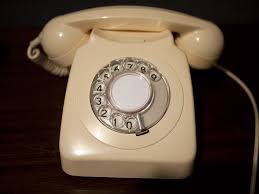
And 'taped' is not the only example of everyday language that we use that harks back to older technology. Mobile phone users (including many too young to remember the old rotary dial phones) will still ask "What number did you dial?" and will 'hang up' at the end of a call, even though these expressions have become pretty meaningless in an age of push button phones and with the decline of the land-line.


At the same time as the VCR was becoming popular domestically, businesses were embracing the fax machine. Not all businesses, though. I recall that in the 1980's, while I was working at Midland Bank in Barking, a number of our customers had fax machines and wanted to send us instructions via that medium. Much to their surprise we had to tell them that we did not possess such a machine. It was not that the bank would not countenance fax machines, just that our branch was not deemed important enough to warrant one. Later when I worked at another branch, we did have a fax machine, but to illustrate the perils of such technology, someone (my late wife, as it happens) put the roll of the thermal fax paper in the wrong way round, resulting in lots of blank faxes and the need to phone loads of customers and ask them if they had sent us a message. The email and its attachments have largely supplanted the fax message, although some businesses still cling to the fax. Take sport; not only do the football authorities in England still hang on to using fax machines to conduct transfer business on deadline day, but just three years ago in America, gridiron footballer Elvis Dumervil missed out on a contract worth $30 million with the Denver Broncos because the fax containing the appropriate paperwork arrived too late, thanks to a poorly performing fax machine.


Some redundant technology is hard to mourn; some we remember with pleasure and lament their passing. On the one hand, the laser disc is not missed by many. They didn't take off in the UK, although they were popular in Japan, which accounted for 3.6 million machines sold in 1981, but once the DVD came along, LaserDiscs were doomed. On the other hand, many people - me included - recall Teletext and the BBC's version, Ceefax, with great affection. In the days before the internet explosion, Teletext was a great medium for finding news and sports results, even if getting to the one result you wanted might mean sitting and waiting patiently for a particular page to load. Anyone complaining nowadays about the wait for a webpage to load should remember that with Teletext, it was possible to go and make a cup of tea, come back, drink it, and still be waiting for the result you wanted!


Over the last half-century we have seen all sorts of technology come and go. The 8-track player, the audio cassette recorder, mini-disc player and Walkman all burst onto the scene, bloomed (relatively) briefly and ended up being largely replaced by MP3 players in general and the ubiquitous iPod in particular. And the iPod's days have long been rumoured to be numbered as music streaming services and the use of mobile phones as music players offer alternatives. At present the popularity of the iPod shows little sign of declining, but there again there was a time when there seemed little prospect of the VCR becoming redundant.

The average household now owns all sorts of technological paraphernalia, some of which has either become outmoded, or will in the not too distant future. Our digital camera (now into its second decade of faithful service) came with its own dedicated printer, which we used once and abandoned as it was slow, expensive to run (print cartridges were exorbitantly priced) and the quality of the pictures was inferior to what you could get having the photos developed at Boots or Snappy Snaps. But we wouldn't be without our all-in-one printer, which along with the PC, makes our study better equipped than many offices I worked in.

We also have a cross-cut paper shredder, which despite the fact that the internet means that bank statements and utility bills are largely online rather than in paper format, still sees a fair bit of use. Unfortunately a disproportionate amount of time is spent unjamming the thing. If there is one piece of technology in desperate need of an upgrade, it's the shredder.


Thursday, 21 July 2016

The Factor Fifty Factor

My first overseas holiday was in 1987. In the company of a number of friends, including Paul Calvert, Graham Bull, Gerry Baker and his brother Brian, I went to C'an Pastilla on the Balearic island of Majorca. That holiday was also the first time I can recall ever using sun screen. Today, for a number of very good reasons, suntan lotion is something that we all use, liberally, both at home and abroad but somehow in 1987 it was only really associated with foreign holidays. Sun screen was deemed unnecessary in Britain, even at the height of summer.


The Alexandra Sol, C'an Pastilla.

Even for fair skinned people like me, protection from the sun in Britain thirty or forty years ago consisted largely of wearing a t-shirt and not staying out in it too long. To be honest, even after experiencing the power of the sun when on holiday abroad, and having come to understand the benefits of suntan lotion, I still sometimes underestimated the power of the sun at home. In fact the two worst cases of sunburn I have had were both received in England. Once in Brighton in the late 1970's when, deceived by a cooling breeze, I burnt my shoulders to the extent that I could not lie on my back in bed that night, and then, in 1993 when I failed to notice the strength of the sun in Cornwall and burned my head. A problem I have always had is that rather than turn an attractive shade of bronze when tanned by the sun, I have a propensity to go very pink and peel almost immediately. After my encounter with the Cornish sun my bright-red bonce started to flake the very next day, leaving me looking like a lobster with an acute case of dandruff - attractive it was not.

Experience has taught me (and many other people, I'm sure) that slathering on the Factor 50 is just as important in Romford as it is in Rome; in 1987 suntan lotion was (to me at least) generic - SPF meant nothing to me. Today I will not use anything less than SPF30 - often I use 50, because while lightly tanned skin may be a nice to have, 'pale and interesting' is OK by me if it means avoiding sunburn. 

Generous applications of this are the order of the day for me.

Apart from my inaugural use of suntan lotion, a major factor in my avoiding getting too burnt in Majorca all those years ago were the hours I kept. Having never been abroad before, and having flown only once before (to Jersey, which takes less than an hour), my trip to Majorca was notable for a few other firsts that we today take very much for granted. Most people will be familiar with that "whoomph" of hot air that greets you as you step off an aeroplane in some hot clime; that, accompanied by bunged up ears resulting from the descent into Palma airport are abiding memories for me. We arrived in the late evening, and that set the tone for the holiday really, with the late evening (stretching into the early hours of the morning) being our peak time. Mornings were generally spent a-bed, sleeping off the previous night's beer while afternoons were passed in the shade by the pool, consuming copious amounts of water. After dinner we would buy as many English daily newspapers as we could and read and swap them as we sipped the odd beer on the terrace before going out to some bar or other nearer midnight than any other hour.

It is well known that the reputation of the British abroad is not a particularly favourable one. The British, it is said, will have no truck with that foreign food, preferring fry up's for breakfast, roasts for dinner, and chips and lager with everything. My first foray into Europe was somewhat fraught on the food front it has to be said. A lot of the 'international' cuisine at the Alexandra Sol Hotel was unfamiliar, and while I may sometimes chide my younger daughter for her limited culinary horizons, they are a lot broader than mine were at her age. Which is something that, along with the exposure to other cultures and an appreciation of other countries, other people, must be a good thing. Fortunately, each successive generation is becoming more adventurous, more willing to try new things, less set in its ways. While it took me until I was approaching thirty before I got a passport and travelled abroad, my daughter has been travelling abroad with us on holiday practically from birth and those experiences can only be a good thing; travel really does broaden the mind. In contrast, my parents only went abroad once between the pair of them. My Father's only excursion overseas was during the Second World War, and my Mother never even owned a passport - her only trip by air was to Jersey, for her honeymoon. Incidentally, my Dad, who never sunbathed, never burned and never used suntan lotion, would tan at the drop of a hat, simply by pottering about in the garden for an hour or so every day during the summer.

I took this picture of C'an Pastilla in 2012 when Val and I visited for the day. The Alexandra Sol's terrace is in the background with the white umbrellas. The resort seemed little changed despite the passage of 25 years.

Mind you, the Germans seem to like their home comforts abroad; many resorts have as many German bars as they do British ones, and the most drink befuddled tourists I ever saw in Majorca were Swedish (or possibly Norwegian). Thrilled by the prospect of buying beer  at prices that didn't necessitate taking out a mortgage, a few Scandinavians we encountered that first year in C'an Pastilla appeared to be determined to drink a year's worth in a fortnight - or perhaps in just one evening.

These days I drink more of this than I do beer.


Having just returned from a holiday to Cyprus, it was interesting to note that there was little if anything in the way of the stereotypical behaviour of the English abroad. We stayed in Paphos, not the hot-bed of boisterous behaviour that might be found along the coast at Ayia Napa, perhaps but two examples of typical Brit behaviour were in evidence. One is the wearing of replica football shirts. It is only the British that seem to wear them other than at actual games once they get past the age of about ten, and the only football shirts in evidence and being worn by anyone beyond school age were Manchester United, Newcastle United, Celtic and Middlesbrough kits. Similarly, while the over exuberant riders of electric scooters up and down the front came from a wide range of nationalities among those under about sixteen, the only boisterous riders of more mature years (in age, if not in behaviour) were exclusively British. Part of the personality of the British male is an inability to grow up, it seems.

Here's a picture of a pelican. This one lives in Paphos.

After initially dipping my toe in foreign waters with a trip to C'an Pastilla, I returned with a similar cast of friends (supplemented by Keith Markham) the following year, which has set a regular pattern of pairs of holidays in more recent years. While Majorca is a regular haunt, I've done Hawaii twice, then Bandos in the Maldives twice and now Paphos twice, which has its benefits since by the second visit the better restaurants and bars have been scoped and the nicer places to visit have been weeded from the less attractive. Not that I subscribe to the idea of visiting the same place year after year, so next summer Paphos may well be supplanted by another venue. Wherever we go, the Factor 50 will follow.


Thursday, 14 July 2016

Tom Ain't Jack

Lee Child's series of novels about Jack Reacher, an ex-US Army military policeman, have been phenomenally successful, selling millions of copies worldwide, so it was inevitable that eventually someone would start adapting them for the cinema. The first, based on Child's novel One Shot, was  released in 2012 and a second, Jack Reacher: Never Go Back is due for release in October this year.


In both films Reacher is played by Tom Cruise, a piece of casting that caused a stir when the first film was mooted because, on the face of it, Tom ain't Jack. From the novels it is clear that Reacher is a big man, standing around six foot five inches tall and he has been described as having a face that "looked like it had been  chipped out of rock by a sculptor who had ability but not much time." Tom Cruise on the other hand, is about five feet seven with typical movie star looks. Reading the novels I'm more likely to picture Tommy Lee Jones than Tom Cruise as Reacher, but I'm sure other readers have their own mental image of Reacher...or James Bond, or Sherlock Holmes for that matter.

Sometimes the picture of a character that your imagination draws when reading a book is entirely from your imagination. Other times it may be because you are reading the book after having seen a film or TV adaptation of the story, and with characters like Bond or Holmes, who have been played by many actors (twelve different actors have played Bond on film, for instance and for Holmes the number is in the hundreds) the chances are it will be the first actor you saw who played the role that you visualise from the words on the page. On which basis, Sean Connery will forever be Bond as far as I am concerned. Not that it always works that way of course. There are certain actors who take over a role, make it their own and thereafter you can't imagine anyone else playing the part. Despite the claims of men like Basil Rathbone and Jeremy Brett, my vision of Sherlock Holmes will now forever be Bendedict Cumberbatch, while Christian Bale is my personal favourite in another role with multiple actors, Batman.

There is always controversy when the part of an iconic character like Bond, Holmes or Batman is recast. With the latter two roles, new versions tend to be reboots or stand alone films, but Bond has carried on way beyond the twelve novels and two collections of short stories written by Ian Fleming in a continuing franchise that creates new excitement and speculation about the new Bond each time the actor playing Bond announces his retirement from the role. With Daniel Craig having decided that enough is enough after four outings as 007, Aidan Turner, Tom Hiddleston, Tom Hardy and Michael Fassbender are among the favourites to take the role at the time of writing, along with the somewhat more controversial suggestion that Idris Elba could be in line for the part. I say controversial because despite being eminently suitable for the role in almost every other regard, Idris Elba is black and James Bond is white. Except, does he have to be?

Idris Elba as Bond, as envisaged by The Daily Mirror.


It is a popular belief that Bond was Scottish, but it was not until the penultimate novel, You Only Live Twice, that Fleming mentioned Bond's background, a detail thought to have been driven by Fleming's approval of Sean Connery's portrayal of the character on-screen. But Bond certainly wasn't considered Scottish in the earlier novels and Fleming conceived him as "a neutral figure—an anonymous, blunt instrument wielded by a government department." By defining Bond as neutral and anonymous, Fleming actually paves the way for Bond not to be an actual individual at all. James Bond, 007 could actually be no more than a nom de guerre -he was employed by the Secret Service, not best known for advertising the identity of its employees after all - so why could the current Bond not just be one of a long line of Bonds?

Other franchises have covered the explanation of different actors playing the same role by making it part of the story.  Take Dr Who, where the good Doctor regularly re-generates, enabling the part to be played by a dozen actors over the years. I wouldn't go so far as to say that Bond should re-generate in the manner that saw Matt Smith morph into Peter Capaldi, but Bond's different appearance and physical characteristics from film to film could be explained by making James Bond, 007 a role within MI6 rather than a unique person. Doing so might make the casting of Idris Elba eminently plausible; it might even make the casting of a woman (Gillian Anderson has been mentioned) possible - Jane Bond has been mooted. Perhaps a female Bond is a step too far, but making Bond a cipher would open up possibilities for the role beyond the current stereotype. And it has actually already been done. The 1967 film, Casino Royale,  was a spoof in which David Niven played the "original" Sir James Bond with six other actors playing agents pretending to be James Bond.

David Niven as Bond in the spoof Casino Royale.


However, it is not solely in casting and characterisation that viewers may find themselves making unfavourable comparisons between a novel and an on-screen version of a story. I recently read Stephen King's novel 11/22/63 in which schoolteacher Jake Epping travels back in time to try to prevent the assassination of President John F Kennedy. In 1960's America Jake Epping becomes George Amberson, yet in the TV programme differences abound. Jake is rarely, if ever, referred to as George and you have to ask, why? Was giving him a completely different name considered too confusing for the average TV viewer? And while Bill Turcotte is a quite important character in the book, his role is relatively brief, yet in the TV programme not only is his role significantly expanded, but his personality seems radically different too. As indeed, does Jake/George's personality. In the TV programme I thought him more hard-nosed than in the novel, yet at the same time more prone to rashness; he reveals that he has travelled back from 2016 more readily than in the book and is generally less likeable than his counterpart on paper. On the whole I have to say I found James Franco's portrayal somewhat at odds with the character that Stephen King created in his novel.

James Franco as Jake Epping with Sarah Gadon as Sadie Dunhill in 11.22.63


But these are the sorts considerations that will strike anyone who has read a book and seen an on-screen adaptation, and for various practical reasons minutely faithful film versions are not always possible. As far as I can recall, the most faithful book to film adaption I've ever seen was Billy Liar.

Tom Courtney in Billy Liar


Meanwhile we await the new Jack Reacher film, and while I have alreadt said that Tom ain't Jack, I guess the casting could have been worse; I just wish he were a little taller, but then again, perhaps so does he.

Thursday, 7 July 2016

More In Sadness Than Anger

England's ignominious exit from Euro 2016 will have provoked a wide range of emotions among the nation's football supporters. From anger and horror to shock and astonishment, England fans will have run the gamut of emotions from A to Z, and some, like me, will have felt resignation, very little surprise and, it has to be said, a certain amount of indifference. After all, we've seen it all before, even though this time round defeat to Iceland was plumbing depths previously not seen since USA beat England 1-0 in 1950.


France 2016 followed pretty much the normal course for England's progress at a major tournament. They were barely troubled in qualifying, winning ten out of ten, but it was hardly a challenging group. Then inevitably there was the launch of the new England kit, and this time, despite some fierce competition from previous efforts, it proved to be almost universally disliked and proved once again that marketing new kits and extracting the last penny from long-suffering English fans remains one of the Football Association's most consistent achievements.

Be honest, did anyone like the new kit?

The first game of the competition, a 1-1 draw with Russia, was followed by some predictable comments from management, players and pundits about "taking positives" out of the game. Sadly, as ever, these 'positives' were not translated into any tangible improvement.

Roy Hodgson - looking for positives.


The win over Wales papered over some cracks, but came only because Hodgson threw caution to the winds and played the second half with four forwards. Inspired substitutions or desperation? Charitably the pundits erred on the side of the former, but nothing could disguise the disquiet over Joe Hart's less than impressive attempt at saving Gareth Bale's long-range free-kick.

The 0-0 draw with Slovakia was perhaps predictable as England rotated their squad, but while Glenn Hoddle, co-commentating on ITV, optimistically continued to maintain that England would come good as they were "totally dominant," the team huffed and puffed with little fluency against a side whose sole ambition was not to concede. It did not bode well for the knock-out stages, whoever England came up against.

Glenn Hoddle, poised to state the obvious.


But England were through, and with a tie in the last sixteen of this over- inflated competition against Iceland to look forward to. Despite England's struggles, a game against the smallest nation at the championships ought not to have presented too great an obstacle for them. Fortunately, I did not see the game - I was at the BBC watching a recording of the radio comedy, Clare In The Community -and it wasn't until I got home that I checked the score. 

I was watching Clare In The Community...
...meanwhile, this was happening. Photograph: Laurence Griffiths/Getty Images.

England 1, Iceland 2, it said, and my reaction was not of shock, not of anger, but of resignation. Really, no one ought to be surprised at England's failure in the knock-out stages of a major tournament because since 1966, they have won just six games after the groups at World Cups and European Championships, and one of those (against Spain in 1996) was on penalties. In fact that win over Spain at Wembley is the only knock-out game that England have won at European Championship finals. Not that England's record in group matches is anything to write home about; twenty-two wins and thirteen defeats in fifty-three games in fifty years. Translate that into a Premier League season and it's a mid-table finish.


So when anyone analyses England's performance at Euro 2016 and asks, "What went wrong?" the answer is surely, "Nothing; this was the norm." The more salient question is what can be done about it? I'm not sure I have the answers any more than anyone else, but I have to ask why Jack Wilshere (three league appearances in 2015-16, two of which were as a substitute) was preferred to Danny Drinkwater or Mark Noble. Or why Harry Kane was taking corners (or free-kicks for that matter). And why do England persist in picking eleven individuals and trying to shoehorn them into a formation (Jamie Vardy as a wide man) rather than selecting the players best suited to a pre-determined system? At one time England were supposed to be competing with the likes of Germany, Italy or Spain; those nations are now streets ahead of us and our natural level now is with the likes of Wales and Iceland . And while those two nations played as teams at Euro 2016, England looked like a scratch side assembled in a pub on a Saturday night and playing their first game together the next morning. That impression was reinforced by the shambolic defending and catastrophic goalkeeping that enabled Iceland to plunder their goals.

At Under-21 level, England are European champions, but few of the current squad are household names and despite the majority of the squad being on the books of English Premier League teams, have relatively few senior appearances between them. Premier League clubs prefer proven talent and are not concerned with its nationality as the preponderance of overseas players in the Premier League shows. The UK's decision to leave the European Union might mean a reduction in the numbers of foreign players in English football, an outcome that the FA ought to welcome as an opportunity to develop young, English talent. But since we all know that the priorities of the top clubs are their success on the  pitch and the balance sheet, not developing talent for the national team, there will no doubt be lobbying on their behalf to maintain their access to the overseas talent pool.

This month the FA celebrate England's 1966 World Cup win, a triumph that increasingly becomes a millstone with each passing year. On the FA's website, chief executive Martin Glenn said: “30 July 1966 was a pinnacle point not just in our football history, but as a nation. We all want to repeat the high of 1966.” And FA chairman Greg Dyke is quoted as saying, “We have an exciting future ahead, and we’re all determined to give the game the best-possible chance to flourish." Words are cheap and as ever, the promise is "jam tomorrow." But what action will there be? FA boss Greg Dyke seems obsessed with the idea of introducing Premier League reserve teams into Football League competitions with some bizarre expectation that this will develop the players who will turn England into a world footballing power. His B-team plan may have bitten the dust, but the Football League are ploughing ahead with Under-23 teams in the Football League Trophy, a move that has more to do with bowing to the wishes of the Premier League teams than developing the national team.

The Guardian had it spot on.


No doubt the FA, the (new) manager and the players will claim that lessons will be learned from the shambles in France, but history proves that we've not learned from previous and similar debacles. The chances of England repeating their 1966 performance is slim; in my lifetime, nonexistent and I say that more with sadness than anger.

Thursday, 30 June 2016

A Midland Odyssey - Part Eight - Technical Irregularities

How often do you write a cheque? Not very often, I'd guess. From the days when writing one was the most common way to withdraw cash from your bank account and the most usual way of paying for many goods and services, cheques are now approaching something of novelty status. From a peak in 1990 when Britons issued four billion cheques, their use fell to 558 million by 2015, and speaking for myself, I probably write less than a dozen each year. Val tells me it is at least a year since she wrote a cheque and I don't think that either of my daughters even have cheque books. In 1978 it was very different...

Like many people who joined Midland Bank (and probably most other UK banks) during the 1970's, I found that my first job was by turns bewildering, boring, nerve-racking, mundane and actually quite important, despite my very junior position. Most of it seemed to involve cheques in one way or another. First task of the day was listing the incoming cheques, i.e. those drawn on our branch's customers and presented at other banks and branches, which had arrived in the clearing. Then throwing them out into three sections, which at Gants Hill were (surnames) A to K, L to R and S to Z. Other branches had more sections, and some would have whole sections dedicated to a single corporate customer who issued large numbers of cheques. Then each section would be fine sorted alphabetically by surname, then initial. Next, each section had to be cancelled, which means identifying which cheques could not be paid, either due to lack of funds or because of a technical irregularity, and which ones could.

An example of a paid and cancelled cheque, complete with Paid and Crossing stamps and cancelled (initialled through the signature in red ink). This is actually for sale on eBay, though why anyone would want it escapes me.


The ones where funds were an issue would be identified by the manager (at Gants Hill in 1976 a bluff Yorkshireman named Mr Hindley - I never knew his first name, and had I known it would not have dared used it). The Control Clerk would pull them out and return them with the reason, 'Refer to Drawer' or 'Refer to Drawer, Please Represent,' the latter meaning that if the payee chose to pay the cheque in at a later date, it might get paid (fingers crossed). Cheques could be returned for any number of technical irregularities; for being unsigned, for being undated, because the amounts in words and figures differed, because it had been stopped by the drawer, because it was mutilated, because it had been crossed by two bankers, and so on and so forth. Cheques that were paid were 'cancelled' by initialling over the signature in red ink and being stamped 'Paid.' Coloured biros were an important part of daily banking life; red for cancelling cheques, green for checking account numbers and blue or black for everything else.


What you couldn't do, of course, was 'bounce' a cheque for lack of funds if it had a Cheque Card number on the back. Cheque guarantee cards demised in 2011, but in 1978 they were highly important. Shops and tradesmen knew they could accept a cheque without worrying it might be unpaid, and they were sought after by customers, not all of whom were deemed credit worthy enough to have one. Amazing when you think that today Debit Cards are almost ubiquitous, yet by 1976 standards a significant number of customers would not be granted one.


After listing, sorting and cancelling the clearing, most of the rest of the day was then spent dealing with cheques paid in over the counter. Separating those drawn on our customers from those drawn on customers of other Midland branches and other banks, listing them, encoding them with the amount and sending the latter two categories off to Head Office. Manual processing was the order of the day when I started work; over the years automation and centralisation resulted in many of the jobs that I learned in my first few years being centralised or disappearing altogether.

If you could look around Midland Bank, Gants Hill in 1976 you would understand why banking then was so labour intensive. There were few automated processes and most work harked back to the days when hand-written ledgers were the norm (and there were some members of staff there for whom those ledgers were fresh in the memory). In short, what you would notice would be the limited amount of technology and how primitive that technology actually was: the legendary Burroughs TC-500 was the most sophisticated piece of kit we had. We didn't even have a photocopier; any copying we needed to have done involved someone trotting over the road to a firm of solicitors, whose machine we could borrow. The number of copies we made would be recorded in a washing book and the solicitors would invoice us every quarter for their costs.

The legendary Burroughs TC-500. Picture:acbm.com


Not that everything we wanted a copy of could be photocopied though. There were many, many documents that we were not allowed to remove from the premises, ledger copies of customer statements being one of them. Every time a customer had a statement issued, a ledger copy would be delivered to the branch. These did not arrive in alphabetical order - goodness knows why they could not have been delivered in order - perhaps it was to give the branch junior something (extra) to do. It always seemed that laborious, manual tasks were considered 'good for the soul.' The ledger copies had to be sorted and then filed in bins held in a wheeled trolley. Half-yearly (or was it quarterly?) these would be bound up and filed. The ledger copies could not be removed from the branch, let alone photocopied, so it was with a sinking feeling that I would have to deal with a request from a customer for a duplicate statement. That process would involve typing the details from the ledger copy onto a specific card. This would then go off in the overnight bag to Head Office. A few days later the duplicate statement would arrive. But this could not be sent directly to the customer yet because for reasons that were probably due to the limitations of the technology available at the time, many details would be excluded from the copy statement, such as the first three digits of cheque numbers, and these would have to be typed onto the duplicate.

The height of technology in 1976, the microfiche reader!


 A rare example of labour saving came in the form of microfiche copies of statements; Gants Hill branch were chosen to pilot the process and instead of a wad of ledger copies arriving each day, a single fiche would be delivered, reducing filing time from an hour or so to about thirty seconds!

Everything that a customer now receives from their bank, from new cheque books, paying in books, credit and debit cards, is sent from a central location. In 1978 all of those things were first sent to the branch. Huge boxes of cheque books would arrive periodically: naturally these were not in any sort of order and had to be sorted and filed in cabinets awaiting a request from the customer for a new book. And paying in books were received in blank and had to have customer details added by the use of an Adrema plate printer, the repetitive thumping sound of which was a daily soundtrack to life in a small branch!


There were fourteen staff at Gants Hill when I worked there, many doing jobs that would today either not exist or have been centralised; were it still open today, it would probably have no more than five or six staff. But while a lot of the work there was labour-intensive and monotonous, I learned things there that stayed with me throughout my thirty-six years. I reckon I could still fine sort and cancel a section of cheques to this day!


Thursday, 23 June 2016

A Shiver In The Dark

I don't recall going to a rock concert between 1992 (Genesis at Earls Court) and 2008 (Porcupine Tree, indigo at The O2) and in that period the means of getting tickets for such events went from the traditional method of queuing up, phoning the venue or going to a ticket agency to booking online; and we all know what a frustrating experience that can be.


Inevitably it seems, tickets for concerts go on sale at nine o'clock on a Friday morning and at one second before the appointed hour the website says tickets are not yet on sale, yet one second after nine (having worn out your finger pressing F5) they are sold out! It is all very different from the days when I first started getting tickets for gigs, way back in the 1970's, the first decade broadcast in colour.

In 1978 I was working in the City of London for the first time, at Midland Bank, Queen Victoria Street. Between Queen Victoria Street and Poultry there ran a lane (it isn't there now, since the whole block has been redeveloped), in which stood The Green Man pub and a record shop that had a ticket agency. On many a lunchtime I would find myself in that shop, perusing the list of upcoming concerts at London venues, and often would join the queue to book tickets. The counter was manned by a chap who had a phone permanently jammed between shoulder and ear, sourcing tickets. You made your booking, took a receipt and hey presto, a few days later would return to pick up your precious tickets. I don't recall ever being disappointed and not being able to get tickets for whatever it was I wanted to see - unlike these days when trying to book tickets online can be fraught and ventures into the secondary market may be a necessary evil.

The corner of Queen Victoria Street and Poultry, as it was before redevelopment.

One of the first concerts I booked tickets for back in those days was for Dire Straits, who I'd gotten into thanks to a girl I worked with (I think it was Denise Haskins). She recommended them, suggesting I must listen to Sultans of Swing. On first hearing, I wasn't terribly impressed, but after a few listens it grew on me and after buying the band's eponymous first album, it was off to the Hammersmith Odeon to see them play live. I also saw them at The Rainbow, Finsbury Park when it was (temporarily) a music venue. Nowadays The Rainbow a Pentecostal church.

"You get a shiver in the dark, it's raining in the park but meantime..."
Picture: Helge ØverÃ¥s

The Hammersmith Odeon (now the Eventim Apollo, but forever the Odeon as far as I am concerned) has always been my favourite venue. I saw Ian Dury & The Blockheads there in what I would describe less as a concert but more as a raucous party with a live band, and also saw Jasper Carrott doing his stand-up routine in the days when he was just finding fame. Dressed in trademark rugby jersey and jeans, he berated the 'cabaret set' comedians who, resplendent in DJ's and bow-ties, played to a scampi-in-a-basket audience. Ironic because years later I saw him play at the Circus Tavern in Purfleet, where he wore a dinner jacket and bow-tie and performed to an audience that had just munched its way through just such a meal.

Ian Dury

The thing about getting tickets for concerts -and this is stating the obvious - is that if a band are playing a number of nights at the same venue, it's much easier than if they are doing a one-night stand. And a one-night stand is effectively what a sporting event is, hence the fact that for cup finals and the like, tickets are at a premium. Which they were back in 1979 when Essex county cricket club reached their first one-day final, in the Benson & Hedges Cup. Prior to 1979, Essex had had a pretty poor record in both one day and county Championship cricket (actually they were a bit of a joke), but that year the county had a chance of their first major honour. Having qualified from their group, they beat Warwickshire in the last eight, and then defeated Yorkshire in the semi-final. I was at that game, having bunked off for the only time in my thirty-six year working life. I wasn't the only one: the game was televised and I, like many others in the crowd at Chelmsford, was trying to keep a low profile in case I was captured by the cameras - explaining that at work the next day would have been tricky.

Naturally my fellow Essex supporting friends and I wanted to be at Lords to see the final against Surrey, but this proved to be difficult. The ticket allocation was such that there were more club members than tickets, so getting one through Essex was out of the question. We tried Lords, we tried the MCC (no chance if you weren't a member), we tried the ticket agencies; it was no good. Then someone suggested trying Surrey. This seemed pointless since their allocation was the same as Essex's and they had more members, but more in hope than expectation, I phoned them. Have you any tickets available? I asked. You may imagine my surprise when I was told, "Yes, but they're limited to four person." I got hold of someone and we went to The Oval that lunchtime (it's only a short tube ride from Queen Victoria Street) and bagged eight tickets.


Essex won the Benson & Hedges Cup Final, their first major honour and I - with a host of friends - was there to see it, sitting on the grass in front of the Lords Tavern. It's hard to imagine these days that spectators at a major sporting event were once permitted to sit on the grass just yards from the pitch and chat to the players as they fielded on the boundary. After the obligatory celebratory pitch invasion, a crowd of us went directly to Brighton for a week. Happy days.


The reason for this week's nostalgia-fest (apart from a desire to get away from the EU referendum) is that I've been reading Danny Baker's excellent autobiography, Going To Sea In a Sieve and since Danny is roughly the same age as me, I could relate to a lot of what he has written, and a lot of what appeared in Cradle to Grave,  the TV adaption of his book. 

It has to be said of course that Danny Baker's formative years were more adventurous, exciting and much more likely to end up in a book or on TV than mine were. While he was serving Elton John and Marc Bolan in a Soho record shop, I was serving secretaries and solicitor's clerks in a City bank. We both lived in council flats and saw Ian Dury in concert though, we at least have that in common.

Thursday, 16 June 2016

The Sick Man Of Europe

Both sides in the EU referendum debate have been issuing dire warnings of the consequences of not voting their way on 23rd June. Earlier in the week I speculated on what might happen if we vote Remain. In the interests of balance, here's some guesswork on what the outcome could be if we vote to Leave.


This is a work of fiction but Donald Trump could be POTUS come November.

Carefully, Brian put his glass down on the table. Despite having been in The Bell for the best part of half-an-hour, he had barely blown the froth off the top of his beer. Well, at nearly ten quid a pint, you had to make it last.

"Can't believe it's only been five years," Brian said sorrowfully. "I remember all that euphoria, all that hope. And look at us now. I just hope Johnson and Farage are pleased with themselves."

I nodded. Five years after the decision to leave the EU and once again Britain was being called the sick man of Europe. Of Europe, note, because we're still part of Europe if not the European Union. Unemployment hit six million last year and shows no sign of slowing. Brian noted dolefully that we were probably the only two customers in the pub who actually had jobs. Mind you, there were only a half-dozen or so other punters, and those of them who weren't stretching their drinks out to last as long as they could were drinking tap water. Our town used to have five, maybe six pubs, all doing a good trade before 23rd June 2016. Now there's only The Bell, and how that keeps going is a mystery.

I asked him how his job was going and he made a sour face.

"Lucky to have it, I guess. Did sixty-five hours last week," he said. "I was right with Jeremy Corbyn when he opposed the Tories doing away with the Working Time Directive, but thank goodness they did. If I couldn't work all the hours God sends I'd never be able to keep my head above water."

"Yes," I acknowledged. "And when Labour got in last year, everyone expected them to put some sort of workers' rights bill in the Queen's speech, but there was nothing. Was a funny old Queen's speech too, what with the royals decamping to Canada and her delivering the speech by Skype."

Brian shrugged. "Say what you like about Corbyn, and I've said plenty, he's a pragmatist. Workers rights are all very well but there're no good to if you've got no job."

"I know," I said. "All those strikes when the Tories did away with paid maternity leave and sick pay and the unions confident Jeremy would see them right, and what did he say? 'Sorry chaps, no can do, the country can't afford it.'"

" Everything's gone up in the shops and what with interest rates up where they are, most of my money goes on the mortgage," Brian moaned.

"Perhaps you should downsize," I suggested.

Brian snorted derisorily. "Have you seen the housing market? Prices are lower than a dachsund's swingers; I've got negative equity and no flipping chance of moving."

Bob, the landlord wandered over, collecting empty glasses and wiping down tables. "Closing at nine tonight lads," he said.

"Oh it's not power cuts again is it?" moaned Brian.

"Yes, 'fraid so," said Bob. "Three days a week, power off at half-nine."

"So much for the cheap energy from Hinckley Point," I said. "When we pulled out of the EU, China pulled its investment. And gas from Russia's a joke, it's so flippin' expensive. If I didn't have to cook with it I'd have it cut off."

"Yeah, me too," said Brian. "Oh, before I forget, are you going to the bank this week?"

"Yeah, on Thursday," I said. "I've got a day off and I want to talk to them about my pension. Why?"

"Oh, I've got a cheque needs paying in. I'd go myself, but what with the branch closures after all the big banks took their head offices to Frankfurt, I can't find the time or the petrol money to drive fifty miles to my branch. Why do you want to talk to them about your pension?"

"Well, turns out Osborne was right," I said. "Annuity rates are pathetic. My lump sum is going to get me naff all, it's worth about a tenth of what it was before we voted out of the EU. At this rate they'll take me out of work in a box before I can afford to retire. George said it would cost us all thirty-two grand, turns out that was optimistic, more like double that."

"This isn't what Farage and Johnson promised us, is it?" said Brian. "And whatever happened to those two anyway?"

"Boris has got dual American citizenship,"  I said. "Went over the pond and took to the after dinner speech circuit."

"And Farage?"

"Well, you know his wife is German," I replied, "He took off with her to Berlin. I understand he's working for some organisation out there that wants Germany out of the EU. The Deutsche Freiheit Partei I think it's called."

Brian nodded...and winced. "You OK?" I asked.

"Not really," he said. "My back's killing me. Went to the quack last week, he's referred me to the hospital for tests, but apparently what with all those health service cuts and staff shortages after all those nurses were sent back to Europe, there's a six month waiting list."

"Oh great," I said. "Boris and his crew reckoned what with all the money we would save, the NHS would be better off. Ha! What a crock that was!"

There was silence for a while. Brian sipped his pint; I just gazed at mine.

"How's Harry?" I asked. Harry is Brian's son, coming up to eighteen and about to leave school. "Is he going to university or what?"

"He wanted to go to Oxford," said Brian, "But the fees are crippling, especially now you have to pay them up front. Oh for the days of student loans! Then he talked about a gap year, back-packing round Europe, but what with the new Exchange Control regulations, he wouldn't be able to take enough dough to get him much further than Calais, even if he could afford it."

"I wouldn't go to Calais anyway," I said. "Too dangerous, what with the French shooting all of the refugees trying to get into France from Britain."

"I know, ironic isn't it? One thing we were really worried about before Brexit, all that unfettered immigration and now the beggars are queuing up to leave and they can't get out!"

We fell silent again. Behind the bar, the TV was showing the news channel. America President Donald Trump appeared on screen.

The sound was off, but no words were needed to appreciate the fervour with which he was speaking. The ticker at the bottom of the screen said, 'Trump announces start of Mexican Wall construction.'


Brian turned to me, gestured toward the TV, and smiling for the first time that evening, said, "Oh well, it could be worse you know, we could have him in charge!"

How England Were Nearly Denied The 1966 World Cup

In 2017, during the bidding process to determine who would host the 2026 World Cup, FIFA President Gianni Infantino addressed the travel ba...