Saturday, 6 May 2023

The Three Hardest Words

It’s the morning of Saturday 6th May 2023, the coronation of King Charles III takes place today, but even before the first guests had arrived at Westminster Abbey, the police were confiscating placards from anti-royalist protesters, some of whom were arrested.

Now, you may say, “Quite right too,” and believe that nothing should spoil the occasion of Charles’s coronation. You may hold similar views about the actions of Just Stop Oil, or Extinction Rebellion.

Police remove placards from anti-royalist protesters.

You may fully support the recently introduced Public Order Act that gives the police greater powers to deal with protests, including the offense of ‘locking on’ whereby a person commits an offense if they attach themselves to another person, an object, or land. Or if they merely go equipped to do so, by which we the act means carrying objects for such a purpose. How do you feel about arresting people for merely being in possession of such things as super glue or a padlock?

Even if you do support such legislation, doesn’t a little part of you feel uneasy that in what we continue to call a free country, our rights are being eroded, little by little? You may say that it’s only extremists, the ant-monarchists and the climate change fanatics, that is to say, those you don’t support, who are being targeted, and that they deserve everything they get. But one day there may be something that you feel strongly about, that gets you up in arms, but about which you cannot lawfully protest about. The right to protest isn’t just being taken away from people you don’t support or approve of.

Just yesterday, the results of local council elections that had taken place in many parts of England on Thursday were announced, but almost overshadowing the results – in which the Conservatives took a battering, losing over 1,000 councillors and the control of 48 councils – were the stories of voters being turned away from polling stations for want of valid photo ID, this being the first time that such ID had been required in England.

Is the requirement to provide photo ID to be able to vote a sensible precaution to avoid fraud at polling stations, or is it voter suppression?

Personation - ‘assuming the identity of another (person) in order to deceive' – at polling stations is very rare indeed, and there were just seven allegations of personation at local elections in England, Scotland and Wales, elections to the Northern Ireland assembly, a series of mayoral elections in England and six Commons by-elections during 2022, none of which resulted in any police action, yet it is estimated that up to two million people lack an acceptable form of photo ID and applications for the government’s free Voter Authority Certificate ran to just 85,000 ahead of the local elections.

The requirement to show photo ID at polling stations is clearly a solution in search of a problem, and one exacerbated by the inconsistency in the types of ID that have been deemed acceptable. 

Proponents of the scheme point to the fact that most of Europe, and even Northern Ireland, requires voters to produce ID, and that the Labour Party – who have largely opposed the scheme – require members to show membership cards to participate in party meetings. This argument spectacularly misses the point. Apart from DenmarkIceland, and Ireland, all European Economic Area (EEA) member states issue national identity cards, and Labour Party members are provided with a card when joining the party. 

I get the argument that successful instances of personation may not be known, but it is likely to be very small indeed, so assuming that this nut of miniscule proportions requires a sledgehammer to smash it, it would surely have been appropriate for the government to write to everyone on the Electoral Register personally to make them aware of this most fundamental change to the manner in which our democracy works and ensure that everyone who needs one has a Voter Authority Certificate but apparently not.

The publicity surrounding events of this week at polling stations, with many people turned away, and some apparently challenged even though they had valid ID (allegedly the likeness of holder’s photos on passports and driving licences was questioned in some places), should mean that come the next General Election the number of people unable to vote for want of correct documentation will be significantly lower, perhaps as low as the number of cases of personation at the last one in 2019 (33 allegations, 1 conviction, 1 caution).

Voted ID wasn’t required seven years ago, at the EU referendum, and despite various attempts at getting Brexit done after Leave won the vote, we seem to have achieved very little that is positive. A recent Savanta survey for The Independent shows that two-thirds of Britons now support a referendum on rejoining, and of course in the years since 2016, many thousands of teenagers, too young to vote then but who were more likely be supportive of the UK being inside the EU, have joined the electoral register.

Even many of Brexit’s staunchest supporters are unhappy because the version of Brexit that we have is not what they wanted, although on the basis that the ballot paper merely asked whether voters wanted to Remain or Leave, any form of Brexit must be what the public voted for as no details of our ongoing relationship with Europe were specified on the paper.

"Leave the European Union." Seven years on we are still arguing what that actually entails.

Where views on a subject are firmly entrenched it is often pointless arguing about them in person, and even more futile arguing on social media, and especially with strangers. There are some subjects like Brexit, or climate change, that are so complex or diverse that few people have an all-encompassing view, but there may be one area in which they are well read. This results in arguments being all about the pros and cons of two individual’s wildly different areas of expertise, areas in which they have no common ground. In such instances, no one gives way.

Paul Graham’s hierarchy of disagreement categorises various types of argument into a pyramid as shown below:


And the reason that the hierarchy can be thought of as a pyramid is that the higher up one goes, the rarer that type of argument becomes.

It used to be said that the hardest three words for a man to utter were “I love you,” but since providing a counter argument or refuting the central point of a particular case rarely cuts any ice with those who with entrenched views on a particular matter, it’s more accurate to say that the hardest three words are “I was wrong.”

Wednesday, 19 April 2023

The Emergency At 3

This coming Sunday, 23rd April, is St George’s Day *. It’s also the anniversary of William Shakespeare’s birth (and death. What perfect symmetry it is to die on your birthday). The London Marathon is taking place, as is the FA Cup Semi-Final between Brighton & Hove Albion and Manchester United, and at 3pm, a UK-wide test of an emergency alert system will make every mobile phone that is switched on (even if in silent mode) sound an alarm and vibrate.

Perhaps you haven’t heard about it and are going to get the surprise of your life on Sunday when your phone (and the phones of everyone in the vicinity) suddenly starts emitting a repeated siren that only goes away when acknowledged.[1] You may be aware that it’s going to happen but will still be taken by surprise because you lose track of the time, or perhaps you won’t get the alert because  you’ve turned the notification off or intend turning your phone off to avoid being interrupted.


Jacob Rees-Mogg said in a party political broadcast monologue on GB News that I caught on Twitter, that government should not be indulging in this type of thing, and confesses that he has disabled the notifications on his phone, which is even more surprising than the news that he has a phone capable of receiving such alerts in the first place.

Sunday will be a test, but the government website, www.gov.uk/alerts, suggests that real alerts will be issued for reasons such as severe floods, fires, and extreme weather. They don’t mention impending obliteration by incoming nuclear ballistic missiles, but that may be another reason, although quite what one should do in such circumstances would appear to be limited. One imagines that an alert would advise people to seek shelter, although places where one could do so effectively strike me as limited at best.  

Let’s hope we never get to find out, or even experience a false alarm of that sort, which was what happened to unfortunate Hawaiians in 2018 when a missile alert message was sent out in error and the agency responsible for it spent 40 minutes trying to work out how to retract it.


There are some people who would have us believe that the alert system is a means of government instilling a sense of permanent fear in the general population. Contrarily, these same people offer the view that such a system will end up being ignored. The alert system is, in some people’s minds, another method of controlling and cowing the populace, in much the same way as things such as Low Traffic Neighbourhoods and 15 Minute Cities are and how covid lockdowns were used to soften us up to accept climate change/net zero lockdowns, with impositions such as restricting the number of new items of clothing we can buy in a year, limiting the use of private cars, and the number of flights we are allowed to take. I’m sure that’s the plot from an episode of Black Mirror.

The reports that contain many of the ideas that lead people to believe that governments and elite conspirators want to control our every move usually stem from some theoretical,  utopian view (or dystopian, depending on your position) of the future produced by a group of academics. On Twitter, these pie in the sky ideas are being presented as though they are established policy, just waiting to be implemented. 


These ideas come from a report, The Future of Urban Consumption in a 1.5°C World, released by Arup, C40 Cities and the University of Leeds. It’s not government policy, although some people would have us believe it is, or soon will be.


If anyone is keeping us in constant fear, it’s the media and various influential social media contributors, as much - if not more so - than governments.

We also hear – frequently, and alarmingly – about Central Bank Digital Currencies (CBDC), and how their introduction will result in cash being abolished and how our spending will be controlled by government who will, through mechanisms like social credit scoring, be able to limit what we are allowed to spend our money on. Along with this, and relying on a 2016 essay by Danish Politician Ida Auken, originally titled, "Welcome to 2030. I own nothing, have no privacy, and life has never been better,” there is a belief that the World Economic Forum will, within the next seven years, collaborate with governments to create systems of control that will end up with everyone but the elite being little more than indentured slaves.

Some targets – banning the sale of petrol and hybrid cars by 2030, making homeowners replace worn out gas boilers with heat pumps – have become part of government policy, but the deadlines are unlikely to be met and may recede into the distance and never be met at all since governments are notoriously unrealistic when it comes to targets and equally useless in meeting them.

We are frequently warned that government wants to surveil and control us. Such were the cautions when the NHS Covid app and digital covid passports were introduced. The app was demised recently and the digital passports have fallen into disuse (not that they were ever widely required in my experience). Frankly anyone with a mobile phone voluntarily gave permission to Apple or Google (or both) to keep them under surveillance long ago (just look at your timeline in Google Maps), while your bank knows exactly where you spend every penny, and Tesco’s Clubcard knows about your spending habits in their stores (that’s exactly why it was designed and built in the first place. The discounts and vouchers are just sweeteners to keep you handing over your data).

You could argue that the Covid app’s demise and the abandonment of the covid passports prove that government has no real desire to control us. Alternatively, perhaps they were just the warm up before the main event, merely there to test the water and ensure that when the time comes for the real deal to be inflicted on us, we will be softened up and ready to comply. Frankly, a lot of these supposed control mechanisms suggest a lot more interest in our lives on the part of government than I believe they actually have, and – if they really wanted to implement them - a far greater degree of competence than they have exhibited in the past (and in this regard I include governments from both sides of the political divide). It’s that lack of competence that reassures me that whatever is suggested, and whether the government intend implementing any of the policies that have been mentioned, it will be a complete fiasco anyway. As Napoleon Bonaparte once said, “Never ascribe to malice that which is adequately explained by incompetence.”

On Sunday, at 3pm I hope to be out of the house somewhere that’s busy to observe the public’s reaction when the government alert system causes their phones to suddenly burst into life, apparently spontaneously. In reality, I’ll probably have forgotten all about it and be taken completely by surprise, although it would not surprise me one bit if, when three o’clock comes, my phone, primed and ready for the alert, remains stubbornly silent.


[1]  Follow this link to see and hear how the alert will appear on your phone https://youtu.be/MvZM-oCReu8

 *Edit: As St George's Day falls on a Sunday in Eastertide this year, the saint's day is more properly observed on 24th April, not that anyone will take any notice.

Thursday, 23 March 2023

“Talk a little, but say a lot.” The Wit and Wisdom of Danny Murphy

Whatever your opinion of the British government’s policy on the Channel crossings by people in small boats might be, and whatever you feel about Home Secretary Suella Braverman’s statement on the subject in early March, or the tweet that it provoked from Gary Lineker that exploded all over social media and the mainstream media, most people will agree that there has never been a period of sports broadcasting in England quite like the one we experienced on the second weekend in March.


Pundits Alan Shearer and Ian Wright declined to appear on Match of The Day after Lineker’s removal, and commentators refused to pick up their microphones. There was no Football Focus (replaced by Bargain Hunt) and instead of Final Score there was The Repair Shop. Match of The Day and Match of The Day 2 were rebadged as Premier League Highlights and featured match action with no commentary or analysis.

The Saturday night highlights package lasted just 20 minutes, but even that modest running time was five minutes longer than the Sunday evening show. Nonetheless, the Saturday programme attracted 2.6 million viewers, half a million more than tuned in the previous week. Did this prove that what the viewers want is a heavily truncated show featuring no commentary or pundits? Or, like rubbernecking motorists peering across the central reservation at the opposite carriageway, were the extra viewers simply voyeurs of the car crash?

Blackpool MP Scott Benton was one who thought that it was the former. Here’s what he tweeted six minutes after the show ended: “Best #MatchOfTheDay episode in years. Had all the goals in No ‘expert’ analysis And finished quicker than usual so I could make the pub for last orders. What’s not to like” (his lack of punctuation). I don’t know how far he lives from his local pub, but getting there, tweeting about it, and beating last orders in six minutes is impressive stuff! (No, I don’t believe he went to the pub).


Football on TV has come a long way from the days when I started watching it. Only a few matches were broadcast live on television back in the 1960s; The FA Cup Final, some England international matches, and European Cup Finals were about the sum total. It seemed that Kenneth Wolstenholme commentated on most of the ones I watched, largely because where there was a choice – both ITV and BBC showed the FA Cup Final in those days – I would choose The Beeb.

Watching footage of games that Wolstenholme covered, the difference in style between him and current commentators is abundantly clear. A particular memory of a Wolstenholme commentary that I have was a match involving Newcastle United. At the start of the game, while describing the kits that the two teams were wearing – especially important to the many viewers watching in black and white – he announced that Newcastle’s black shorts had “the manufacturer’s fiddly bits down the sides.”  The multi-coloured, logo covered shirts with numbers that don’t conform to what he would remember as the players’ positions would boggle his mind were he to see them today.

Kenneth Wolstenholme

Newcastle United in their shorts with the “the manufacturer’s fiddly bits down the sides.”

Events in games seemed sometimes to take Wolstenholme by surprise, and he often greeted goals with a simple, “And it’s a goal!” as though no one could have seen it coming. One of his contemporaries, David Coleman, of course habitually announced goals – especially the first of the game – by simply reciting the score in an emphatic manner.

Commentators today offer a bewildering array of facts and statistics to enhance the match experience for their viewers and listeners. John Motson, who sadly died recently from bowel cancer at the age of 77, may not have been the first match broadcaster to supplement their commentary with statistics about games, players, stadiums, and competitions, but he was the one who made an art of it. Largely, he did it in a way that improved the viewers’ experience; he was a bit like your mate at a game who mentions in passing some esoteric fact about one of the players or some previous match because he’s interested in it, and thinks you might be too. Too many commentators today sound as though they have committed the whole of the Sky Sports Football Yearbook (forever simply the Rothman’s as far as I am concerned) to memory and are hell-bent on reciting it all for the ‘benefit’ of their poor viewers.

The late John Motson in trademark sheepskin coat.

There may be people for whom late Saturday night television is incomplete without a dose of the wit and wisdom of Match of The Day pundit Danny Murphy, but I would be sceptical about that, or any claims that Match of The Day audiences want the amount of punditry that is routinely inflicted on them for that matter. To be fair, I’ve never heard anyone who watches MOTD claim to want more chatter at the expense of the action, but it must be true of some people because everyone’s tastes are different, as the ongoing popularity of Mrs Brown’s Boys proves.

The best football commentators add to the enjoyment of games by bringing to our attention things we might not have seen, or imparting relevant information we might otherwise not have had, not by wittering on endlessly, describing events that we’ve all seen with our own eyes and vainly thinking that they are being insightful, or trying to shoehorn in some alleged witticism or tenuous metaphor that they have written and rehearsed to the point that any illusion of spontaneity has been thoroughly removed. Some commentators have me reaching for the remote control to lower the volume to barely audible. Sam Matterface is one, and I’m not alone apparently, because as soon as ITV announce that the commentary team for a game are Matterface and Lee Dixon, Twitter goes into overdrive with mickey-taking memes.


When Martin Tyler first began commentating, John Motson suggested that he should, “Talk a little, but say a lot.” It was sage advice, and something that many of today’s football commentators would benefit from following.


Tuesday, 17 January 2023

To The Letter of The Law, But Outside Its Spirit

There was unanimity among those I was standing with while watching the Manchester derby in the bar before the Jersey Bulls v Romford game last Saturday that United’s equaliser by Bruno Fernandes should have been disallowed for offside against Marcus Rashford, and there was incredulity when the goal was allowed.

It was widely held that Rashford was both seeking to gain an advantage and was interfering with play, but in saying so, most people were quoting from a half-remembered version of the offside law that no longer applies. The offside law has changed so frequently in recent years that very few of us have been able to keep up with those changes. But none the more for that, there were good reasons why the goal should have stood…but reasons why it should not have too. With offside calls, it’s possible for the decision to be simultaneously wrong, and right.

The concept of gaining an advantage has changed over the years such that this is deemed to have occurred only when a player who is in an offside position plays the ball after it has rebounded off a post, or bar, or an opponent, but not merely by their lurking in an offside position.

As for interfering with play, Rashford could only have been deemed to have been doing so if he had touched the ball – which he didn’t - or if he prevented an opponent from playing the ball, or made an action that impacted on the ability of an opponent to play the ball, and he didn’t do either of those things, so therefore he was unequivocally not offside. Or was he?


Two eminent former referees could not agree on the decision in the aftermath. Keith Hackett had no doubt; “Rashford is offside,” he wrote in The Sunday Telegraph. “To allow Fernandes’s goal to stand is a total nonsense.”

Being in an offside position is not an offense in itself of course, but Hackett goes on to say that Rashford was offside because he was “clearly attempting to play a ball which is close” (Law 11, section 2). Hackett also rightly pointed out that Darren McCann, the assistant who flagged Rashford offside, is one of the most experienced in world football. McCann has given more offside decisions than most of us have had hot dinners and got the vast majority of them right too. Hackett would therefore have supported McCann’s decision.

Meanwhile, speaking on Sky Sports, another former top-class referee, Dermot Gallagher opined that had he been the man in the middle, he would have stuck by assistant Darren McCann’s flag and called Rashford offside. But he then went on to say that referee Stuart Attwell would, from the view that he had, have formed the opinion that Rashford had not impacted on his opponents and was therefore not offside, hence him allowing the goal.


Gallagher also said that this was not a factual offside, but was a subjective one. Which tends to support a view that I have held for a long while: Offside decisions can be given that are technically correct, but which are morally, ethically, and subjectively, completely wrong. To avoid that conflict, and to return to Keith Hackett, “The law is awful and requires a complete rewrite.”

In this instance, because Rashford does not touch the ball, he is not technically offside. The ball however, is clearly within playing distance – defined in the laws as “(the) Distance to the ball which allows a player to touch the ball by extending the foot/leg or jumping,” and as it was within Rashford’s playing distance, there is a strong argument that he was in possession of the ball and therefore technically offside as well as subjectively so.

The Twitterverse has come up with a number of examples from seasons past where players in similar positions to Rashford’s have been given offside, but these are largely irrelevant as the laws have changed since some of these incidents occurred.

Although I would agree with Darren McCann’s decision to raise his flag and say that the goal ought to have been ruled out, I can see both sides of the argument in much the same way as Dermot Gallagher did. I suppose the acid test is, if my team conceded an identical goal, would I accept it graciously, or would I argue in favour of it being disallowed? The answer is that I would be spitting feathers! 

As a result, we’re back to the subjectivity of it all, and the biggest problem with that is – and I’ve said this before – that football is quite precious about having laws, and laws should not be contradictory, laws should not be subjective. To put it bluntly, laws must be objective, so in this I fully support Keith Hackett’s point of view; the law is an ass and needs a rewrite.

One could sum up this decision by say that while it was correct within the letter of the law, it was clearly not within its spirit, a consideration that the laws say that referees must apply when making a decision.

One controversial decision in one game in one country is unlikely to be enough to prompt a change in the law. It could result in a change in the way it is interpreted in England, although the fact that the Professional Game Match Officials Limited (PGMOL) - the body responsible for referees in the Premier League - have backed Stuart Attwell’s decision suggests that that might not be the case.

At some point in the near future, the offside law will change – again – and just about the only thing we can be certain of is that the change won’t add clarity but will simply produce more grey areas and more subjectivity to the decision making. That’s something to look forward to.


Monday, 16 January 2023

Strike!

Workers in the UK banking industry have never been particularly militant. During the thirty-six years I worked for Midland Bank/HSBC, there were, to the best of my knowledge, only two disputes that led to strike action. Largely this was due to the fact that the trade union was weak; the majority of staff were not union members.

At some point during the late 1970s or early 1980s, a union rep from what was then either the National Union of Bank Employees (NUBE), or the Banking, Insurance and Finance Union (BIFU) – the name changed in 1979 – came to the branch I was working at in Romford as part of a recruitment drive. He was told to leave by the branch manager and not darken our doors again after he called non-union members “f*****g parasites” for accepting pay rises that the union negotiated.

The only times strike action that I can recall being taken during my time in work came in the late 1970s, and then in the mid-1980s, and that second one was somewhat feeble to be honest. In the late 1970s, workers at Midland Bank’s data centre in Brent, north London, went on strike for two days a week (Tuesdays and Thursdays) for a while. The majority of customers would have been blissfully unaware that any industrial action was being taken, but for those of us who worked in branches, it was pretty inconvenient.

At some point during the 1980s there was a dispute over working on Christmas Eve. When 24th December fell on a weekday, we closed at mid-day, but one year when the last working day before Christmas was not actually Christmas Eve, and we were expected to work a full day, the union decided to flex its muscles and a ballot was called to see if union members were in favour of striking and walking out at lunchtime.

The ballot having been called, the vote went in favour of strike action. I recall that at Midland Bank, Barking – where I was working at the time – the majority of union members voted in favour of striking, but some were somewhat reluctant to follow it through. In the end, I was one of those that walked out at mid-day. To be honest, it was pretty insignificant and a full day’s work in similar circumstances became the norm in later years.

I was always of the opinion that had there been any further disputes in the bank, then a work to rule would have been much more effective than a strike. Most employers rely on workers going the extra mile, doing unpaid overtime and shortcutting processes in order to get the job done. I worked in a number of departments where, had everyone decided to do their jobs exactly by the book, work their contracted hours only, and work strictly in accordance with their job descriptions, then the bank would have ground to a halt. I’m sure that many workers, in many other industries, would say the same.

The 1970s were rife with strikes in many industries and it was almost an act of faith by Prime Minister Margaret Thatcher to reduce the power of the trade unions, and as a result, membership fell from 13 million in 1979 to around 7.3 million in 2000. We have therefore become used to a period of some decades in which industrial action and strikes have become a rarity. Now, however, many industries are seeing strike action; railway workers, nurses, ambulance workers, junior doctors, university lecturers, and teachers are all striking or threatening to.


The very people who were applauded at the height of the covid pandemic, the very people who were lauded as heroes, the key workers without whom we wouldn’t have got through lockdown, are now being vilified because they are striking in pursuit of reasonable pay rises. I mentioned the former editor of The Sun, Kelvin McKenzie, in my last blog as he called the men and women who drive ambulances as “vile shitbags.” He has subsequently decided that the NHS is full of vile people, that firemen are more interested in their other jobs (pretty sure that this is an outdated, urban myth), and that he looks forward to unions being fined and public sector workers being sacked when they strike.

I’m not picking particularly on McKenzie, it’s just that his vitriolic tweets keep appearing in my Twitter timeline, despite my not following him (coincidence or not, but since Elon Musk bought Twitter, my timeline now seems full of people I don’t follow), and his views seem representative of a section of society – and members of government – who have decided that fighting for a reasonable pay increase is a heinous offense. There have been suggestions that – as McKenzie alluded to – the government may legislate to sack public sector workers who strike. This of course is a bonkers idea; imagine an industry in which workers like nurses or paramedics, or doctors, need several years of training and cannot be replaced overnight, and having those very workers dismissed for going on strike. That really would improve the level of service.

The language used in describing some of these disputes is interesting. “Hard working people” will be unfairly affected if certain workers strike, they say. But the strikers are hard working people too, hard working people who would like to be fairly rewarded for their labours. And as for nurses and others in the health service, there’s a suggestion that what they do is less a job, and more a vocation, the implication being that that somehow that justifies poor salaries, that these workers should be selfless and regard a job well done as reward itself. None of which puts food on the table nor pays energy bills.

It’s difficult to be envious of people with extreme wealth sometimes, but the man next door, who normally earns the same as you but who suddenly gets a generous pay rise, is fair game for our jealousy and resentment, or at least that is how we have been programmed to think by the government and the media.

It’s true that strikes inconvenience ordinary members of the public as much, if not more, than the employers, but in the disputes currently taking place it seems that there is a lot more sympathy among members of the general public than is often the case. In most of these disputes, it seems that the public recognise that the striking workers have legitimate grievances. It also helps that in the dispute on the railways, RMT union leader Mick Lynch is a much more reasonable and measured figure than his predecessor, the late Bob Crow, who was much more combative.

One way or another, the current disputes we are seeing will be resolved. What sort of reaction this provokes from the government in terms of legislation to limit union powers even further than Margaret Thatcher’s did remains to be seen. Perhaps if striking becomes more difficult, then unions may have to look to alternative forms of action, like the work to rule, because surely you can’t be punished for doing your job properly, can you?


Sunday, 1 January 2023

Motivated Reasoning

I haven’t written a blog for more than three months now; the last one that I published was just after the death of the Queen. It means that 2022 was my least productive year in terms of blogs with just 13 published, the lowest since 2018.

There are a couple of reasons for this. Firstly, I’ve been busy writing other stuff. You may know that I write for Romford FC’s programme, which entails three pieces (two of 800 words each, and one of about 500) for every home game, and between August and Christmas, there have been twenty-two programmes to write for; in the same period last season, it was ten. On top of that, I’ve been writing articles and match reports for the football club’s website, which amounts to about 2,500 words a week, so time available to write blogs has shrunk.

Secondly, and probably more pertinently, I’ve run out of inspiration. More than once I’ve written an opening paragraph and then not even bothered saving it because I got bored, or because I’ve written something similar in the past. Then there are some subjects that, no matter how I feel about them, I have consciously decided to avoid, politics in general and Brexit in particular, and Covid (especially the conspiracy theories and again, the politics of it all).

When it comes to these subjects (among others), it seems that views, once set and entrenched, are difficult to change. The tribalism that exists in say, which football team you support, is equally evident in politics and recently, in views on the industrial action being taken by nurses, postal workers, and railway workers. Look at people like Kelvin McKenzie, former editor of The Sun, who I’m certain was among the cheerleaders of the NHS staff during the pandemic, but who recently described some of them as ‘vile shitbags,’ or Isabel Oakeshott (journalist) who seems to believe that nurses don’t deserve a pay rise because she believes that they spend all their time standing around and drinking tea, but who would have been leading the Thursday night clapping back in 2020.


There are people – and McKenzie and Oakeshott may well be among them – who don’t accept the lived experience of others if they don’t conform to their own beliefs. And it’s no use countering prejudice and opinion with facts because these people have formed an opinion, found one fact (or more likely, factoid), that supports their position and stick rigidly to it, despite a veritable cornucopia of evidence against. This is particularly applicable to the outcome of Brexit. On TV programmes such as the BBC’s Question Time it’s possible to find an audience member bemoaning the negative impact that Brexit has had on their business only to be told by a member of the panel (usually a Tory MP, often Jacob Rees Mogg) that they are wrong, that their perception of their lived experience is wrong.

Politicians are at the head of the queue of people with limited expertise or knowledge of a given subject who will pontificate and pronounce with absolute certainty, even though they are completely wrong.


Some nurses may earn £30,000 a year, some nurses may use food banks, and some may not be good at managing their finances, but Anderson confidently asserts that the majority of nurses fall into all three categories, even though it is highly improbable he could find any evidence to support the statement.

People who will not be swayed, or are unwilling to change their minds when faced with facts that discredit, debunk, or disprove their position are usually displaying motivated reasoning, where emotional biases lead to justifications or decisions based on their desirability rather than an accurate reflection of the evidence. This commonly manifests itself when someone who denies that something like Anthropogenic Climate Change exists, and rejects all facts and research that support it, homing in on anything that supports their view. Climate change is an interesting subject in that many people without any scientific qualifications (nor it seems, any significant knowledge of any science whatever) feel able to express opinions on the subject and be taken seriously, purely because they aren’t convinced or believe that it’s all part of some conspiracy.

A lot of this becomes evident through the BBC and it’s aims of impartiality, balance and objectivity. To quote Emily Maitlis, the former Newsnight presenter when speaking at the MacTaggart Lecture at the Edinburgh TV Festival last August, “It might take our producers five minutes to find 60 economists who feared Brexit and five hours to find a sole voice who espoused it. But by the time we went on air we simply had one of each; we presented this unequal effort to our audience as balance. It wasn’t.”


As a result, it’s not unusual to find an expert in a particular subject, be it climate change, Brexit, Covid, or whatever, debating their specialism with someone who holds a contrary view based on limited understanding of the topic, but whose voice is given equal weight, even if their sole argument is “I’m not convinced.”  There’s an element of Dunning Kruger at play here, with being unconvinced shorthand for “I’m a clever person, but I don’t understand this, therefore it cannot be true.”

In this way, the BBC have pitted climate scientists with decades of experience in the field against the likes of Nigel Farage or Nigel Lawson in their quest for ‘balance’ on the subject, despite the fact that the broadcaster had to admit that in 2017, they had allowed Lawson to lie, unchecked, about the subject in an interview on the Today programme on Radio 4.

It’s very rare to find anyone changing their mind in TV or radio debates, or on social media. You’ll be hard pressed to find someone whose opinion, which may be based on prejudice and little knowledge, change their standpoint because a well marshalled argument, backed up with evidence, is presented to them. In the same way, once we form an opinion of a media figure, we are unlikely to change that either.

Nigel Farage and Piers Morgan are probably the ultimate Marmite men of British broadcasting. If you disagree with Farage’s views on Brexit and immigration, you will probably be hard pressed to agree with him on other topics, so when he recently expressed the perfectly reasonable view that travellers from China arriving in the UK should be tested for Covid, his critics’ knee-jerk reaction was to disagree, even if they fundamentally would have agreed with the idea had it been espoused by someone they admired.

Piers Morgan has so many opinions on so many topics, that I imagine many people simply expect to disagree with everything he says and do so on principle. The problem with that is that when he says something sensible (it happens, honestly) it can be hard to agree because of who he is and not for what he said.

If 70% of what someone says (or a newspaper publishes, or is broadcast on TV or radio) is offensive or we simply disagree with it, reasonable views and content that they promote get lost in the noise. We may feel unable to agree with one position that actually chimes with our own standpoint because we may feel tainted by association with someone whose views on other matters we find abhorrent.

Too few people change their minds, even in the face of overwhelming evidence. Personally, I've never had a problem admitting that I'm wrong - and I've had plenty of opportunities!


Monday, 12 September 2022

End of Reign Stops Play

That this country has a Royal Family is often a controversial topic. I know people who are staunch supporters of the Royal Family, but I also know people who would be more than happy if we no longer had a monarchy.

I am by no means a royalist, but neither am I a republican. I guess that on the subject of the Royal Family, I am agnostic, but on balance, I’d probably say that having a Royal Family is a good thing.

Whatever your view on the monarchy, you would have to have a heart of stone not to have been affected by the recent death of Her Majesty, Queen Elizabeth II. The story that broke about The Queen’s health on the morning of Thursday 8th September was ominous. The fact that family members were said to be travelling to Balmoral was even more portentous. Tweets from various MPs about the atmosphere in Parliament suggested that this was serious indeed, so when the news finally broke that the Queen had died, the shock - while still palpable - was tempered to a degree; I suspect that most of us knew what was coming.

Despite my ambivalence about the Royal Family, I can’t say that I wasn’t affected a little when I heard that Queen had died, and it’s really rather bizarre what made me a little teary. It wasn’t any of the archive footage of Her Majesty, or anything any of the commentators said, it was actually this video of The Queen and James Bond making their entry at the Opening Ceremony of the Olympic Games in 2012, in London.


But there again, there’s a lot associated with the 2012 Olympic Games that makes me a bit emotional, especially Mo Farah’s Gold medal winning run in the 10,000 metres (see One Night In Stratford - An Olympic Retrospective). It saddens me that the euphoria, the joy, and the pride in being British that the Games of the XXX Olympiad brought to the nation has evaporated in the last ten years.

The Queen’s death left many organisations with decisions to make about whether to continue with their normal activities or to cease temporarily. Among them was The Football Association, and whatever decision they made, they were not going to please everyone. Had The FA decided that football continued as normal, marking Her Majesty’s death with the usual formalities of black arm bands and two-minute silences, half the country would have been up in arms, muttering about ‘disrespect.’

The fact that the Queen was Patron of The FA, and her grandson, Prince William, is its current President, must have influenced their decision to cancel everything from the Premier League down to grassroots football, but that decision inevitably provoked indignation and rage in the Twitterverse (some of which bordered on hysteria) especially since some other sports like Rugby League, ice hockey, and cricket opted to continue. There were suggestions that just one weekend of postponements could threaten the very existence of some clubs and cause severe hardship for people who earn a living from the game. Clubs may well have lost money – and so will fans who booked transport and overnight accommodation to attend games that were postponed - but of course that happens week in, week out during the winter months due to the weather, and often with even less notice.

Presented with the binary choice as they were, The FA were always going to make the wrong decision in the eyes of some. The only decision they could have reached that would have been worse than the alternatives would have been to leave the choice to the individual leagues or clubs, which seemed ominously possible when the hours until an announcement was made grew and grew.

Completing the day’s programme, but observing the usual niceties, would have been preferable in my view, but the decision to postpone matches was understandable, although it was surprising that no formal protocol already existed. Most organisations have disaster recovery or contingency plans for events like this, and it is something that I would have expected The FA to have concrete plans for, and if they had, they could have kept speculation to a minimum, kept everyone off tenterhooks, and put themselves in a position where they could have informed everyone earlier than mid-day on Friday.

It has often been said that these days society has less respect for the monarchy, traditions and customs than was once the case, and that in years gone by, postponing entertainment and sport would have been the default position when the monarch died: Not entirely true. Although virtually all sport was cancelled for a fortnight after the death of Queen Victoria, The FA’s decision to postpone matches then was not met with universal approval within the game.

The Football League were not happy that The FA had taken this decision without considering the financial implications for its clubs and some wanted to play in protest. On 26th January 1901, four days after Queen Victoria’s death, some matches did go ahead. There were games in both divisions of the Football League and in the Southern League, with some clubs bringing forward league fixtures to fill the gap left by cancelled FA Cup-ties.

But after the Queen’s father, King George VI, died on 6th February 1952 there was a full programme of football matches on Saturday 9th February with games preceded by a minute’s silence and with players wearing black armbands. Notable games in the First Division that day saw Chelsea beaten 4-1 at Sunderland, and Arsenal winners 2-1 at Tottenham. 

Football results for 9th February 1952

That particular Saturday was also the date of the Third Round of the FA Amateur Cup, and eight games took place, with some famous old names taking part. Scores included Barnet 4, Bromley 2; Briggs Sports 4, Brentwood & Warley 0; Leyton 4, Dulwich Hamlet 2, Crook Town 4, Romford 4 and Tilbury 0, Walthamstow Avenue 2.

Grimsby Town manager, Bill Shankly, third left, at Blundell Park on 9th February, 1952

As is so often the case, there were some who felt that rules did not apply to them when The FA announced their blanket suspension of football on 10th September. Sheffield International of the Sheffield & District Fair Play League decided to play a friendly. They were subsequently charged by The FA with bringing the game into disrepute. Whatever you may think about The FA’s decision to suspend football, nothing confers the right to pick and chose which of their rules you abide by.


Meanwhile Eton School played two matches against Rossall School. Eton is of course, famous for providing Britain with twenty Prime Ministers, starting with Robert Walpole in 1721, and most recently, Boris Johnson. All over the rest of the country however, schoolboys and girls who would otherwise have been playing football were left to find other amusements.

Clearly, the art of breaking rules that bind the rest of the country but which Etonians find inconvenient or tiresome is on the curriculum at that school.


Tuesday, 30 August 2022

Winter Is Coming.

It seems to me that most people who wax nostalgic about the 1970s were either very young, or not even born during that decade. I became a teenager in the early 1970s, so I was insulated by my parents from a lot of the problems the country faced then, but I know that Mum and Dad had many struggles.

With inflation in double digits and a litre of diesel costing nearly £2, with prices of gas and electricity soaring, supermarkets putting security tags on everyday items like cheese, and Sainsburys charging £7 for a box of fish fingers, there’s no denying that we are currently experiencing a cost of living crisis.

Add in some industrial unrest on the railways and at Royal Mail, the searingly hot weather we had in July that was even more extreme than 1976, water shortages, hosepipe bans and sewage dumped into the sea and anyone looking back with fondness at the 1970s has recently had the opportunity to experience much of what that decade was like. All we need is Abba to hit number one with a re-release of Dancing Queen (it was number one for six weeks in September/October 1976) and we really will be back there. The prospects are that winter 2022-23 will top anything that the 1970s produced in terms of awfulness.

 As I wrote in one of my blogs about the 1970s[1], “The 1970's are remembered by some as a sort of Golden Age in England. But for all that the 1970's produced some great music, it was a decade that style forgot when it came fashion, and it was a decade probably best remembered for the Winter of Discontent, rampant inflation, unparalleled industrial strife, IRA atrocities, and Britain being dubbed 'The Sick Man of Europe.' It was the decade of my teenage years, and although there is much to look back on with fondness, there was much about the 1970's that was a struggle and not all that pleasant.”

We are told that this winter, pensioners and others on low incomes will have to choose between eating and heating. This is nothing new; back in 2012, Culture Secretary Nadine Dorries tweeted that very sentiment.[2] Pretty soon, the eating v heating dilemma will be one faced not just by pensioners, but by many people who have never had to face it in the past.

According to Chancellor of The Exchequer Nadhim Zahawi, even those earning £45,000 a year will struggle as energy bills go up by an anticipated 80% this year, and even more in 2023. For once, a Tory politician is not suggesting that if people cannot pay their bills they should simply get a better paid job, perhaps realising this time, that that is not a realistic solution.


Chancellor Nadhim Zahawi admits that even those earning £45,000 will struggle with their energy bills. Fortunately for him, MP's can claim heating costs for second homes on expenses, and can even try to pay to heat their stables at the public's expense.

If an annual income of £45,000 is not enough to keep people from struggling, how will pensioners survive? The full rate of the current State Pension is £185.15 per week, or £9,627.80 per year. The predicted gas and electricity price increases suggest that even if the annual pension goes up to £10,600 in 2023 as is expected, pensioners could be left with as little as £10.92 a day for food, transport and other essential living costs. Essentials include Council Tax bills, and if we assume a bill of £1,500 then that leaves only £6.80 per day for food and other living costs; a Council Tax bill of £2,000 leaves just £5.43 per day for everything else.

What is the answer? I’m sure I don’t have one. Money saving guru Martin Lewis (below) doesn’t have one; he said in an interview recently, “There is NO cutting back. There is NO Money Saving Expert. You could put me into one of those households and do every trick in the book and I wouldn't even get close to scratching the sides of what is needed.” 


Some people seem to think that they have are answers, although they are not especially useful ones. Baroness Hoey – formerly plain Kate Hoey, once Labour MP for Vauxhall - said, “Those of us brought up before central heating wore extra jumpers when winter came.” A lot to unpack in those fourteen words. I was brought up in a house that had neither central heating nor double glazing. The metal framed windows would be covered in ice on the inside on winter mornings. Neither our bathroom nor separate toilet had any heating at all. I often wore nearly as many clothes in bed as I wore when I went out, my dad never slept without a woolly hat on, and the winter cold triggered my Mum’s neuralgia. Waking up, exhaling, and seeing your breath condense is not a pleasant experience, and one not solved by putting an extra jumper on.

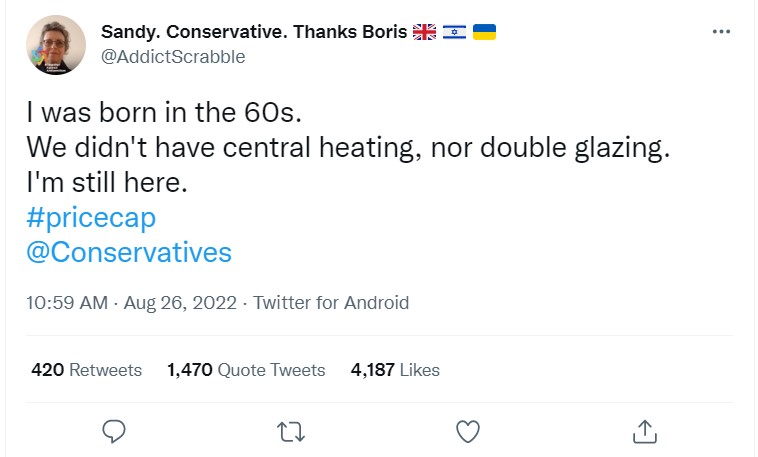
There’s a tweet from Sandy, a Conservative (naturally), who Thanks Boris (again, naturally) and says that they didn’t have double glazing or central heating in the 1960s but are still here. They didn’t have energy bills that represented over 60% of their income either. 

People – if indeed they are real people, and not bots – who tweet this sort of stuff presumably think that just surviving is all we should aspire to. Perhaps they think sending barefoot young children to work in factories, up chimneys and down mines would also be acceptable today because the Victorians did it. They’d probably consider it character building.

Ominously, a lot of businesses have been tweeting their expected energy bills for the coming year. This from The Rose & Crown pub, is frightening. The number of businesses that could go under in the coming months is very scary indeed. And when businesses go bust, people lose their jobs, and when people lose their jobs they will struggle even more to meet their food and energy bills.


The Daily Mail has a competition to win your energy bills paid for a year, energy company Ovo suggest doing star jumps and cuddling our pets to keep warm (assuming you can afford to keep a pet), while This Morning’s consumer expert Alice Beer suggests saving money by eating mouldy food rather than throwing it away. All of these, plus the idea that we should not be squeamish about drinking sewage water speak of a country that simply has given up.


Now I agree that in this country we throw away a lot of food that is perfectly edible, but Alice Beer’s advice is potentially dangerous. The Food Standards Agency says, while it is possible that removing the mould and a significant amount of the surrounding product could remove any unseen toxins that are present, there is no guarantee that doing so would remove them all”. 

There’s a saying that if I owe my bank £1,000 I have a problem, but if I owe them £1,000,000 they have a problem. Similarly, if I owe my energy supplier £1,000 then I have a problem and will be disconnected if I can’t pay, but if the 28 million households in the UK each owe their energy suppliers £1,000 then can they cut all of them off?  Probably not, but they can – and will – continue putting prices up. 

Perhaps our prospective Prime Minister, Liz Truss, has the answer.


Winter is coming. Put another jumper on.


[1] See https://rulesfoolsandwisemen.blogspot.com/2019/01/the-1970s-part-one-decade-that-style.html

[2] In 2012 Dorries was not yet Culture Secretary. That year she had the Conservative whip removed after appearing on the TV show, “I’m A Celebrity, Get Me Out of Here.” Some of the recent tweets attributed to her appear to have been faked, but whether or not this is a real one, the eating v heating dilemma has been a real one for many people for many years.

How England Were Nearly Denied The 1966 World Cup

In 2017, during the bidding process to determine who would host the 2026 World Cup, FIFA President Gianni Infantino addressed the travel ba...