Thursday, 26 April 2018

Who Play At Annfield? And Other Questions

Which Scottish League club play at Annfield? Who won the Wearside League last season? Who is Wolves' most capped player? At one time I could have answered those questions in a flash; at one time it was pretty much compulsory for me to be able to. As a member of the Romford Supporters Club Quiz Team in the 1970's and 1980's those were the sort of questions you could expect to face in the Home Counties Supporters Clubs Quiz League, in which Romford's team played sides from Barking, Wimbledon, Barnet, Southend, and Gravesend & Northfleet, among others. And all of the questions were composed from information contained in the Rothmans Football Yearbook, which was first published in 1970, and knocked existing publications like the Playfair Football Annual, or the News of The World Football Annual into a cocked hat. 


When Romford first entered the league, home matches were played in the Social Club at the football club's Brooklands ground and the team included well-known supporters like Jim Hughes, Dale Sharp, Barry Dove and Jon Walsh. Occasionally, football club secretary John Haley would be on the team. In those early years there was little danger of Romford actually winning anything, in fact the team were once described by the Quiz League Secretary as "the chopping blocks of the league." This changed in 1976 when Romford rather startled their opponents by winning five out of their six league games and becoming the first team ever to win at Gravesend, by a score of 60-51. Gravesend won the league - just, on points difference - finishing narrowly ahead of Romford and Barking (the only team to beat Romford) as all three sides finished with records of won five, lost one. By this time the team had changed a bit, with Martin Bailey, Rob Godfrey and myself joining and reducing the average age of the team a little (it was a long time ago). The team's finest hour came in 1980 when the league was won for the only time. The football club had folded in 1978, but the quiz team kept going and that year beat Wimbledon (by common consent, the best team in the league at that time) in the first game of the season. Thanks in part to the addition to the team of Andy Prescott, for whom the quizzes were as much an academic exercise as anything else, Romford won the league, winning every league game. We actually took it seriously that season, going so far as to have revision sessions.

It may not seem like much, but it's one of the few things I have ever won!


And here are some pictures of the people who won it with me.

With Brooklands long gone, home games were played at local venues like Collier Row FC (now also gone), or pubs like The Durham Arms in Romford, but as some of the team drifted away and new faces like my friend and work colleague Keith Markham were drafted in.  None of these new recruits had seen the football team play, and some of them would have been hard-pressed to point to Romford on a map.  Home games migrated into Central London and to pubs like The Bloomsbury Tavern in Shaftesbury Avenue. By this time the quizzes were little more than an excuse to meet up, socialise and have a few beers. At some point in the mid-1980's the team disbanded.
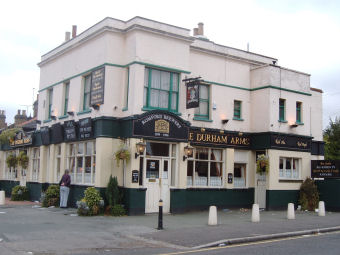
The Durham Arms in Romford

The Bloomsbury Tavern

The first Rothmans Football Yearbook (or as everyone knew it, 'the Rothmans', or sometimes just 'the book') cost eighteen shillings (90pence) and ran - as did subsequent editions - to about 1,000 pages, covering everything from the World Cup to what we would now refer to as Step 6 football. If it wasn't in the Rothmans, it probably wasn't worth knowing. The first edition of the Rothmans that I owned was the 1971-72 issue; it cost £1 and my parents bought it for me while we were on holiday (Eastbourne, I think) and I bought every subsequent book until sometime in the mid-1980's, when the quiz team packed up and the need to own new issues diminished.


The book was sponsored by Rothmans until 2003 when they withdrew due to legislation restricting tobacco sponsorship in sport. Sky Sports took over as the new sponsors from the 2003–04 edition onwards (somehow I imagine that most diehards still call it 'the Rothmans'), but in March this year Sky withdrew their support and the book's future is in doubt. The internet is probably partly to blame; who needs a book that is as thick as a brick and just as weighty, when all the information you could ever need is just a couple of taps away on your smartphone? The Home Counties Supporters Clubs Quiz League is still going, albeit the format has changed from head-to-head matches to contests featuring all six remaining member teams on a monthly basis at a pub in Clerkenwell. Assuming that all the question are still derived from 'the Rothmans' and that Sky do drop their sponsorship and the book is no longer published, this is going to force the league into drastic action to find a source as impeccable to replace it.


The Rothmans was football's answer to Wisden - that great cricket almanac that has been published continuously since 1864 and thankfully shows no signs of imminent demise - perhaps never treated with the same sort of reverence, but mightily respected by all who encountered it. If 'the book' does cease publication, then the casual statistic loving football fan will be left with few choices. There is the Nationwide Football Annual, but with the most recent edition containing a mere 244 pages, it is hardly in the Rothmans' league, though it does have longevity on its side. The Nationwide Football Annual began life in 1887 as the Athletic News Football Annual; it lasted 59 years under that name until it became the Empire News and Sunday Chronicle Annual. The newspaper for which it was named merged with the News of the World in 1960 and the annual changed its title again. With the failure of the NotW, the Nationwide Building Society - once sponsors of the Football League - put their name to it.


In the days when the Rothmans was a compulsory purchase at the start of every season, each new edition would take its place on my bookshelf alongside its predecessors until eventually a combination of a lack of space and the Romford Supporters Quiz Team finally folding resulted in me throwing them out. If I had kept them they might have been worth a few bob now, although the highest price I've seen for one goes to the first year's edition (which I did not own) and is available on Amazon at £59 in paperback and a staggering £340.75 for the hardback. Nowadays I suppose that the diehards, the technophobes and the quiz enthusiasts are the book's primary market and one which is in all likelihood dwindling. Nonetheless, it would be a shame if Sky pulled the plug on football's most respected publication, and all apparently for the sake of the £30,000 annual sponsorship money that the broadcaster puts into it. Think about that; Sky are happy to pay £3.579bn for the rights to broadcast the next three years of Premier League football, but reluctant to stump up some small change to keep a book going after nearly half a century of publication.


Finally, to return to the questions at the top of the page. The Scottish League club that played at Annfield were Stirling Albion (they now play at the Forthbank Stadium); the Wearside League was won by Jarrow last season, and Billy Wright (105 England appearances between 1939 and 1959) remains Wolves' most capped player.

Thursday, 15 February 2018

Fear The Machines

Should we fear the rise of the machines? And if so, should it be for the reason science fiction suggests?


The rise of artificial intelligence (AI) has created conflicting opinions. There's a school of thought that machines with artificial intelligence will bring about a utopian world; equally, there are plenty of people who believe quite the opposite, that AI will be mankind's downfall. Steven Hawking has said that AI could be the "worst event in the history of our civilization." Elon Musk is another who cautions about the dangers of AI. Meanwhile, Mark Zuckerberg is a high-profile proponent of AI and says that he is "really optimistic" about its future.


Stephen Hawking and Mark Zuckerberg: Differing views on AI

The rise of AI, the prospect of the machines taking over and attempting to wipe out mankind à la the Terminator films is an enduring science fiction trope, and it's by no means a recent one either. E.M. Forster's 1909 short story, The Machine Stops, posits a world in which mankind has become almost totally reliant on a machine that provides for their every need, and that civilisation collapses when the machine stops working. It is less apocalyptic than the elimination of man by nuclear weapon-wielding robots, but more plausible perhaps as we now have become so reliant on our gadgets and the technology behind them that without them we would possibly no longer be able to function.


Setting aside any fears that the growth of AI might eventually reach the point where self-aware machines start to view mankind as a nuisance at best, and a threat at worst, and wipe us all out, there are reasons to view the rise of AI with some trepidation, although there are as ever, plenty of opposing views. Ever since the Luddites destroyed the machinery in cotton mills that were threatening their jobs, we have viewed advances in mechanisation and technology in the workplace with ambivalence. For every worker freed from the dangerous, the dirty, and the simply monotonous by mechanisation, automation, and computerisation, the trade-off is a reduction in the number of available jobs.

Luddites taking it out on the machines that took their jobs.


Going back to the heyday of Tomorrow's World, before the mobile phone, before the home computer - before the spread of the office computer even - and we were frequently told that in the world of the future machines would remove the drudgery from our working lives, that we would have more leisure time as our working week reduced. Except, even then I felt that was over-optimistic; if machines reduced the number of hours we would need to work, then the amount of remuneration we would receive would fall correspondingly. Or, as it turns out today, there are fewer people doing the same number of hours (or more), while other people are herded into jobs with zero-hour contracts and precarious employment if they can find a job at all.

Raymond Baxter presenting Tomorrow's World, a programme that regularly predicted a utopian world in which the working week would be truncated as machines took over our jobs and increased our leisure time.

According to the Future of Work Commission, a body set up in 2017 by Labour MP Tom Watson to look into how the UK is dealing with the new technological revolution, " the most apocalyptic predictions about the impact automation will have on jobs are far too pessimistic." Instead, the report says, " automation and artificial intelligence will create as many jobs as they destroy."[1]  Watson himself says, “If the heavy lifting and routine tasks of the future can be carried out by 21st-century machines, then the workforce of the future will be free to focus on activities that generate greater economic benefits for a greater number of people. That is liberating. So I suppose what I’m really saying is – robots can set us free.”

Tom Watson

Hand in hand with this, Watson and his Commission propose that employers should encourage flexible working and leave for learning, to allow employees to gain new skills as their current roles become mechanised. Worthy ideas, but perhaps naive. It is all well and good to say that as a worker's role become mechanised they can retrain and gain new skills, but it is difficult to imagine whole swathes of manual workers displaced from their roles retraining and finding positions as HR consultants or finance officers within their company, even if they had the inclination, desire, or wherewithal, if the positions simply do not exist.

As we saw with disputes on the London Underground and Southern Railways, when proposals were made to replace booking office staff and train guards with ticket machines and one-man-operated trains respectively, trade unions rarely take kindly to this sort of thing, and fight vigorously to maintain the rights of the workers to continue in their roles, even if automation can replace them; and that after all, is part of their raison d'être. And in the pursuit of retaining jobs for their members, unions can be excused pushing for them to be redeployed in roles that add no value - a bit like replacing a lorry driven by a human being with an autonomous vehicle but requiring a man to walk ahead of it waving a red flag.

It isn't just manual workers who are threatened by the rise of the machines in the workplace. As anyone who worked in an office in the 1970's will testify, mechanisation, automation, and computerisation replaced the tedious manual tasks we were all engaged in, enabling employers to make savings by reducing the headcount. For the workers who remained, rarely did the amount of work reduce, in fact as many discovered, workloads increased - the concept of doing more with less, is not a new one.

These changes, together with reducing and removing redundant and duplicated processes and tasks that add no value, have enabled organisations to shrink their workforce still further; and it's likely to get worse. According to the think-tank Reform, about 250,000 jobs could be replaced by robots by 2030, and these are jobs such as administrators in Whitehall and the NHS, GP receptionists and the like. Reform also claims that around 30 percent of nursing duties, like collecting information and administering non-intravenous medication, could also be automated.

"Take two aspirin a day and come back and see me if you're no better in a fortnight."


The sorts of numbers Reform are bandying about are based on existing technology, and technology we can currently foresee, but looking at the changes that I for one saw in nearly forty years in the workplace, these are likely to be merely the tip of the iceberg. There will be many advances that will enable the automating of processes and jobs that can only currently be performed by people which we can presently not conceive of - by way of example, when I started work the idea of mobile phones, the internet, and personal computers was the stuff of science-fiction; now we take them for granted.  And if these advances come to pass then the people displaced by them are unlikely to find full-time employment elsewhere; the gig economy will expand, and as Mark Zuckerberg has argued, some form of basic universal income will be necessary.

What we'll be reduced to once the machines have taken all of our jobs.


The Terminator films may have given us cause for concern that the rise of the machines could see us all wiped out by a nuclear holocaust, but personally I am more concerned that if we do all die in a hail of ICBMs, it will be the result of the actions of one or two men with dodgy hair-do's and vast nuclear arsenals, not some super-computer. AI induced armageddon is more likely to be driven by the algorithms that run the machines trading on the world's stock markets, causing financial meltdown in a frenzy of selling that drives companies out of business and bankrupts everyone.

Actually, it's even more likely we'll die of boredom if machines eventually replace almost every job on the planet, albeit that those who still do have a job will find themselves working longer and harder than ever.


Thursday, 11 January 2018

Lost In Music

2017 was a bumper year in terms of my attending live music events; having totted them up, I find that I went to nearly twenty gigs, concerts, radio recordings, etc. There was opera, there was prog; there was classical and there was pop; there was stuff I adored, and there was stuff I tolerated; there were shows I paid quite a lot to see, and there were shows that were free.

In my younger days I was lucky enough to see some really big bands;  the first concert I ever saw, in the 1970's, was Genesis at Earls Court, which rather set the tone for seeing big acts in big venues, like Yes at Wembley Arena, 10cc at the same venue, Genesis at Wembley Stadium, Dire Straits at the Hammersmith Odeon, those sorts of artists and venues. But between 1992 (Genesis at Earls Court, again) and 2008 (Porcupine Tree at indigO2) I saw nothing, partly because my musical tastes had ossified and the bands I had always liked had stopped touring, or if they were still playing, were nigh on impossible to get tickets to see.

Genesis recorded their best-selling live album, Seconds Out, during the tour I first saw them on.

From the mid-2000's onwards, however, I have found a whole new raft of bands to enjoy, driven largely by my discovering a whole new generation of bands playing prog rock, that much maligned, much misunderstood, but still hugely popular musical genre. And swept along and buoyed up by the new wave of prog bands and artists like Big Big Train, and Steven Wilson, there has been a resurgence in the popularity of artists such as Steve Hackett and bands like Yes. And so in 2017, I found that there was an abundance of artists that I wanted to see, and remarkably, despite the difficulty that many people - myself included, on occasions - have in getting tickets without having to resort to using secondary sites charging extortionate prices, I managed to get tickets for everything that I wanted to see.

At this point I could launch into a review of all of the shows I saw in 2017 - but I won't because that would be almost as tedious to write as it would be for you to read, so instead, here's some edited highlights.

Best Show
Well, at the start of the year I expected that the much anticipated Big Big Train gig at Cadogan Hall would be a shoo-in for this, but the first night -which I attended - had a few technical issues in the first half, and although I enjoyed the show immensely, it perhaps suffered from the weight of expectation. ABC, performing the whole of their glorious Lexicon Of Love album (up there in my favourite five albums of all time) at the Royal Albert Hall was a real highlight of the year; similarly, Fish doing the whole of Marillion's Clutching At Straws was marvellous. But the show that stood out, head and shoulders above all others was Frost* at Dingwalls. Playing most of their third album - Falling Satellites - and selections from Milliontown and Experiments In Mass Appeal, they were superb, and the highlight of my year. An honourable mention has to go to Tubular Bells For Two, however. Billed as " One album, two men, too many instruments…" this comprises two Australian multi-instrumentalists playing Mike Oldfield's classic album live and in its entirety; the show that I saw in October was stunning and at times, bonkers.

Frost* at Dingwalls.


Best Venue
I have always been a great fan of the Hammersmith Odeon (or whatever they are calling it this week), and I saw Anderson, Rabin and Wakeman (now known as Yes featuring Anderson, Rabin and Wakeman) there last March, and still love the place. 

Anderson, Rabin and Wakeman at Hammersmith Odeon.

The London Palladium, where I saw Steve Hackett is a great venue too; the Royal Albert Hall is simply marvellous, as is the Royal Opera House (I saw Rigoletto in December), but my favourite venue of the year - and I had not been there before last May - is the Islington Assembly Hall. Opened in 1930, this Grade Two listed building closed in the 1980's and lay unused for thirty years. 
Steve Hackett at the London Palladium.

There are original art deco style interiors and staircases to admire at the Assembly Hall, and the concert hall - while being admittedly quite plain - affords a great view from wherever you stand, and although there is balcony seating - and some on the floor - it is a venue best enjoyed standing in my view; in fact I have discovered this last year that given the choice, I'd stand rather than sit at shows these days. From a purely aesthetic point of view, the Union Chapel in Islington takes some beating; an absolutely stunning venue.

Riverside at Islington Assembly Hall
The fabulous Union Chapel


Worst Show
In truth, there were no bad shows in the roster of events that I saw last year, but there was one that I endured rather than enjoyed - well, two actually, the same artist twice. Headlining one of the free events that I saw - The Roundhouse Music Festival in Dagenham's Central Park - were Steve Harley & Cockney Rebel, not an act I am a big fan of. My wife, on the other hand really likes them, so when she saw that they were playing at Nells Jazz and Blues Club in Kensington, she was keen to go, but not so keen to go alone, so as a dutiful husband, I went too.

Steve Harley, not my favourite, but at least we had good seats.


Biggest Surprise
Last May, I saw three great gigs in a week: Steve Hackett at the London Palladium, Riverside at the Islington Assembly Hall, and then Blackfield at the same venue. A musical collaboration between Steven Wilson - a man whose musical influence has spread far and wide, and further it seems with each passing month - and Aviv Geffen, Blackfield were outstanding, surpassing my expectations. And, as a bonus, Wilson - who was not slated to appear on the tour (tickets were sold with that expressly stated) came on stage for three songs. A great night, better than I expected.

Steve Wilson (centre) on stage with Aviv Geffen (right) at Islington Assembly Hall with Blackfield.


Best Support Act
Only four gigs that I saw had support (I'm excluding the two outdoor events that I saw that featured multiple performers). My experience of support acts is that they are either terrible or surprisingly brilliant (many years ago I saw Bryan Ferry - he was awful, the support act, Londonbeat, were superb). Of the few that I saw in 2017, the best was undoubtedly Doris Brendel, who supported Fish. So good was she that I bought three of her albums from the merchandise stand, and they certainly stand up to scrutiny, with Upside Down World being especially worth a spin (it's available on Amazon and Spotify).

Doris Brendel - best support of the year, I'd happily go see her and her band again.


Best T-Shirt
I have a weakness for buying t-shirts at gigs (see Quirks and Idiosyncrasies), and I have lost count of the number of them that I have; I added eight to the collection in 2017. As for the best of those, it's a toss-up between Frost* and Fish, with the latter just edging it.


This year promises to be a slightly less frantic one for music - just five gigs in the diary (so far, anyway) - with Lifesigns at the Half Moon, Putney and Steven Wilson at the Royal Albert Hall particularly anticipated. There are plenty of bands and artists I'd still like to see though, and one who has been inserted firmly on my bucket list after seeing a documentary about him, and then seeing him live on TV with Chic ringing in the New Year, is Nile Rodgers. It's quite possible I'll never get the chance to see him, but I live in hope.


2017's Full List
1.       Anderson, Rabin and Wakeman at Eventim Apollo (aka Hammersmith Odeon)
2.       ABC at the Royal Albert Hall
3.       Steve Hackett at the London Palladium
4.       Riverside at Islington Assembly Hall
5.       Blackfield at Islington Assembly Hall - Support from Pat Dam Smyth
6.       Rick Wakeman - Piano Pieces at Cadogan Hall
7.       Big Big Train at Cadogan Hall
8.       Tubular Bells For Two at Union Chapel - Support from Gypsy Fingers
9.       Steve Harley & Cockney Rebel at Nells Jazz & Blues Club, Kensington
10.   Frost* at Dingwalls - Support from Romain Thorel
11.   Fish at Islington Assembly Hall - Support from Doris Brendel
12.   Rigoletto at Royal Opera House
13.   An American In Paris at Dominion, Tottenham Court Road
14.   BBC Singers at Temple Church Winter Festival
15.   In Tune - BBC Proms at Imperial College Union
16.   David Live (David Bowie Tribute) at RUSS Club, Romford
17.   David Bowie, Fleetwood Mac and Aerosmith tribute acts at Central Park, Dagenham
18.   Steve Harley & Cockney Rebel at Central Park, Dagenham
19.   Elvis Fest (Elvis Presley tribute acts) at Central Park, Dagenham
20.   The Blockheads at the Havering Show, Harrow Lodge Park
21.   Ray Lewis Still Drifting at the Havering Show, Harrow Lodge Park


Thursday, 14 December 2017

Losing Our Memories

Imagine if there was no internet. Not that the internet had never existed, but imagine that it was suddenly turned off, never to return. We have become so reliant on it that the consequences would be almost catastrophic. Working from home would become impractical, shopping from home would have to be done by phone or by post, and social media would disappear. On the plus side, there would be no more tweets from Donald Trump, no more invitations on Facebook to play Candy Crush, and no more dubious emails from strangely benevolent Nigerians offering riches beyond compare in exchange for your bank details. But, while the internet has brought us untold benefits, and has enriched our lives in many ways, our increasing reliance on it comes at a cost, a cost to our memories and our cognitive powers.

Imagine if this was all there ever was, for all eternity, when you tried to connect?


I have always enjoyed quizzes; I think it stems back to my days at junior school, where we had a teacher - Mr Harris (he drove a green Rover car and had a finger missing; those two facts are not connected, he lost his finger during the war) - who would set us questions to go home and find the answers for. Armed with nothing more than a basic encyclopaedia, I would seek the answers to puzzles such as, Who designed the Suez Canal?[1] Or, the dates of the First World War, the sort of things that were rarely taught, but which are useful to know. In later years I regularly competed in quizzes, playing for a team that took part in a league (the questions were exclusively about football), and then a monthly quiz in which about twenty teams took part, and in which my team had its fair share of success. And that enjoyment of quizzes has been in part responsible for, and a result of the pleasure I get from gaining and retaining information, facts and trivia, purely for its own sake. Having a retentive memory was something that I found useful and important at work, and both at work and at home, I've frequently had people ask, "How did you know that?" when I wheel out some useful (or sometimes not very useful) information. And the answer is that it is simply ingrained in me to learn and retain stuff, as well as being something that I get pleasure from. It might be more pertinent for me to ask people who don't retain information in a similar manner, "Why don't you know that?"

The man responsible for the Suez Canal.


These days, the answer to that question would increasingly be along the lines of what's the point, that's what Google is for. And that worries me, as it seems to me that we are creating a culture in which knowing things is becoming less important and that we are increasingly relying on technology to do the work our brains should be doing. I am not alone in thinking this; more eminent minds than mine have concluded the same thing. Professor Frank Gunn-Moore, director of research for the School of Biology at the University of St Andrews, is quoted as saying that people 'outsource [their] brain to the internet' rather than using their memory to recall facts. The professor - who is an Executive Member of the Scottish Dementia Research Consortium - considers our use of the internet  as "an experiment the human race is running and we will have to wait and see if this outsourcing affects dementia prevalence."

Professor Frank Gunn-Moore

There has been a lot of focus in the medical profession about obesity in recent years. According to a study in The Lancet, as many as 2.1 billion people - that's almost 30% of the global population - is obese or overweight[2] and we are urged by governments - local and national - and by our doctors to eat more healthily and exercise more, yet while we understand that our bodies need exercise, we seem progressively more likely to neglect exercising our brains. Back in my primary school days, when Mr Harris asked us to find out the longest river in the world[3], we would scurry home to our reference books and look up the answer, and then we would retain it and retrieve it when relevant, such as while playing Trivial Pursuit, or watching some TV quiz show when the question came up. Nowadays a classroom of children asked that question would whip out their smartphones and Google it. It does seem that the internet has changed school lessons - and especially homework - out of all recognition. When my younger daughter was still at school - she left a couple of years back - it seemed that no piece of homework could be completed without reference to the internet, and while in my day, I struggled back and forth from home to school laden down with textbooks, they seemed to be conspicuous by their absence during my daughter's education.

In hardback, this textbook was the heaviest known to man when I was at school.

Google Maps means never having to leave the house with an A-Z in your pocket when visiting somewhere new, nor having a road atlas in the glove box of your car. Technology means not having to remember phone numbers anymore as they are all on your smartphone. Google means never having to retain anything; look that fact up, use it and forget it - until the next time you need it when you have to look it up again.

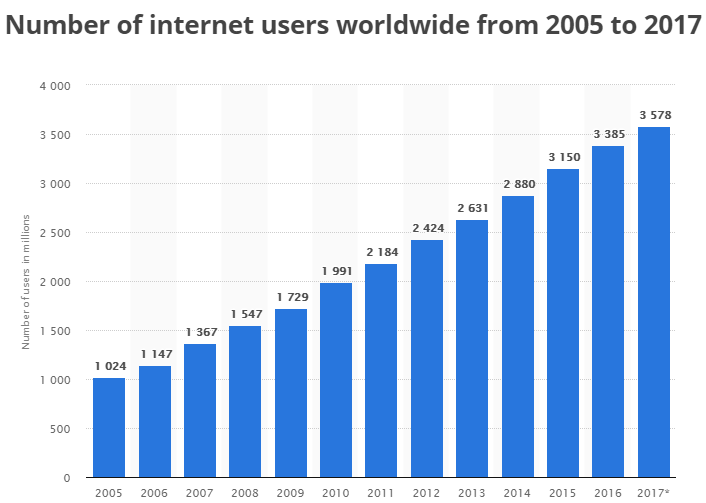
In millions, the number of internet users globally - it comes to about 40% of the world's population.

There will be people who will pour scorn on this; there will be people who think that because it is easier to Google something than use an encyclopaedia - or heaven forbid - our brains, it must be better, or that using Google stimulates the brain rather than weakening it (sounds counter-intuitive to me, but some people believe it). Those ideas are way off the mark in my view, and smack of denial. I know that as I get older, my memory is slowly deteriorating. Facts slip away (especially names; for some reason TV and radio presenter Clive Anderson's name seems particularly difficult for me to recall), and my recollection of events from yesteryear get jumbled or lost completely, so I know that if I exercised my brain less, it would atrophy at a rate of knots.

Who's this again?

A major reason why I started writing this blog back in 2012 was to exercise my mind, so it is ironic that having railed against our over-reliance on the internet, I am using the internet in order to get that mental exercise. But then, the internet is not an entirely bad thing; just as the consumption of salt, sugars and fats is important to our diet, so too can the internet be important to us. As with many things, moderation is the key.


[1] It was Ferdinand de Lesseps.
[3] The Nile, although there are claims that the Amazon is longer.

Thursday, 9 November 2017

Lest We Forget

Every year, for as long as I can remember, I have bought a poppy. Most years I buy a second one as the first gets dishevelled and crumpled, or simply lost. I have never considered it as a political gesture, nor a controversial one, simply as a mark of respect for the members of the armed forces who have died in the line of duty. Increasingly however, it seems that what began as a simple gesture after the Great War has become contentious, either because of matters of etiquette, or the increasing politicisation of wearing - or not wearing - a poppy.


As a matter of etiquette, there has frequently been debate as to when the poppy should be worn. Some say it ought not to be worn until 1st November, and there have in the past been complaints that TV presenters were wearing them in October. Personally, I don't wear a poppy before 1st November, and normally stop doing so after Remembrance Sunday, but that's my choice: if you want to wear yours from the day The Royal British Legion launch their appeal (this year it was 26th October) until some indeterminate day in the future, then I for one have no problem. Then there is the matter of whether one should wear one at all. Channel 4 News presenter Jon Snow once decided not to wear a poppy on air, saying demands for him to wear one were "poppy fascism". A few years ago, ITV News presenter Charlene White decided not to wear a poppy on screen and received abuse and criticism on social media. Like Jon Snow, she said that she happily wore one on Armistice Day, but would not wear one on air, and her choice ought to be respected, this is after all, still a free country.

The problem has become that wearing a poppy or not wearing one has become politicised. Wear one and some people will claim that you are glorifying war. In my view that is akin to saying that those who lay floral tributes at the sites of people killed on the road are glorifying road traffic accidents, but - and this is key to where I am coming from - if your view is different, then, by all means, you are welcome to it. Just do not force it on others. There are zealots who believe that not wearing a poppy is unpatriotic, an act of sedition, of treason perhaps, and they are entitled to that belief. So long as they do not force it on others. Wear a poppy if you want; don't wear one if you don't, but whichever way you jump, respect the right of others to do the opposite. Some people have become uncomfortable wearing the poppy as there is a growing belief that it has been 'hijacked' by right-wing groups in much the same way as the Cross of St George has supposedly become a symbol of fascism the implication being that anyone wearing or displaying either is beyond the pale. While I can understand that, symbols like the poppy or the Cross of St George only get hijacked because people allow them to, because they become submissive in the face of an opinion that says that if you continue to do something you have done for over thirty years, like wearing a poppy, you have suddenly become an intolerant, anti-democratic, totalitarian, xenophobic racist - which you probably haven't.

Writing in The Independent recently, Otto English opined that it is time to ditch the poppy as its original meaning has been lost, that it is no longer relevant. I don't agree, but he is of course entitled to his opinion, one which he is free to hold and publish thanks in no small part to the men whose sacrifices the poppy represents. Anyway, his opinion is based largely on the basis that poppies commemorate only those who served in the Great War of 1914-18 and the Second World War (1939-1945) and that the last of the Great War veterans have died and those from the second conflict are now so few in number. However, Remembrance Sunday is a tribute to the "contribution of British and Commonwealth military and civilian servicemen and women in the two World Wars and later conflicts (my italics)."  So while he is entitled to his view, it is based on a false premise.

While we are on the subject of ditching things that are no longer relevant, may I suggest we do away with Bank Holidays, which made sense in the days when workers did not automatically receive holiday entitlements from their employers? Or perhaps we could do away with Christmas and Easter on the grounds that the majority of UK citizens do not identify with any religion.[1] There is a whole raft of things we do that are no longer relevant, that have lost their meaning - or perhaps I should say there are things that in some people's opinion are no longer relevant - but that does not automatically mean we need to stop doing them.

Were I serious about doing away with Bank Holidays, I've no doubt that many of you would be up in arms, but why, if it were simply my opinion? It is not as though it would actually happen, any more than the poppy and Remembrance Sunday are going to get dumped simply because a journalist his written a think piece deeming them no longer relevant. Half the problem today is that everyone has an opinion about everything, and thanks to social media, has the opportunity to inform the rest of the world of it. Equally, they have the opportunity to try to shoot down in flames anyone who has an opinion that does not conform to their own - on any subject and at any time. A civilised society has room for many different opinions, but sadly we are becoming increasingly intolerant of opinions which differ from our own. I am saddened by the number of posts that I read on social media which descend into slanging matches because one person holds a view that others disagree with, but which they find it impossible to argue with cogently, being able only to hurl invective at the poor unfortunate who dared express an unpopular opinion.

My last words on the subject of poppies:

If you want to wear one, that's great.
If you don't want to wear one, that's fine too.
If you wear one and see someone who isn't, accept it.
If you don't wear one and see someone who is, accept it.


[1] Source: British Social Attitudes Survey and the European Social Survey.

Thursday, 2 November 2017

Is That A Wind Up?

There is a post doing the rounds on social media that asks people to name something from their childhood that younger people would not understand, and I thought of that post while wandering round the house on Sunday morning, looking for clocks to put back from British Summer Time to GMT. It isn't so much the changing of the clocks, but the fact that these days many of them do it themselves that is different today,  so it is just the devices not connected to the internet, like the central heating and the microwave and an actual stand-alone clock on the mantelpiece that need manual attention. Even the thing on my wrist that tells me the time - it's a Fitbit, rather than just a watch - updates the time automatically.


What really struck me was that everything that has a clock in it in our house runs off the mains or batteries; younger people will rarely - if ever - have encountered, the clock or watch that needs winding up. I have worn a watch of one kind or another since I was quite young, but it seems that these days the younger generation are more likely to rely on their phones for telling the time, albeit that wearable technology like the Apple Watch and Fitbits may reverse that trend.

I remember my first watch - a wind-up job, of course - as it was a Christmas present. Sadly, it didn't last very long as my Dad managed to drop it and break it (well, that's what he told me), but it got replaced with a new Timex, which was then really the brand to have. I had that watch for some years, although now sadly I cannot remember what it was like. At some point during the 1970's the digital watch appeared, with Sinclair (of ZX-Spectrum computer fame) producing one that had to be assembled at home, by "anybody who can use a soldering iron," another thing that is very much a thing of the past, except for devoted hobbyists. Unable to tell one end of a soldering iron from the other, I refrained from buying such a watch, virtues of which were its proclaimed accuracy and not needing to be wound up.


Accuracy: that is probably the feature that I for one value most in a watch, and one which led me to bin the self-winding one I bought. Freed from the need to wind the thing up every day, the self-winding watch required just a couple of minutes of swishing about in a figure-of-eight pattern to get it started, whereafter the natural movement of one's wrist would keep it going. That element was fine, but the fact that it kept such poor time - usually gaining a minute or two every day - meant that I went back to my old wind up model. One would think that these days clocks and watches would keep nearly perfect time, and in fact of all the devices in our house that display the time, there is little more than a minute's discrepancy between any of them, except the one on the microwave which, left to its own devices, will be fifteen minutes ahead of every other clock in the house within a month of being reset. Why I wonder, does that happen?

Aside from winding up clocks and watches, I imagine that there are many of the younger generation who would find cassette tapes a bit of a mystery, and especially the associated repair kit. Those of you of a certain age will, I'm sure, remember - and none too fondly - listening to a music cassette, only for the song to suddenly distort and the tape abruptly stop. Having pressed the Stop button, one gingerly ejects the tape. 


The best case scenario is then that the tape has merely tangled slightly in the recording heads and that after extricating it, increasing the tension on the tape with a pencil through the sprocket hole would do the trick, although that section of the tape would now, forever more, sound slightly garbled. The worst case however would be a broken tape - or a tape so badly mangled that it had to be broken - and requiring splicing. Out would come the splicing kit, the tape would be repaired and playable, but at the cost of a second or two of song, such that when playing it back in future there would be a sudden jump, rather like with a scratched vinyl record. I was going to say that vinyl records are something that current and future generations might scratch their heads over, but vinyl seems to be making something of a comeback, although the prices are a bit eye-watering, if you ask me.

If you are under  50, you probably have no idea what this is.

 
One thing that the younger generation is only too aware of, however, and which they usually greet with eye-rolling dismay, is when someone - usually a parent - starts up a monologue that begins with, "Back in my day." Admit it, we've all done it, and such diatribes risk entering Monty Python's Four Yorkshiremen territory, frequently referring back to the days when TV came in two channels (in black and white), there was nothing on the box during weekday afternoons except the test card, and Sunday afternoon viewing was a choice between a couple of ropey old films (usually some Second World War picture, or a Western), followed by Songs of Praise. Plaintive cries of "I'm bored" were the soundtrack to such afternoons: any teenager claiming to be bored nowadays will risk hearing such stories repeated.


Floppy discs, video cameras, fax machines, rolls of camera film, having to stay in to watch a particular TV show because VCRs hadn't been invented, the Christmas blockbuster TV premiere of a film that had been in cinemas five years ago, dial-up internet, or the Encarta CD-ROM because you didn't have the internet yet, or if you did someone wanted to use the landline to make a telephone call at the same time...the list could go on. The pace of change -particularly in technology - is such that what to me are recent developments, like MySpace, Friends Reunited, and MSN Messenger are now just memories. It is impossible to conceive what future generations will make of the things today's youngsters wistfully recall. Like watches without batteries, they will probably think it's a wind-up.


How England Were Nearly Denied The 1966 World Cup

In 2017, during the bidding process to determine who would host the 2026 World Cup, FIFA President Gianni Infantino addressed the travel ba...