Thursday, 18 May 2017

An Unlikely Hat-trick

On the face of it, my Father would have struck many people as being a typical Labour voter. For most of his life, he lived in council houses or flats. He had a series of insecure, not very well paid jobs, and for many years he had to scrimp, save, and make do just to make ends meet. He would have been a prime candidate to be labelled one of the JAM's (just about managing), as six million families in Britain on middle to low incomes have now been dubbed, and he certainly would have been one of the "many, not the few," at whom the Labour Party have aimed their manifesto for the upcoming election.  Yet despite that, he usually voted Conservative. And he did so because he said that he was generally better off under the Tories than under a Labour government.

Jeremy Corbyn launches Labour's manifesto.
                                                                                                                                                
After last year's EU referendum, Leave voters in general - and the older ones in particular - were dubbed stubborn, selfish, or just plain stupid, for having voted the way they did, for not considering future generations, who, said the Remain enthusiasts, had the most to lose from Brexit. The implication was that for some people, altruism ought to be the main driver in determining where to put your cross on the ballot paper. But altruism doesn't pay the rent or put food on the table - it is difficult to selflessly vote for 'jam tomorrow' - particularly a tomorrow you aren't going to see - when you already lack bread on which to put this hypothetical jam. (Enough! Stop torturing that poor metaphor! - Ed.)


So, if he were still alive, would my Dad vote Labour this year? From a cursory glance at the key election pledges in the party's manifesto, there are some things he probably would have admired. Guaranteeing the so-called 'triple lock' on pensions, increasing the minimum wage, doing away with zero-hours contracts, abolishing tuition fees, increased funding for the NHS, building one million new homes, recruiting ten thousand more police officers - all measures against which it would be churlish to argue. The creation of the NHS was one of this country's greatest achievements, and preserving it remains critical to the well-being of this nation, but while the Labour party maintain that the NHS is not safe in Tory hands, the Labour party have not always covered themselves in glory in their management of it either. Tony Blair's famed 1997 claim that there were "24 hours to save the NHS" clearly did not work out too well, and it's no use solely blaming the Tories for the current state of the NHS considering that Labour were in power for the majority of the period since.

Tony Blair's efforts to save the NHS were not entirely well received.


And who would argue against the idea of ten-thousand extra policemen? Not me, for one. As long as Diane Abbott is nowhere near the implementation of such a plan - especially the budgeting. Abbott's cringe-making radio appearance in which she 'misspoke' and initially claimed that the cost of such an increase in police numbers would be £30 per head, per year, has been matched by Shadow Chancellor John McDonnell being unable to quote the figure for the national deficit and Shadow Education spokeswoman Angela Rayner unable to say how many primary school pupils would benefit from Labour's proposed reduction in class sizes. It bodes ill that three potential cabinet ministers in a possible Labour administration are so poorly briefed on their specialist subjects.

John McDonnell's inexact grasp of the size of the national deficit would fill few with any confidence about his suitability to be Chancellor.

Capping energy bills - first proposed by then Labour leader Ed Miliband at the last election - gets another airing, and is such a universally popular scheme that the Tories seem likely to appropriate it for their own manifesto. Capping energy bills is clearly easier if the energy providers are brought back into public ownership, as Labour propose doing with the creation of at least one publicly owned energy company in every region of the UK. But - and this is a question that surfaces time and again when looking at Labour's pledges - where is the money coming from?

The money would, it seems, come chiefly from increasing tax - 'tax and spend' being a way of life with Labour - and so we see proposals to increase income tax to 45p for anyone earning over £80,000 and 50p for those whose incomes exceed £123,000. Presumably, anyone on £123,000 would be deemed wealthy enough to afford such an increase, although oddly enough Jeremy Corbyn (annual salary £137,000) claimed, in an ITV interview, that he is not wealthy. Further income would be generated by a levy on what Labour call 'excessive' salaries - 2.5% on earnings over £330,000 and 5% on those over £500,000. And then there is the proposed 20:1 limit on the gap between the lowest and highest paid workers in companies given Government contracts.[1] In fairness, if that does come to pass, one hopes that a Labour administration would lead by example and immediately implement this policy in national and local government, and in all nationalised industries.

Meanwhile, Labour propose that corporation tax be increased to 26%, predicting a £19.4billion increase in revenue, and that further revenue would be generated from giving HMRC extra powers to chase individuals and corporations who avoid tax, a measure which all of us who have no choice but to pay our fair whack through PAYE would applaud.

There are, however a few problems. Whatever latter day equivalent of a fag packet that Labour's income and expenditure calculations were scrawled on is as likely to be as reliable as those of previous administrations, that is to say, the result of much guesswork and over-optimism. It might be fully costed, but can it be fully funded? Time will tell (well, it might depending on the outcome of 8th June), but their pledge to renationalise the railways as existing franchises expire (probably just as well we voted for Brexit, as this would be so much more difficult if we remained in the EU) and bring energy and water companies into public ownership would be hideously expensive. Those of us who remember the nationalised railways, which were chronically underfunded, inefficient, and beset with labour-relation issues, would suggest that the belief that renationalisation would be an improvement is a triumph of hope over experience. Labour's proposed strengthening of trade union power also suggests a return to the days when industrial action on the railways was often more regular than the trains themselves.

A common sight for commuters on strike-hit Southern Rail. Coming to a station near you soon, in the event of a Labour victory on 8th June.

The further left in the Labour party you go - to the point where people can only see the Conservatives as 'the nasty party,' and cannot utter the word 'Tory' without the suffix, 'scum' - this manifesto is presumably being greeted with great enthusiasm. For the more moderate, comparisons with Michael Foot's 1983 election manifesto - dubbed 'the longest suicide note in history' - abound.[2]  For anyone to the right of Labour, it does nothing to stop perpetuating the belief that Labour policy is driven by spite and envy, that raising standards for the underprivileged must always be accompanied by penalising the well off - as Gore Vidal said, " It is not enough to succeed. Others must fail."

New hope? No hope!


Many people will see the Labour manifesto as proof that come June 8th, Theresa May will be returned to power and with a significantly increased majority. But as Brexit and Trump have proved, the polls are not to be trusted. A Corbyn victory would complete an unlikely - but not impossible - hat-trick. I still don't think that my Dad would vote Labour, though.


[1] Charles Woodburn, chief executive of BAE systems, who have many government contracts, has a basic salary of £875,000 - with bonuses etc, his pay is said to be in the region of £3million per annum. To comply with Labour's proposal, the minimum salary within BAE would need to be £150,000, or else Mr Woodburn would need to take a pay cut of around £2.5million based on the current average UK annual salary of  £27,600

[2] Interestingly, apart from calling for unilateral nuclear disarmament, higher personal taxation for the rich, , abolition of the House of Lords, and the re-nationalisation of recently privatised industries like British Telecom, British Aerospace, and the British Shipbuilders Corporation, the 1983 Labour manifesto also called for withdrawal from the EU, or European Economic Community (EEC) as it was then known.

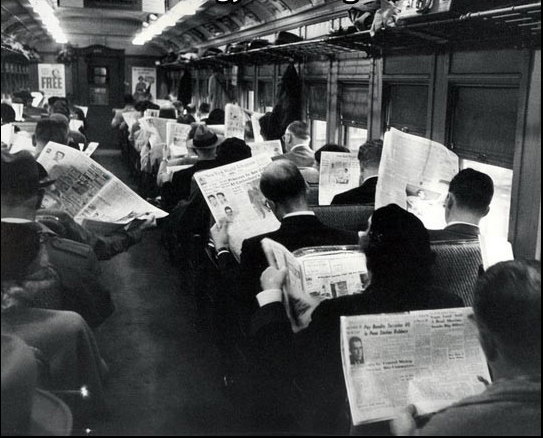
Thursday, 11 May 2017

A Good Hate

Once upon a time the morning commute - by train, or bus, or by tube - would be full of people reading newspapers. There might be the odd rebel gazing out of the window, or reading a book, or perhaps updating their diary, but everyone else was reading a newspaper. And normally, the full range of newspapers was represented - from The Times to the Daily Express; from the Daily Telegraph to The Sun, and with the occasional Financial Times thrown in for some colour.


And you could tell who was who, and their social standing, by the newspaper they read, as was so eloquently put by the (fictional) PM, Jim Hacker in a 1986 episode of Yes, Prime Minister:

"Don't tell me about the press. I know exactly who reads the papers. The Daily Mirror is read by people who think they run the country; The Guardian is read by people who think they ought to run the country; The Times is read by the people who actually do run the country; the Daily Mail is read by the wives of the people who run the country; the Financial Times is read by people who own the country; the Morning Star is read by people who think the country ought to be run by another country, and the Daily Telegraph is read by people who think it is."[1]


Today your average tube or train carriage, or bus, is filled with commuters tapping at lap-top keyboards, listening to their iPods, or scrolling through social media feeds on their mobile phones, and of those who are reading newspapers, the majority will be reading a free-sheet like Metro or The Evening Standard. Newspaper sales have declined significantly in Britain, as this graph shows:


A factor in the decline in newspaper readership has inevitably been the explosive growth of the internet, and mobile internet usage, with the younger generation embracing that technology at the expense of reading newspapers. When I started work and began commuting, people of my age read newspapers much more than they seem to now. I have no doubt that school teachers still implore their students to read 'a quality newspaper' (by which they generally mean The Times or Daily Telegraph) just as much as they did when I was young, but I bet that very few do. To be fair, many of us didn't when I was at school, we mostly read whatever our parents read, which in my case was The Daily Mirror. These days, with newspaper readership in such decline, many teenagers quite likely rarely see a paper at home, let alone read one.

Britain's most popular newspapers in print, with twelve and ten million monthly readers respectively, are The Sun and the Daily Mail. Contrarily, this country's two most unpopular newspapers - by which I mean the papers held in the lowest esteem - are The Sun and the Daily Mail. The Sun, detested  on Merseyside since its coverage of the Hillsborough disaster, has made itself even more unpopular with the piece written by Kelvin McKenzie about Ross Barkley and has found itself banned by both Liverpool and Everton football clubs. The disapproval in which the newspaper is held resulted in the then Labour leader Ed Miliband having to apologise for having his picture taken with a copy of a special edition that the paper produced in 2014 to mark England's World Cup campaign. Now whatever one may think of The Sun, it remains a legitimate part of the mainstream media and for a politician to have felt he had to apologise for any sort of association with it is remarkable, especially when one considers its position as the top selling printed paper. As many people have remarked, it is extraordinary how well The Sun sells considering that no one will admit to reading it.


A lot of people are not prepared to admit to reading the Daily Mail, either - well, not unless they want some abuse lobbed in their direction - despite its huge readership. According to a YouGov poll, it is thought of as bigoted, right-wing (needing to point this out is a bit like having to describe water as being wet), biased, nasty, and misleading by its detractors. Meanwhile, its supporters think it is in touch with ordinary people, interesting, informative, and prepared to stand up for ordinary people. It is suggestive that 'ordinary people' get two mentions among the paper's positive points, and one wonders whether these ordinary people find that the Mail reflects their own views or whether it leads and guides them. I suspect that for many people, the Mail's position merely validates their own. Again, it is remarkable how many people, who claim they never read the Mail, are able to quote chapter and verse on what it has written, which they subsequently find so offensive.

Reality TV stars and WAGS -
the staple of The Sidebar of Shame
The Daily Mail sells in the region of 1.4million copies per day, and when one factors in the received wisdom that says that the average number of readers of a printed paper is six, that's over six million readers per day, or nearly ten percent of the population. But where the Mail really scores is in its online readership, with dailymail.co.uk getting over ten million visits per day, and receiving 240million visitors globally each month, including 80million in the US. And, in case you had not seen it, the most renowned - or perhaps, notorious - element of the website is The Sidebar Of Shame. The Sidebar Of Shame, the right-hand graphical element of the site, contains literally hundreds of thumbnails of celebrities (the majority of whom you will never have heard of) in various states of dress, undress, and distress, accompanied by text of such inanity that it makes your brain hurt.


The Mail's website cannot, with the 1,200+ stories it publishes each day, exercise the same editorial control that is possible in a printed paper, hence the cavalier attitude to grammar that sometimes prevails. The apparent reliance on spellcheckers and predictive text often result in completely inappropriate words appearing. My favourite was where something 'spread like wildlife,' instead of 'like wildfire.' Hilarious, as MailOnline itself might describe it.

I used to be a Daily Mail reader; when I started work I wanted a tabloid sized paper (broadsheets being too inconvenient on buses and trains to my mind), and the Mail was then perhaps not quite as rabid as it is now. And it was worth buying for the columns by Ian Wooldridge and Keith Waterhouse alone;  to my mind they were two of the finest writers to grace the pages of any British newspaper, let alone the Mail. I gave up buying the paper a year or so before I retired because as it's number of pages grew it started to become too large to read, and much of it was uninteresting. Instead, I started picking up the more compact and - in a half-hour train journey - more easily digestible, Metro, which has the added bonus of being free.

The wonderful Ian Wooldridge and Keith Waterhouse

I still buy the Mail, but only on Saturdays and solely for the TV guide in the Weekend magazine supplement (honest!) The paper itself gets flicked through in a cursory manner; little gets read since most of it is features I am uninterested in or opinion pieces - and I'm not short of my own opinions.

Alfred (“Sunny”) Harmsworth, who co-founded the Mail in 1896, said, at around the time of the second Boer War, that, "The British people relish a good hero...and a good hate." In terms of giving the public things to hate in 2017, the Mail is still providing good value for money.


[1] And of course, the punch line -supplied by his Private Secretary, Bernard Woolley - after Jim Hacker was asked about people who read The Sun, was, "Sun readers don't care who runs the country, as long as she's got big tits."

Thursday, 4 May 2017

A Tragedy In 46 Parts

This Saturday, the English Football League's regular season comes to an end. For some teams, all is still to play for, for others, their fates are sealed. Whether they win, draw -or in all probability - lose at Blackpool, Leyton Orient are already relegated to the National League following a season that has seen them employ more managers (five) than they have won home games (four).

I started watching Orient back in the late 1970's. Romford, the team I had supported from the age of ten, went bust in 1978, and for many years I was a season ticket holder at Brisbane Road. When Romford reformed in 1992 I had a dilemma, which I solved by watching the two teams alternately. Then, on a fateful night in February 1995, when Orient entertained Blackpool and lost 1-0 on their way to relegation to Division Four, the then manager John Sitton sacked fans' favourite Terry Howard at half-time. It was my last visit to Brisbane Road until last Saturday.

With my fellow O's fans, back in the 1980's - I am second left at the front.


Orient's season has been appalling. Despite a half-way decent start - O's were fourth after winning at Grimsby Town in August - they slipped steadily down the table and were rock bottom by March. A 3-0 defeat at Crewe on 22nd April meant they had lost their League status, and it would be a brave man who would bet on them regaining it in the near future. Off the pitch, their season has been even worse. Aside from appointing six different managers since last September, owner Francesco Becchetti has left players, staff, and suppliers unpaid. Her Majesty's Revenue and Customs (HMRC) served the club with a winding-up order (the tax bill has since been settled), while players and staff had to wait weeks for their pay. Other suppliers - such as the printers of the club's programme - remain unpaid, and as result, recent issues - including Saturday's - consisted of just a single sheet folded into sixteen pages.

Circumstances reduced the match programme to a sad affair.

I arrived at Brisbane Road last Saturday to find it surprisingly jolly in the April sunshine. It certainly looked a lot different compared to my last visit. It wasn't all-seater then; what were open terraces behind each goal are now covered stands, and the blocks of flats at the corners of the ground were not there, either. The enclosure where I habitually stood, in front of the East Stand, is now seats for away supporters, so I had a ticket for the West Stand (completely refurbished since my last visit).

Orient defend a corner at the much changed Buckingham Road End.
Considering that this game was the first since relegation had been confirmed, most Orient fans I saw and spoke to seemed remarkably stoical. Perhaps their contempt for the club's owner was over-riding any depression at the loss of League status. The game itself was unremarkable. Having trailed 1-0 at the interval, Orient equalised with a cracker of a goal from their best player, Sandro Semedo, but with twelve minutes remaining, gifted the visitors - Colchester United - a second goal with a piece of stunningly incompetent defending. Two minutes later it was 3-1 and, as they say, game over. Five minutes from time, after a red flare landed in the Orient penalty area, it seemed that it literally was game over, with fans invading the pitch, clearly seeking to force an abandonment. Of course, this being Orient, this was football's most orderly, and polite, albeit slightly surreal, pitch invasion. There were people in wheelchairs and mobility scooters and some of the stewards were kicking a ball about with fans at one end of the ground rather than trying to remove them. When the demonstration ended, it did so in the most bizarre fashion.

Orient supporters take to the pitch to protest against the club's owner.

An hour after the fans took to the pitch, it was announced that the game was 'cancelled,' an unusual choice of word, since 'abandoned' is the norm, and a further hour later, the players returned to the pitch to see out the final five minutes (plus stoppage time!), to the back-drop of deserted stands. I was comfortably at home by this stage;  I left fifteen minutes into the protest, as I could see no way the game would resume (and although I was wrong on that score, I would not have been able to watch the conclusion even if I had remained).

A key reason for this somewhat unusual state of affairs was, explained the English Football League (EFL), because " it was deemed appropriate that the game needed to be played to a conclusion in order to maintain the integrity of the competition and in respect of Colchester United's position of being able to qualify for the Sky Bet League Two Play-Offs." Integrity - now there is another interesting choice of word. The EFL maintained the integrity of their competition through an act of subterfuge, which resulted in seven or eight minutes of Anschluss football.[1] If the dénouement of a football match ever lacked integrity or dignity, this was it.

The Leyton Orient v Colchester United match ends in bizarre
circumstances. Photo: East London Advertiser.
It seems that the EFL have recently been fairly flexible in their idea of what passes for integrity anyway. After all, this is the organisation that deemed that Leyton Orient's owner, Francesco Becchetti, having passed their Owners and Directors Test (the test that determines whether someone is a 'fit and proper' owner), then had no obligation to run the club properly or competently. To most people, being a fit and proper owner of a club is indivisible from being capable, or willing, to manage it properly. Not to the EFL apparently, who claim that "the test governs the eligibility of who is able to own a club; it does not also ensure that those individuals have the capability to manage it properly."  If that truly is the basis of it, then it is a worthless, pointless, test.

You can tell this man is the Chairman, it says it on his coat. 
His motives are less clear. Photo: Evening Standard.

But there again, the EFL have form for the pointless, and the worthless, having presided over the integrity-free zone called The Checkatrade Trophy. Having declared that an important objective of the competition was to give young, English, academy players the opportunity to gain valuable experience, they promptly fined clubs like Luton Town for fielding too many young, English, academy players. Cynics might conclude that the EFL's disinterest in directly addressing the issues at Leyton Orient may be due to the fact that after Saturday, the club is no longer their responsibility as they will fall into the National League, but what of the Football Association? The silence from Wembley over the goings on at Brisbane Road has been deafening, and while they did issue a six-match stadium ban to Becchetti after he kicked his then assistant manager Andy Hessenthaler,[2] they seem to have no appetite for addressing concerns over the kicking he is giving his football club.

The FA and their apologists might wring their hands and ask, but what can they do? Well, the FA are quick to act when someone tweets something, writes something, or says something that they deem to be 'bringing the game into disrepute,' and frankly what is more disreputable than the seemingly wilful destruction of a football club? How reputable is not paying the wages of players and staff? How reputable was the statement on the club's website in which the owner seemed to throw his toys out of the pram because the supporters did not like him? One presumes from the absence of any statements - even one merely expressing concern - that they are either content or do not care.

Emmanuel Frimpong - then with Arsenal - was fined £6,000 in 2012 for insulting a Spurs fan on Twitter.
Photo: Sky Sports
Much sports journalism throws hyperbole at the mundane; too many minor mishaps are characterised as tragedies. But this season, when more has been written about Leyton Orient than at probably any other time in their history, the word tragedy is entirely apposite. At Blackpool, The O's will play their final League game of the season, a season that truly has been a tragedy in forty-six parts.

While every other club will start planning for next season as soon as the dust settles on this one, the continual upheaval and apparent lack of leadership at Brisbane Road may mean that Orient are grossly underprepared for life in the National League. Stories that have emerged since I started writing this blog suggest that Becchetti has paid off some of the remaining debts, despite which - and I truly hope that I am wrong - I fear that this tragedy is far from complete.


[1] During the 1982 World Cup in Spain, West Germany played Austria with both sides aware that a win by one or two goals for West Germany would result in both them and Austria qualifying at the expense of Algeria, who had finished their group matches. The game ended 1-0 to West Germany with neither side making any attempt to score any further goals. As a result, FIFA decreed that the concluding games in the group stages should in future kick off simultaneously. Anschluss was the unification of Austria and Nazi Germany in 1938.

Thursday, 27 April 2017

Cooking With Gas

I have a lot of admiration for the contestants on shows like The Great British Bake Off and MasterChef. After all, it can sometimes be stressful cooking for family and friends in the safety of your own kitchen - I always find the getting everything to be ready at the right time and getting it all to the table while it's still hot particularly exacting - but in front of the cameras, in an unfamiliar kitchen with the clock ticking? And then having your food critiqued by experts while the nation watches? No thanks. But there again, I am under no illusions that I am by any means a good enough cook to attempt to enter one of these programmes: I'm certainly not sophisticated enough.


John Torode and Gregg Wallace introduce MasterChef

Like many people, I struggle for inspiration, although I am not yet quite as mired in repetition as my late mother was at one time, when, if for no other reason, you could tell what day of the week it was by what you were having for dinner: "Meatloaf; must be Wednesday." And as in most families, there are certain ingredients that if they are not vetoed completely, are only acceptable if served sparingly or occasionally. But I do enjoy cooking, which surprised me when I first started to do so regularly, which was only about twenty-odd years back. The major reason I started cooking regularly was because I routinely got home from work an hour or so before my wife and it seemed only reasonable for me to at least start the evening meal. Now, I do most of the cooking at home, but there are times when, like my dear old mum, I run out of ideas and fall back on the old standbys, the spag bols and the chillis, the beef casseroles, and the meat, potato and two veg sort of things. When it comes to the spag bols and the chillis, I like to mince my own meat. After the horsemeat scandal of 2013, I stopped buying supermarket mince, and was disappointed with what our local (and well respected) butcher offered, so I bought a mincer.


Recently, however it has not so much been inspiration that I have needed, but rather choosing the type of meal that lends itself to more limited cooking facilities than I have been used to, because in February we had a gas leak. The leak was traced to the hob, which had to be isolated. The National Grid were good enough to leave us a single, electric hob (and a small convector heater, because until we could have the hob isolated, we had no gas supply and consequently no heating) and I am cooking on it still. Why you may ask have I not just replaced the hob? Well, we have some other issues in the kitchen, including the perennial  water problems[1] that mean at least some of the plumbing needs fixing. This, by the by, means that the dishwasher is currently hors de combat  as using it tends to cause a modest flood, so in the not too distant future we have to bite the bullet and have the whole kitchen remodelled - not something I particularly relish.


At present I have an electric oven (which takes an eternity to heat up and is so underpowered that most things take significantly longer to cook than they should), a microwave, and that single, electric hob. The hob is better than nothing but it proves that for me, gas is superior to electric, simply because it is instantly responsive. And with just one hob, cooking something that would normally need three hobs becomes an interesting exercise in getting a meal prepared that doesn't take three times as long as normal and where everything is still hot when dished up (obviously a hot tray comes in handy). The lack of responsiveness of this otherwise decent little hob also means that I have found that the Delia Smith method of poaching eggs is indispensable (when the pan threatens to boil over, remove from heat and leave it for five minutes or so; the eggs continue to cook in the boiling water and are absolutely perfect).  

We have been in a similar position before. When we had a new kitchen fitted at the house we lived in before we moved, we had to have the whole kitchen contents in the lounge temporarily, and had only a microwave to cook with. Frequent trips to local takeaways ensued, which a weekly trip to McDonald's apart, I have fought shy of at the moment.

This time of year, with the weather improving (this week's cold snap excepted) many people's thoughts turn to barbecues, and in fact I have noticed some evidence that some folk have already started cooking al fresco during the few really quite warm days we had recently, but although the barbie is immensely popular, I'm afraid I can think of little that is worse. I have never been a fan of eating outdoors. The memories of roadside 'picnics' on trips out with my parents and aunt and uncle (he did the driving, we didn't have a car), consisting largely of cheese, cucumber and salad cream sandwiches, come flooding back when anyone suggests eating outdoors.  One sees it less these days, but there seemed to once be a time when in the summer, virtually every lay-by was occupied by at least one car-load of people unwrapping sandwiches and pouring tea from Thermos flasks. Personally I have never found that my dining experience is enhanced by having to fend off seagulls and pigeons or swatting away wasps and flies, nor is it improved by trying to eat from a paper plate while balancing a drink in the other hand, or while perched precariously on a fold-up chair that threatens to tip the occupant onto the grass at the slightest ill-advised movement.

Expectation...
If eating outdoors is bad enough, then cooking outside is even worse: I have never understood the attraction of slaving over what is basically a fire, charring burgers and sausages to an even blackness on the outside while maintaining a state of rawness on the inside, potentially poisoning oneself and anyone else ill-advised enough to actually eat anything you have cooked. I suppose it is possible I might have a different view if I had ever used a proper barbecue as cooking in the garden chez Woods has only ever been done using disposable barbecues, on which subject, a word of advice. If you are going to ignore the instruction that says "Remove this card before lighting," make sure you have an ample supply of water at hand. I realise that these views will be anathema to the two-thirds of the nation who own barbecues and get through 40,000 tonnes of barbecue charcoal every year, but it is probably no coincidence that cases of food poisoning in the UK almost double over the summer months - you have been warned.


...reality.


Sooner or later (later, probably) I'll get round to having a new kitchen fitted, then I'll be cooking with gas...again!

Thursday, 20 April 2017

Train Of Thought

I'm sure we have all done it, drifted away from whatever we began thinking about, our train of thought meandering down some obscure, reflective branch line, diverted into mental sidings or ending up derailed entirely. On such occasions I often end up wondering, how did I get here? Subsequently picking apart my thought processes and retracing my mental journey leads me to return to whatever I was originally thinking about, marvelling at the leaps from one notion to another.

That isn't to say that any of this is especially profound: we aren't talking about stream of consciousness stuff a la James Joyce or Virginia Woolf here, more the sort of connected ideas that lead from making a mental shopping list to suddenly recalling in vivid detail some embarrassing event from one's schooldays. Have you ever noticed, by the way, that while you may have completely forgotten something that happened yesterday, you can recall in perfect and excruciating detail, an event that occurred thirty or more years ago that causes you to cringe as much today as it did at the time? No? Just me then.


Anyway, I digress. I was lying in bed the other morning, squinting blearily at the curtains, and noticed a pattern in the floral design that reminded me of a woman, in profile, wearing sunglasses.  This, in turn, made me recall the images that appeared in the wallpaper in my bedroom when I was very young. The paper was principally white but covered with random dots. By squinting at them from a certain angle, it was possible to discern shapes and pictures, like the little dog, or the old man bent over a walking stick. There were, however some dots in the wallpaper that the manufacturer was not responsible for, but rather were made by me. Beneath the wallpaper was a layer of Warmaline (for those of you unfamiliar with Warmaline, it is a white polystyrene veneer that provides insulation and reduces condensation: I am amazed it is still available, but apparently you can still buy it). Warmaline is only a couple of millimetres thick, but like popping bubble wrap, there is great pleasure to be had from pushing something pointy against it and feeling the resistance break. The nose cone of my Fireball XL5 toy was a particularly popular tool for performing this task, although I had to undertake this activity quite sparingly and in unobtrusive locations lest I incur the wrath of my parents.


Thinking about Warmaline - something I don't think I've done for four decades or more - led me to consider another popular household product from my childhood, viz Fablon. My Dad was quite keen on Fablon, and that is putting it mildly. The television, the case of which was a dull brown Bakelite, was covered immediately with a fetching oak pattern, as was the kitchen table, and a bookshelf that I made in woodwork at school. Basically, anything in the house that remained stationary for long enough risked being covered in sticky-back plastic.

This isn't it, but our kitchen table looked remarkably similar to this Fablon covered piece of furniture.


That reminds me that the Fablon covered kitchen table was where I was forced to do my homework by candlelight during the three-day week in the winter of 1974 when I huddled with my parents in the kitchen using the gas stove to provide some warmth.  I'm trying to imagine how school children could do that today, given their apparent total reliance on the computers and the internet. The kitchen table was also where I often worked myself up into a frenzy of frustration at my inability to build anything of any note from the Meccano set that my parents bought me. I think that of all the toys, books and games I was given as a child, that Meccano set was the most annoying and I have no doubt it was the one thing my Mum and Dad regretted buying over all others. I was rather more adept with Betta Bilda, however. Betta Bilda was the rival to Lego made by Airfix - probably better known for their construction kits of aeroplanes like the Spitfire, the Mustang and the Stuka - and I was a prolific builder with it; usually L-shaped bungalows for some reason.


The enforced use of the kitchen table to do my homework by candlelight thanks to the three day week reminds me of other random, minor hardships that most of us in Britain endured during the 1970's. There was a potato shortage one year that resulted in mashed and chipped potatoes being replaced on the school lunch menu by crisps: sausage and crisps is a peculiar meal.

Then there was a bread shortage, ameliorated in our household by the purchase of some bread making kits from a health food shop. These produced something that looked like bread, tasted vaguely like bread, but which had the texture of sponge cake; it was almost impossible to butter and disintegrated when you took a bite. When there was a milk shortage, I was immensely pleased with myself when I tracked some down in a shop in the City while I was working there, only to have my pleasure tempered more than somewhat on getting it home to discover that it was UHT milk - my first encounter with it - and despite it being just about tolerable in tea, we decided we would rather go without. It may have been the milk, or it may have been that the cups were never rinsed and dried properly that contributed to the odd taste of the coffee we had after lunch when I was in the sixth form at school. At the time I thought it tasted distinctly of Fairy Liquid, but more likely it was a combination of very cheap coffee and UHT milk, now I think about it again.


In the late 1970's - when I first started commuting to London - I habitually bought a newspaper in the morning to read on the train. At that time newspapers were printed with ink that would dye your hands black within seconds. By the time I arrived at work, I -and thousands of other people like me- looked like one had done a shift down t'pit! Obviously, this ink was immediately transferred to any other object one might come into contact with, so much so that the only other thing that I took to work - a paperback book - would be covered with black finger marks. To avoid this, I bought a plastic book protector from John Menzies in Cheapside. The shop is no longer there, and today, newspaper ink no longer comes off on your hands - well, not to the degree it once did anyway.


I looked for the woman wearing sunglasses in my curtains again this morning. She had gone. There was a small, red bird with a blue beak, though.


Thursday, 13 April 2017

The April Fool

Perhaps the most celebrated and most widely believed April Fool's Day prank was the one perpetrated by the BBC's Panorama programme in 1957 when they declared that a combination of the mild winter and the eradication of the dreaded spaghetti weevil meant that Swiss farmers were reaping a bumper pasta crop that year. Even today, the average Briton consumes just 2.5 kg of pasta per year[1]; sixty years ago, the average Brit was barely aware of pasta's existence, let alone where it came from, so the idea that it might grow on trees was clearly taken as perfectly plausible by a considerable number of viewers, some of whom contacted the BBC asking how to grow their own spaghetti trees.


Over the years we have become increasingly more suspicious and less susceptible to being taken in by the outlandish stories that appear in the press or on TV on All Fool's Day, to the point where no doubt a number of completely authentic, if somewhat unlikely, stories get dismissed each year as wind ups. This year's crop of hoaxes included the Domino's letterbox warmer to keep your pizza hot and the supposed marriage of Prince Harry and Meghan Markle, neither of which stood up to much scrutiny. Slightly more plausible were reports of a new Bronze Age figure near the famous White Horse at Uffington, and that Sir David Attenborough was to front a BBC documentary about the Grime music[2]. To show how plausible that latter one was, it convinced the Grime artist Stormzy, who went as far as sending the BBC a lengthy tweet expressing his displeasure at the prospect.


Most April Fool stories have the longevity of a mayfly, and our traditional means of consuming them - the press and TV - have meant that they only resurface when tales are told of past years' pranks, but now, with the ubiquity of the internet, things are different. Anyone who has a social media account will know that from time to time, old news resurfaces on their timeline. Hence, stories of the death of a celebrity will re-emerge: Leslie Nielsen, Tony Hart, and Peter Falk are just three of the people who have died twice, their original deaths having been re-reported on social media and them being mourned all over again. Which is where the internet gives April Fool stories the durability that other sections of the media do not.

Leslie Nielsen, born 1926, died 2010...and 2016


Anyone who has ever browsed the internet knows how easy it is for a search for a Yorkshire Pudding recipe to escalate into reading an article about sheep farming in the Scottish islands in three clicks, so suddenly accidentally encountering an article about polar bears being found in the Hebrides is entirely possible. Helpfully, the Daily Telegraph website, where the story about the bear originally appeared, has since updated the page to make it clear that it was a hoax, but not all internet sites bother. Therefore, while the somewhat improbable stories one sees on the net may be scrutinised for a week or so after 1st April, if you read the same story in July or December, how finely tuned are your critical faculties? Not so much, would be my guess. So when Nokia genuinely announced in March this year that they were relaunching their iconic 3310 model, no doubt a lot of people started scouring the web for more information and may have chanced upon a story from 2014 about that particular phone making a comeback - except that was an April Fool[3]. That is a light-hearted matter, and while it may be potentially embarrassing for anyone repeating it, it does no harm. Others may be more damaging, however.

Nokia 3310 mocked up for an April Fool. Shame it isn't real.


April Fool stories differ from the more insidious fake news story thanks to their (normally) implausible nature and the fact that even the publishers debunk them fairly rapidly, but as well as these two types of story, we are increasingly confronted with the tales of outrage. These are much beloved of certain news outlets, The Daily Mail and The Daily Express being prime candidates. A couple of weeks ago, for example The Daily Express explosively announced, "Using a McDonalds drive thru could land you a £1,000 FINE and a driving BAN," because, they said motorists using the Apple Pay or Android Pay apps on their mobile phones would infringe the law that makes it an offence to touch your phone while behind the wheel. The Highway Code lists other things that it suggests ought to be avoided while driving, like listening to loud music, changing a CD or tuning the radio, eating and drinking, smoking, and arguing with your passengers, all on the grounds that these are distractions. Equally, fumbling for loose change, extracting notes from your wallet and paying the cashier for your large Big Mac meal might be seen as distractions, certainly just as much - if not more so - presenting a mobile phone to a card reader. And according to Greater Manchester Police, it would be an offence for a driver to pay at McDonald's with an app on their mobile unless the engine was off and the handbrake engaged. When asked for comment, McDonald's said they hoped that, "common sense (would be) used when the police are applying the rules of this law.” And so say all of us.


This sort of story - normally the preserve of the silly season, when newspapers have no real news to report - has become more prevalent, largely due to news -and I use the word loosely - expanding to fill the space available to report it. Much debate followed in the comments section on this story as to whether a McDonalds drive thru[4] constituted the road or public highway, or whether the law would apply if it is deemed private land. That, plus the fact that I am writing about it now, means that a considerable amount of time and effort has been expended on what to all intents and purposes is a hypothetical question and not real news at all. Should the day ever dawn when a motorist is prosecuted for paying for their takeaway using Apple Pay, then we will officially have arrived in Hell in a handcart, but at least the story will be worth talking about.

Oh, and in case you wondered, the story on the Express website was datelined 31st March, so not an April Fool - although somehow it might as well have been.


[1] By comparison, average annual consumption in Italy is 26kg per person. Source: http://www.internationalpasta.org
[2] For my fellow old fogies, Grime, apparently, is "a form of dance music influenced by UK garage, characterized by machine-like sounds."
[4] I dislike 'thru' but use it for the sake of consistency.

Thursday, 6 April 2017

A Moveable Feast

Some of our local schools broke up for the Easter holiday last Friday. The others - which are in a different borough - pack up tomorrow. Unlike when I was at school and the Easter holidays -  regardless of the date of Easter Sunday itself - were wrapped around that particular weekend, the school holiday now move  according to how early or late Easter - the holiday we call 'a moveable feast' - is. It makes more sense this way; in my schooldays, when Easter was early, we had barely gone back after half-term before we were off again: when it was late, it was only just gone before Whitsun week was upon us. While it makes sense to adapt the school holiday to the date of Easter, it can make it difficult for parents to arrange childcare if they have children at different schools that take their holidays at different times. Not that childcare was a consideration when I was young, as during such holidays and with both my parents working,  I would be left at home from the age of about ten, with strict instructions not to go out or open the front door to any callers. There is no law in the UK as to what age a child can be left alone, although it is an offence to leave a child alone if it places them at risk, and the National Society for the Prevention of Cruelty to Children (NSPCC) recommends that children under twelve are not left alone for lengthy periods: fortunately it did me no harm.

A solitary pedestrian in Romford back in the days when your average town just closed down on a Sunday.

Easter Sunday, like Christmas Day, is a day when the shops in England are closed - the large ones at least, so Easter Sunday is a bit of throwback to the days of my childhood when Sunday was the most boring day of the week. For a flavour of what all Sundays - not just Easter Sunday - in Britain were like in the 1950's and 60's, feast your ears on this, Tony Hancock's "A Sunday Afternoon At Home"


One thing that Easter has always meant to me is football. Today, thanks to the demands of television and the fact that despite everyone claiming that the players are so much fitter than they were fifty years ago, the Easter programme consists of just two matches per club and stretches from Thursday through to Tuesday; it was quite different fifty years ago. Back then it was the norm for teams to play on Good Friday, Saturday and Easter Monday, with two games against one other club bookending the Saturday fixture - and they were not all local derbies either. At Easter 1968, for instance, Romford- who I had just started supporting - played Wellington Town (now AFC Telford United) home and away, a round trip of 350 miles, with a home game against Hillingdon Borough sandwiched in between. Three games in four days were the norm at Easter and rarely if ever did you hear managers or players complain. Today if it were suggested that we return to such a schedule there would be apoplexy among Premier League managers - they get quite agitated at the prospect of three games in a week as it is.

Football at Romford FC's Brooklands ground in the 1970's, although I cannot confirm it was Easter.

Easter at school usually marked a turning point for the PE department. We would return to school after the Easter holiday to find all of the football and hockey goal posts removed - the rugby posts always remained in situ - and the running track marked out. Easter meant that winter sports were set aside in favour of athletics and cricket, although I confess that we played cricket at school rarely. Running, jumping and throwing things were the preferred options of most of our PE teachers between Easter and the summer holidays. Tennis was not available for boys on the grounds that it was a girls sport: quite how that was justified I will never know.

The goalposts have gone, in favour of a running track.


One unusual thing that I associate with Easter is snow. While white Christmases are actually quite rare in Britain, snow at Easter is much more common, and the Met Office records show that snow has been recorded in 2013, 2008, 1998, 1994, 1986, 1983, 1978, 1977 and 1975. In 1983, when Easter fell at the beginning of April, Scotland, the Midlands, and Kent had up to 10 cm. I can recall the snow at Easter in 1975 and 1977, and the reason for that is, funnily enough, football matches. In 1975, Romford played at Nuneaton Borough on Easter Saturday, which that year was in late March, and we experienced all four seasons in one day, with snow falling as our coach - which broke down more than once on the journey - trundled up the M1. And then in 1977, on Easter Monday at Tonbridge, a veritable blizzard engulfed the ground an hour or so before kick-off. Happily, both games went ahead, and more happily still, Romford won them both.

Football and snow apart, Easter is probably most associated with chocolate eggs (the religious connotations aside, which are a given). Like Bonfire Night fireworks, by the time I reached a certain age my parents offered me the opportunity to pass up on the traditional delights in favour of something else - usually a book. This year it seems there is some controversy over the sale of Easter eggs, or more specifically the packaging. There are people up in arms that Cadbury and Nestlé appear to have dropped the word Easter from their chocolate egg packaging, although Cadbury seems just to have moved it to the back of the packaging. Meanwhile, according to Nestlé, "Chocolate eggs (are)  synonymous with Easter... the association is now an automatic one. There has been no deliberate decision to drop the word Easter from our products." Even the Prime Minister - who one might think would have more pressing concerns - has been lured into the controversy to comment on the Easter egg hunt partnership between Cadbury and the National Trust, which is called The Cadbury Egg Hunt, thus omitting the word 'Easter.'  This naturally, is seen by many as diluting Britain's Christian heritage and pandering to minorities, whereas dropping Easter from egg packaging is more likely to be a marketing ploy to boost sales among people who would not otherwise buy them. The National Trust website, while it does not include the word Easter in the title of the egg hunt, uses it six times on the page detailing the egg hunts.


Comments, such as those by John Sentamu, the Archbishop of York, who said that dropping Easter from the Egg Hunt was "tantamount to spitting on the grave of Cadbury," a reference to Cadbury's founder, John Cadbury, maybe miss the point a bit, since according to one of Cadbury's descendants, he was "a Quaker who did not celebrate Easter." Considering that what we traditionally call Easter eggs go on sale as soon as the supermarket shelves have been cleared of Christmas goodies, and that the vast majority of people who buy them don't see the inside of a church from one year to the next, getting vexed on religious grounds seems a tad insincere to me.


Apart from Hot Cross Buns, which I absolutely love, there is another food that I will forever associate with Easter, and that is chicken. It is difficult to imagine now, with chicken so cheap and plentiful, that there was a time when poultry was relatively much more expensive than beef or lamb, so chicken and turkey were a rare treat - well they were in my household when I was growing up - with turkey the default option at Christmas. For Easter Sunday however, our moveable feast was always chicken.


How England Were Nearly Denied The 1966 World Cup

In 2017, during the bidding process to determine who would host the 2026 World Cup, FIFA President Gianni Infantino addressed the travel ba...