Thursday, 10 November 2016

The Day Brexit Got Trumped

2016 is going to go down as the year that turned politics on its head. A year in which we learned, as if we were not already aware, that politicians can and will say just about anything that they think will get the electorate on their side. And that the electorate's capacity for the unexpected should never, ever be underestimated. Naturally, having seen Britain make a spectacularly unexpected - and to many, spectacularly stupid - decision, America seemed to say, "Anything you can do..."


All politicians thrive on  saying what the public want to hear; take Tony Blair for example. Blair tapped into the public consciousness on subjects that the masses were thinking about. On the National Health Service, in the run up to Labour's 1997 General Election win, he said, " We have 14 days to save the NHS." Nearly twenty years later, despite ten years of Blair in Downing Street, the NHS apparently still needs saving. When Princess Diana died, also in 1997, he exploited the zeitgeist when he called her "the people's princess."  And his talent for the soundbite extended even to the moments when, arriving in Belfast for the talks that led to the Good Friday agreement - a not inconsiderable achievement, it has to be admitted - he said, without a trace of irony, "A day like today is not a day for soundbites, really. But I feel the hand of history upon our shoulders. I really do."

Blair understood what the public wanted to hear, and gave it right back to them. This year his legacy has been felt in the run up to Britain's referendum on membership of the European Union, an unedifying campaign aptly described by the author Robert Harris as, "The most depressing, divisive, duplicitous political event of my lifetime." The EU Referendum campaign featured the most egregious falsehoods and obfuscations as both sides sought to exploit the public's fears. Take the claim that leaving the EU would save us £350million a week, all of which could be spent on the NHS. The claim was widely discredited at the time and the 'pledge' to fund the NHS with this sum has been dropped since the referendum result - if indeed anyone in the Leave camp itself ever believed it would actually happen - but enough people were probably swayed by the claim to put their X in the Leave box.

I didn't believe this...
...I'm struggling with this.

Rabble rousing and tub thumping, the Leave campaigners tapped into the public's dissatisfaction with the EU - and let's face it, even among those who voted Remain, I imagine that there are many who would admit that the EU is not without faults, but voted as they did on the basis of remaining being the lesser of two evils - and that is the way politics is for me these days. Far less campaigning on the positives of what the candidates can do, more about how bad it will be if the other lot win. Any positives that a candidate or party claim will accrue from their victory are vague soundbites along the lines of "Taking our country back" or "Making this country great again." Formless phrases, ambiguous claims without substance but which enough people will believe, and which will drive enough people to vote that way.

And there even appears to be a perversity among people that will drive them to do one thing despite it seeming that the most appropriate course of action is the exact opposite. In the aftermath of the referendum the newspapers, radio and TV featured a perplexing number of members of the public who admitted that they voted Leave despite supporting Britain's continued membership of the EU - a position that appeared to spring from a desire to say that if it all went horribly wrong, they could distance themselves from that decision on the grounds that they voted for Brexit. Perhaps this sort of perversity is the reason why I turned on the television yesterday morning to find that Donald Trump had been elected President of The United States. From coverage of the campaign it became clear that there were enough Democratic Party supporters who would not vote for Hillary Clinton on personal grounds - maybe they would not vote Republican, but they weren't going to vote Clinton - giving the Democrats a major disadvantage with so many of their traditional supporters disillusioned about their choice of candidate.

Terry Pratchett in Thief of Time.

Meanwhile Donald Trump - like Tony Blair and so many other politicians before him - was campaigning on a platform of telling the public exactly what they wanted to hear. The average man (or woman) in the street, whether they are American or British or German or French, wants pretty much the same thing. A job, a decent standard of living and security from  harm or danger. So when Trump said he would "make America great again," when he promised to create 25 million new jobs, when he promised to be tough on Islamic State,  to "just bomb those suckers… there would be nothing left,"  when he dismissed climate change science as "a hoax" he spoke to a great rump of people who had seen their jobs disappear - largely outsourced or offshored - who worry about terrorism and who are sceptical about climate change. And in a country where there are more guns than people (112 guns per 100 people), he did his popularity no harm by speaking against gun control.


He spoke to the people who felt that they had been left behind, ignored and unconsidered, put a metaphorical arm round their shoulders and told them that he would look after them. He flattered them into believing that, unlike Obama, unlike George W, unlike any of his predecessors, he cared about their plight and more importantly, would do something about it. Now, he may even believe that himself, but as the saying goes, you can't please all of the people all of the time, and for many, Trump's ascent to the position sometimes known as Leader of The Free World is going to lead to the same sort of disappointment and disillusion that attends the outcome of any election.

On our side of the pond we have been feeling the effects - real, and opportunistic, of Brexit - ever since 23rd June, and the recent High Court ruling that MPs must vote before Article 50 can be invoked - a Government appeal against which will be heard in the Supreme Court on 5th December - leaves us in a kind of limbo, which at least is not the case in the US, albeit that the outcome of this week's election may have provoked the same kind of disbelief. The key difference is that for those who truly think that Britain made a mistake when it went to the polls in June there remains a possibility - no matter how remote - that the vote may eventually be judged exactly what even Nigel Farage has admitted it was, that is, merely advisory and not binding on Parliament. However, no such get out of jail card exists for those members of the American public currently cringing at the prospect of a Trump Presidency.


"God Bless America," goes the song by Irving Berlin. Today he might have written "God Help US."

Thursday, 3 November 2016

The New Romance of The Cup

The father of the modern Olympics, Baron Pierre de Coubertin, said "The most important thing in the Olympic Games is not winning but taking part." Which I have always found somewhat contradictory when set against the Olympic motto - also coined by de Coubertin - "Citius, altius, fortius"   (swifter, higher, stronger), suggesting a quest to be the best.

It has been said that it is only losers who say that winning is less important than taking part and most people would agree that in competitive sport, winning is by definition the object of the exercise. Take the joy we have felt in Britain at the success of our athletes at both the Olympics and Paralympics in 2012 and 2016; it is a radical departure from our usual practice, honed over many decades, of celebrating glorious failure.

Pierre de Coubertin, father of the modern Olympics.
But success in sport has to be measurable objectively, which if you think is stating the obvious, let me explain one of the problems I have with certain sports. A football match is won by the team that scores the most goals, a tennis match by the player who wins the most sets, a golf tournament by the player who shoots the lowest scores - all measurable without ambiguity. I have always had a problem with sports where the outcome is decided by the opinion of one person, or a group. Take diving, or gymnastics. Sometimes, even to the untrained eye, one competitor will clearly be better than another, but with both these sports there are exercises or dives with varying degrees of difficulty, with different tariffs and which are scored by expert judges on the basis of their opinion - an informed opinion, but an opinion nonetheless. Generally, however it seems the system in these sports works fairly well, with little or no debate over the results - the same cannot always be said for others, with boxing the event that is frequently mired in controversy.

In the Rio games this summer, Irish boxer Michael Conlan accused AIBA - that's the organisation that oversees  amateur boxing -  of corruption after losing on points in the bantamweight quarter-finals to the Russian Vladimir Nikitin.  “They’re known for being cheats. Amateur boxing stinks from the core right to the top,” he said. It was by no means the first highly contentious decision in Olympic boxing history and doubtless will not be the last.

How the Guardian reported Conlan's defeat in Rio.

In most team sports there are awards for individuals based on their performance in matches, and these, the Man of The Match award, or the prize for the Most Valuable Player or Player of The Year are by their very nature almost entirely subjective. Is the Man of The Match the rugby player who scored the winning try, the cricketer who took the most wickets, or the goalkeeper who saved a penalty? Or, is the Man of The Match the unspectacular player who performs with quiet perfection but without making a game changing impact? You pay your money and take your choice, but it is usually a subjective choice.

Equally subjective are those team awards given for the best performance in a specific month, or in the case of knock-out competitions, a particular round of matches. For instance, the Football Association's 'Club of The Round' award, handed out to the club deemed most meritorious in each round of the FA Cup. Traditionally this award has gone to clubs who have achieved an outstanding - and usually unexpected - result; the good old act of giantkilling. But not this season. This season the award for Club of The Round goes, not to the team who, against all odds, beat a team from a league - or several leagues - above them, but to the club that knows its way round social media better than its rivals.

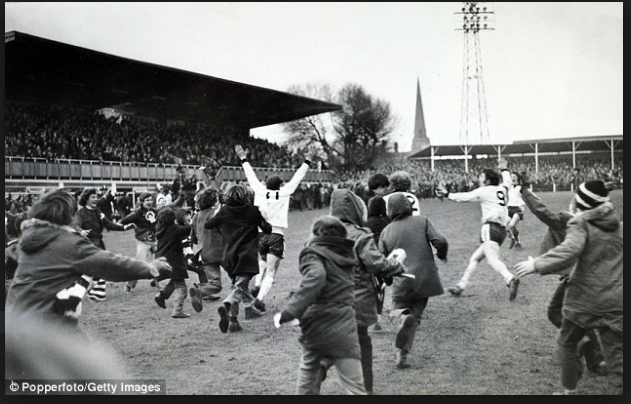
Hereford United's famed FA Cup triumph over Newcastle United. This is how sport should be enjoyed.
The more common sight at football matches these days. If it isn't on your phone, it doesn't count.

This came to my attention - and I suspect, of a good many other people -for the first time when Altrincham won the award following their 3-1 Fourth Qualifying Round win over Matlock Town, a result as about as unsurprising as say, Premier League West Ham United beating Championship side Barnsley. But there again, they did not win the award on the pitch, but rather, they won it off it for their social media work ahead of the game. This is because this season, the FA's Club of The Round award is judged on non-playing criteria. Here is what the FA's website has to say on the subject:

The Emirates FA Cup Club of the Round has been introduced this season to recognise qualifying-round clubs for their efforts in advertising their games to drive attendance and raise recognition and awareness of non-league football.
From the first round qualifying onwards, clubs are given a suite of ten bespoke marketing assets by The FA to be used across print and social media. The first round qualifying fixtures, played over the weekend of 2-4 September, saw 117 of 232 clubs utilise the assets offered to them to proactively market their respective fixtures.
Clubs are judged on a range of criteria including attendance, number of promotional assets used on social media or in print, best social media coverage and video content, before the winner is selected from a shortlist of entrants by an FA panel.

Now, being the supporter of a non-League club, I am all in favour of initiatives that raise the profile of the game below the English Football League, and in doing so, the clubs who best use the various social media platforms and other types of material to publicise their games are to be congratulated. But I am somewhat uncomfortable about making an award for clubs whose use of Twitter is deemed more important than their efforts on the pitch.

This is how the FA's website described Hanwell Town's performance that won them the prize, which includes "£500 paid social media support" - whatever that entails -: "The club... was the first on record at this level to proactively use the marketing creative on a roadside LED, advertising their Emirates FA Cup fixture against Enfield Town on the A40 for nine days between 4am and 2am. They also used a range of assets provided across their social media account and recorded an attendance of 212 for their fixture against their north London opponents – a 77% increase on their usual average league gate of 120."

Photo from the Football Association website.

This is the new romance of the FA Cup, where terms like, "proactively use the marketing creative, " and "a range of assets provided across their social media account," replace back-page tales of derring-do as a non-League club earns a replay against a Football League team and where a last minute winner that pulls off sensational giantkilling is judged subordinate to one-hundred and forty characters tapped onto a smartphone screen. This convoluted jibber-jabber, much loved by marketing men and business school graduates, speaks of a complete lack of feeling for the sport, but top class football has been becoming increasingly about the commercial aspects and less about the action for years now, why should we be surprised if this is not spreading to all levels of the game?

Enfield Town (yellow), on the attack at Hanwell Town. Photo from the Hanwell Town website.


Sadly, that increased attendance at Hanwell's game has not been matched at any of their home games since, suggesting that the larger gate was possibly more to do with the visit of relatively well supported opponents than it was to do with Twitter activity or motorists on the A40 suddenly developing a longing to see the local football team in action. The report on Hanwell Town's website suggests that the home support was " seriously outnumbered by their North London visitors." But don't tell the Football Association that.

Social media and advertising are important these days, but not more than the sport. After all, where he alive today, I doubt Baron Pierre de Coubertin would be saying, "The most important thing in the Olympic Games is not winning but Tweeting about it." At least, I hope not.


Thursday, 27 October 2016

Are You Happy?

Are you happy? If so, what is making you happy? Are you always happy (or at least most of the time), and do you think everyone has the right to be happy?

I ask because I have recently finished reading Derren Brown's new book, Happy: Why More or Less Everything is Absolutely Fine, which poses, and seeks to answer, the questions, "What does being happy actually mean? And how do you even know when you feel it?" I have actually been told that it is possible that I don't know how to be happy, and the question of happiness is one that has challenged scholars and the writers of my favourite sit-com alike (see the episode of Frasier:  Cranes Go Caribbean, in which Frasier asks his ex-wife Lilith, "Do you think I know how to be happy?"), so what does the state of happiness actually look like? Pinning down happiness is tricky; as Alan Watts writes in The Wisdom of Insecurity (which I am quoting not having read the book, but from seeing Derren Brown reference it), it is like trying to tie up water in a paper package. Most dictionaries define happy along the lines of "delighted, pleased, or glad, as over a particular thing," and happiness as the state of being happy, so happiness, or being happy is, on these terms, a quite transitory emotion. It's the emotion we feel when our sports team win - a feeling that may only last until their next match, especially if they lose that one - or after a particularly pleasant evening spent with friends, but is it really a lasting state of mind? Perhaps not; perhaps we need another term, but for the moment, happy will have to suffice.


"Do you think I know how to be happy?"

I approached Derren Brown's book with the expectation that it would be at least in part a self-help book, but this being written by a man who, in his most recent stage show ostensibly performed 'miracles' as a means of debunking the faith healers and their spectacular - and completely ineffective - cures for all manner of maladies, it was never going to be that straightforward. In fact, Brown is critical of the self-help manual, which in his opinion, "can be counter-productive and lead simply to more anxiety," so what help we are being offered in his book is less a 'get-happy-quick' scheme and more a method for identifying the things that are barriers to our happiness, and then removing them.


There is much in Derren Brown's book about stoicism, and if I had considered the subject before I read it, would have thought a stoic to be someone who bore hardships lightly and with fortitude, accepting the challenge they faced as inevitable and beyond their control, much like Londoners during The Blitz. In my ignorance, I was not aware - or perhaps had once known and later forgotten - that Stoicism is a school of Greek philosophy founded by Zeno of Citium in the early 3rd century BC. The first of Stoicism's basic tenets is that "If you are pained by external things, it is not that they disturb you, but your own  judgement of them. And it is in your power to wipe that judgement now."[1] And how often do we react if we feel slighted by others by feeling hurt, when there was no intention to hurt us, where the slight was unintended and the pain we feel is solely a construct of our own mind? Oh yes, there will be times when events do hurt us and we are justified in feeling hurt, pained or disturbed; the key is identifying whether or not that is the case.


Stoicism's second basic tenet may be summed up by American theologian Reinhold Niebuhr's oft quoted Serenity Prayer; "God grant me the serenity to accept the things I cannot change, the courage to change the things I can, and the wisdom to know the difference." Or more pithily, don't worry about things you cannot change.

Now both of these tenets of Stoicism are possibly easier said than done. If, like me, you are a habitual worrier it is not easy to shake off the ingrained, entrenched behaviours that mean that I - and people like me, of whom I imagine there are millions - will worry about things I cannot alter, and will struggle to see the difference between an event and their reaction to it. Which is where I often find self-help books on many subjects to be ineffective; it is all very well saying that to conquer a fear, or to alter a pattern of behaviour one should do a certain thing, but without explaining how to do that thing, that advice is useless, a bit like the instruction manual for a music player that I had which genuinely said, "To increase the volume, increase the volume." And the funny thing is that Derren Brown's book seems to offer little practical instruction on how to stop worrying about the things one cannot change, yet for once, I find that I've read a book that tells me what to do, but not how, and that is still fine. It is perhaps that I have had the patterns of behaviour that cause me anxiety and make me worry pointed out to me and have realised that in many cases, worrying is futile and that sometimes, even when I am disturbed by events, I am looking at the wrong driver of that disturbance.


To give an example, when I retired at the end of 2012, I was happy to do so; it came at pretty much the age I had always wanted to retire at. Since then there have been times when I have been unhappy and thought that perhaps my retiring was a factor, or the cause of my unhappiness. Except it wasn't, other factors were to blame, factors which would have been in effect had I retired or not, and instead of blaming retirement for my unhappiness I ought to have identified the real cause and what - if anything - I could do about it. I have a lot to be grateful for, which I need to recognise and be content with. I also have a habit - one which I am strenuously fighting to break - of worrying on other people's behalf, perceiving them to have a problem and worrying how they will solve it, while all the while, they may not even consider whatever it is to be a problem!

And sometimes it is not practical to expect to be happy, because despite some people believing it to be so, is it really our birthright? Nor may it be desirable: sometimes, as Derren Brown says, 'good enough' is sufficient. If, as I would contend, happiness is a transitory emotion, then it must be so that whenever we consider ourselves happy, it is because we have been unhappy, and could be so again just as easily.

 If we desire to always be happy we are riding for a fall, perhaps we are better off being content. You may say that being happy or being content are the same thing, and that my belief that it is preferable to be content rather than happy is mere semantics, but I see contentment as being satisfied with what one has rather than continually aspiring to more - a 'more' that does not necessarily exist, to be content with 'good enough' and not to demand perfection. I'll settle for that...and being stoic.


[1] Marcus Aurelius, Meditations

Thursday, 20 October 2016

The Pragmatic Perfectionist

I used to think of myself as something of a perfectionist, and made a virtue of it; I wouldn't do that now. Increasingly, perfectionism - or at least considering oneself to be a perfectionist - is seen as a vice rather than a virtue. The somewhat disingenuous notion of claiming - in a job interview perhaps -that one of your faults is perfectionism, is now more commonly seen as exactly that - a fault - rather than a desirable quality. The impression that the so-called perfectionist is endeavouring to portray may be of the meticulous worker who shows incredible attention to detail, is diligent and will not settle for second best, and who is therefore a desirable asset for any employer; they may instead be creating an altogether different, and largely unfavourable, impression.

To many - and this is a feature of almost all articles about what not to put in your CV and what not to say at job interviews - the man or woman who claims to be a perfectionist is going to be labelled a nit-picking pain in the backside; annoying and obsessive and generally not good to work with. And to a large extent that is right, perfectionists are likely to be fixated by minutiae, unable to see the bigger picture and so focussed on getting everything just so that they are unable to finish tasks and thus risk missing deadlines.

There are some jobs in which being a perfectionist must be an asset. Given the choice I'd prefer to be operated on by a surgeon who was a perfectionist rather than one who went about his work with a "That's probably good enough," sort of attitude, but in many jobs and professions, there gets to a point where increasingly delving into detail and worrying at tasks adds little or nothing and can be detrimental. Often the point is reached when further tinkering and tampering actually impairs the process or product; a sort of diminishing return.

I once worked with someone whose role, among others, was helping to design process flows, and anyone who has done that sort of thing (and I have) knows that in analysing a process or activity, there comes a point where having covered all of the basics and important stuff, you reach a state where anything else that gets added merely makes the thing more complex and introduces potential failure points without adding value. And this person, in their eagerness to cover all the bases, in their quest for perfection, would frequently need extended deadlines and would often design processes that only they really understood, included unnecessary functionality and were impractical to build.

There is a fear of failure with some people that drives them to constantly refine, fiddle, and tamper to the point where their search for perfection actually contributes to their failure. Nowhere is this more evident than in sport, where teams - or individuals - may, when they are going through an indifferent spell, and are making simple mistakes, try to cut out those errors by getting everything 'just so' and make matters worse. The golfer, whose putting has gone to pot could be an example, or the footballer for whom the goals have dried up; both will over compensate and try too hard. The golfer gets the yips and three putts from a foot from the hole, and the striker takes an extra touch just to be sure and is tackled. Striving to be perfect and to eradicate mistakes sometimes achieves precisely the opposite. It is at times like these that the perfectionist needs to think of another word that begins with P, and that is pragmatism.

One of my many jobs working for HSBC was system testing, taking the application that the programmers had built and making sure it worked - or more precisely, trying to break it, trying to use it as it would actually be used in the real world and see what it did when things went slightly awry, or when the system was asked to do something that it had not really been designed to expect. With virtually everything we touch these days being based on one computer system or another, when we are all so reliant on our smartphones and the apps that they run, software and system testing is becoming more and more important. There are lots of tools for the tester, and testers themselves are highly skilled, sometimes as skilled or even more so than the people who wrote the code they are testing. But when I started testing it was in a quite informal environment and the way I learned to test was quite unstructured, albeit that it was taken seriously. What I quickly realised was that in most cases, when given something to test, covering every possible scenario was out of the question because it could not be done within the deadline- and anyway, my experience has been that you no matter how much you test, once a system or a program goes live, some user will do something you could not possibly have thought of!

That is where the pragmatism comes in, dealing with things realistically, making decisions based on practical rather than theoretical considerations, and accepting that sometimes perfection isn't possible. For instance, I once worked on a project for which the bank brought in a highly paid team (much more highly paid than us mere employees) of external testers to work on an automated process that was being developed. They spent about six months testing (with the team they had, this worked out at about three man-years of testing) this automated process, while I was tasked with testing the manual equivalent (that is, the exceptions that did not automate).  They tested every conceivable scenario - and some that I was at great pains to point out to them were not actually possible. As far as I remember, they never really finished the testing.

I was given two weeks to test my piece...on my own. I did it - it involved some very long days - and at the end of it, the manual process went live...and the automated process did not. The stuff I tested worked -with a few inevitable glitches, some of which were with the mainframe side of things rather than the user interface or the actual functionality that I had been responsible for testing. And the only reason that I managed to get it tested and the bugs fixed within the deadline was because, rather than insist on perfection, I was pragmatic. There was a point I reached when I had to chose between meeting the deadline with a product that worked well enough or missing the deadline to squeeze in a bit more testing...and missing the deadline wasn't an option.


There is a difference between attention to detail and perfection, and I'm a great believer in the Pareto principle; about 20% of your effort will cover about 80% of what you need to achieve, and the other 80% of your effort will be spent on the last 20%. Sometimes that extra effort brings such a marginal reward that it isn't worth the time. The pragmatic perfectionist who applies the Pareto principle allied to attention to detail will always be more effective than a straightforward perfectionist, because ultimately, the pragmatic perfectionist gets things finished.

Thursday, 13 October 2016

Doing What's Best

It goes without saying that parents want what is best for their children (even if the children do not necessarily think it's what they want - or need), the general principle being that as parents we want our children to have opportunities that we did not have in order to be able to make the best of their lives. This does not mean giving in to the child's ever whim, it does not mean featherbedding them - and there are plenty of examples of the rich and famous declaring that they will not simply bankroll their offspring, but will make them work for their successes, although how much of that is simply said for publicity and how much of it is true is moot.

Giving your child the best start they can have and equipping them for their adult lives starts with education. Everyone will have a view on what constitutes the best form of education their child can receive, whether it is a private school or a state school, grammar school or comprehensive: even at primary school level, parents go to great lengths to ensure that their children get into their school of choice. So the news that Baroness Chakrabarti, former director of human rights group, Liberty and now the Labour shadow attorney general, is sending her son to Dulwich College, an independent school to whom she will pay £18,000 a year in fees for his education, ought to be no one's business but hers.  


Baroness Chakrabarti

Well it would not have been had not been for the fact that at the same time as Chakrabarti was revealing that her son would be attending what many regard to be an elitist school, she was voicing her opposition to grammar schools on the grounds that they are selective. Which of course is what Dulwich College is. Inevitably this has led to her being accused of hypocrisy, which as Alan Bennett once said, is something that Britain excels at - and, I would say, condemns in equal measure. But accusing a politician of being a hypocrite is a bit like accusing a bear of being hairy.  A sign saying, "Don't do as I do, do as I say," might as well be hanging over the door at Westminster, where it almost seems that hypocrisy is a prerequisite for political office.


I have no problem with the baroness wanting to give her child the best education she can. Just like Diane Abbott, whose son went to the private City of London school, or Emily Thornberry, whose child went to Dame Alice Owens School. They both also felt that they were sending their children to schools that would enable them to achieve the most. How can I object to Chakrabarti sending her son to a selective school if that is what she wants to do and can afford to do and while the option remains open to them? But Chakrabarti, Abbott and Thornberry all took the opportunity to send their offspring to selective, grammar type schools while arguing that grammar schools are socially divisive, elitist and perpetuate inequality. The argument that opponents of grammar schools use is often equality, that a school system that does not include grammar schools must be fairer, must promote equality. And because they believe that grammar schools sustain inequality and elitism, and that these twin evils must be eradicated, the manner in which they propose levelling the playing field is not to raise every other school to the standards of the schools they send their children too, but to reduce all other schools to the lowest common denominator. Naturally, this would not affect the selective, fee paying schools they favour with their custom; it speaks of an attitude summed up by Gore Vidal when he said, "It is not enough to succeed. Others must fail."

Dulwich College


What idealists who imagine a grammar school-free world to be is some utopia where all children can thrive regardless of ability in environments that do not favour the more able at the expense of the less gifted. Have these people never been to a school of any kind recently? All schools, be they secondary-modern, comprehensive or grammar, will have children of varying abilities. In the interests of getting the best out of people, schools stream their pupils, even the non-grammar schools. And if they don't then the gifted get held back, but the less able are no better off.  And if the school isn't streaming, then an informal hierarchy will form itself because anyone who believes that children of secondary school age are all fair-minded, egalitarian and not at all prone to forming cliques or creating their own social rankings was presumably born middle-aged.

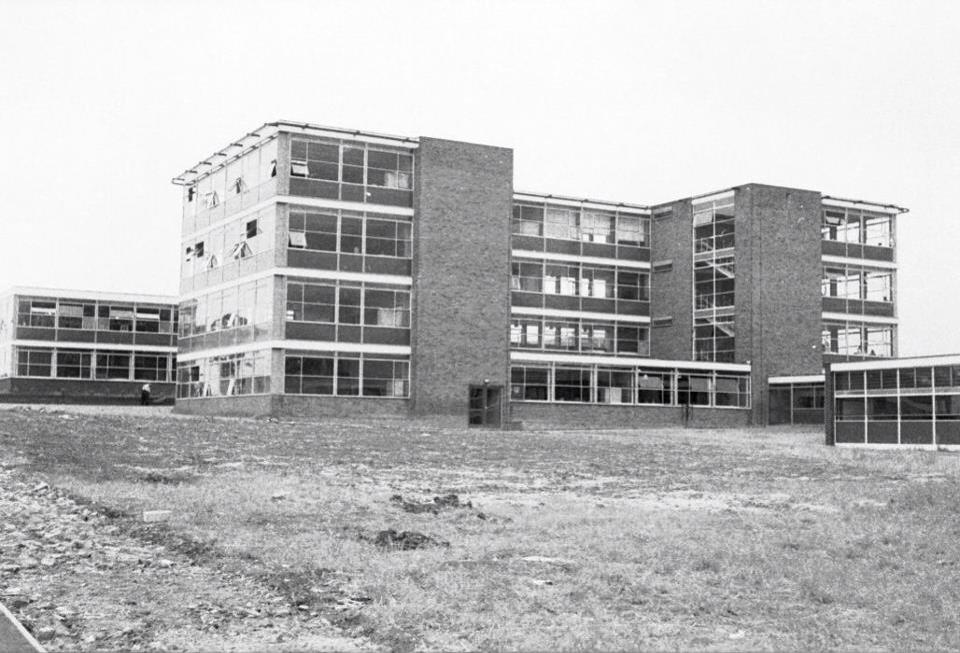
My alma mater, North Romford Comprehensive School - now closed and demolished.


As it happens, I am not a fervent supporter of grammar schools; I didn't go to one and neither did my wife or most of my friends, but I see no reason why they should not exist, nor why parents should not have the opportunity to send their children to them. My wife and I, and our children, went to various comprehensive schools, and while I can't say that my school days were the happiest of my life, I cannot fault the education I got at my school, which was what Alastair Campbell would have called a 'bog-standard comprehensive.' What I am a supporter of, however is freedom of choice, and if people want to send their children to fee-paying, selective schools, they should have the right to; if they want to send them to selective grammar schools, they should be able to. If they want to send them to comprehensive schools - and I reiterate, there is nothing wrong with the comprehensive school - they should be able to.


What they should not have to do is have their choice of school limited by people who make rules that they do not believe should apply to them.

Thursday, 6 October 2016

A Midland Odyssey - Part Nine - Stranger In A Strange Land

In 1998 I was working in the Midas Team in St Magnus House, Lower Thames Street in London. Midas had been developed as a PC based query system for Multicurrency Payments Department (MPD), the area that processes all of the UK Bank's payments, home and abroad[1]. My role was to liaise with the business, gathering requirements, handling their questions and testing the application. It was hard work, but enjoyable, and I must have been pretty good at it, because when the Bank decided to install a version of the application in HSBC's Correspondent Banking Department in Hong Kong, I was chosen to not only test it, but also to travel to Hong Kong and help with the implementation in January 1999.

But as Christmas 1998 approached, my wife Val and I were plunged into a nightmare. Our daughter, Sarah - who was fifteen months old - fell ill. She was fractious and restless, cried all the time and was sleeping poorly. The doctor could not tell what was wrong, and when her condition failed to improve, we took her to the hospital. Again, the doctors were unsure what was the matter, but one of them said - and I will always thank him for this - that we were not taking her home until he had discovered what was wrong. Eventually he asked permission to perform a lumbar puncture - just to rule some things out, he said. When he came back he gave us the devastating news that Sarah had meningitis. I have never been so scared in my life, but fortunately the diagnosis was made in time to get her the treatment she needed and she ultimately made a full recovery, but while she was in hospital - and both Val and I spent nights there, sleeping in uneasy chairs - any thoughts of a trip to Hong Kong were far from my mind.

HSBC Headquarters, Queens Road Central, Hong Kong

Sarah's recovery meant that I was able to fly out to Hong Kong, but not without a sense of apprehension at leaving Val alone with her - and some trepidation at the prospect of two weeks in a strange place, together with the prospect of dealing with the Midas implementation alone, albeit with support from the UK - six thousand miles away and six hours behind.


As I was still a Grade 5 clerk at the time (I think that is GCB7 in the new structure), the Bank didn't exactly push the boat out when they booked my flight and I was shoehorned into Economy for the twelve hour flight, which left at 9pm instead of the scheduled 6pm and meant that I landed in Hong Kong at three o'clock on a Sunday afternoon. And rather than stump up for a hotel, the Bank billeted me with Chris Doyle, a manager in the Correspondent Banking team at his flat in Happy Valley. I don't think that I properly thanked him for his hospitality; as a stranger in a strange land, not having to spend a fortnight in a lonely hotel room, but having some company and being included in the social life of Chris and his fellow ex-pats was something I was grateful for. Chris thoughtfully gave me a piece of paper with his address written in Cantonese and a phonetic English translation (something like "pow ma day surn gayling fong") that was of immense assistance the night I got a cab home alone with a driver who spoke little or no English.

View from The Peak

Hong Kong was a mixture of the familiar and the alien. Out for a walk one lunchtime, I passed well known stores and restaurants; Marks & Spencer, Louis Vuitton, McDonalds, and then, turning a corner into a less well trodden side street, I saw a man with a stick, driving a dozen chickens before him! And this contrast was apparent in the office too. One evening I was involved in a call with my manager in the UK, Raj Soni and the manager of Correspondent Banking in Hong Kong, Geoff Armstrong, who had been my boss at Threadneedle Street International Banking Centre. Having been in a meeting with people I had worked with at home, it seemed odd to walk out of the office that night into Queens Road Central rather than Lower Thames Street. That mixture of the recognisable and the unrecognisable is one thing that makes Hong Kong so alluring, and although I suffered some pangs of home-sickness, the familiar sights and the work made it less painful, even if I suffered chronic jet-lag. Many an evening I would doze off in an armchair, my book falling to the floor with a thud that woke me up, only to find myself unable to sleep once I got to bed, dozing fitfully until the alarm went off, by which point I felt exhausted.

Pictured on her visit to London some months later, Maria Ng from HSBC Hong Kong's Correspondent Banking Department and yours truly.


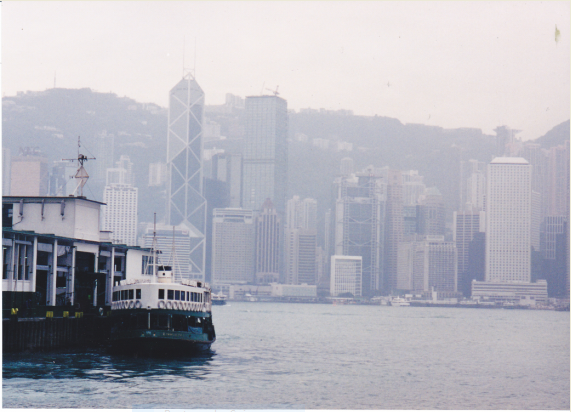
Although I was only there for two weeks, I saw enough to recognise a subtly different working culture. While in the UK I was used to people arriving at nine, working in a blur until five or five-thirty and then leaving, in Hong Kong I would get to the office just after eight in the morning to find most desks occupied, and leave at six in the evening with people still working. One evening I was still there at 8pm and hardly anyone had gone home. But between times, whereas my colleagues in MPD or the Midas Team would be flat out almost all day, in Hong Kong the daily grind was more laid back. I'm not saying they did less work, just that they seemed prepared to allow the work to progress at a more leisurely pace. Since I was there for two weeks, I had opportunities for sightseeing. I went to The Peak. The famous Peak Tram runs from Central to Peak where there are brilliant views of the city and harbour. I took the equally renowned Star Ferry to Kowloon and the bustling Wan Chai.

Looking across the harboir from Kowloon


Apart from Hong Kong, the furthest I ever had the chance to travel on bank business were Sheffield and Livingston in Scotland, and the trip to the former British colony (it was handed over to the People's Republic of China in July, 1997) was one I'll never forget. The implementation went as well as could be expected - a few minor glitches, but generally it was rated a success - and I had the chance to see a part of the world I might otherwise have not. I would recommend anyone who gets the opportunity to visit Hong Kong to go, it really is a different world.


Thursday, 29 September 2016

Taking Money From Strangers

Interviewed after his one and only game as England manager, Sam Allardyce related an anecdote about a stranger giving him a 'lucky' coin at the team hotel prior to the match, so it is perhaps fitting that it was taking money from strangers, or at least agreeing to do so, that brought an end to his sixty-seven day, one match, reign.

It isn't the first time that Allardyce has been on the receiving end of allegations of impropriety. In 2006, Allardyce and his son Craig - who is a football agent - were alleged to have taken bribes from agents for signing players. Allardyce senior denies ever taking, or asking for, money, but it may be with those allegations in mind that The Daily Telegraph newspaper included him in an investigation into bribery and corruption in British football that has been ongoing for ten months.


The facts of the story are simply that Allardyce met with men posing as representatives of a Far East company and agreed to travel to Singapore and Hong Kong to give talks on how Football Association rules that prohibit third party ownership of footballers could be circumvented. In return, Allardyce was told that he would receive around £400,000 although as we know, he would never have received such a payment because he would not have had the opportunity to earn that money; the deal was completely bogus. Which begs the question, has Allardyce done anything wrong? Without doubt he has been caught out making a complete error of judgement; he said so himself: "It was an error of judgement...I sort of helped out someone I've known for 30 years," but is an error of judgement like this an offence for which someone can lose their job? In a way, yes inasmuch as although no actual offence has been completed - he did not take any money, he did not give advice on getting round FA regulations - he did in principle agree to commit an offence, which in law is known as an inchoate offence, that is an act that is anticipating or preparatory to a further criminal act. In that respect, were they offences in law rather than breaches of Football Association rules, The Daily Telegraph journalists were, to my mind, on shaky ground in that they were in fact inciting Allardyce to commit an offence.

Adam Lallana scores the only goal of Sam Allardyce's reign. Remember that, it will come up in quizzes before too long.
All of this is beside the point, since Allardyce's contract with the FA was terminated by mutual consent - you have to love that expression, I have no doubt it was more a question of Allardyce agreeing to jump before he was pushed - because his conduct was deemed 'inappropriate' and there can be no doubt that it agreeing in principle to commit an offence is inappropriate in anyone's book. But in some ways, this was almost a sideshow when compared with Allardyce's criticisms of his predecessor, Roy Hodgson, of Gary Neville, and of the redevelopment of Wembley Stadium. The FA's coverall charge 'bringing the game into disrepute' could just have easily have been levelled; it might not have brought him the sack, but the comments he made were hardly becoming of a national team manager in the company of strangers, even if he believed the conversation to be off the record.


Of equal - probably even greater -concern are The Daily Telegraph's investigations into corruption in English football that they maintain reveal that managers, officials and agents have been taking money to arrange player transfers. They claim to have evidence of an assistant manager at 'a high profile football club' accepting a £5,000 payment, that ten managers have taken bribes to fix player transfers, and that a high-profile manager admitted his players broke FA rules by betting on their own games, which he failed to report. In addition two well known managers allegedly discussed working for the same fictitious firm as Sam Allardyce did.

Now the allegations of actual offences are of course, very serious and deserve rigorous investigation by the Football Association and the appropriate penalties imposed if the individuals are guilty, but I am sure I am not the only person uneasy about the ethics of punishing managers who have allegedly discussed working for fictitious firms in ways that would contravene FA regulations. Allardyce called it 'entrapment' and there is no better word for it, and entrapment is a morally difficult concept to defend in every circumstance, however while the law protects against the state (the police for example) causing citizens to perform illegal acts, it does not protect against private parties - newspapers or other sections of the media -doing so. And in those instances, the actions of the private ‘entrapper’ often go beyond what would be deemed appropriate by law enforcement officers.

While there are many who would argue that the actions of The Daily Telegraph have exposed an element of the erstwhile England manager's character that would disbar him from holding that post, it is equally possible to argue that without the newspaper's actions, Allardyce would not have had the opportunity to agree to commit a hypothetical offence. The circumstances are like a thought experiment, akin to Schrodinger's Cat: Is an incitement to commit an offence where the parties to which the offence relate are fictitious and the person inciting the act has no intention of actually commissioning the act nor of paying the person being so incited, an actual offence? And how far does one take this? Perhaps if a football manager were engaged in conversation by a journalist and asked if, hypothetically, he could arrange for a player to be owned by a third party and he said, yes, in theory he could, would that be an offence? No, of course not and Allardyce's actions, while stupid are not much more than one step removed.


But, having spent so long railing against corruption in FIFA and UEFA, the FA could not stand idly by and allow any behaviour that might possibly be construed as corrupt to go unpunished. Sam Allardyce might claim that his only crime is stupidity: as a defence goes, that isn't good enough. And the problem with complaining about entrapment is that unless you say 'No,' you've no defence at all.

Thursday, 22 September 2016

The Green Wheelie Bin Tax

The attempt by Margaret Thatcher's  Conservative government in the late 1980's to introduce what was commonly  called the Poll Tax - more properly the Community Charge -and the ensuing riots driven by the unpopularity of the tax is generally held to be one of the chief reasons for Maggie's demise. Yet it always struck me - and still does, come to that - that the Community Charge was a more equitable way of assessing and collecting local taxes than either the rates that preceded it or the current Council Tax system. Since the system of collecting local taxes known as rates - which began life as the poor rates in the seventeenth century, being replaced by the general rates following the 1925 Rating and Valuation Act - was based solely on the notional value of a property, a family of five wage earners would pay the same as a single pensioner living in an identical property next door, despite using more significantly more local services, and despite having an income several times greater than said pensioner. It seemed to me to fit the principle, "From each according to his ability, to each according to his needs" but many people disagreed.


The problem with the Community Charge was less the principle than the implementation and large families in small properties saw their liability to the local authority increase significantly. With some justification, the tax was seen as saving money for the rich and moving the burden of paying for local services onto the poor. The principle remains sound, however - a family of five will generally consume more local services than a person living alone, however neither will use more street lighting nor be more of a burden on the council's planning department than the other: so perhaps the time is coming for another change in the way in which local taxes are calculated and collected. And I say that because of moves that are afoot in the London Borough in which I live that suggest that in the future council tax bills may be more tailored towards the services we consume and the degree to which we use them.

Only 12% of Barking & Dagenham's revenue comes from Council Tax, while Children's Services represent the largest outgoing.


Now, I have often sung the praises of my local council who, although they require me to pay them the best part of £2,000 per annum, have always provided a good level of service. The streets are clean, the street lights work, my refuse gets collected (albeit the refuse collectors went on strike last year for what seemed like an eternity)and generally the council get on with things with little fuss or bother. And last year, when I was clearing out my mother's house after her death, they came and took away stacks of bulky waste, although they do make an additional, nominal charge for that, which is a direction they - and other councils - are increasingly likely to take. Despite it being extremely difficult to avoid paying Council Tax - in 2014-15 it had a collection rate of 97% - it covers less than 25% of council expenditure, with central government funding and business rates covering the other seventy-five percent. But with cuts in government funding and income from business rates subject to fluctuations as businesses prosper or founder, local council services have come under increasing pressure and all local authorities are faced with the unpalatable alternatives of either having to increase council tax or cut services - or both.


At present my local council collect my domestic waste weekly and my recycling and garden waste fortnightly; next week is the last week when my garden waste will be collected this year and the service should resume next March. But when - or if - it does, I may find myself paying extra, as the council have started a consultation on whether residents would be prepared to pay extra for garden waste collections. And although they estimate it would be as little as £1 per week, I figure it would probably be considerably more than that, since the most efficient way of running such a scheme is to sell residents garden refuse sacks - and the more sacks you use, the more you will pay, or if they continue with the wheelie bin system then I guess I will be paying more than most as due to the size of my front garden (thanks to the large tree in it), I need two wheelie bins, into which I still sometimes struggle to fit all my grass cuttings and the leaves the tree drops. The proposal to charge extra for garden waste collection has predictably provoked many comments on social media, with opponents arguing that they already pay enough in Council Tax and supporters taking the viewpoint that many people pay for the service despite not using it, such as those who live in flats or other properties that have no gardens.

Come Autumn and our wheelie bins get filled with leaves.


I realise that in many other boroughs paying extra for garden waste collection is the norm, but stepping down the road of individual pricing for any service that some people might describe as optional could lead to a rather difficult debate about what an individual pays for versus what they consume. Council tax pays for schools, roads, libraries, children's services and adult social care: it also contributes towards the cost of the police and fire service, and while many of these are core services to which we all should pay, I would argue that some are optional extras. I no longer have children attending school in the borough; in fact since both of my children attended secondary school in a neighbouring borough, it is seven years since I had a child in a school in my borough. So just as the tenant of a flat on the tenth floor of a tower block who generates no garden waste feels they ought not pay for garden waste collection when they have no garden, should I be expected to pay for services like schools or libraries that I don't use? But schools and libraries are essential services, you may say. Well, so is garden waste collection - if you have a garden, because by charging extra for it, councils risk residents refusing to pay and  fly-tipping their waste, which then costs even more to clear.

Fly tipping is a major problem. This mile long tip appeared overnight near the Dartford Crossing in November 2014. Photo: East News

But whether it is individual prices for optional services, privatising services, or sharing services and resources with neighbouring boroughs, the way in which local authorities raise income and how they spend it will change. Council partnerships with private enterprises are increasingly the norm, while merging some services with those in other boroughs is also an increasing trend. The changes to the landscape of local government services that are currently in train are being delivered incrementally and at varying rates to varying degrees across the country rather than in one fell swoop, yet they are  possibly even more fundamental than the introduction of the so-called Poll Tax. Unlike the protests against the Poll Tax, I doubt there will be protesters marching on Barking Town Hall towing green wheelie bins.

How England Were Nearly Denied The 1966 World Cup

In 2017, during the bidding process to determine who would host the 2026 World Cup, FIFA President Gianni Infantino addressed the travel ba...