Thursday, 18 August 2016

One Man's Trash

The first time I saw an advertisement for a car boot sale, I confess that I was mystified. Common sense told me that it could not be a sale of car boots, but otherwise I was perplexed. Today there can be few people who do not know what one is and there are literally hundreds of such sales up and down the country - there are over seventy regular car boot sales in Essex alone.


The car boot sale apparently originated in Canada - where, unsurprisingly, it was known as a trunk fair - and the idea was introduced into the UK by a Catholic priest from Stockport, as a charity fundraiser in the early 1970's. Val and I have done a few boot sales to sell off household items that have been surplus to requirements - most recently, we did one last weekend - and we are always amazed by the amount, and type, of things that people will buy. We have sold books, CDs, toys, clothes, furniture, jewellery, perfumes, shoes - you name it, it seems folks will buy it. Arriving at the boot sale and setting up, it was amazing how many other sellers (they must be sellers, as the sale wasn't open to buyers for another hour) descended upon us asking if we had particular items - watches and perfume were especially popular, not that we had any of either. These hardened sellers obviously know what things sell best.

The good old British car boot sale.

Five or six hours later we had made a few quid - not as much as the last time we did a boot sale, but an amount not to be sniffed at - and we packed up the remaining items and took them home, either to take to an unsuspecting charity shop, or to throw away. One reason for going to a boot sale last weekend was to coincide with our having hired a skip so that we could clear out our shed and garage, the latter being used for storing everything except a car. There are two reasons why our car doesn't go in the garage; firstly, even if I could get the car in it, the garage is barely wide enough to open a car door and get out, and secondly, the garage is full of the flotsam and jetsam we accrue and then dispose of on a regular basis. Annually it seems we accumulate piles of detritus; cardboard boxes and other wrappings from domestic purchases that we keep on the offchance that either we have to return said purchase or in case the box comes in handy, which it rarely does. After spending a few days last year trolling back and forth to the local tip, we decided to hire a skip this year, to save time, if not money,  and like the car boot locusts who descend the moment you arrive at a Sunday morning sale, our skip has attracted a few passing totters who have relieved us of sundry items like chairs, an old lawn mower, scooter and ironing board.


What really is remarkable is the amount of stuff we manage to amass these days and how much of it is rubbish. Outside our back door we have four wheelie bins; one for normal waste, one for recycling and two for garden waste (we have a large garden and the first lawn cut of spring will easily fill both bins) and they are always full come collection day. Contrast this to fifty years ago when I was a nipper and my parents had one bin, small in comparison to any of my wheelie bins, which was for all of their refuse and which was emptied each week.

Today, a row of wheelie bins has replaced the single bin and the old fashioned dustman:


These days we, and I'm sure many of you, have more rubbish than we can cope with. There are innumerable reasons for this. Firstly there is packaging. Everything that my parents bought loose now comes in layers of packaging. My Mother would go to the greengrocers and have pounds of potatoes, onions, carrots and whatever, weighed loose by the shopkeeper and tipped directly into her shopping bag. Nowadays supermarkets insist on selling everything in plastic, with some fruit or veg sitting on polystyrene trays in the bags, and while I try and buy as much loose as possible, with some things there is no choice. Convenience foods when I was young were tinned, by and large. Ravioli and rice pudding out of a can were the nearest thing to ready meals that my Mother ever cooked (or should that be heated?), whereas nowadays you can see shoppers' trolleys piled high with microwave lasagne or paella all of which generate obscene amounts of waste card and foil containers. My parents' generation cooked more food from scratch, meaning that the waste they generated was more likely to be potato peelings and the leaves from a cauliflower (both of which were of course compostable).

Secondly there is the conspicuous consumption that many people indulge in and from which few are immune. Despite the undoubted hardships that many people have suffered and continue to suffer as a result of economic downturn and austerity measures, a good many things are cheaper, both relatively and actually, than they were twenty or thirty years ago. Look at video recorders, which I wrote about recently. The first one I bought, in 1989, cost £350; fast forward (pun intended) to the days when the last ones were on sale in the High Street and they were going for under fifty quid. And clothes: thanks to shops like Primark, the price of polo shirts, shorts, lightweight jackets, even winter coats, are lower than they were in the days when I had a full head of hair (about 1985).

We live in an increasingly throw-away society, even though that term is hardly new, having been first coined in 1955 in Life magazine. Few people 'make do and mend' like our forebears, we dispose of things because they bore us rather than because they are worn out. Manufacturers of consumer items like mobile phones, televisions games consoles, all forms of computers and tablets - most electronic devices really - constantly bring out new versions of their products, encouraging us to upgrade, upgrade, upgrade.

The amount we throw away is astonishing. This graphic shows the domestic waste from each home in the London Borough of Barking & Dagenham.


At one time many people would fight shy of buying used goods - there was a certain stigma about doing so. Today, with the proliferation of boot sales, the rise of the charity shop and the stores selling pre-owned or vintage, cherished items, and the incredible popularity of websites like Gumtree and eBay, buying second-hand is to some extent fashionable - and cheaper. We all generate more rubbish and things we simply tire of or outgrow than any previous generation, which means  that anything we can do to reuse or recycle more and more must be a good thing. Today more than ever, one man's trash is another man's treasure. 

Thursday, 11 August 2016

"We Are Sorry For Any Inconvenience Caused"

The most mealy-mouthed, insincere apologies you will ever encounter are those that routinely accompany announcements made on public transport systems, tacked on the end of messages informing you that your train is formed by only four coaches instead of eight, delayed for some reason, or simply cancelled outright.

The number of times the average commuter hears that sort of apology is so great that quite quickly they are tuned out, thus it is only the more remarkable, ad hoc apologies that stick in the mind. One of my favourites has to be the apology from the driver of a train as it ground to a halt at Goodmayes Station en route to Liverpool Street, to the accompaniment of a loud bang. The delay in our service, and the cause of the bang, he told us was due to a pigeon landing on the overhead power cables...and exploding. Fortunately this did not cause sufficient delay for me to be late, although the pigeon was very late.

More frustrating than the disingenuous apologies, however are the complete lack of announcements - useful or otherwise - when things are not running properly. When I worked at Canary Wharf, the Jubilee Line station there would resound to frequent announcements stating the obvious, that "A good service is operating on the Jubilee Line" when the trains were running properly. There would be signs reinforcing the statements made on the public address, and cheerful Transport for London (TfL) staff would be (superfluously) manning the ticket barriers and generally milling about. On the day you arrived on the platform to find the indicator board blank, or one suggesting that the next train would not be for another twenty minutes instead of the usual three or four, announcements there would be none and TfL staff would be conspicuous by their absence, having probably barricaded themselves in their offices to avoid the wrath of the thousands of disgruntled commuters.


Station staff are not responsible for signal failures, broken down trains or people trespassing on the tracks, which are the sorts of reasons that services grind to a halt, so I cannot say that I blame the staff for going into hiding.  After all there is nothing worse than being subjected to abuse from unhappy would be passengers  when the problem is not of your making; and having worked in customer services I've experienced the shoe being on that particular foot; and if running away is not an option, then grinning and bearing it is the only recourse.

Less easy for rail travellers to sympathise with are the occasions when rail workers take industrial action. There are at present at least two industrial disputes on the railways, one on Eurostar and another on Southern railways. I don't pretend to know all of the ins and outs of either dispute, but on a very basic level the first appears to be about the detrimental effect on the work-life balance of train managers caused by what the National Union of Rail, Maritime and Transport Workers (RMT) call " the company’s failure to honour a 2008 agreement" on unsocial hours and duty rosters. If the union are to be believed, and the company have not honoured an agreement that presumably forms part of the employees' contracts then you have to have sympathy with their position.

Southern rail trains have been going nowhere recently.

The second dispute seems to stem from a desire by Southern rail's train operating company, Govia Thameslink Railway, to introduce driver only operation on their services, which the RMT oppose on health and safety grounds (not, apparently, as the cynic in me might have thought, in order to preserve jobs where one no longer exists). Concerns over health and safety are, like accusations of racism, hard to resist. Everyone, from management to unions to passengers must consider that health and safety are not areas anyone should be skimping on. Except that other rail networks run one man operated trains - and have done for many years - without any undue problems, and only yesterday (Wednesday, 10th August 2016), two-hundred passengers were evacuated without incident from a C2C train at Dagenham after a fire onboard caused by overheating brakes. C2C operate without guards; why they can do so without compromising health and safety but the RMT maintain that Southern rail cannot, I do not know.

Whatever the wrongs and rights of these disputes, one thing is for sure, the transport unions in general, and the RMT in particular, remain the most confrontational of Britain's trade unions. There is no doubt that trade unions are generally a good thing, going all the way back to the 1830's and the first real union, the Grand National Consolidated Trades Union (GNCTU). But while it is generally believed that the withdrawal of labour should be the last resort, it all too often seems that the railway workers' unions are way too trigger happy when it comes to initiating strike action. And, as is so often the case, it is the general public that suffers the most when they do. Shop workers, cleaners, office workers, teachers, nurses; you name it, there is hardly an occupation unaffected by a rail strike.  However, while the travelling public may have little sympathy with the unions, then the rail companies don't get  much either, generally being held in fairly low esteem by commuters anyway. You might say that rail companies and the unions are a match made in heaven - or hell.


By and large the travelling public has become so accustomed  to the inconvenience that is caused to them by strikes that they simply ignore them and make alternative arrangements. Back in the late 1980's a series of weekly strikes by railway workers meant no trains and no tubes in London for six consecutive weeks. My employers, Midland Bank, ran coaches from all points of the compass to ferry staff to Central London. On week one they underestimated the number needed and my first wife June (who worked with me at Threadneedle Street) and I were left standing on the pavement (largely because June insisted we went to the back of the queue!)  In weeks two to five the bank ran sufficient coaches, but our working day was condensed between 11am and 3pm, although there were four hours stuck in traffic either side of that period. In week six our coach took us to North Woolwich where we were decanted onto a boat to sail to Tower Pier. Having got used to truncated hours on Wednesdays, we actually arrived at the office earlier than was most people's normal arrival time, much to the chagrin of many!

Under BR, Liverpool Street was dirty, smokey and dingy.

Nowadays, Liverpool Street is a much more pleasant place to be.


Some people may say that if it were not for the parlous state of the railways since they fell into private ownership, the unions would not have to act in the way they have. That if the railways were in public ownership and not in the control of companies interested primarily in the return to their shareholders, there would be peace and harmony between bosses and unions. Except, of course that during the days of the nationalised British Rail the railways were chronically underfunded, rolling stock was dated, uncomfortable and unreliable, stations were dirty, dingy and potentially dangerous, and industrial action was a regular occurrence; more regular than it is now, in fact.


At the Labour Party conference in 2015, nationalisation of the railways became official party policy and Jeremy Corbyn, speaking recently about the Southern rail dispute reaffirmed his party's commitment to nationalisation. European Union law, and in particular the First Railway Directive, make competition in the rail industry compulsory - under the directive, multiple train companies must be allowed to use the same track, making nationalisation difficult, if not impossible. Ironic, isn't it, given that they were ostensibly in the Remain camp during the EU referendum debate, that a central plank of Labour Party policy will become much easier to implement now that the UK has voted for Brexit.

Thursday, 4 August 2016

Frost* In July

To use a sporting comparison, if the Royal Albert Hall (RAH) is like Wembley Stadium, then the O2 Academy in Islington is more like Dagenham & Redbridge's ground. With a capacity of just 250 (all standing), the O2 holds about a twentieth of the number of punters that can fit into the RAH and while the RAH is an eye-pleasing piece of Victorian design, the O2 is a somewhat featureless hall in a shopping centre that is unlikely to win any prizes for architectural merit.

Frost* in July (and June).

Both fulfil similar purposes as concert venues, and I've been to both in recent months. In May I was at the RAH to see Yes (see A Fragile Drama), last Saturday I was in Islington to see Frost* and as well as a contrast between the venues, there was some contrast between the experiences and the shows themselves. The show that Yes put on at the RAH was, as one might expect from a band that have been recording and performing for nearly fifty years, thoroughly professional but - and this was probably due more to the fact that I was way up in the circle - lacking a certain intimacy. No such risk of a lack of that at the O2 Academy where I ended up about ten feet from the stage, which inevitably put me at a similar distance from one of the speakers, hence the fact that from the moment I left until nearly twenty-four hours later I was afflicted with partial deafness and a ringing in the ears.


My (somewhat distant) view of Yes at the Royal Albert Hall.

My rather closer view of Frost* at the O2 Academy, Islington


For those of you unfamiliar with Frost* (and that asterisk is part of the name, not a reference to a footnote in this blog, by the way), they are a prog-rock act formed in 2004 by singer-songwriter Jem Godfrey, who has written for acts such as Atomic Kitten, Shayne Ward and Holly Vallance - about as far from prog as one can imagine. Frost*'s first album, Milliontown, was released in 2006 and was on repeat on my CD player for quite some time after I received it. Experiments In Mass Appeal followed in 2008 and then there was a hiatus until Falling Satellites came out this year. As you might expect, the most recent album featured heavily in the live show, meaning that in the weeks leading up to the gig that album got a number of spins so that I could acquaint myself with it. And how joyous was the sound of tracks like Signs and Closer To The Sun, but for me (and I suspect I was not alone), the highlight of Frost* at the O2 Academy was the encore, consisting of Black Light Machine and The Other Me from the Milliontown album. I left the concert buzzing, metaphorically and in the case of my ears, literally.

The walk back to Liverpool Street (engineering work on the Northern Line meant that Angel tube station was closed) took me through parts of Shoreditch that were also absolutely buzzing. The area, which has undergone considerable gentrification in recent years, has become one of  London's most popular and fashionable quarters, even if the hipster sub-culture that has become synonymous with the area has courted some controversy, viz the protest at the Cereal Killer Cafe in September 2015. The walk also gave me time to reflect on Frost*'s support act, which actually consisted of fifty per-cent of Frost* themselves, namely Jem Godfrey and John Mitchell, playing under the name Twats in Hats and who played, among other songs, the fabulous Losers Day Parade.

The night before the Frost* gig, and back at the Royal Albert Hall, the BBC Proms featured what the corporation's website described as "A celebration and reinterpretation of the music of David Bowie with the Berlin-based, genre-defying musicians’ collective s t a r g a z e and its Artistic Director AndrĂ© de Ridder." Following Bowie's death in January this year, this show was both eagerly awaited and tickets sold out within an hour. Had I had the opportunity I would have loved to have been there, but as it happened watching it on television was in the end probably preferable, since it was a show that was quite difficult to enjoy. In truth, had I been there for it I would quite possibly have walked out before the end.

Now, I don't have a problem with weird stuff, and given that David Bowie was a great innovator and an artiste who constantly reinvented himself, it was both inevitable and appropriate that the concert was anything but a slavish copy of his material; it was fitting that it reinterpreted his songs, showcasing them in a new light. But much of this was not a reimagining, more a mutilation. It started well enough, though. Despite the fact that Neil Hannon of The Divine Comedy looked disconcertingly like a young David Blunkett, his performances on Station To Station, and particularly This Is Not America were excellent, even if the rapping from Kid Elf on the latter song did not contribute much. But thereafter it went downhill. 
David Blunkett - sorry, Neil Hannon, performing Station to Station


Marc Almond's rendition of Starman was slightly better than his attempt at Life on Mars (which was terrible), but not much. John Cale, looking like Billy Goat Gruff in a skirt, performed a version of Space Oddity that might have sounded fine in his head, where there was obviously a tune quite different from that being played by the musicians going on,  not that the tune being played by the orchestra bore more than a passing relation to the one penned by David Bowie. Meanwhile a highly truncated version of Rebel, Rebel concluded with the conductor,  AndrĂ© de Ridder, asking the audience, "Recognise it?" to which the answer in our household was a resounding "No", and judging by the lukewarm reception given it by the audience in the RAH, a similar one was on their lips too.

John Cale, whose arrival on stage was greeted more rapturously than his performance.


But the highlight of the concert in the Woods household (one which reduced Val to tears of laughter), was the performance of Jherek Bischoff. Bischoff is an American musician whose album, Cistern, was partially recorded in an empty two million gallon underground water tank under Fort Worden in Port Townsend, Washington. It's that sort of fact that immediately makes me think that the resulting output is going to be pretentious twaddle with more than a shade of the Emperor's new clothes, although having now heard parts of it, I'd just say it is more dull than anything else. Bischoff's performance at the Prom was bizarre, although I imagine it was quite normal for him. Playing guitar with eyes tightly closed, his melodramatic style of playing was at times quite out of keeping with the music. Looking like the tune playing in his head was Johnny B Goode rather than Blackstar, he seemed poised to burst into a Chuck Berry style duck-walk even during the most sedate passages.

Jherek Bischoff (centre), contemplating a duck-walk.


There's a school of thought that Bowie would rather have enjoyed the adaptation of his music as performed in the Prom; I suspect he would have enjoyed the concert more than the audience at the Royal Albert Hall did, but I doubt there was an audience anywhere in the country who enjoyed a gig last weekend as the one that saw Frost* in July.


Thursday, 28 July 2016

Bye, Bye, VCR

Next week the last company in the world making video cassette recorders (VCR) will cease production.  At one time Japanese manufacturers Funai Electronics were selling 15 million units per year; that has fallen to around 750,000 although like me, you may be amazed that it is still that many. The last big name store stocking VCR's in the UK,  Dixons (a name that has since disappeared from our High Streets anyway), stopped selling them as long ago as 2004, although remarkably as many as one household in ten in the UK still had a VCR machine as recently as 2013. The advent of the DVD and streaming video services like Netflix, meant that eventually the demise of the VCR was assured.


The rise and fall in popularity of the VCR is an example of a phenomenon that has been a feature of technological change over the last forty or fifty years that is unprecedented in history. There can be no other era in which so much new technology has been invented, become popular and been subsequently superseded in such a short space of time. Although video recording machines have been around since the 1950's, it was only with mass production and technical innovation in the 1980's that the machines became a standard feature in most homes. Not that they were particularly cheap back then: I remember that the first one I bought cost around £350 in 1989; by the time I bought my last one, the average price of a VCR had fallen to about fifty quid. Looking back to the early days of VCRs, the original novelty of being able to time and record a TV programme while you were out to watch later has now become so ordinary with the new breed of hard-disk drive recorders that we take it for granted. And, whereas thirty years ago if you forgot to record a programme that was it, now there are the catch-up channels and the like that make recording shows almost redundant. One thing that has not been lost however -at least, not for my generation - is the language of the VCR. I cannot be alone in continuing to say that I have 'taped' a show, even though I have not owned a VCR for years.

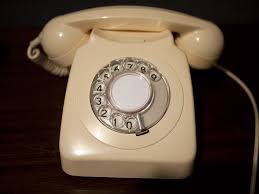
And 'taped' is not the only example of everyday language that we use that harks back to older technology. Mobile phone users (including many too young to remember the old rotary dial phones) will still ask "What number did you dial?" and will 'hang up' at the end of a call, even though these expressions have become pretty meaningless in an age of push button phones and with the decline of the land-line.


At the same time as the VCR was becoming popular domestically, businesses were embracing the fax machine. Not all businesses, though. I recall that in the 1980's, while I was working at Midland Bank in Barking, a number of our customers had fax machines and wanted to send us instructions via that medium. Much to their surprise we had to tell them that we did not possess such a machine. It was not that the bank would not countenance fax machines, just that our branch was not deemed important enough to warrant one. Later when I worked at another branch, we did have a fax machine, but to illustrate the perils of such technology, someone (my late wife, as it happens) put the roll of the thermal fax paper in the wrong way round, resulting in lots of blank faxes and the need to phone loads of customers and ask them if they had sent us a message. The email and its attachments have largely supplanted the fax message, although some businesses still cling to the fax. Take sport; not only do the football authorities in England still hang on to using fax machines to conduct transfer business on deadline day, but just three years ago in America, gridiron footballer Elvis Dumervil missed out on a contract worth $30 million with the Denver Broncos because the fax containing the appropriate paperwork arrived too late, thanks to a poorly performing fax machine.


Some redundant technology is hard to mourn; some we remember with pleasure and lament their passing. On the one hand, the laser disc is not missed by many. They didn't take off in the UK, although they were popular in Japan, which accounted for 3.6 million machines sold in 1981, but once the DVD came along, LaserDiscs were doomed. On the other hand, many people - me included - recall Teletext and the BBC's version, Ceefax, with great affection. In the days before the internet explosion, Teletext was a great medium for finding news and sports results, even if getting to the one result you wanted might mean sitting and waiting patiently for a particular page to load. Anyone complaining nowadays about the wait for a webpage to load should remember that with Teletext, it was possible to go and make a cup of tea, come back, drink it, and still be waiting for the result you wanted!


Over the last half-century we have seen all sorts of technology come and go. The 8-track player, the audio cassette recorder, mini-disc player and Walkman all burst onto the scene, bloomed (relatively) briefly and ended up being largely replaced by MP3 players in general and the ubiquitous iPod in particular. And the iPod's days have long been rumoured to be numbered as music streaming services and the use of mobile phones as music players offer alternatives. At present the popularity of the iPod shows little sign of declining, but there again there was a time when there seemed little prospect of the VCR becoming redundant.

The average household now owns all sorts of technological paraphernalia, some of which has either become outmoded, or will in the not too distant future. Our digital camera (now into its second decade of faithful service) came with its own dedicated printer, which we used once and abandoned as it was slow, expensive to run (print cartridges were exorbitantly priced) and the quality of the pictures was inferior to what you could get having the photos developed at Boots or Snappy Snaps. But we wouldn't be without our all-in-one printer, which along with the PC, makes our study better equipped than many offices I worked in.

We also have a cross-cut paper shredder, which despite the fact that the internet means that bank statements and utility bills are largely online rather than in paper format, still sees a fair bit of use. Unfortunately a disproportionate amount of time is spent unjamming the thing. If there is one piece of technology in desperate need of an upgrade, it's the shredder.


Thursday, 21 July 2016

The Factor Fifty Factor

My first overseas holiday was in 1987. In the company of a number of friends, including Paul Calvert, Graham Bull, Gerry Baker and his brother Brian, I went to C'an Pastilla on the Balearic island of Majorca. That holiday was also the first time I can recall ever using sun screen. Today, for a number of very good reasons, suntan lotion is something that we all use, liberally, both at home and abroad but somehow in 1987 it was only really associated with foreign holidays. Sun screen was deemed unnecessary in Britain, even at the height of summer.


The Alexandra Sol, C'an Pastilla.

Even for fair skinned people like me, protection from the sun in Britain thirty or forty years ago consisted largely of wearing a t-shirt and not staying out in it too long. To be honest, even after experiencing the power of the sun when on holiday abroad, and having come to understand the benefits of suntan lotion, I still sometimes underestimated the power of the sun at home. In fact the two worst cases of sunburn I have had were both received in England. Once in Brighton in the late 1970's when, deceived by a cooling breeze, I burnt my shoulders to the extent that I could not lie on my back in bed that night, and then, in 1993 when I failed to notice the strength of the sun in Cornwall and burned my head. A problem I have always had is that rather than turn an attractive shade of bronze when tanned by the sun, I have a propensity to go very pink and peel almost immediately. After my encounter with the Cornish sun my bright-red bonce started to flake the very next day, leaving me looking like a lobster with an acute case of dandruff - attractive it was not.

Experience has taught me (and many other people, I'm sure) that slathering on the Factor 50 is just as important in Romford as it is in Rome; in 1987 suntan lotion was (to me at least) generic - SPF meant nothing to me. Today I will not use anything less than SPF30 - often I use 50, because while lightly tanned skin may be a nice to have, 'pale and interesting' is OK by me if it means avoiding sunburn. 

Generous applications of this are the order of the day for me.

Apart from my inaugural use of suntan lotion, a major factor in my avoiding getting too burnt in Majorca all those years ago were the hours I kept. Having never been abroad before, and having flown only once before (to Jersey, which takes less than an hour), my trip to Majorca was notable for a few other firsts that we today take very much for granted. Most people will be familiar with that "whoomph" of hot air that greets you as you step off an aeroplane in some hot clime; that, accompanied by bunged up ears resulting from the descent into Palma airport are abiding memories for me. We arrived in the late evening, and that set the tone for the holiday really, with the late evening (stretching into the early hours of the morning) being our peak time. Mornings were generally spent a-bed, sleeping off the previous night's beer while afternoons were passed in the shade by the pool, consuming copious amounts of water. After dinner we would buy as many English daily newspapers as we could and read and swap them as we sipped the odd beer on the terrace before going out to some bar or other nearer midnight than any other hour.

It is well known that the reputation of the British abroad is not a particularly favourable one. The British, it is said, will have no truck with that foreign food, preferring fry up's for breakfast, roasts for dinner, and chips and lager with everything. My first foray into Europe was somewhat fraught on the food front it has to be said. A lot of the 'international' cuisine at the Alexandra Sol Hotel was unfamiliar, and while I may sometimes chide my younger daughter for her limited culinary horizons, they are a lot broader than mine were at her age. Which is something that, along with the exposure to other cultures and an appreciation of other countries, other people, must be a good thing. Fortunately, each successive generation is becoming more adventurous, more willing to try new things, less set in its ways. While it took me until I was approaching thirty before I got a passport and travelled abroad, my daughter has been travelling abroad with us on holiday practically from birth and those experiences can only be a good thing; travel really does broaden the mind. In contrast, my parents only went abroad once between the pair of them. My Father's only excursion overseas was during the Second World War, and my Mother never even owned a passport - her only trip by air was to Jersey, for her honeymoon. Incidentally, my Dad, who never sunbathed, never burned and never used suntan lotion, would tan at the drop of a hat, simply by pottering about in the garden for an hour or so every day during the summer.

I took this picture of C'an Pastilla in 2012 when Val and I visited for the day. The Alexandra Sol's terrace is in the background with the white umbrellas. The resort seemed little changed despite the passage of 25 years.

Mind you, the Germans seem to like their home comforts abroad; many resorts have as many German bars as they do British ones, and the most drink befuddled tourists I ever saw in Majorca were Swedish (or possibly Norwegian). Thrilled by the prospect of buying beer  at prices that didn't necessitate taking out a mortgage, a few Scandinavians we encountered that first year in C'an Pastilla appeared to be determined to drink a year's worth in a fortnight - or perhaps in just one evening.

These days I drink more of this than I do beer.


Having just returned from a holiday to Cyprus, it was interesting to note that there was little if anything in the way of the stereotypical behaviour of the English abroad. We stayed in Paphos, not the hot-bed of boisterous behaviour that might be found along the coast at Ayia Napa, perhaps but two examples of typical Brit behaviour were in evidence. One is the wearing of replica football shirts. It is only the British that seem to wear them other than at actual games once they get past the age of about ten, and the only football shirts in evidence and being worn by anyone beyond school age were Manchester United, Newcastle United, Celtic and Middlesbrough kits. Similarly, while the over exuberant riders of electric scooters up and down the front came from a wide range of nationalities among those under about sixteen, the only boisterous riders of more mature years (in age, if not in behaviour) were exclusively British. Part of the personality of the British male is an inability to grow up, it seems.

Here's a picture of a pelican. This one lives in Paphos.

After initially dipping my toe in foreign waters with a trip to C'an Pastilla, I returned with a similar cast of friends (supplemented by Keith Markham) the following year, which has set a regular pattern of pairs of holidays in more recent years. While Majorca is a regular haunt, I've done Hawaii twice, then Bandos in the Maldives twice and now Paphos twice, which has its benefits since by the second visit the better restaurants and bars have been scoped and the nicer places to visit have been weeded from the less attractive. Not that I subscribe to the idea of visiting the same place year after year, so next summer Paphos may well be supplanted by another venue. Wherever we go, the Factor 50 will follow.


Thursday, 14 July 2016

Tom Ain't Jack

Lee Child's series of novels about Jack Reacher, an ex-US Army military policeman, have been phenomenally successful, selling millions of copies worldwide, so it was inevitable that eventually someone would start adapting them for the cinema. The first, based on Child's novel One Shot, was  released in 2012 and a second, Jack Reacher: Never Go Back is due for release in October this year.


In both films Reacher is played by Tom Cruise, a piece of casting that caused a stir when the first film was mooted because, on the face of it, Tom ain't Jack. From the novels it is clear that Reacher is a big man, standing around six foot five inches tall and he has been described as having a face that "looked like it had been  chipped out of rock by a sculptor who had ability but not much time." Tom Cruise on the other hand, is about five feet seven with typical movie star looks. Reading the novels I'm more likely to picture Tommy Lee Jones than Tom Cruise as Reacher, but I'm sure other readers have their own mental image of Reacher...or James Bond, or Sherlock Holmes for that matter.

Sometimes the picture of a character that your imagination draws when reading a book is entirely from your imagination. Other times it may be because you are reading the book after having seen a film or TV adaptation of the story, and with characters like Bond or Holmes, who have been played by many actors (twelve different actors have played Bond on film, for instance and for Holmes the number is in the hundreds) the chances are it will be the first actor you saw who played the role that you visualise from the words on the page. On which basis, Sean Connery will forever be Bond as far as I am concerned. Not that it always works that way of course. There are certain actors who take over a role, make it their own and thereafter you can't imagine anyone else playing the part. Despite the claims of men like Basil Rathbone and Jeremy Brett, my vision of Sherlock Holmes will now forever be Bendedict Cumberbatch, while Christian Bale is my personal favourite in another role with multiple actors, Batman.

There is always controversy when the part of an iconic character like Bond, Holmes or Batman is recast. With the latter two roles, new versions tend to be reboots or stand alone films, but Bond has carried on way beyond the twelve novels and two collections of short stories written by Ian Fleming in a continuing franchise that creates new excitement and speculation about the new Bond each time the actor playing Bond announces his retirement from the role. With Daniel Craig having decided that enough is enough after four outings as 007, Aidan Turner, Tom Hiddleston, Tom Hardy and Michael Fassbender are among the favourites to take the role at the time of writing, along with the somewhat more controversial suggestion that Idris Elba could be in line for the part. I say controversial because despite being eminently suitable for the role in almost every other regard, Idris Elba is black and James Bond is white. Except, does he have to be?

Idris Elba as Bond, as envisaged by The Daily Mirror.


It is a popular belief that Bond was Scottish, but it was not until the penultimate novel, You Only Live Twice, that Fleming mentioned Bond's background, a detail thought to have been driven by Fleming's approval of Sean Connery's portrayal of the character on-screen. But Bond certainly wasn't considered Scottish in the earlier novels and Fleming conceived him as "a neutral figure—an anonymous, blunt instrument wielded by a government department." By defining Bond as neutral and anonymous, Fleming actually paves the way for Bond not to be an actual individual at all. James Bond, 007 could actually be no more than a nom de guerre -he was employed by the Secret Service, not best known for advertising the identity of its employees after all - so why could the current Bond not just be one of a long line of Bonds?

Other franchises have covered the explanation of different actors playing the same role by making it part of the story.  Take Dr Who, where the good Doctor regularly re-generates, enabling the part to be played by a dozen actors over the years. I wouldn't go so far as to say that Bond should re-generate in the manner that saw Matt Smith morph into Peter Capaldi, but Bond's different appearance and physical characteristics from film to film could be explained by making James Bond, 007 a role within MI6 rather than a unique person. Doing so might make the casting of Idris Elba eminently plausible; it might even make the casting of a woman (Gillian Anderson has been mentioned) possible - Jane Bond has been mooted. Perhaps a female Bond is a step too far, but making Bond a cipher would open up possibilities for the role beyond the current stereotype. And it has actually already been done. The 1967 film, Casino Royale,  was a spoof in which David Niven played the "original" Sir James Bond with six other actors playing agents pretending to be James Bond.

David Niven as Bond in the spoof Casino Royale.


However, it is not solely in casting and characterisation that viewers may find themselves making unfavourable comparisons between a novel and an on-screen version of a story. I recently read Stephen King's novel 11/22/63 in which schoolteacher Jake Epping travels back in time to try to prevent the assassination of President John F Kennedy. In 1960's America Jake Epping becomes George Amberson, yet in the TV programme differences abound. Jake is rarely, if ever, referred to as George and you have to ask, why? Was giving him a completely different name considered too confusing for the average TV viewer? And while Bill Turcotte is a quite important character in the book, his role is relatively brief, yet in the TV programme not only is his role significantly expanded, but his personality seems radically different too. As indeed, does Jake/George's personality. In the TV programme I thought him more hard-nosed than in the novel, yet at the same time more prone to rashness; he reveals that he has travelled back from 2016 more readily than in the book and is generally less likeable than his counterpart on paper. On the whole I have to say I found James Franco's portrayal somewhat at odds with the character that Stephen King created in his novel.

James Franco as Jake Epping with Sarah Gadon as Sadie Dunhill in 11.22.63


But these are the sorts considerations that will strike anyone who has read a book and seen an on-screen adaptation, and for various practical reasons minutely faithful film versions are not always possible. As far as I can recall, the most faithful book to film adaption I've ever seen was Billy Liar.

Tom Courtney in Billy Liar


Meanwhile we await the new Jack Reacher film, and while I have alreadt said that Tom ain't Jack, I guess the casting could have been worse; I just wish he were a little taller, but then again, perhaps so does he.

Thursday, 7 July 2016

More In Sadness Than Anger

England's ignominious exit from Euro 2016 will have provoked a wide range of emotions among the nation's football supporters. From anger and horror to shock and astonishment, England fans will have run the gamut of emotions from A to Z, and some, like me, will have felt resignation, very little surprise and, it has to be said, a certain amount of indifference. After all, we've seen it all before, even though this time round defeat to Iceland was plumbing depths previously not seen since USA beat England 1-0 in 1950.


France 2016 followed pretty much the normal course for England's progress at a major tournament. They were barely troubled in qualifying, winning ten out of ten, but it was hardly a challenging group. Then inevitably there was the launch of the new England kit, and this time, despite some fierce competition from previous efforts, it proved to be almost universally disliked and proved once again that marketing new kits and extracting the last penny from long-suffering English fans remains one of the Football Association's most consistent achievements.

Be honest, did anyone like the new kit?

The first game of the competition, a 1-1 draw with Russia, was followed by some predictable comments from management, players and pundits about "taking positives" out of the game. Sadly, as ever, these 'positives' were not translated into any tangible improvement.

Roy Hodgson - looking for positives.


The win over Wales papered over some cracks, but came only because Hodgson threw caution to the winds and played the second half with four forwards. Inspired substitutions or desperation? Charitably the pundits erred on the side of the former, but nothing could disguise the disquiet over Joe Hart's less than impressive attempt at saving Gareth Bale's long-range free-kick.

The 0-0 draw with Slovakia was perhaps predictable as England rotated their squad, but while Glenn Hoddle, co-commentating on ITV, optimistically continued to maintain that England would come good as they were "totally dominant," the team huffed and puffed with little fluency against a side whose sole ambition was not to concede. It did not bode well for the knock-out stages, whoever England came up against.

Glenn Hoddle, poised to state the obvious.


But England were through, and with a tie in the last sixteen of this over- inflated competition against Iceland to look forward to. Despite England's struggles, a game against the smallest nation at the championships ought not to have presented too great an obstacle for them. Fortunately, I did not see the game - I was at the BBC watching a recording of the radio comedy, Clare In The Community -and it wasn't until I got home that I checked the score. 

I was watching Clare In The Community...
...meanwhile, this was happening. Photograph: Laurence Griffiths/Getty Images.

England 1, Iceland 2, it said, and my reaction was not of shock, not of anger, but of resignation. Really, no one ought to be surprised at England's failure in the knock-out stages of a major tournament because since 1966, they have won just six games after the groups at World Cups and European Championships, and one of those (against Spain in 1996) was on penalties. In fact that win over Spain at Wembley is the only knock-out game that England have won at European Championship finals. Not that England's record in group matches is anything to write home about; twenty-two wins and thirteen defeats in fifty-three games in fifty years. Translate that into a Premier League season and it's a mid-table finish.


So when anyone analyses England's performance at Euro 2016 and asks, "What went wrong?" the answer is surely, "Nothing; this was the norm." The more salient question is what can be done about it? I'm not sure I have the answers any more than anyone else, but I have to ask why Jack Wilshere (three league appearances in 2015-16, two of which were as a substitute) was preferred to Danny Drinkwater or Mark Noble. Or why Harry Kane was taking corners (or free-kicks for that matter). And why do England persist in picking eleven individuals and trying to shoehorn them into a formation (Jamie Vardy as a wide man) rather than selecting the players best suited to a pre-determined system? At one time England were supposed to be competing with the likes of Germany, Italy or Spain; those nations are now streets ahead of us and our natural level now is with the likes of Wales and Iceland . And while those two nations played as teams at Euro 2016, England looked like a scratch side assembled in a pub on a Saturday night and playing their first game together the next morning. That impression was reinforced by the shambolic defending and catastrophic goalkeeping that enabled Iceland to plunder their goals.

At Under-21 level, England are European champions, but few of the current squad are household names and despite the majority of the squad being on the books of English Premier League teams, have relatively few senior appearances between them. Premier League clubs prefer proven talent and are not concerned with its nationality as the preponderance of overseas players in the Premier League shows. The UK's decision to leave the European Union might mean a reduction in the numbers of foreign players in English football, an outcome that the FA ought to welcome as an opportunity to develop young, English talent. But since we all know that the priorities of the top clubs are their success on the  pitch and the balance sheet, not developing talent for the national team, there will no doubt be lobbying on their behalf to maintain their access to the overseas talent pool.

This month the FA celebrate England's 1966 World Cup win, a triumph that increasingly becomes a millstone with each passing year. On the FA's website, chief executive Martin Glenn said: “30 July 1966 was a pinnacle point not just in our football history, but as a nation. We all want to repeat the high of 1966.” And FA chairman Greg Dyke is quoted as saying, “We have an exciting future ahead, and we’re all determined to give the game the best-possible chance to flourish." Words are cheap and as ever, the promise is "jam tomorrow." But what action will there be? FA boss Greg Dyke seems obsessed with the idea of introducing Premier League reserve teams into Football League competitions with some bizarre expectation that this will develop the players who will turn England into a world footballing power. His B-team plan may have bitten the dust, but the Football League are ploughing ahead with Under-23 teams in the Football League Trophy, a move that has more to do with bowing to the wishes of the Premier League teams than developing the national team.

The Guardian had it spot on.


No doubt the FA, the (new) manager and the players will claim that lessons will be learned from the shambles in France, but history proves that we've not learned from previous and similar debacles. The chances of England repeating their 1966 performance is slim; in my lifetime, nonexistent and I say that more with sadness than anger.

How England Were Nearly Denied The 1966 World Cup

In 2017, during the bidding process to determine who would host the 2026 World Cup, FIFA President Gianni Infantino addressed the travel ba...